Executive summary
No two wire plants want the same coil. A steel wire winding machine is matched to the wire diameter, the coil size and weight, the line speed and what happens to the coil next. Our equivalent solution is configured per project around those points, from small 10–50 kg coils for retail to heavy coils up to 1,000 kg. This page shows which client needs drive the design, how to estimate winding time per coil, and what to send us.
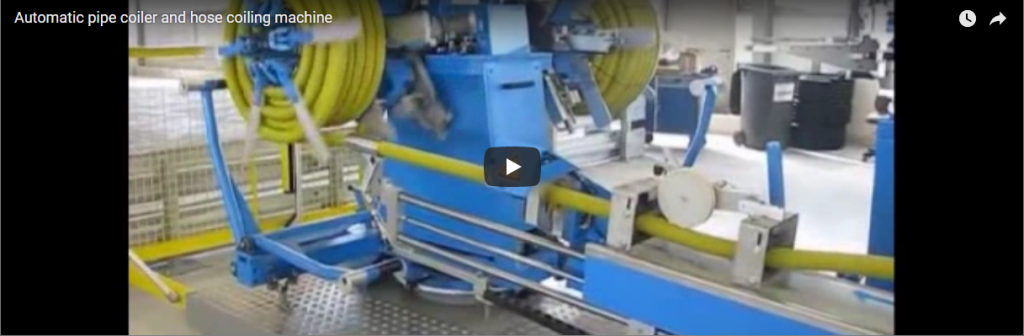
This is a semi-automatic take-up winder on a blue-painted frame with a rotary base and vertical coil formers. A curved feed arm comes down over the former and a guide rod leads the drawn wire onto it. A pneumatic cylinder under a clear cover is mounted on the frame.
An operator in safety glasses and gloves handles and ties the finished coil by hand and moves it off the station, while a mesh fence closes off the working area. Automatic through-the-eye wire binding is the fully automatic option for the same step.
Inhaltsverzeichnis
- The client needs that shape the machine
- Wire diameter, coil size and weight
- Winding speed and tension
- Winding time per coil
- What happens after winding
- Typische Daten
- Auswahl-Checkliste
- Sicherheit
- Häufig gestellte Fragen zur Technik
- Nächster Schritt
- Verwandte lesen
- Quellen
The client needs that shape the machine
| Kundenbedarf | What it changes in the machine |
|---|---|
| Wire diameter and grade | guide rollers, wire path and drive torque |
| Coil ID, OD and width | reel or former size and arm stroke |
| Coilgewicht | turntable load, drive and doffing method |
| Line speed upstream | winding speed and wire accumulator size |
| Next step: strap, bind or wrap | coil transfer and packing station |
| Floor space and operators | manual, semi-automatic or fully automatic loading |
The turntable, arm and wire guide stay the same in principle. The sizes and the automation level around them are what we change.
Wire diameter, coil size and weight
Small coils for hardware and retail run on a compact winder with a packing station: coil ID 250–550 mm, OD 400–700 mm, width 100–300 mm and 10–50 kg. Heavier industrial coils use a reel of about 560 mm diameter and coil weights of 50–1,000 kg, with wire of 2–4 mm diameter. The heavier the coil, the more the doffing and handling after winding matter.
Winding speed and tension
The heavy-coil winder runs up to 360 m/min on a torque motor, so tension stays steady as the coil grows. Where the winder follows a drawing or rewinding line, a vertical wire storage with 5–20 m of accumulated wire takes up speed changes, and its tension is set from the control cabinet. Even tension gives tight, square coils that strap well and do not collapse in transport.
The accumulator also synchronises the winder with the upstream drawing line. As it fills or empties, the winder speeds up or slows down, so the drawing line can keep running through a coil change. Motor power and the wire tensile range are confirmed at quote.
Winding time per coil
Wire mass per metre = 7,850 kg/m³ × π × d² ÷ 4. Winding time = coil mass ÷ (mass per metre × winding speed). For 3 mm steel wire, a 500 kg coil at 360 m/min (example):
| Einblick in das | Berechnung | Lösung |
|---|---|---|
| Drahtquerschnitt | π × 3² ÷ 4 | 7.07 mm² |
| Masse pro Meter | 7.07 × 10⁻⁶ × 7,850 | etwa 0.0555 kg/m |
| Wire length per coil | 500 ÷ 0.0555 | ungefähr 9,010 m |
| Winding time | 9,010 ÷ 360 | ca. 25 min |
Add the doffing and loading time to get the full cycle. Real winding speed depends on the wire grade and the upstream line, and it is confirmed at quote.
What happens after winding
On a semi-automatic winder the operator ties the coil by hand and lifts it off. On a fully automatic line the finished coil is shifted to the next station. On our winding and binding machine the coil is bound through the eye with wire, using a wire feeding and twisting unit. Other lines strap with 2 or 4 straps, or wrap the coil in film. A crane or transfer device then lifts the coil to storage.
Typische Daten
| Artikel | Heavy-coil winder | Small-coil winder and packing line |
|---|---|---|
| Rollendurchmesser | Über 560 mm | n/a |
| Spulen-ID/AD | zum angegebenen Preis bestätigt | 250–550 mm / 400–700 mm |
| Spulenbreite | zum angegebenen Preis bestätigt | 100 – 300 mm |
| Kabeldurchmesser | 2 – 4 mm | zum angegebenen Preis bestätigt |
| Coilgewicht | 50-1,000 kg | 10-50 kg |
| Wickelgeschwindigkeit | bis zu 360 m/min | zum angegebenen Preis bestätigt |
| Verpacken | wire binding through the eye | 2 or 4 straps |
| Energieversorgung | zum angegebenen Preis bestätigt | Wechselstrom 220/380 V, 50/60 Hz |
Auswahl-Checkliste
- Wire diameter, grade and surface.
- Spulen-Innendurchmesser, Außendurchmesser, Breite und Gewicht.
- Upstream line speed.
- Spulen pro Schicht.
- Binding, strapping or wrapping after winding.
- Level of automation and floor space.
Sicherheit
The winder is designed to EN ISO 12100:2010 for risk assessment and EN 60204-1 for electrical equipment. EN 415-10 is added when the winder is integrated with automatic packing modules such as strapping or wrapping. The turning coil, the moving arm and the running wire are the main hazards, so a mesh fence closes off the winding area. Guarding and CE documents are agreed per project.
Häufig gestellte Fragen zur Technik
Q: What wire sizes can it wind? A: The heavy-coil winder takes 2–4 mm wire. Other sizes are matched per project.
Q: How heavy can a coil be? A: 50–1,000 kg on the heavy-coil winder, 10–50 kg on the small-coil line.
Q: How long does one coil take? A: Coil mass ÷ (mass per metre × speed). A 500 kg coil of 3 mm wire at 360 m/min takes about 25 min.
Q: Can it follow my drawing line? A: Yes. A wire storage with 5–20 m of accumulated wire takes up speed changes between the line and the winder.
Q: Can it strap the coil too? A: By hand on the semi-automatic winder. On an automatic line, the coil is bound through the eye with wire, or strapped with 2 or 4 straps.
Nächster Schritt
- Send your wire size, coil size and weight, and line speed an info@fhopepack.com.
- Legen wir fest the winder size, speed and packing step.
- Wir antworten innerhalb von 24 Stunden mit einem Vorschlag und einem Kostenvoranschlag.
Verwandte lesen
- Automatic wire coiler (product)
- Automatic steel wire coiling and strapping machine (product)
- Automatic steel wire coiler for wire winding and strapping
- Automated steel wire rewinding and binding line
- Wickel- und Verpackungsmaschine für Stahldrahtspulen
Quellen
- FHOPE product pages: automatic steel wire winding and binding machine; steel wire winder and strapping machine; steel wire winder and packing line
- EN ISO 12100:2010; EN 415-10; EN 60204-1
- The steel wire winder shown above
Letzte Überprüfung: 21.09.2026