Executive summary
A profile stacking line takes long metal profiles off the production conveyor one at a time and builds them into stacks for packing. Our gantry stacker lowers a lifting head onto each profile, picks it up and places it on the growing stack. It handles lengths from 3,000 to 7,000 mm and up to 250 kg per lift. A worked example shows how the axis speeds set the pick cycle.
Inhaltsverzeichnis
- Why stack by machine
- How the gantry stacker works
- Stacker data
- Worked example: one pick cycle
- Choosing the gripper
- Where it fits in the line
- Auswahl-Checkliste
- Sicherheit: EN 415-10 und ISO 12100
- Häufig gestellte Fragen zur Technik
- Nächster Schritt
- Verwandte lesen
- Quellen
Why stack by machine
Long profiles leave the line one by one, but they ship in stacks. Two people lifting a 6 m profile by hand is slow, tiring work, and edges get knocked in the process. A gantry stacker lifts each profile level along its full length and sets it down in the same place every time. Stacks come out square and with the right count.
How the gantry stacker works
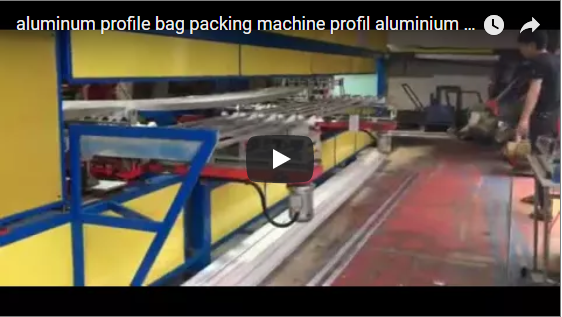
The profiles here are long perforated metal profiles, fed in from the left on a blue roller line. A heavy blue gantry spans the line, with a row of lifting heads on vertical slides along its length. When a profile reaches its stop, the heads come down onto it, grip it and lift it clear. The gantry carries it sideways and sets it on the stack, then returns while the next profile feeds in.
Because all the heads move together, the profile is held at several points and stays straight, even at 7 m. The main lift and the sideways travel each run on their own drive with adjustable speed. Fast moves cover the distance, and slow moves set the profile down gently.
Stacker data
| Artikel | Wert |
|---|---|
| Profillänge | 3,000 – 7,000 mm |
| Load per lift | bis 250 kg |
| Einzelprofil | bis 100 kg |
| Hauptaufzugsgeschwindigkeit | 0.1–0.512 m/s |
| Sideways travel speed | 0.026–0.256 m/s |
| Tuning | 380 V, 50 Hz |
| Betreiber | 1 |
Worked example: one pick cycle
Illustrative layout: the head drops 0.4 m to the profile, lifts 0.4 m, travels 1.2 m to the stack, drops 0.4 m, lifts 0.4 m and returns 1.2 m. All moves are at top speed. Speeding up, slowing down and gripping add time on top of this, so the result is a lower limit.
| Einblick in das | Berechnung | Lösung |
|---|---|---|
| Vertical moves | 4 × 0.4 ÷ 0.512 | ≈ 3.1 s |
| Sideways moves | 2 × 1.2 ÷ 0.256 | ≈ 9.4 s |
| Travel time per pick | 3.1 + 9.4 | ≈ 12.5 s |
| Travel-only ceiling | 3,600 ÷ 12.5 | ≈ 288 picks per hour |
| Layer of six 15 kg profiles | 6 × 15 | 90 kg, under 250 kg |
Ergebnis. Sideways travel takes three quarters of the cycle, so keeping the stack close to the line pays off most. Light profiles can be lifted a layer at a time, up to 250 kg per lift, which multiplies the output. The 288 figure counts travel only. Real output is lower once speeding up, slowing down, gripping and the slow set-down are added, and we measure it at commissioning.
Choosing the gripper
We offer two main ways to pick profiles: mechanical clamp arms, and electromagnetic lifters. Magnets suit steel profiles and tubes, and on tube lines we use them for diameters from 6 to 95 mm. Aluminum is not magnetic, so aluminum profiles are picked with mechanical clamps. Vacuum cups need a closed surface to seal, so on perforated profiles like these we use clamps or magnets instead.
Where it fits in the line
The stacker sits after cutting or finishing, before strapping or wrapping. On aluminum lines we build stackers that also feed spacers and fill baskets, for example after sand blasting. Stacks then go on to bundle strapping or wrapping.
Auswahl-Checkliste
- Profile shape, width, length and weight.
- Stack size and pattern.
- Profile pro Stunde.
- Spacers between layers, yes or no.
- Next step: strapping, wrapping or baskets.
Sicherheit: EN 415-10 und ISO 12100
We design the stacker to EN 415-10 and assess its risks to ISO 12100. The main hazards are the moving gantry, the descending heads and a suspended load. The work area is fenced, and opening a guard door stops all motion.
Häufig gestellte Fragen zur Technik
Q: How long can the profiles be? A: From 3,000 to 7,000 mm.
Q: What can it lift? A: Up to 250 kg per lift, and up to 100 kg for a single profile.
Q: What limits the speed? A: Mostly the sideways travel distance to the stack, then grip and set-down time.
Q: Can it pick steel and aluminum? A: Yes. Steel can be picked with magnets or clamps, and aluminum with clamps.
F: Welche Norm ist anzuwenden? A: EN 415-10 für die Maschine und ISO 12100 für die Risikobewertung.
Nächster Schritt
- Send profile drawings, lengths and output an info@fhopepack.com.
- Legen wir fest the gantry, heads and stack layout.
- Wir antworten innerhalb von 24 Stunden mit Layout und Angebot.
Verwandte lesen
- Automatic aluminum profile stacker (product)
- Aluminum profile stacking machine (product)
- Automatic profile wrapping machine with long conveyor buffer system
- Stahlblechbündel-Umreifungsband
- Bündelbindemaschinen für Aluminiumprofile
Quellen
- FHOPE product page: automatic aluminum profile stacker
- FHOPE project correspondence on stacking methods (mechanical arm and electromagnetic)
- Our profile stacking line shown above
- Worked example: illustrative layout
- Normen: EN 415-10; ISO 12100:2010
Letzte Überprüfung: 21.09.2026