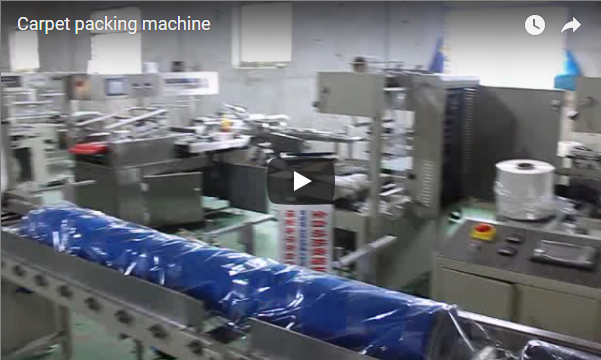
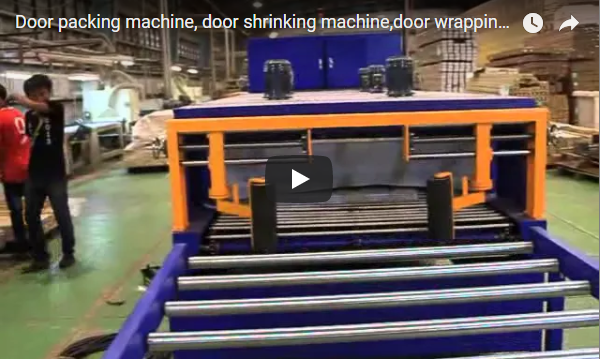
ملخص تنفيذي This video shows an automated pipe bagging and shrinking line in operation: long plastic pipes are fed in, wrapped with film, shrunk tight under a heating unit, and pushed out onto a roller conveyor as finished, film-wrapped products. The footage covers feeding, clamping and alignment, film application, heat shrinking, and discharge. It does not show cycle times, capacity figures, pipe diameter limits, or power specifications — those must be confirmed with the manufacturer.
لماذا هذا الفيديو مهم؟
If you buy or operate pipe packaging equipment, a short clip can tell you more than a brochure page. This footage shows a complete bagging and shrinking process for long plastic pipes, filmed from several angles: a wide shot of the whole line layout, close-ups of the clamping and film-applying sections, and a view of the shrink unit discharging finished pipes.
The purpose of this article is to walk you through what the machine actually does on screen, separate direct observation from reasonable inference, and list exactly what you cannot see — so you know what to ask the manufacturer before committing to a purchase.
What the video shows: process overview, step by step
The video presents the process in two main visual sequences. The first sequence (roughly the first 70 seconds) shows a wide view plus close-ups of the upstream section; the second sequence (roughly 75–115 seconds) shows the heating and discharge side of the line.
Feeding and transport
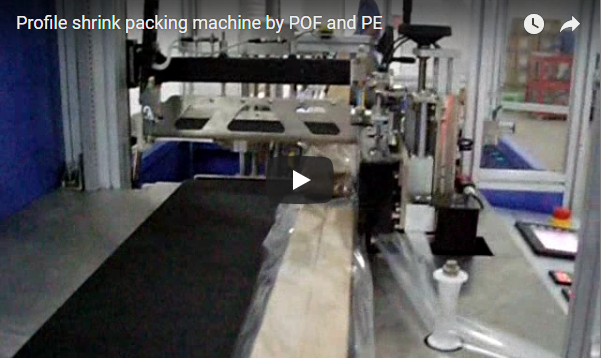
At the start of the video (t≈0–25s), the line is shown at rest: a blue-and-white main processing unit on the left with a roll stand and conveyor structure, a black two-roller belt conveyor across the foreground, and a white auxiliary unit on the right. A long, semi-transparent grey pipe is then continuously pushed out of the main unit, slides along metal guide rails onto the conveyor, and travels to the right at a steady speed (t≈30–55s).
Clamping and alignment
In close-up (t≈60–65s), the pipe enters a zone where two blue cylindrical rollers grip it. The pipe surface shows slight lengthwise wrinkling at this point, and the stainless-steel work surface carries a yellow triangular high-voltage warning label. This clamping stage appears to center and stabilize the pipe before the wrapping stage.
تطبيق الفيلم
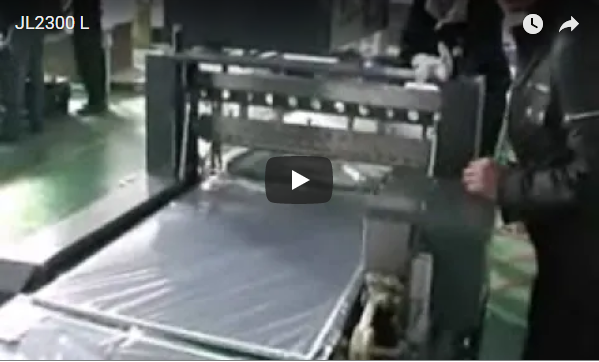
Around t≈70s, the pipe passes through multiple parallel metal roller tracks while a white film or label with light blue printing is fed in from above and pressed against the pipe wall. A small control panel with an LCD screen and push buttons is mounted on the left column of the machine. This is where the “bagging” part of the solution happens: film is brought into contact with the pipe before the heat stage.
Heat shrinking and discharge
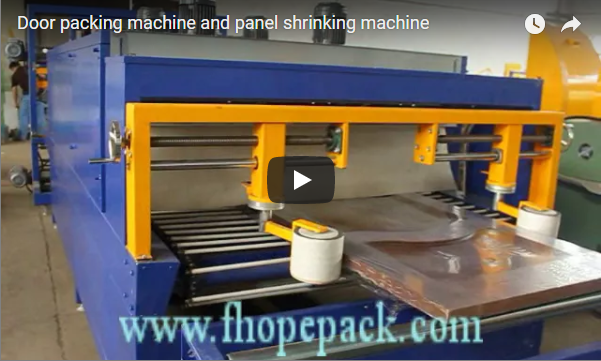
The second half of the video shows the other end of the line. A long white pipe with a green stripe is fed in from the right, guided by rollers and clamping mechanisms into the middle heating/shrinking area of the machine. Film is unrolled from above and draped over the pipe as it is gripped and fed forward. Under the heating unit the film contracts and wraps tightly around the pipe body. Around t≈100–110s, the finished, tightly wrapped pipe is pushed out onto a roller conveyor and moves away to the left. At t≈115s the machine stands idle with a wrapped pipe still resting on the conveyor — one completed cycle is visible end to end.
The machine in view: main components
Based on what is visible across the footage, the line consists of these elements:
| مكون | Observed on screen | الوظيفة الظاهرة |
|---|---|---|
| Main processing unit (blue/white frame) | Left side, with roll stand, guide rollers, blue clamping rollers, multi-layer roller tracks | Feeds, clamps, and guides the pipe; applies film |
| Belt conveyor (black, two-roller) | Foreground, running left to right | Transports pipe between stations |
| وحدة التسخين/الانكماش | White/grey enclosure over the mid-section with vents on top | Houses the heating element that shrinks the film |
| Roller discharge conveyor | Right/left output side | Carries finished pipes away |
| لوحة التحكم | Left column, lower-middle: LCD touch screen, red mushroom-head emergency stop, orange start button, LED indicators | Operator control and emergency stop |
| لافتات تحذير | Yellow triangular lightning-symbol stickers on the work surface, columns, and auxiliary unit doors | Electrical hazard marking |
The layout is linear: material flows in one direction, entering on one side and exiting on the other. The work surfaces are brushed stainless steel, and the frame is painted steel. The machine sits on adjustable leveling feet.
The product being packaged
The workpiece is a long, rigid plastic pipe — light grey/white with a slightly frosted surface, consistent in appearance with PVC or PE pipe, though the material is not labeled on screen. In the second sequence the finished pipe carries a white shrink film with a wide green horizontal band, and a printed mark reading “SUNSHINE” is visible on the pipe surface, along with a blue oval emblem. The film after shrinking is taut against the pipe with only minor natural wrinkles.
Relative proportions suggest a pipe diameter in the range of roughly 80–120 mm and a length of at least two meters, but these are visual estimates only — the video provides no measuring reference and no specifications.
ما لا يُظهره الفيديو
This is important for buyers. The following are غير قابل للملاحظة in the footage and should be confirmed with the manufacturer:
- Rated capacity (pipes per hour) and single-cycle time
- Pipe diameter and length range the machine accepts
- Heating method details (hot air vs. infrared) and temperature settings
- متطلبات الطاقة والجهد والتردد للمحرك
- Machine dimensions, total weight, and floor-space footprint
- Film material compatibility (LDPE, LLDPE, PET, etc.) and consumption per pipe
- Safety options: light curtains, door interlocks, guarding upgrades
- Certifications (CE, UL, or local equivalents) and documentation
- Control system details: PLC brand, fault diagnostics, remote monitoring or MES/SCADA integration
- Maintenance intervals, spare-parts lists, and after-sales response times
Any vendor claim about throughput or shrink quality that goes beyond what this video shows should be backed by a live test with your own pipe product.
ملاحظات الملاحظة المباشرة
تلتزم النقاط التالية بما هو مرئي فعلياً في اللقطات:
- The line has a linear layout: main processing unit on the left, belt conveyor across the foreground, white auxiliary unit (consistent with a heat-shrink or winding unit) on the right.
- A long semi-transparent grey pipe is continuously pushed out of the main unit and travels along guide rails onto the belt conveyor.
- Close-up footage shows the pipe passing between two blue cylindrical clamping rollers, with slight lengthwise wrinkling on the pipe surface at that point.
- A white film or label with light blue printing is fed from above and pressed onto the pipe wall while the pipe moves through parallel metal roller tracks.
- A control panel is mounted on the left column with a small LCD screen, a red circular emergency stop button, an orange start button, and LED indicators.
- Multiple yellow triangular warning labels with a lightning symbol appear on the work surface, the columns, and the auxiliary unit door.
- In the later sequence, a white pipe with a green-striped film enters from the right, passes under a heating enclosure, and exits as a tightly wrapped product onto a roller conveyor.
- The text “SUNSHINE” and a blue oval emblem are visible on the finished pipe surface.
- No fixed safety fencing, light curtain, or door interlock is visible in any frame.
- No readable text appears on the machine itself; on-screen panel content is illegible.
ملاحظات وتحذيرات السلامة
The machine carries yellow triangular electrical-hazard warning labels in several places, and a clearly visible red mushroom-head emergency stop button is mounted at a typical operator height on the control cabinet. However, the footage shows no physical guarding around the working area, no light curtain, and no door interlock.
Practical implications, as inference (not shown in the video):
- The heating zone is a burn hazard; operators should keep hands clear and never clean the clamping or heating area while the line is running.
- Gloves and eye protection are sensible around rotating rollers and moving pipe.
- The emergency stop should be function-tested on a regular schedule.
- If you plan unattended or high-volume operation, ask the manufacturer about adding light curtains or interlocked guards to meet your local safety regulations.
Who this solution fits
Based on the visible process, this type of bagging-and-shrinking line is a reasonable candidate for:
- Manufacturers of medium-to-large diameter plastic pipe (drainage, cable protection, irrigation, or similar industrial pipe) who currently bag pipes manually.
- Plants where consistent, wrinkle-free film appearance matters for shipping protection or shelf presentation.
- Lines where dust and moisture protection during storage and transport is a requirement.
It is less obviously suited to:
- Highly irregular or non-circular profiles, which would need custom clamping.
- Very short pipes, where the continuous conveyor design may be underused.
- Facilities that require full perimeter guarding as standard — you would need to confirm guard options.
الأسئلة التي يجب طرحها قبل الشراء
استخدم قائمة التحقق هذه في استفسارك:
- What pipe diameter and length range does this configuration accept, and what changeover is needed between sizes?
- What is the tested cycle rate with pipes of my dimensions?
- Which heating method is used, and which shrink film types and thicknesses are compatible?
- What safety packages are available (light curtain, interlocked doors, fencing) and do they meet my local regulations?
- Is fault diagnosis and alarm output included? Can the line integrate with my PLC/MES environment?
- What are spare-part lead times and after-sales response commitments?
الأسئلة الشائعة
Does the video show how fast the line runs? No. Pipe movement looks steady and continuous, but no cycle time or throughput figure can be read from the footage. Check with the manufacturer for tested rates on your pipe size.
What pipe material is being packaged? The pipe appears consistent with PVC or PE, but the video contains no label confirming the material. Check with the manufacturer about material compatibility.
Is the film applied as a bag or as a wrap? The footage shows film being fed over the pipe and then shrunk tight — the “bagging and shrinking” of the title. The exact bag-forming mechanism is not fully visible; confirm details with the manufacturer.
Are safety guards included? No fencing, light curtain, or interlock is visible in the video. Warning labels and an emergency stop button are visible. Ask the manufacturer what guarding options are available for your region.
Can the machine handle different pipe diameters? The clamping rollers and adjustable fixtures suggest some range, but the video shows only one pipe size in operation. Confirm the adjustment range and changeover time with the manufacturer.
المصدر والمنهج
The facts in this article come from analysis of the video above. The footage was sampled into frames and reviewed by a vision model; the video contains background music only, with no narration or speech, so no spoken content was transcribed. Time references are based on frame sampling intervals and are approximate. All capability, specification, and certification questions remain open and should be verified with the manufacturer.
القراءة ذات الصلة
- خط تعبئة الأنابيب البلاستيكية — the full-line version of this packaging approach
- آلة تعبئة الأنابيب — machine-level options for pipe packaging
- آلة الانكماش — heat shrink equipment details
- حلول التغليف — browse other application solutions
الخطوة التالية
If this pipe bagging and shrinking process matches your product, the fastest way to evaluate it is with your own pipe samples. اتصل بنا to discuss your pipe dimensions, film requirements, and target output, and to arrange a test run.