ملخص تنفيذي Manual hose wrapping appears cost-effective initially because the upfront tool is merely a handheld film dispenser. In practice, production costs accumulate rapidly through repetitive labour, uncontrolled stretch film consumption, package ovalisation, and packing-station bottlenecks behind extrusion lines. A horizontal orbital hose coil wrapper finishes each bundle in 20–38 seconds with pre-calibrated web tension and helical overlap. This engineering guide details the operating cost model, delivers verified FPCA-200 and FPCA-300 mechanical envelopes, and outlines the procurement and factory acceptance criteria for extrusion plants.
The Hidden Costs of Manual Wrapping
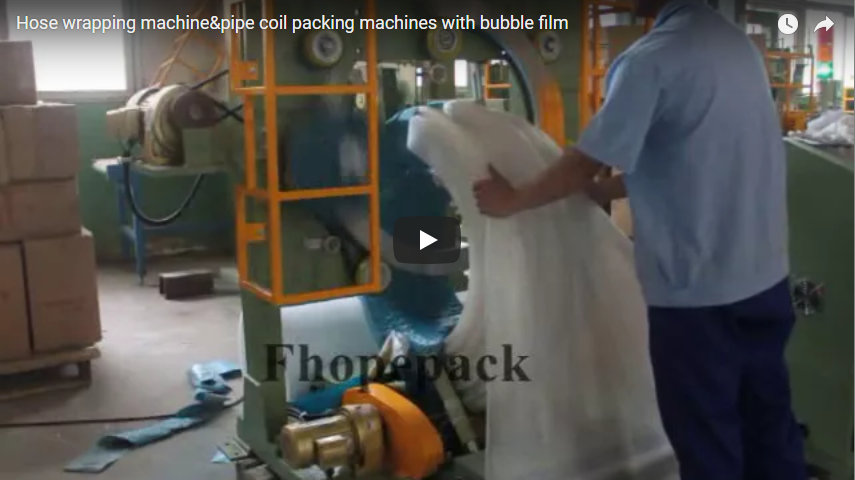
Manual packaging hides its cost in four places: labour per coil (1–2 operators per coiler), cycle time (90–180 s and highly variable, against 20–38 s of pure wrapping on a wrapper), film use (irregular overlap instead of a preset ratio), and pacing (packing backlogs throttle the coiler instead of absorbing its peaks). Add coil deformation from vertical mandrel wrapping and the ergonomic load of sustained bending, and the hourly rate stops describing the real cost.
A Cost Model You Can Fill In
Four inputs drive the model: coils per shift (extruder output in metres divided by cut length), manual labour hours (coils × manual seconds ÷ 3,600), machine hours (coils × floor-to-floor seconds ÷ 3,600), and film weight per coil. Labour saving is the hour difference times the loaded wage; film saving is the weight difference times film cost per kilogram; payback is capital cost divided by the daily sum of both plus rework avoided.
Worked Example: One Shift
Take an 8-hour shift producing 400 flexible PVC hose coils, with 120 s of manual handling and wrapping per coil against a 45 s floor-to-floor machine cycle (25 s wrap plus 20 s handling, cut and tuck):
| معامل | عملية حسابية | نتيجة |
|---|---|---|
| ساعات العمل اليدوي | 400 × 120 ثانية ÷ 3,600 | 13.3 ساعة تشغيل |
| Manual headcount | 13.3 ساعة ÷ 8 ساعات | 1.7 (two operators) |
| ساعات عمل الآلة | 400 × 45 ثانية ÷ 3,600 | 5.0 machine-hours |
| استخدام الآلات | 5.0 ساعة ÷ 8 ساعات | 62.5% (one operator, part-time) |
| Manual film | 32 g per coil | 12.8 كجم لكل وردية |
| Automated film | 20 g per coil | 8.0 كجم لكل وردية |
| تم حفظ الفيلم | 12.8 - 8.0 | 4.8 كجم لكل وردية |
The labour side falls from two full-time packagers to one operator at roughly 63% utilisation, who can palletise or watch the upstream coiler between cycles. All figures are illustrative — substitute your own timings and wage rates.
Break-Even Coil Count
Break-even is simply installed cost divided by saving per coil. Saving per coil is labour saved plus film saved plus damage avoided:
- العمل: 120 − 45 = 75 s saved per coil. At a loaded wage of 24 USD/hour (0.00667 USD/s) that is 0.50 USD per coil.
- فيلم: 12 g saved per coil at 2.50 USD/kg gives 0.03 USD per coil.
- Damage avoided: unravelling and transit claims, taken here as 0.07 USD per coil.
- الإجمالي: 0.50 + 0.03 + 0.07 = 0.60 USD per coil.
Against an installed cost of 18,000 USD, break-even is 30,000 coils. At 400 coils per shift over two shifts (800 per day) that is about 37.5 operating days. These are illustrative figures, not a quotation.
What a Horizontal Hose Coil Wrapper Does Instead
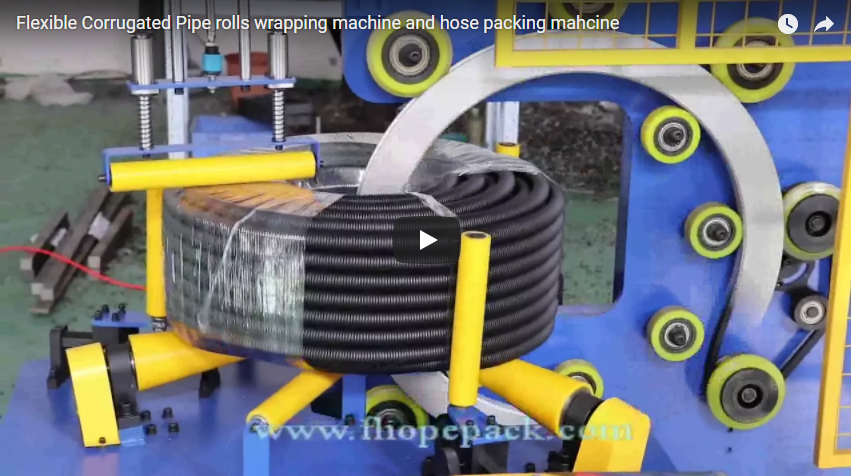
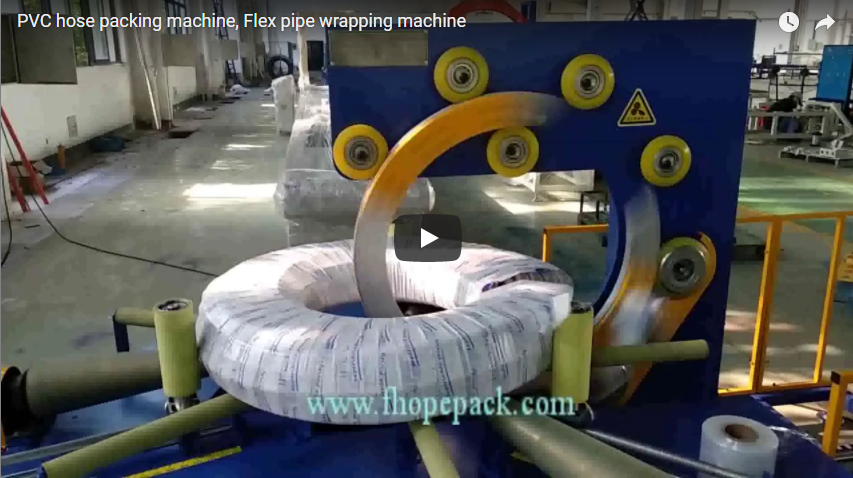
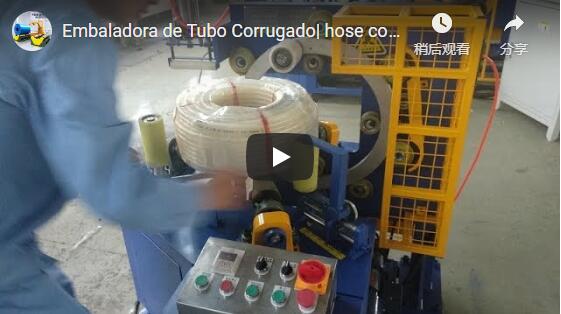
In a horizontal orbital wrapper, the hose bundle rests flat on driven support rollers while adjustable vertical side rollers locate and track the coil’s outside diameter.
A balanced rotating ring passes vertically through the eye of the coil while the support rollers turn the coil on its flat face. The ring carries the film carriage through the toroidal opening and lays overlapping helical layers; because ring speed and roller speed are synchronised, overlap stays even around the full circumference.
FPCA-200 and FPCA-300 Technical Specifications
Packaging coils of varying dimensions requires matching the machine’s orbital ring diameter to the coil profile. A single ring geometry cannot cover the entire spectrum of extrusion profiles.
One ring geometry cannot cover every extrusion profile, so the two models split the range:
| المواصفات الخاصه | فبكا-200 | فبكا-300 |
|---|---|---|
| قوة القيادة | 2.0 كيلو واط | 2.4 كيلو واط |
| مزود الطاقة | تيار متردد 380 فولت ، 50 هرتز | تيار متردد 380 فولت ، 60 هرتز |
| لفائف معرف | 150 – 400 مم | 250 – 510 مم |
| لفائف OD | 250 – 500 مم | 400 – 900 مم |
| عرض لفائف | 80 – 200 مم | 60 – 300 مم |
| الوزن فائف | 2-50 كجم | 20-200 كجم |
| سرعة الرنين | 10–120 دورة/دقيقة | 10–90 دورة/دقيقة |
| وقت الانتهاء | 20-30 ثانية لكل لفة | 20-38 ثانية لكل لفة |
| تداخل | 20–80 ٪ | 10–90 ٪ |
| المواد | البولي إيثيلين، غشاء التمدد، البولي فينيل كلوريد | البولي إيثيلين الخطي منخفض الكثافة، والبولي فينيل كلوريد، وأغشية البولي إيثيلين، والورق |
- FPCA-200: light tubing — pneumatic PU hose, medical tubing, garden hose, conduit — up to 500 mm OD and 50 kg.
- FPCA-300: heavier fluid-transfer hose, reinforced assemblies, or coils needing film plus outer kraft paper for export, up to 200 kg.
- Above the 300 envelope: the FPCW series (200/300/400) adds PLC with HMI and easier loading; frames above the 300 range are quoted per project.
Engineering Mechanics: Preventing Ovalisation and Slack
Soft profiles — unreinforced PVC, silicone, low-durometer TPE — fail in two ways.
Ovalisation. Wrapping a coil on a vertical mandrel lets gravity and film tension turn a circle into an oval. Flat support on coated steel rollers spreads the load across the whole base face and keeps the coil round, with side guide rollers holding the OD concentric without marking a finished jacket.
Core necking. Excess film tension pulls the inner wraps inward, narrowing the eye and kinking the first cut lengths. An adjustable friction damper and spring-loaded brake on the carriage hold unwinding tension below the radial crush strength of the hose wall, so the bundle is tight without collapsing the core.
When a Horizontal Wrapper Is the Right Fit
يناسب: deformable coils needing flat base support (10–200 kg); core-sensitive tubing that kinks on a mandrel; export loads needing film plus kraft paper; lines that must pack in under 60 s floor-to-floor to keep pace with the coiler.
لا يصلح: coils beyond 900–1,200 mm OD or 200 kg, which need floor-mounted or turnstile wrappers; rigid pipe coils that want PET or steel strapping rather than surface film; and sub-15-second robotic inline cells.
Selection Checklist and RFQ Inputs
- خرطوم: OD, wall thickness, durometer, surface finish.
- لفائف: min/max ID and OD, stack height, gross weight.
- الإنتاجية: average and peak coils per hour, shifts, changeover intervals.
- فيلم: LLDPE, PVC, woven PP tape or kraft paper.
- توريد الأفلام: roll OD, core (50 or 76 mm), web width.
- الأتمتة: manual station, pneumatic cut-and-clamp, or powered conveyors.
- المرافق: voltage, phase, frequency, and air at 0.5–0.7 MPa for pneumatic options.
Factory Acceptance Testing (FAT) Guidelines
- التخليص: run maximum and minimum coils through the ring and confirm at least 50 mm between carriage and product.
- تداخل: measure around the full circumference and hold the target, for example 50% ± 5%.
- النزاهة: coil still round, ID unchanged, jacket free of roller marks.
- أوقف: trip it at maximum ring speed (120 r/min on FPCA-200, 90 r/min on FPCA-300) and confirm the ring stops without carriage release or film snap.
- الانترلوك: opening a guard removes drive power from the ring.
Machine Safety Standards: EN 415-10 and ISO 12100
A ring carries rotational inertia and presents pinch and shear hazards. Design follows the EN 415-10 packaging-machinery framework with a risk assessment to ISO 12100:
- الحراسة: fixed panels and interlocked mesh enclose the ring envelope during the cycle.
- الانترلوك: access doors stay locked until the ring reaches zero speed.
- Loading zone: the infeed is protected so the cycle cannot start with hands in the wrap path; the arrangement follows the site risk assessment.
- لوتو: lockable isolators and pressure dump valves make film replenishment and servicing safe.
أسئلة وأجوبة هندسية
What separates wrap time from floor-to-floor time?
20–30 s (FPCA-200) or 20–38 s (FPCA-300) is ring rotation only. Floor-to-floor adds loading, start, cut and tuck, and unloading, typically 40–55 s.
Can an FPCA-200 take a 700 mm OD coil?
No. Ring clearance is mechanical, and the FPCA-200 tops out at 500 mm OD — the carriage would strike the coil. 400–900 mm OD needs the FPCA-300 frame.
How is thin-walled tubing kept from crushing?
Driven base rollers turn the coil on its flat face so the weight is spread over many contact points, and the friction brake on the dispenser sets tension independently of the ring speed.
What maintenance does the drive need?
Belt tension checks, roller coating inspection, ring bearing lubrication, and keeping the tracking sensors clean.
Next Steps for Packaging Line Automation
- قياس: min/max coil ID, OD, stack height, weights, and hourly coiler output.
- طابق الظرف: compare your matrix with the فبكا-200 or فبكا-300 نطاقات.
- Ask for the assessment: send dimensions and line speeds and get a layout plus a 24–48 hour proposal covering ring envelope, roller configuration and guarding.
Related Equipment and Technical Documentation
- FPCA-200 Cable & Hose Coil Wrapping Machine
- FPCA-300 Cable & Hose Coil Wrapping Machine
- FPCW Cable & Hose Packaging Machine Series
المراجع الفنية:
- FPCA-200 data: ID 150–400 mm, OD 250–500 mm, width 80–200 mm, 2–50 kg, 2.0 kW, 10–120 r/min.
- FPCA-300 data: ID 250–510 mm, OD 400–900 mm, width 60–300 mm, 20–200 kg, 2.4 kW, 10–90 r/min, film or paper.
- Standards: EN 415-10 packaging machinery safety; ISO 12100 risk assessment.
آخر مراجعة: 2026-11-05
مرجع الهندسة والمعدات: للاطلاع على معايير اللف والربط والتغليف المداري الآلي للأنابيب والخراطيم المرنة، انظر آلات اللف والربط الآلية للخراطيم والأنابيب وحلول آلات تعبئة اللفائف من FHOPEPACK.