
Vertical Coil Wrapping Machine Buyer’s Guide: Key Features to Look For (Tension, Speed, and Safety)
Choosing the right vertical coil wrapping machine is a critical decision for any metal processing plant manager. It’s not just about buying a piece of equipment; it’s about investing in a solution that directly impacts your bottom line, worker safety, and production reliability. As someone who has walked the factory floor and now runs my own packing machine business, I understand the pressure you face. You need a machine that won’t just work, but will perform consistently under the demanding conditions of a steel mill or heavy manufacturing environment. This guide will cut through the noise and focus on the three most critical performance pillars you must evaluate: tension control, operational speed, and integrated safety systems. Getting these right means solving your core challenges of efficiency bottlenecks, product damage, and workplace hazards.
The right vertical coil wrapping machine directly addresses your biggest operational headaches by providing precise, consistent tension to prevent product damage, a speed that matches your production line to eliminate bottlenecks, and built-in safety features that protect your most valuable asset—your people. This combination is what transforms a capital expenditure into a high-return investment that boosts productivity and peace of mind.
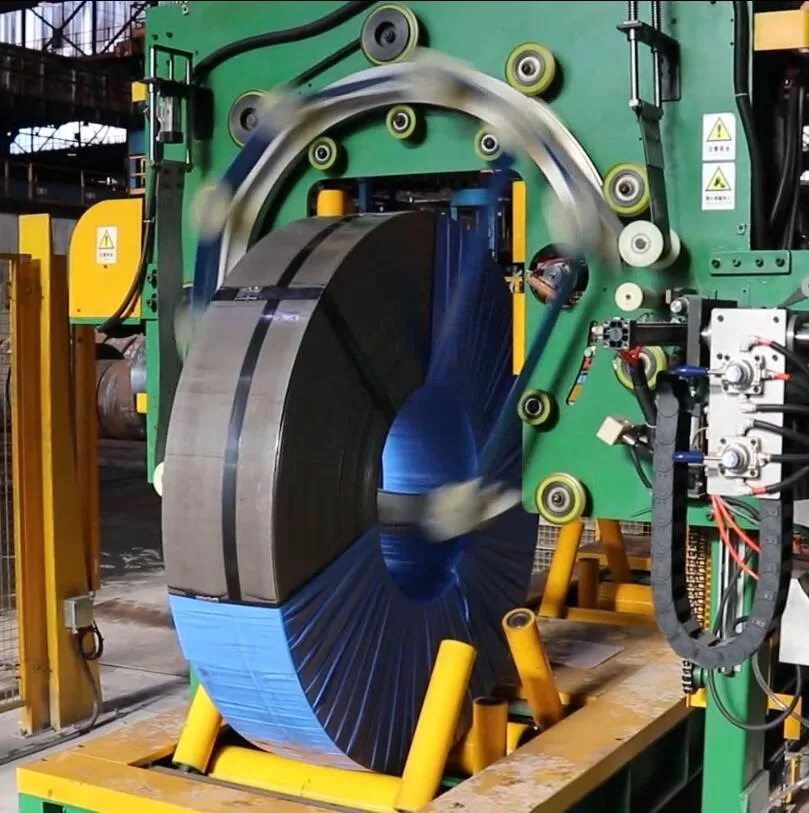
Let’s move beyond generic specifications. To make a truly informed decision, you need to understand how each core feature translates into real-world benefits on your shop floor. We will break down each key area—tension, speed, and safety—into actionable insights. This will help you ask the right questions and identify the machine, and the partner, that can handle the rigor of your daily operations and support your growth for years to come.
1. Why is Precise Tension Control the Most Critical Feature for Preventing Coil Damage?
Imagine a finished steel coil, perfect from the rolling process, getting scratched or dented during its final packaging stage. This is a direct hit to your profitability and customer satisfaction. The primary culprit is often inconsistent or excessive tension during the wrapping process. A machine that pulls the film too tight can deform the coil edges, while loose tension leads to unstable, insecure loads that are prone to shifting and damage during transit. For a plant manager, this translates into costly returns, rework, and a damaged reputation.
Precise and adjustable tension control is the non-negotiable foundation of a quality vertical coil wrapping system because it is the primary defense against product loss. It ensures the protective film is applied with just the right amount of force—secure enough to hold the coil firmly through the supply chain, yet gentle enough to preserve the coil’s pristine surface finish. Modern systems achieve this through servo-driven mechanisms or advanced PLC-controlled brakes that automatically compensate for changes in coil diameter and film roll depletion, maintaining consistency from the first wrap to the last.
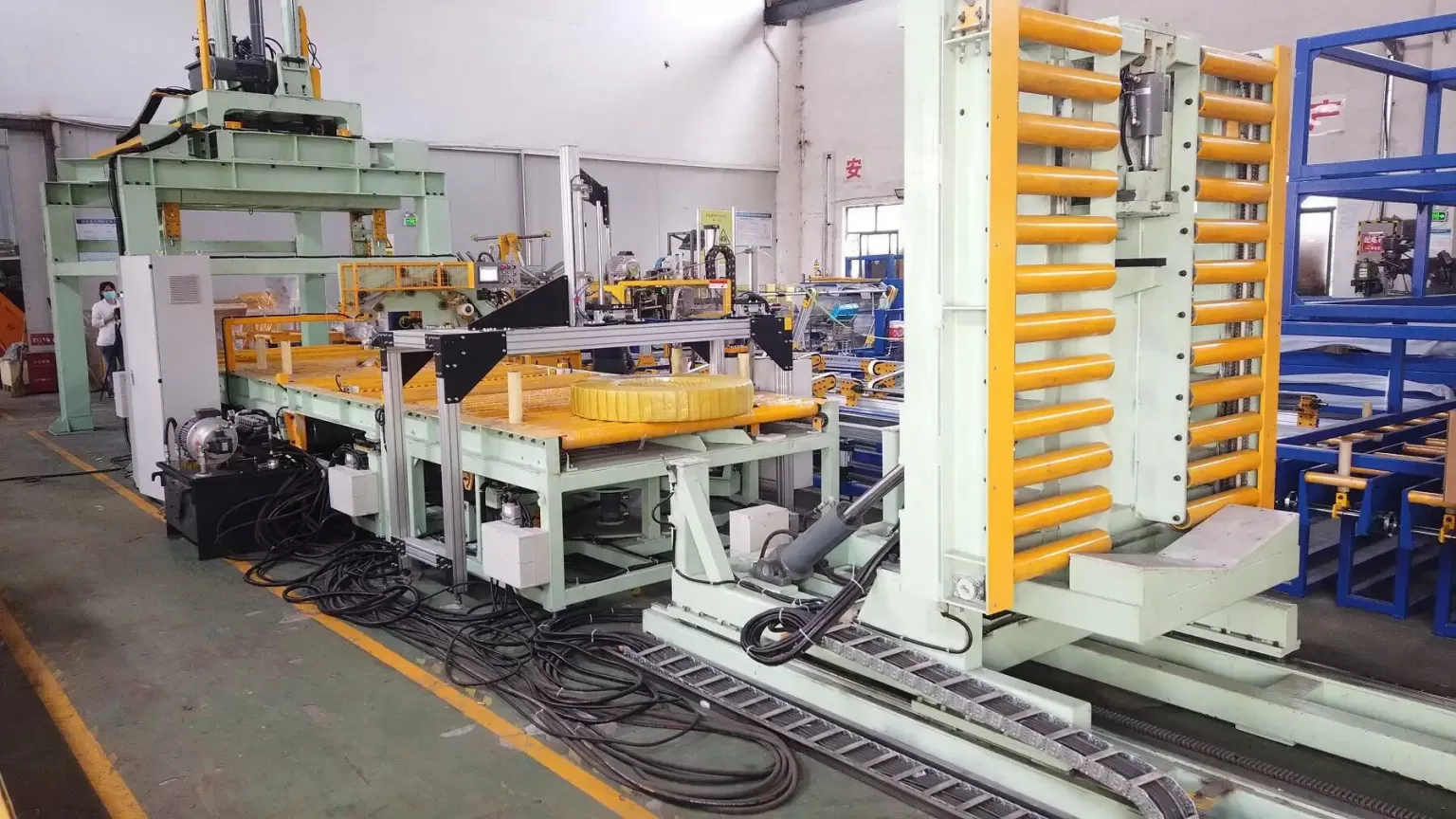
To dive deeper, let’s look at the components and technology that enable superior tension management. Not all tension systems are created equal, and understanding the differences is key to protecting your investment.
The Technology Behind Reliable Tension
A robust tension system isn’t a single component but a synchronized set of parts working together.
| Component | Function | Why It Matters |
|---|---|---|
| Servo Motor Drive | Provides precise, programmable rotational force for the film carriage. | Allows for exact speed and torque control, enabling complex wrap patterns (like cross-wrapping) and perfect tension repeatability for every coil. |
| Dancer Arm or Load Cell | Acts as a real-time tension sensor. The dancer arm uses a spring-loaded roller; the load cell measures force directly. | Continuously monitors film tension and sends feedback to the control system to make instant adjustments, compensating for film roll run-down or speed variations. |
| PLC with Tension Control Algorithm | The brain of the operation. It processes sensor data and adjusts the motor or brake accordingly. | A sophisticated PLC doesn’t just react; it predicts and maintains a smooth, consistent tension curve, preventing jerks or slack that cause damage. |
Consequences of Poor Tension Control
Choosing a machine with a basic, non-adjustable friction brake system is a high-risk decision. Here’s what can go wrong:
- Film Breakage: Excessive tension snaps the film, causing production stoppages, material waste, and requiring operator intervention.
- Coil Edge Damage (“Bite Marks”): The film or machine components dig into the soft coil edges, leading to customer rejections.
- Unstable Loads: Insufficient tension results in loose wraps. During handling or shipping, the film can unravel, leaving the coil exposed to corrosion and impact damage.
- Increased Film Usage: An inconsistent system often over-wraps to compensate for insecurity, driving up your consumable costs month after month.
For a high-volume environment like yours, the goal is zero-defect packaging. This starts with a machine whose tension system is engineered for precision, not just advertised as a feature. When evaluating suppliers like Fengding or Wuxi Buhui, ask for a live demonstration with coils similar to your own. Watch the tension readout on the PLC. It should be a steady line, not a jumping graph. Your coils are valuable; the machine that protects them should be equipped with the technology to do the job right, every single time. (long tail keywords: precise coil wrapping tension control, prevent steel coil edge damage, PLC-controlled film tension system)
2. How Do You Determine the Right Machine Speed for Your Production Line Bottleneck?
A common mistake is chasing the highest “cycles per hour” number on a brochure. A machine that wraps at 60 coils per hour is useless if your upstream production line only outputs 20 coils per hour. Conversely, a slow machine that creates a backlog at the packaging station becomes the new bottleneck, delaying shipments and clogging your floor space. The right speed is the one that synchronizes seamlessly with your overall production rhythm, creating a smooth, efficient flow from manufacturing to dispatch.
The optimal machine speed is determined by conducting a thorough analysis of your total line output, coil handling time, and required wrap patterns—not by the manufacturer’s maximum rated speed. It’s about finding the “sweet spot” where the wrapper keeps pace without forcing upstream processes to wait or downstream logistics to stall. A machine with a variable speed drive allows you to fine-tune this balance, adapting to different coil sizes or production targets without sacrificing wrap quality.
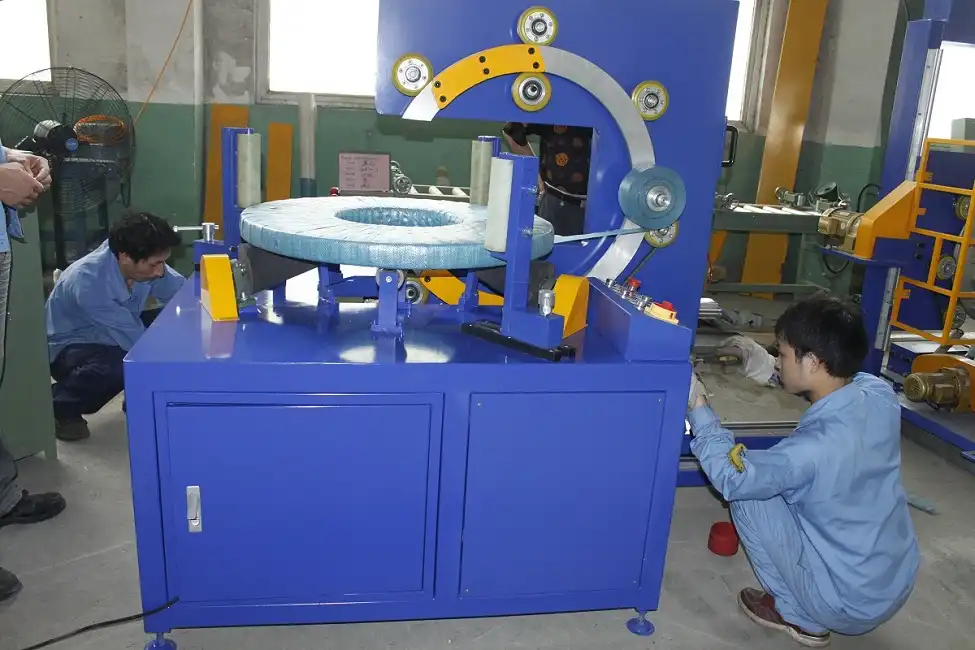
Speed is more than just a motor RPM. It’s a function of the machine’s entire workflow. Let’s break down the factors that influence true, effective throughput.
Key Factors Influencing Real-World Throughput
Effective speed = (Wrap Cycle Time) + (Load/Unload Time) + (Pattern Change Time).
-
Automated Loading/Unloading Integration: This is the biggest time-saver. A machine that requires a forklift to manually position each coil will always be slower than one integrated with a conveyor, turntable, or automatic coil car.
- ✅ Solution: Look for machines designed for easy integration with material handling systems. Fengding often excels here, offering modular designs that connect directly to roller conveyors.
-
Wrap Pattern Complexity: A simple spiral wrap is faster than a reinforced cross-wrap (which provides superior stability for overseas shipping). Your product’s destination dictates the pattern, which dictates the time.
- ✅ Solution: Ensure the machine’s programming allows for quick selection of pre-set patterns. The ability to switch from a “fast domestic” pattern to a “secure export” pattern with two button presses maintains flexibility without crippling speed.
-
Machine Acceleration/Deceleration: A machine that jerks to start and stop wastes time and stresses components. Smooth, rapid acceleration profiles are a sign of quality servo controls.
- ⚠️ Ask the supplier: “What is the average cycle time for a 1-ton coil with a 4-overlap cross-wrap pattern, including simulated load positioning?” This real-world metric is far more valuable than a theoretical maximum.
The Cost of Mismatched Speed
Getting the speed wrong has direct financial implications:
- Too Slow: Creates inventory pile-up, requires more staging area, delays truck loading, and ultimately limits your plant’s total output capacity.
- Too Fast (for your line): You pay a premium for capability you don’t use. The machine may also be cycling so fast that it compromises other features like tension control or safety perimeter checks.
The goal is synchronized production flow. Map your current process from the end of the rolling line to the shipping dock. Identify where delays happen. A partner who understands this—like an engineer who has managed a factory—won’t just sell you the fastest machine. They will help you analyze your workflow and recommend a system that removes the bottleneck at the packaging stage, delivering a clear return on investment through improved overall throughput. (long tail keywords: coil wrapping machine throughput analysis, synchronize packaging with production line, automated coil loading systems)
3. What Safety Features Are Non-Negotiable in a Modern Vertical Wrapper?
In a heavy industrial setting, safety is not a luxury; it’s a fundamental responsibility. Manual coil handling and wrapping are fraught with risks: crush injuries, entanglement, and strain from repetitive motion. A vertical wrapping machine concentrates significant force and moving parts in one area. Beyond moral obligation, a single serious incident leads to human tragedy, massive downtime, insurance premium hikes, and regulatory scrutiny. Your goal to “improve safety” is paramount, and the machine you buy must be an active partner in achieving it.
Modern vertical coil wrappers must incorporate engineered safety solutions that physically prevent access to danger zones during operation. These are not just add-ons but integrated systems, including light curtains, safety-rated interlocks on all access doors, and emergency stop circuits that meet international standards like ISO 13849. These features create a protective envelope around the machine, ensuring that if a worker steps into a hazardous area, the system stops immediately and safely.
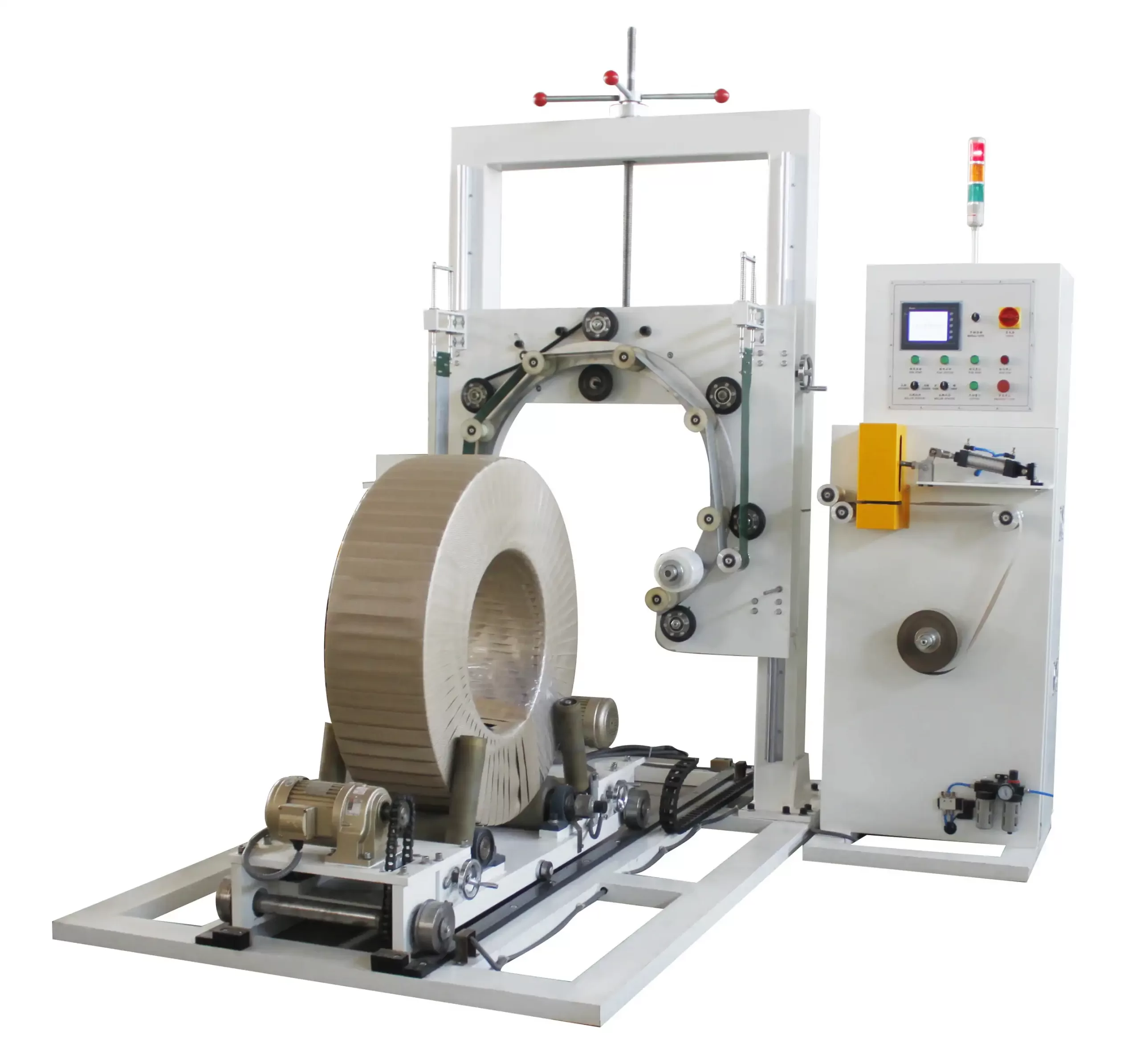
Let’s categorize the essential safety features from basic requirements to advanced protections. Think of this as a checklist for your factory walk-through or supplier questionnaire.
Essential Safety Feature Hierarchy
🔴 Tier 1: Critical Physical Guards & Emergency Stops
- Fixed Guards: Permanent barriers around rotating arms, chain drives, and pinch points.
- Interlocked Guard Doors: Any door or panel that allows access to maintenance areas must have a safety switch that cuts power when opened.
- E-Stop Buttons: Clearly marked, easily accessible mushroom-head buttons on all sides of the machine. When pressed, they must initiate a controlled stop (not a power chop that could cause other hazards).
🟡 Tier 2: Active Detection Systems
- Light Curtains: Creates an invisible infrared screen around the loading zone. If broken, the machine cycle pauses. This is crucial for protecting operators during coil positioning.
- Safety Mats: Pressure-sensitive mats on the floor around the machine. If stepped on, they signal the machine to stop.
- Two-Hand Control: For certain manual initiation steps, requires the operator to use both hands simultaneously on separate buttons, ensuring hands are away from moving parts.
🟢 Tier 3: Ergonomic & Operational Safety
- User-Friendly HMI: A clear, intuitive control panel with error messages in the local language reduces operator confusion and mistakes.
- Centralized Lubrication: Allows for safe maintenance without technicians needing to reach into dangerous spots with grease guns.
- Fall Prevention on Platforms: If the machine has an integrated platform for top wrapping, it must have standard guardrails and toe kicks.
The Partner’s Role in Safety
A reputable supplier doesn’t just bolt on safety devices; they design the machine with safety as a core principle. Ask them:
- “Can you provide the machine’s risk assessment documentation?”
- “Do your safety circuits comply with Performance Level ‘d’ (PLd) or Category 3?”
- “How do you train our maintenance team on safe lockout/tagout (LOTO) procedures for your machine?”
A partner like Fengding, which supplies to large, safety-conscious mills, typically has this documentation and philosophy ingrained. Investing in a machine with robust, certified safety features is an investment in your team’s well-being, your plant’s continuous operation, and your own peace of mind. It turns a potential hazard zone into a predictable, controlled process. (long tail keywords: ISO compliant coil wrapping safety, light curtain protection for packing machines, industrial machine safety interlock systems)
4. Beyond the Spec Sheet: How Do You Choose a Reliable Partner for Long-Term Support?
You’re not just purchasing a machine; you’re entering a long-term relationship. The most feature-packed vertical coil wrapping machine will become a costly paperweight if the supplier disappears after the sale or cannot provide timely technical support and spare parts. For a plant manager, downtime is the enemy. When a critical machine fails, you need a partner who answers the phone, understands the urgency, and has the expertise and parts inventory to get you back online fast. Your past experiences with unreliable vendors make this the most critical, yet often overlooked, part of the buying decision.
Choosing a reliable partner is more important than choosing a specific machine model. The right partner offers deep application engineering expertise, proven local service support, and a commitment to your long-term productivity through training, readily available spare parts, and responsive technical assistance. They act as an extension of your maintenance team, ensuring your investment delivers value for its entire lifecycle, not just on the day of installation.

Evaluating a partner requires looking beyond sales presentations. Here are concrete steps and criteria to assess their true capability and commitment.
The Partner Evaluation Checklist
Use this framework during your supplier discussions and reference checks:
-
🔧 Technical & Application Expertise:
- Do they ask detailed questions about your coils (weight, diameter, surface finish), your facility layout, and your specific pain points?
- Can they provide case studies or references from similar industries (steel, wire, aluminum) in your region?
- My Insight: A good engineer will want to visit your plant. If a supplier only wants to sell from a catalog, be wary. I always insist on seeing the client’s operation because the best solution is born from understanding the real problem.
-
📞 After-Sales Service Structure:
- Do they have trained service engineers located in your country or region? What is their guaranteed response time?
- Do they maintain a local spare parts inventory for critical components (PLC, servo drives, sensors)?
- Do they offer comprehensive operator and maintenance training programs?
-
🛠️ Manufacturing Quality & Transparency:
- Can you visit their factory? The organization and quality control on their shop floor reflect the machine you’ll receive.
- What is their standard warranty period? What does it cover? (e.g., 2 years on parts and labor is a strong sign of confidence).
Red Flags vs. Green Flags
| Red Flags 🚩 | Green Flags ✅ |
|---|---|
| Vague answers about service support. | Provides a dedicated service contact and a standard service level agreement (SLA). |
| No local references or unwilling to share them. | Connects you with 2-3 existing customers who can vouch for their service. |
| “One-size-fits-all” solution with no customization. | Offers optional modules (e.g., different film clamps, pre-stretch upgrades) to tailor the machine to your needs. |
| Pressure to decide immediately with a “today-only” discount. | Respects your procurement process and provides a detailed, itemized proposal for comparison. |
In my journey from factory engineer to business owner, I’ve learned that the best partnerships are built on shared goals. Your goal is uninterrupted, safe, efficient production. A partner’s goal should be to ensure your machine is a key contributor to that. They should be as invested in your success as you are. When you find a supplier who demonstrates this mindset—through their questions, their proposals, and their post-sale support plan—you’ve found more than a vendor; you’ve found a strategic ally for your operation’s future. (long tail keywords: coil wrapping machine after sales service, reliable packaging equipment supplier, industrial machine manufacturer support network)
Conclusion
Selecting the right vertical coil wrapping machine is a strategic decision that hinges on three core technical features—precision tension control, synchronized operational speed, and integrated safety systems—and one critical human factor: choosing a reliable, expert partner. By focusing on these pillars, you move beyond simple procurement to making an investment that safeguards your product quality, optimizes your production flow, protects your workforce, and delivers a clear, long-term return. Remember, the best machine is one that solves your specific problems reliably, day after day, supported by a partner who stands behind it. For a durable solution engineered for heavy industry, exploring options from a specialized coil wrapping machine manufacturer is the essential first step toward transforming your packaging line from a bottleneck into a competitive advantage.








