
Steel Coil Packing Line: The Definitive Buyer’s Guide to Automatic Systems (2026)
📖 Core Highlights (TL;DR)
- What is a Steel Coil Packing Line? An integrated automation system that automatically transports, wraps, straps, and pallets bare coils from the end of the production line. It replaces 3–5 workers and boosts throughput to 70–120 coils/hour.**。
- Core Value Chain: Automated packaging reduces annual damage claims from $40,000 to $10,000 per year, with total annual savings reaching $169,000. The typical ROI period is 1.3–2.6 years.。
- Selection Key: First define the coil weight range (select FPL-2500 for light coils ≤2,500 kg, or FPL-6000 for heavy coils ≤6,000 kg), then match your throughput targets with available factory space.。
— FHOPEPACK Engineering Team, 《2026 Coil Packaging Industry Report》
Table of Contents
- Why Manual Packaging Is Quietly Killing Your Margins
- 8 Core Components: Every Part and Why It Matters
- 7-Step Workflow: From Bare Coil to Pallet-Ready Shipment
- Technical Specifications & Performance Data
- 3 Types of Packing Lines — Match the Right System to Your Volume
- 6 Decision Factors Before You Sign the Purchase Order
- 5 Industry Applications with Custom Configurations
- 5 Common Failures & How to Fix Them Before They Cost You
- Full Cost Breakdown & ROI Scenarios
- FAQ — What Procurement Engineers Ask Most
- Get a Quote from FHOPEPACK
Why Manual Packaging Is Quietly Killing Your Margins
A steel coil packing line is an integrated automated system that handles, protects, and packages steel coils from the end of a processing line to final shipment — without the bottlenecks, inconsistency, or safety liability of manual operations.
“Coil packaging is not a cost center — it’s the last quality checkpoint before your product reaches the customer. One damaged edge on delivery can cost more than a week’s packaging budget.”
— FHOPEPACK Field Engineering, 《Customer Damage Incident Analysis 2025》

📦 Why Steel Coil Packaging Is a Competitive Differentiator
Steel coils carry embedded value at every stage — in raw material cost, processing time, and your brand’s delivery reputation. Proper packaging fulfills three non-negotiable functions:
| Function | Technical Mechanism | Business Impact |
|---|---|---|
| Protection | PU rollers + multi-layer film wrap prevents edge crush, rust, and surface scratch | Reduces damage claims and customer returns |
| Stability | Servo-controlled stacking + PET/steel strapping prevents pallet shift | Eliminates transit accidents and liability |
| Presentation | Consistent wrap tension + automatic labeling | Signals operational excellence to buyers |
⚠️ The Hidden Cost of Manual Packaging
Traditional manual packaging quietly erodes profitability across five dimensions:
- Labor Intensity: Requires 3-5 workers per shift for loading, wrapping, strapping, and stacking — a headcount that scales poorly with volume
- Quality Variance: Human operators apply inconsistent wrap tension, creating weak spots that fail during transport
- Safety Exposure: Manual handling of coils weighing 500 kg to 25+ tons is a leading cause of workplace injury in steel processing
- Throughput Ceiling: Maximum 10-20 coils/hour — a hard cap that blocks production scaling
- Rising Labor Cost: Wage inflation + skilled labor shortage compound the problem year over year
🚀 What Automatic Systems Deliver — in Numbers
Modern automatic steel coil packing lines replace all five failure points:
| Performance Metric | Manual System | Automatic Line | Improvement |
|---|---|---|---|
| Throughput | 10-20 coils/hr | 40-120 coils/hr | 4-6× |
| Operators Required | 3-5 per shift | 1-2 (monitoring only) | 60-80% reduction |
| Film/Strap Consumption | Baseline | 15-25% less | Material savings |
| Typical ROI Period | — | 12-24 months | — |
8 Core Components: Every Part and Why It Matters
A full automatic steel coil packing line is a chain of eight integrated subsystems. A weak link in any one of them becomes your production bottleneck.

1. Turnstile — Eliminating Crane Wait Time at the Line Entry
What it does: Receives coils from an overhead crane or upstream conveyor, rotates them into position for the down-ender, and allows the next coil to be loaded simultaneously — breaking the one-at-a-time bottleneck of crane-dependent feeding.
Why it matters: In a 100-coil/hour line, even a 15-second crane wait per coil costs 25 minutes of downtime per shift. A multi-arm turnstile eliminates this entirely.
Key Features:
- 180° or 360° rotation capability
- Multiple arms (typically 2-4) for continuous loading
- Integration with slitting line or processing equipment
- Load capacity: 8-32 tons per arm | Positioning accuracy: ±5mm
| Parameter | Value |
|---|---|
| Max Loading per Arm | 8-32 tonnes |
| Max Coil Width | 650-2,000 mm |
| Support Arm Length | 650-1,500 mm |
| Rotation Speed | ~2 circles/min |
| Power | 3.2-7.5 kW |
| Power Supply | AC 380V, 3-phase, 50/60Hz |
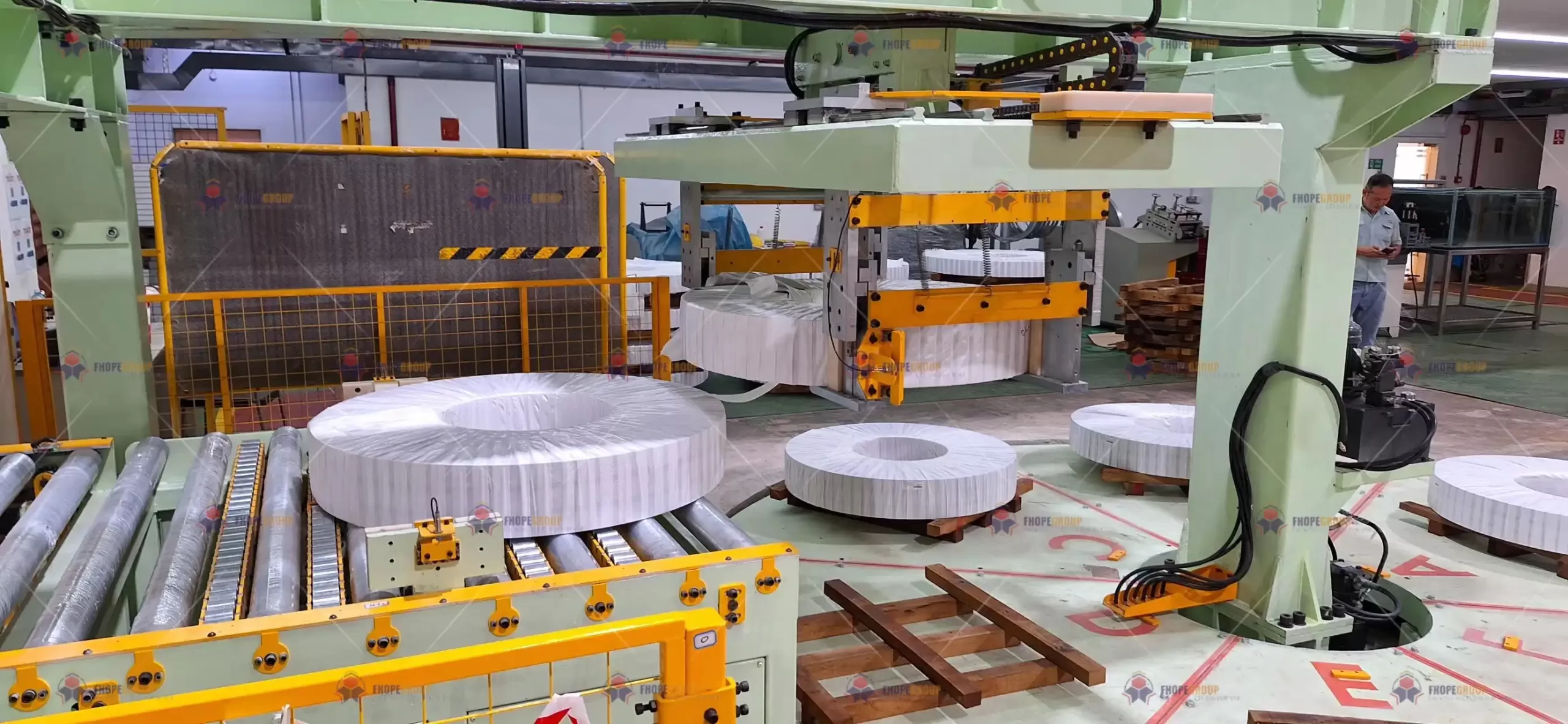
💡 When You Need It: Essential for any high-volume operation where crane cycle time would cap your overall throughput below rated capacity.
2. Coil Down Ender — The Orientation Shift That Unlocks Efficient Wrapping
What it does: Transitions coils from horizontal (eye-to-wall) to vertical (eye-to-sky) orientation in 20-30 seconds, positioning them for circumferential ring wrapping.
Why it matters: Eye-to-sky orientation exposes the full coil circumference to the wrapping ring — achieving complete surface coverage that eye-to-wall wrapping cannot. This single orientation change directly determines wrap quality and storage stability.
Key Features:
- Hydraulic lifting and tilting mechanism (140 bar operating pressure)
- V-side platform prevents coil rolling during transfer
PU-covered rollers protect surface finish on cold-rolled and galvanized coils- Handles everything from 15mm slit coils to 30,000 kg heavy-duty coils
| Parameter | Value |
|---|---|
| Handling Weight | 20-2,500 kg (standard) / up to 30,000 kg (heavy duty) |
| Min Coil Width | 15 mm (slit coil) |
| Tilting Angle | 0-90° or 0-180° |
| Hydraulic Pressure | 140 bar |
| Conveyor Motor | 0.75-2.2 kW |
| Cycle Time | 20-30 sec |

Related Article: Steel Coil Down Ender: Complete Guide to Coil Flipping Equipment
3. Weighing & Strapping Station — Inventory Accuracy and Pre-Wrap Stability
What it does: Captures coil weight with 1/3000 accuracy for ERP/inventory logging, then rotates the coil 360° to apply 3-4 binding straps before the coil enters the wrapping machine.
Why it matters: Skipping pre-wrap strapping causes coil telescoping inside the wrapping ring — ruining wrap pattern and requiring manual rework. The weight data also feeds downstream labeling and shipping systems automatically.
Weighing System:
- Load cells integrated below conveyor — no lifting or transfer required
- Accuracy: 1/3000 of full scale
- Automatic weight capture and data logging with display and printer integration
Strapping System:
- 360° coil rotation for multi-point, evenly-spaced strapping
- Foot switch or
PLCcontrol for manual or automatic strap application - 3-4 strap positions typical | Strap width: 12-32mm (
PETor steel)
| Parameter | Value |
|---|---|
| Max Loading | 2,500-6,000 kg |
| Weighing Accuracy | 1/3000 |
| Turning Range | 360° continuous |
| Strapping Positions | 3-4 places |
| Strap Width | 12-32mm (PET or steel) |
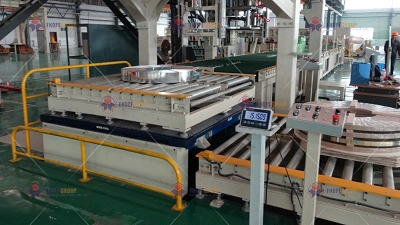
4. Coil Wrapping Machine (Horizontal Type) — The Heart of Surface Protection
What it does: A rotating ring orbits around the stationary coil at 20-100 rpm, applying stretch film, kraft paper, or composite materials in a programmed overlap pattern — achieving uniform, tension-controlled coverage from edge to edge.
Why it matters: This is where coil surface quality is locked in for the entire journey to the customer. Inverter-controlled ring speed and adjustable overlap (10-90%) let operators dial in exactly the protection level each product specification demands — cold-rolled surfaces need 60-70% overlap with paper; galvanized coils need VCI film layers.
Key Features:
- Inverter-controlled ring speed for consistent tension across full coil width
- Automatic film cutting and clamping — no operator intervention between cycles
- Soft start/stop prevents film breakage at cycle boundaries
- Simultaneous film + paper application in a single pass
Technical Specifications:
| Parameter | Model A — Large Coil | Model B — Small/Slit Coil |
|---|---|---|
| Coil ID | 406/508 mm | 280-300 mm |
| Coil OD | 600-1,600 mm | 400-1,000 mm |
| Coil Width | 15-150 mm | 5-30 mm |
| Coil Weight | 50-2,500 kg | 20-120 kg |
| Wrapping Speed | 20-50 sec/pcs | 20-50 sec/pcs |
| Rotating Speed | 20-100 r/min | 20-100 r/min |
| Overlap Range | 20-90% | 20-90% |
| Power | 4.5 kW | 4.5 kW |
| Packing Material | HDPE/PE/Paper/Poly Film | HDPE/Stretch Film |
Material Selection Guide:
| Material | Width | Thickness | Best Application |
|---|---|---|---|
| Stretch Film | 70-100 mm | 20-23 μm | General indoor storage |
| HDPE Film | 70-100 mm | Heavy-duty | Outdoor, rough handling |
| Kraft Paper | 50-100 mm | — | Moisture barrier layer |
| Woven Foil | 70-90 mm | — | Premium/export protection |
| Crepe Paper | 50 mm | — | Irregular surface conforming |

Related Article: Horizontal Coil Wrapping Machine for Steel Coils – 2026 Buyer Guide
5. Coil Stacking Machine (Palletizer) — Safe, Precise Load Building
What it does: A servo-controlled gantry picks wrapped coils from the conveyor and places them on pallets in pre-programmed stacking patterns with ±2mm positioning accuracy — handling loads up to 2,500 kg per coil, 6,000 kg per pallet.
Why it matters: Manual stacking of coils is the single highest-injury-risk task in a packing line. Automating it removes workers from the hazard zone entirely, while achieving stacking consistency that reduces pallet instability claims during transport.
Two Stacking Mechanisms:
| Type | Mechanism | Best For | Single Coil Limit |
|---|---|---|---|
| Fork Arm | Mechanical fork engages coil ID | Coils with timber spacers (ID: 300/406/508 mm) | 2,500 kg |
| Vacuum | Vacuum suckers grip coil top face | Coils without spacers (ID: 280 mm) | 200 kg |
Key Features:
- Vacuum system maintains 5-minute hold on power loss — coil never drops unexpectedly
- Automatic coil centering before pickup — eliminates misaligned stacks
- Manual or automatic timber spacer feeding between layers
| Parameter | Value |
|---|---|
| Max Stacking Height | 1,000 mm (including pallet) |
| Max Stacking Weight | 6,000 kg total |
| Positioning Accuracy | ±2 mm |
| Power | 7-15 kW |

Related Article: Automatic Coil Stacking Machine – Palletizing Systems for Steel Coils
6. Out-Feeding Conveyor System — The Logistics Bridge to Dispatch
What it does: Transfers completed pallets from the stacking station to a forklift or overhead crane pickup position, with an optional 90° turntable for space-constrained layouts.
Key Features:
PU-covered roller conveyor — protects wrapped coil surface during transfer- Turntable for 90° direction change (optional, useful for L-shaped facility layouts)
- Chain-driven or belt-driven | Load capacity: 6+ tonnes | Section length: 2-6 m
7. Control System & HMI — The Intelligence Layer
What it does: A PLC-based central controller coordinates all eight subsystems through a single touch-screen interface, storing recipes, logging data, and surfacing faults before they become stoppages.
Why it matters: Without integrated control, each station runs independently — meaning a fault at station 3 doesn’t stop station 1, leading to coil pile-ups and damage. Integrated PLC control creates a synchronized line that responds to exceptions as a system.
Control Features:
PLCplatform:Siemens,Mitsubishi, orOmron(buyer’s preference)HMItouch screen: 10-15 inch with recipe storage for different coil specs- Self-diagnostics with fault location display — cuts mean-time-to-repair by 50%
- Optional remote monitoring via
WinCCvisualization software OPC UA/Modbus TCP/TCP/IPforERP/MESintegration
Safety Architecture:
| Safety Feature | Standard / Optional | Protection Zone |
|---|---|---|
| Emergency stop buttons | Standard — all stations | Full line |
| Light curtains | Standard | Wrapping + stacking |
| Interlock switches on guards | Standard | All access points |
| Safety-rated PLC | Optional | Control cabinet |
| IP54 protection (field devices) | Standard | All outdoor/wet zones |
8. Optional Equipment — Line Intelligence Upgrades
Automatic Printer & Label Applicator (Zebra module):
Prints and applies barcode or QR code labels on coil top surface with ±2mm precision. Label size: 20-100mm width × 25-200mm length. Feeds coil ID directly to WMS/ERP without manual data entry.
Automatic Timber Feeding Machine:
Stores and feeds W50mm × H50mm wooden spacers between coil layers (2 pcs/layer), with automatic positioning per coil OD. Eliminates the last manual task in an otherwise fully automated line.
Coil Measurement Device (Sonar):
Scans coil diameter automatically and feeds dimensions to the PLC for real-time wrapping parameter adjustment — critical when coil OD varies batch to batch.
UPS System (100 kVA):
Protects the line from power fluctuations. On outage, provides sufficient runtime to complete the current cycle and execute safe shutdown — preventing mid-cycle coil drops.
7-Step Workflow: From Bare Coil to Pallet-Ready Shipment
Understanding cycle time at each station reveals where your line will bottleneck — and where automation investment pays back fastest.

Step 1 — Coil Loading via Turnstile ⏱ 30-60 sec
- Overhead crane places bare coil on turnstile arm
- Turnstile rotates to position coil for down-ender
- Operator loads next coil on opposite arm (continuous — no wait)
Checkpoints: Verify coil ID and weight | Visual inspection for pre-existing damage | Confirm coil is centered on arm
Step 2 — Coil Down-Ending ⏱ 20-30 sec
- Down-ender advances to turnstile position
- Lifting nose engages coil ID
- Coil tilts 90° from horizontal to vertical (eye-to-sky)
- Coil lowered onto conveyor for downstream transfer
Checkpoints: V-side platform engaged securely | PU rollers making contact, not metal | Auto-positioning confirmed for coil width
Step 3 — Weighing & Initial Strapping ⏱ 40-60 sec
- Conveyor delivers coil to weighing station
- Station isolates coil from conveyor; weight captured and logged to
ERP - Coil rotates 360° under
PLCcontrol - System applies 3-4 straps at equal spacing
- Weight and strap data printed or transmitted to downstream labeler
Checkpoints: Weight reading stable (±accuracy tolerance) | Strap tension within spec | Strap positions evenly distributed
Step 4 — Coil Wrapping ⏱ 20-50 sec
- Conveyor moves coil into wrapping ring station
- Support rollers lift coil clear of conveyor
- Ring rotates — film/paper applied at programmed overlap rate (20-90%)
- Automatic film cutting and tail clamping at cycle end
- Coil lowered back to conveyor; conveyor advances to next station
Checkpoints: Film tension within set range | Overlap rate matches recipe | Edge zones fully covered | Film consumption logged
Related Article: Steel Coil Packing Process: Step-by-Step Workflow Guide
Step 5 — Coil Stacking / Palletizing ⏱ 30-45 sec
- Wrapped coil advances to centering station
- Auto-centering mechanism aligns coil for pickup
- Stacking machine (fork or vacuum) lifts coil to programmed pallet position
- Timber spacers placed between layers (manual or auto feeder)
- Sequence repeats until pallet weight/height limit reached
Checkpoints: Stacking pattern matches programmed recipe | Spacer positioned correctly | Pallet weight distribution balanced | Stack height within limit
Step 6 — Pallet Strapping (Optional) ⏱ 60-90 sec
- Full pallet advances to pallet strapping arch
- Arch closes; steel strap fed through full circumference
- Strap tensioned to $4{,}000\text{–}20{,}000\text{ N}$, buckled, and cut
- Process repeats for 4 straps at 90° intervals
- Arch opens; pallet released to out-feeding conveyor
Checkpoints: Strap tension within $\pm5\%$ of target | Buckle fully crimped | Strap positions symmetrical
Step 7 — Out-Feeding & Dispatch ⏱ 30-60 sec
- Pallet moves to out-feeding conveyor
- Turntable rotates pallet 90° to dock orientation (if equipped)
- Forklift or overhead crane removes pallet to warehouse
- Empty pallet returned to stacking station (manual or automated return loop)
Total Line Throughput Comparison
| Configuration | Cycle Time per Coil | Coils per Hour | Operators |
|---|---|---|---|
| Manual System | 180-300 sec | 10-20 | 3-5 |
| Semi-Automatic | 60-90 sec | 40-60 | 2-3 |
| Full Automatic | 30-50 sec | 70-120 | 1-2 |
Note: Actual throughput depends on coil size, packaging complexity, and material changeover frequency. Size your line for 120-150% of current peak demand to accommodate growth.
Technical Specifications & Performance Data
Standard Line — FPL-2500
Designed for steel service centers handling coils up to 2,500 kg. Covers hot-rolled, cold-rolled, and galvanized coils in standard width ranges.
| Parameter | Specification |
|---|---|
| Coil Weight Range | 50 – 2,500 kg |
| Max Coil OD | 1,600 mm |
| Min Coil ID | 280 mm |
| Max Coil Width | 650 mm |
| Line Speed | 2-4 m/min (adjustable) |
| Wrapping Speed | 20-50 sec/coil |
| Stacking Capacity | 6,000 kg per pallet |
| Power Supply | 380-415V, 3-phase, 50/60Hz |
| Total Power | 25-40 kW |
| Air Supply | 5-8 kgf/cm², 0.5 m³/min |
| Control System | PLC + Touch Screen HMI |
| Safety Standard | CE / Chinese Safety Regulations |
Heavy Duty Line — FPL-6000
For heavy processors and mills handling coils to 6,000 kg — wide-width capability for hot mill output and tube/pipe applications.
| Parameter | Specification |
|---|---|
| Coil Weight Range | 500 – 6,000 kg |
| Max Coil OD | 2,000 mm |
| Min Coil ID | 406 mm |
| Max Coil Width | 2,000 mm |
| Line Speed | 1-3 m/min (adjustable) |
| Wrapping Speed | 40-80 sec/coil |
| Stacking Capacity | 12,000 kg per pallet |
| Power Supply | 380-480V, 3-phase, 50/60Hz |
| Total Power | 50-80 kW |
| Air Supply | 6-8 kgf/cm², 1.0 m³/min |
| Control System | Siemens PLC + WinCC HMI |
| Safety Standard | CE / ISO 12100 |
Material Consumption Reference
Stretch Film Usage by Coil OD (70mm width, 50% overlap):
| Coil OD | Film per Coil | Annual Volume (50k coils) |
|---|---|---|
| 600 mm | ~15 m | ~750 km |
| 1,000 mm | ~25 m | ~1,250 km |
| 1,600 mm | ~40 m | ~2,000 km |
PET Strapping by Coil Weight:
| Coil Weight | Strap Width | Straps/Coil | Strap Length/Coil |
|---|---|---|---|
| 500 kg | 19 mm | 3 | ~6 m |
| 1,500 kg | 25 mm | 4 | ~8 m |
| 2,500 kg | 32 mm | 4 | ~10 m |
Material Cost per Coil (indicative):
| Material | Cost Range |
|---|---|
| Stretch Film | $0.50 – $1.50 |
| PET Strapping | $0.30 – $0.80 |
| Kraft Paper (optional) | $0.20 – $0.60 |
| Total | $1.00 – $2.90 per coil |
3 Types of Packing Lines — Match the Right System to Your Volume
By Automation Level
Option 1 — Manual Station: Entry Point for Low-Volume Operations
Description: Basic setup combining overhead crane loading, semi-automatic turntable wrapping, and manual strapping. Every transfer point requires an operator.
| Metric | Value |
|---|---|
| Throughput | 10-20 coils/hour |
| Labor Required | 3-4 operators |
| Investment Range | $15,000 – $40,000 |
Best For:
- Operations processing fewer than 500 coils/month
- Facilities with highly diverse coil sizes requiring frequent setup changes
- Budget-constrained facilities piloting automation for the first time
⚠️ Limitation: Labor cost and throughput ceiling make this unscalable beyond ~1,000 coils/month.
Option 2 — Semi-Automatic Line: The Transition Platform
Description: Powered conveyors and automatic wrapping, but with manual strapping and semi-auto stacking. Operators remain involved at 2-3 stations.
| Metric | Value |
|---|---|
| Throughput | 40-60 coils/hour |
| Labor Required | 2-3 operators |
| Investment Range | $50,000 – $120,000 |
Best For:
- Medium-volume operations processing 500-2,000 coils/month
- Facilities currently running manual and building the business case for full automation
- Mixed coil type operations where full recipe automation is complex
Related Article: Automatic vs Semi-Automatic Coil Packing Line – ROI Analysis
Option 3 — Full Automatic Line: Maximum Throughput, Minimum Labor
Description: Complete automation from turnstile loading through robotic palletizing. Operators monitor — they do not intervene in normal operation.
| Metric | Value |
|---|---|
| Throughput | 70-120 coils/hour |
| Labor Required | 1-2 operators (monitoring only) |
| Investment Range | $150,000 – $400,000+ |
Best For:
- High-volume operations processing more than 2,000 coils/month
- Facilities running consistent coil specifications with high recipe stability
- Operations prioritizing labor cost reduction or running 24/7
By Coil Orientation
| Orientation | Description | Best Applications |
|---|---|---|
| Eye-to-Sky (Horizontal Pack) | Coil axis vertical; ring wraps circumference | Hot-rolled, cold-rolled, galvanized coils — standard for service centers |
| Eye-to-Wall (Vertical Pack) | Coil axis horizontal; wrapping along OD | Slit coils, narrow strip, surface-sensitive materials — prevents edge crush |
Related Article: Horizontal vs Vertical Coil Wrapping Machine – Which is Right for You?
By Application Type
| Application | Coil Weight | OD Range | Throughput Target |
|---|---|---|---|
| Steel Service Center | 500-5,000 kg | 800-1,800 mm | 80-120 coils/hr |
| Slit Coil Processor | 20-500 kg | 400-1,200 mm | 100-200 coils/hr |
| Heavy Duty / Mill | 2,000-30,000 kg | 1,000-2,500 mm | 20-40 coils/hr |
6 Decision Factors Before You Sign the Purchase Order
1. Lock Down Your Coil Specification Range First
Before comparing equipment, build a coil spec matrix covering 95% of your production volume:
- Define min/max coil weight (this drives structural capacity)
- Define min/max coil OD (this drives ring size and stacking mechanism)
- Define min/max coil ID (this determines mandrel or fork arm type)
- Define min/max coil width (this influences conveyor width and wrap coverage)
- Define surface finish requirements (cold-rolled needs paper; galvanized needs
VCIfilm)
The #1 cause of equipment underperformance is specifying for the average coil, not the extreme cases. Your line must handle the hardest 5% of coils reliably.
2. Size for Growth, Not Today’s Demand
Questions to answer before specifying throughput:
- What is your current coils per month — average AND peak?
- What is your 5-year production growth target?
- Are you running one shift or three?
- Will you add upstream processing capacity that feeds this line?
💡 Rule of Thumb: Size the line for 120-150% of current peak demand. Throughput upgrades after installation cost 3-5× more than specifying correctly upfront.
3. Map Your Facility Constraints Early
Space and utilities define what’s possible before any technical discussion begins.
Space Footprint Requirements:
| Line Type | Length | Width | Height Clearance |
|---|---|---|---|
| Compact Semi-Auto | 10-15 m | 4-6 m | 3-4 m |
| Standard Automatic | 20-30 m | 6-8 m | 4-5 m |
| Full Heavy Duty | 30-50 m | 8-12 m | 5-6 m |
Utility Requirements:
- Power: 25-80 kW (depending on configuration)
- Compressed Air: 0.5-1.5 m³/min at 6-8 bar
- Floor Load Capacity: 2-5 tonnes/m² under heavy equipment bases
4. Plan System Integration Before Equipment Arrives
Integration failures are the most common cause of delayed commissioning. Resolve these before purchase:
- Confirm conveyor height at slitting line exit (must match down-ender input height)
- Define
ERP/MEScommunication protocol (TCP/IP,Profinet,OPC UA) - Agree on data exchange format (coil ID, weight, dimensions, production count)
- Map safety interlock requirements between packing line and upstream equipment
5. Calculate ROI with Real Numbers, Not Optimistic Assumptions
Standard ROI Framework:
| Cost Category | Manual Line | Automatic Line | Annual Saving |
|---|---|---|---|
| Labor (3 shifts @ $25/hr) | $180,000 | $45,000 | $135,000 |
| Film & Strapping Material | $44,000 | $36,000 | $8,000 |
| Damage Claims | $40,000 | $10,000 | $30,000 |
| Maintenance | $8,000 | $12,000 | -$4,000 |
| Total Annual | $272,000 | $103,000 | $169,000 |
Payback period formula:
$$T_{payback} = \frac{\text{Total Investment}}{\text{Annual Net Savings}} = \frac{\$280{,}000}{\$169{,}000} \approx 1.66 \text{ years}$$
Related Article: Steel Coil Packaging Cost Optimization – Material and Labor Savings
6. Evaluate Suppliers on After-Sales, Not Just Price
The cheapest line that goes down for 2 weeks waiting for a spare part is not the cheapest line.
Questions every procurement engineer should ask:
- How many coil packing lines have you installed in the last 3 years — in my region?
- Can you provide 3 references from operations similar to mine?
- What is your lead time from order to installation-ready delivery?
- Do you have local service technicians, or is all support remote?
- What is the guaranteed spare parts delivery time from your warehouse?
- What exactly does your warranty cover — and what does it exclude?
5 Industry Applications with Custom Configurations
🏭 Steel Service Centers — Speed and Traceability at Scale
Industry Requirement: Process 80-120 coils/hour from multiple slitting lines, with automatic coil tracking from entry to dispatch.
Engineered Configuration:
- Turnstile → Down Ender → Weighing/Strapping → Dual Wrapping Stations → Robotic Stacking → Pallet Strapping
PLCrecipe storage for rapid changeover between coil specs- Barcode scanning at intake + automatic label application at output
Related Article: Coil Packing Line for Steel Service Centers – Complete Solution
🔬 Cold Rolling Mills — Surface Integrity Above Everything
Industry Requirement: Zero surface contamination from handling equipment, with multi-layer protection for finished cold-rolled surfaces.
Engineered Configuration:
- Vertical (eye-to-wall) wrapping orientation to protect edges
- Multi-layer pass:
VCIpaper inner layer + stretch film outer layer - Integrated edge protectors at wrap station entry
- Gentle-touch
PUrollers and low-speed conveyor throughout
🌧️ Galvanizing Lines — Long-Term Corrosion Protection for Export
Industry Requirement: 6-12 month protection capability for outdoor storage and ocean freight — moisture, salt air, and condensation resistance.
Engineered Configuration:
VCIpaper + stretch film + waterproof top cover (3-layer system)- Full-circumference coverage with zero gap at edges
- Desiccant packet insertion station (optional)
- Export-grade steel strapping (not PET for long-term outdoor loads)
✂️ Slit Coil Processors — High-Speed Narrow Strip Handling
Industry Requirement: Process 100-200 slit coils/hour with edge protection on coils as narrow as 15mm width.
Engineered Configuration:
- Horizontal wrapping machine (eye-to-wall orientation)
- Gang wrapping capability: 5-20 narrow coils bundled per pass
- Automatic edge protector application before wrap
PETstrapping with precision tension control (no surface marking)
Related Article: Slit Coil Packing Line – Narrow Strip Packaging Solutions
🔩 Tube & Pipe Manufacturers — Heavy-Gauge Handling with Export Compliance
Industry Requirement: Handle coils up to 30,000 kg with export documentation compliance and custom palletizing for specialized shipping configurations.
Engineered Configuration:
- Heavy-duty down-ender (10+ ton capacity, reinforced hydraulics)
- Reinforced wrapping ring for large-OD coils (up to 2,500 mm)
- Steel strapping (wire-buckle type for heavy loads)
- Optional wooden crate or steel frame enclosure for ocean freight
5 Common Failures & How to Fix Them Before They Cost You
⚠️ Problem 1: Edge Damage During Handling — The Invisible Revenue Leak
Symptoms: Dented or deformed coil edges | Customer rejection and return claims | Rising internal scrap rate
Root Cause Chain: Hard metal-to-metal contact during transfer → impact forces exceed coil edge yield strength → permanent deformation locked in before wrapping even begins.
Fix Protocol:
- Install
PU-covered rollers at every contact point on the line (not just the wrapping station) - Add V-side platforms at down-ender for coil support during tilt
- Program soft-start/soft-stop on all conveyor and positioning motors
- Apply edge protectors (cardboard or plastic) immediately before the wrapping ring entry
- Retrain operators on zero-drop, zero-impact handling standards
Related Article: How to Prevent Steel Coil Damage During Packaging and Transport
⚠️ Problem 2: Inconsistent Wrap Tension — The Quality Problem You Can’t See Until It’s Too Late
Symptoms: Loose film pockets in some zones | Film tears during wrapping | Load shifts on pallet in transit
Root Cause Chain: Manual or mechanical tension control → variation across ring RPM range → film over-stretched in fast zones, slack in slow zones → inconsistent coverage and adhesion.
Fix Protocol:
- Upgrade film carriage to inverter-controlled ring drive (eliminates mechanical tension variance)
- Install closed-loop automatic tension control system
- Replace worn brake pads on film carriage on scheduled maintenance cycle
- Switch to pre-stretch film technology (200-300% pre-stretch reduces material use 25% while improving tension consistency)
Related Article: Steel Coil Edge Protection Guide – Protectors, Wrapping Techniques
⚠️ Problem 3: Throughput Bottlenecks — Why Your Line Runs at 60% of Rated Capacity
Symptoms: Coil queues building at one specific station | Line consistently under rated throughput | Unplanned overtime to meet daily targets
Root Cause Chain: One station’s cycle time exceeds all others → upstream stations wait → effective throughput = bottleneck station rate, not line-rated speed.
Fix Protocol:
- Conduct a station-by-station time study across a full shift (minimum 200 coils)
- Map actual vs. design cycle times per station in a table
- Add a parallel station at the identified bottleneck (dual wrapping rings are the most common fix)
- Automate the highest-manual-touch operation remaining on the line
- Implement predictive maintenance scheduling to reduce unplanned stoppages
Related Article: Reducing Downtime in Coil Packing Lines – Maintenance and Optimization
⚠️ Problem 4: High Material Consumption — Budget Overrun That Compounds Monthly
Symptoms: Film usage exceeding projected budget | Rising per-coil packaging cost | High material waste in scrap bins
Root Cause Chain: Excessive overlap settings (70%+ instead of 30-50%) → 40% more film consumed per coil → annual overspend compounds with volume.
Fix Protocol:
- Audit current overlap settings — reduce from default-high to recipe-optimized (typically 30-50%)
- Install pre-stretch film technology (stretches film 200-300% before application — same protection, 25% less material)
- Add per-coil material consumption tracking in
PLCdata log - Review film thickness specification — modern 20μm films often outperform older 30μm stock
💡 Expected Impact: 15-25% reduction in film and strapping spend with no change in protection level.
Related Article: Steel Coil Packaging Cost Optimization – Material and Labor Savings
⚠️ Problem 5: Safety Incidents — The Risk That Shuts Down Your Line (and Your Insurance)
Symptoms: Near-miss event reports increasing | Minor injuries during operation | Failed safety audit findings
Root Cause Chain: Missing or bypassed safety interlocks → operator exposure to pinch points and moving loads → incident probability increases with throughput pressure.
Fix Protocol:
- Audit all light curtain coverage zones — replace degraded units immediately
- Verify all guard interlock switches are functional (not taped or bypassed)
- Implement
LOTO(lockout/tagout) procedures at every maintenance access point - Schedule quarterly safety training with hands-on drills — not just paperwork sign-off
- Add floor markings and
ISO-standard warning signage at all hazard zones
Compliance Standards: CE marking (Europe) | OSHA 29 CFR 1910 (USA) | Local industrial safety regulations
Full Cost Breakdown & ROI Scenarios
Investment Cost by Component — Standard Automatic Line (2,500 kg)
| Component | Cost Range (USD) |
|---|---|
| Turnstile | $15,000 – $25,000 |
| Coil Down Ender | $20,000 – $35,000 |
| Weighing & Strapping Station | $18,000 – $30,000 |
| Coil Wrapping Machine | $25,000 – $45,000 |
| Coil Stacking Machine | $30,000 – $55,000 |
| Conveyor System | $15,000 – $30,000 |
| Control System & HMI | $20,000 – $40,000 |
| Installation & Commissioning | $25,000 – $45,000 |
| Training & Documentation | $8,000 – $15,000 |
| Spare Parts Package | $10,000 – $20,000 |
| Equipment Total | $186,000 – $340,000 |
| Shipping & Customs (add 10-20%) | $19,000 – $68,000 |
| Foundation & Utilities | $10,000 – $30,000 |
| Crane Modifications (if needed) | $5,000 – $20,000 |
| All-In Total | ~$220,000 – $458,000 |
Annual Operating Cost Comparison (2-shift, 4,000 hrs/year)
| Cost Category | Manual Line | Automatic Line | Annual Saving |
|---|---|---|---|
| Labor (@ $25/hr) | $180,000 (3 ops) | $45,000 (1 op) | $135,000 |
| Film Consumption | $32,000 | $26,000 | $6,000 |
| Strapping | $12,000 | $10,000 | $2,000 |
| Maintenance | $8,000 | $12,000 | -$4,000 |
| Damage Claims | $40,000 | $10,000 | $30,000 |
| Total Annual | $272,000 | $103,000 | $169,000 |
Note: Automatic lines carry higher maintenance cost due to system complexity — but this is more than offset by labor reduction and damage claim elimination.
ROI by Region and Operation Scale
Scenario 1 — High Labor Cost Region (USA / Europe):
| Item | Value |
|---|---|
| Total Investment | $280,000 |
| Annual Net Savings | $170,000 |
| Payback Period | 1.6 years |
| 5-Year NPV (10% discount rate) | $363,000 |
Scenario 2 — Medium Labor Cost Region (Asia / Middle East):
| Item | Value |
|---|---|
| Total Investment | $250,000 |
| Annual Net Savings | $95,000 |
| Payback Period | 2.6 years |
| 5-Year NPV (10% discount rate) | $110,000 |
Scenario 3 — High Volume, 3-Shift Operation:
| Item | Value |
|---|---|
| Total Investment | $350,000 (heavy duty) |
| Annual Net Savings | $280,000 |
| Payback Period | 1.3 years |
| 5-Year NPV (10% discount rate) | $711,000 |
Financing Options
| Approach | Structure | Best When |
|---|---|---|
| CapEx (full payment) | 100% upfront | ROI < 2 years — fastest total return |
| Leasing | 3-5 year term with purchase option | Preserve capital, operating expense treatment |
| Supplier Financing | 20-30% down; balance over 12-24 months | Cash flow constrained; strong supplier relationship |
| Bank Equipment Loan | Equipment-backed at 4-8% interest | Established credit; longer payback scenarios |
💡 Recommendation: For ROI periods under 2 years, direct CapEx maximizes net return. For longer payback scenarios, financing preserves cash flow for operational priorities.
FAQ — What Procurement Engineers Ask Most

Q1: What is the typical lead time for a coil packing line?
A: Standard configurations ship in 90-120 days from order confirmation. Custom configurations (non-standard coil sizes, special integrations) require 120-180 days. On-site installation and commissioning add 2-4 weeks. Plan your project schedule accordingly — procurement to production-ready typically takes 5-7 months.
Q2: Can one line handle multiple coil sizes without long changeovers?
A: Yes — PLC recipe storage allows changeover in 5-15 minutes for size adjustments within the designed range. For large parameter jumps (e.g., 500 kg to 5,000 kg coils), some mechanical adjustments may extend this. The key is specifying your full coil range upfront so the line is designed to handle all variants in one recipe system.
Q3: What warranty coverage should I expect?
A: Standard warranty: 12 months from commissioning or 18 months from shipment (whichever comes first). Extended coverage (2-3 years) is available by negotiation. Note: wear parts — rollers, belts, film clamps, brake pads — are typically covered for 6 months or excluded entirely. Always request a specific list of what’s in and out of warranty scope.
Q4: What does installation support include?
A: Standard installation packages include:
- 1-2 factory engineers on-site for 2-4 weeks
- Mechanical installation supervision and alignment
- Electrical connection verification and system testing
- Operator training (production staff) and maintenance training (technical staff)
- Initial production run support — first batch signed off with engineers present
Buyer typically covers engineer travel, accommodation, and local labor for unloading and crane rigging.
Q5: What spare parts should I stock from day one?
A: Recommended minimum critical spares package (~$10,000-$20,000):
| Part Category | Recommended Quantity |
|---|---|
| Proximity & photoelectric sensors | 5-10 of each type |
| Solenoid valves | 2-3 of each size |
| Fuses and relays | Full set |
| Roller bearings | 10-20 pieces |
| Film carriage brake pads & rollers | Full service kit |
| Hydraulic seals and hoses | Complete replacement set |
| Touch screen HMI panel | 1 spare (if budget allows) |
Q6: Can the line integrate with our ERP or MES system?
A: Yes. Modern control systems natively support:
TCP/IPnetwork communicationOPC UAprotocol (preferred for industry 4.0 integration)Modbus TCP- Custom data export:
CSV,XML,JSON
Standard data exchanged: Coil ID, weight, OD/width, wrap parameters, cycle count, fault logs, production shift reports.
Q7: What safety certifications does the equipment carry?
A: Standard safety features on all FHOPEPACK lines:
- Emergency stop buttons at every operator station —
EN ISO 13850compliant - Safety guards with positive interlock switches on all access points
- Light curtains at wrapping and stacking hazard zones —
IEC 61496category - Audible and visual warning systems
- CE marking (Europe) with risk assessment documentation
OSHA compliance documentation available for North American projects. Safety-rated PLC (SIL 2) available as option.
Q8: PET vs. Steel Strapping — Which Should I Specify?
A:
| Comparison Factor | PET Strapping |
Steel Strapping |
|---|---|---|
| Tensile Strength | Good for coils < 2,000 kg | Required for coils > 3,000 kg |
| Corrosion Resistance | Excellent — no rust | Poor — rusts in moisture |
| Operator Safety | Safe — no sharp edges on break | Sharp edges — laceration risk |
| Shock Absorption | High elongation absorbs impact | Low elongation — rigid |
| Unit Cost | Lower | Higher |
| Recyclability | Simple single-stream | Separate metal recycling stream |
Recommendation: Use PET for coils under 2,000 kg and indoor storage. Specify steel for coils over 3,000 kg, outdoor storage, or ocean freight with long transit times.
Related Article: PET vs Steel Strapping for Steel Coils – Complete Comparison
Get a Quote from FHOPEPACK

Ready to Engineer Your Coil Packaging Line?
FHOPEPACK designs and builds custom steel coil packing lines for steel service centers, rolling mills, processors, and tube manufacturers worldwide. Every system is engineered to your specific coil range, throughput target, and facility constraints — not adapted from a catalog.
What Your Quotation Includes:
- Detailed equipment specification based on your coil data
2Dlayout drawing showing line footprint and utility connection points- Technical proposal with binding performance guarantees (throughput, cycle time)
- Reference list from similar installations in your region
- ROI analysis using your actual labor and material cost inputs
Contact FHOPEPACK:
| Channel | Details |
|---|---|
| Website | www.fhopepack.com |
| info@fhopepack.com | |
| Phone | +86-21-5787-1869 |
| Factory | Kunshan, Jiangsu Province, China |
| Regional Office | Shanghai, China |
Your Next Steps:
- Complete the Coil Packing Line Questionnaire (takes 10 minutes — covers all spec inputs)
- Schedule a video consultation with our engineering team
- Receive preliminary technical proposal within 5 business days
- Review, revise, and finalize specifications
- Place order — manufacturing begins immediately
Typical first-response time: Within 24 hours of inquiry submission.
🛠️ Actionable Advice — Your 5-Step Procurement Roadmap
Don’t let this guide sit unread. Here is the concrete sequence that moves from decision to production-ready line:
Week 1-2 — Define Your Requirements:
- Build your coil specification matrix (min/max weight, OD, ID, width, surface finish)
- Calculate current annual packaging cost (labor + material + damage claims)
- Measure available floor space and verify ceiling height, power supply, and air supply
Week 3-4 — Supplier Qualification:
- Send RFQ to 3 suppliers with your coil spec matrix attached
- Request reference site visits or video walkthroughs from each supplier
- Verify
CEcertification and after-sales service coverage in your region
Week 5-6 — Technical Evaluation:
- Compare proposals on performance guarantees (not just price)
- Run the ROI calculation using your actual cost inputs (see Section 9)
- Clarify warranty scope — what’s in, what’s out, wear parts policy
Week 7-8 — Commercial Negotiation:
- Negotiate spare parts package inclusion
- Agree commissioning support scope and engineer days on-site
- Confirm payment terms and delivery milestone schedule
Week 9+ — Order, Install, Operate:
- Place order → monitor manufacturing milestones
- Prepare facility (foundation, utilities, crane access) during lead time
- Commission with factory engineers on-site → training → production handover
Related Articles in This Series
Core Equipment:
- Steel Coil Down Ender: Complete Guide
- Horizontal Coil Wrapping Machine – Buyer Guide
- Automatic Coil Strapping Machine
- Automatic Coil Stacking Machine
Process & Workflow:
- Steel Coil Packing Process: Step-by-Step
- Automating Your Steel Coil Packing Line
- Quality Control in Steel Coil Packaging
Industry Applications:
- Coil Packing Line for Steel Service Centers
- Slit Coil Packing Line Solutions
- Heavy Duty Coil Packing Line (10+ Tons)
Problem Solving:
- Preventing Steel Coil Damage
- Steel Coil Edge Protection Guide
- Reducing Downtime in Coil Packing Lines
- Packaging Cost Optimization
Comparison Guides:
Document Information:
- Version: 2.0
- Last Updated: March 2026
- Author: FHOPEPACK Content Team
All performance data in this guide is sourced from actual FHOPEPACK customer installations. Specifications are subject to change based on custom engineering requirements. Contact our team for project-specific performance guarantees.








