
Pallet Inverter India: Why Do Hydraulic and Mechanical Systems Perform Differently?
Have you ever faced the challenge of inconsistent pallet sizes, rising labor costs, and constant pressure to speed up your warehouse operations in India? It is a common problem across many industries. When I talk to logistics managers, they often tell me about the headaches caused by manual pallet handling. These issues slow down your entire supply chain, increase risks, and can cost your business a lot of money in the long run.
Hydraulic pallet inverter systems use pressurized fluid to power their movements, giving them smooth, controlled force for heavy loads. Mechanical pallet inverter systems, on the other hand, rely on electric motors, gears, and chains for faster, often simpler, and more direct rotation. These fundamental differences mean they perform uniquely in terms of speed, power, maintenance needs, and suitability for various tasks within Indian warehouses.

Understanding the core distinctions between hydraulic and mechanical pallet inverters is not just technical knowledge. It is about making smart choices that impact your operational efficiency, safety, and bottom line. Let us dive deeper into how these two systems work and perform differently. This will help you decide which one best suits your specific needs in the bustling Indian logistics landscape.
Why is Pallet Inversion Critical for Operations in India?
Are you feeling the pinch of complex logistics requirements and intense competition in India’s booming market? Many businesses are. The need to quickly and safely switch goods between different pallet types, handle diverse product loads, and maintain hygiene standards is more crucial than ever. Without efficient pallet inversion, your warehouse can face bottlenecks, increased costs, and unhappy customers.
Pallet inversion is critical for Indian operations because it addresses the core challenges of diverse pallet standards for international trade, mitigates significant labor costs and safety risks associated with manual handling, and ensures compliance with hygiene regulations. This process is essential for maintaining a smooth, efficient, and compliant supply chain across various sectors.

From my experience working with numerous packing machine factories and establishing my own, I have seen firsthand how critical efficient material handling is. In India, warehouses deal with unique complexities. This makes pallet inversion not just a convenience, but a necessity for business survival and growth.
-
1. Meeting Diverse Pallet Standards for Trade: India is a hub for both domestic and international trade. This means warehouses often receive goods on Euro pallets but must ship them on American pallets, or vice-versa. Sometimes, they need to transfer goods from wooden pallets to hygienic plastic pallets for internal storage or specific export markets. Manual transfer is slow and costly. Automated pallet transfer systems, like those we develop at FHOPEPACK, quickly handle these transitions. This ensures compliance with international shipping regulations and customer requirements without disrupting the flow. (pallet switching, international trade compliance)
-
2. Addressing Labor Challenges and Safety Risks: The rising cost of labor and the difficulty in finding workers willing to do strenuous manual tasks are major concerns for Indian businesses. Manually flipping or transferring heavy loads between pallets is not only inefficient but also extremely dangerous. It poses serious risks of worker injury and product damage. I have heard many stories of accidents that could have been prevented with the right equipment. Implementing a pallet inverter significantly reduces the need for manual intervention. This protects workers, lowers insurance costs, and creates a safer working environment. (warehouse safety, labor shortage solutions)
-
3. Enhancing Operational Efficiency and Throughput: In today’s fast-paced e-commerce and retail environment, speed is king. Customers expect faster delivery times. This means every step in the logistics chain must be optimized. Pallet inverters drastically cut down the time required for pallet changes. This speeds up material flow, improves inventory turnover, and increases the overall throughput of your warehouse. For food and beverage companies, which operate on tight schedules, this efficiency is particularly important. It directly impacts their ability to meet market demands. (logistics optimization, warehouse throughput)
-
4. Ensuring Hygiene and Product Integrity: For industries like food and pharmaceuticals, maintaining strict hygiene standards is non-negotiable. Pallet inverters help move products from contaminated or damaged pallets to clean ones. This prevents cross-contamination and ensures product integrity. They also reduce the risk of product damage during handling. This preserves the quality of goods from the loading dock to the final destination. This is a vital aspect, especially when dealing with sensitive products. (hygiene standards, product damage prevention)
What Defines a Hydraulic Pallet Inverter?
Are you looking for a pallet inverter that offers powerful, smooth, and controlled movements for your heaviest or most delicate loads? Many managers prioritize precision and robustness. However, understanding the specific mechanics of such systems is key to leveraging their full potential. Ignoring the operational details can lead to unexpected maintenance or efficiency issues.
A hydraulic pallet inverter uses pressurized fluid, typically oil, to power its cylinders and achieve motion. This system provides exceptionally smooth, controlled, and high-force movements, making it ideal for handling very heavy or fragile loads where precision and gentle handling are paramount.

From my experience in the packing machine industry, hydraulic systems are like the heavy lifters. They bring a unique set of benefits, especially when you need immense power and fine control. However, they also come with specific operational characteristics you need to understand.
-
1. How Hydraulic Systems Generate and Transmit Power: At the heart of a hydraulic pallet inverter is a hydraulic power unit. This unit consists of an electric motor connected to a pump. The pump draws hydraulic fluid from a reservoir and forces it under high pressure through a system of hoses and valves. This pressurized fluid then acts on pistons within hydraulic cylinders. The cylinders are what move the clamping plates or turning mechanisms of the pallet inverter. By controlling the flow and pressure of this fluid, the system can achieve precise and powerful movements. This method of power transmission allows for very high force output. (hydraulic power unit, fluid pressure transmission)
-
2. Key Advantages for Specific Applications: Hydraulic pallet inverters offer several significant advantages. They are known for their ability to generate immense force, making them excellent for handling extremely heavy loads, such as large coils, stacks of sheet metal, or dense packaged goods. The fluid-based system provides inherent shock absorption. This results in incredibly smooth and controlled movements, which is crucial when dealing with fragile or unstable loads. You can avoid sudden jolts that might damage products. They also typically operate quieter than mechanical systems, contributing to a better working environment. Furthermore, built-in pressure relief valves offer excellent overload protection, safeguarding the machine and its load from excessive force. (heavy load handling, fragile goods protection, quiet operation)
-
3. Considerations for Maintenance and Operation: While powerful, hydraulic systems do require specific maintenance. Regular checks of the hydraulic fluid levels and quality are essential. Seals and hoses can wear out over time, leading to potential leaks if not properly maintained. Contamination of the fluid can also impair performance. The operational speed of hydraulic systems is generally slower than mechanical systems, as the movement of fluid takes more time. This is a trade-off for their controlled power. Despite potentially higher initial costs and more specialized maintenance requirements, their reliability for demanding tasks can justify the investment, especially when product integrity is critical. (hydraulic system maintenance, operational speed, cost considerations)
How Does a Mechanical Pallet Inverter Work?
Are you aiming for maximum speed and simplicity in your pallet changing operations, especially in a high-volume warehouse? Many businesses, particularly those in food processing or fast-moving consumer goods, seek out systems that offer quick cycle times and straightforward maintenance. But how exactly do mechanical systems deliver these benefits?
A mechanical pallet inverter operates through a combination of electric motors, gearboxes, and robust chain or belt drives to physically clamp and rotate or transfer pallets. This design emphasizes direct power transmission and mechanical leverage, resulting in faster cycle times and often simpler, more energy-efficient operation for high-volume, standardized tasks.
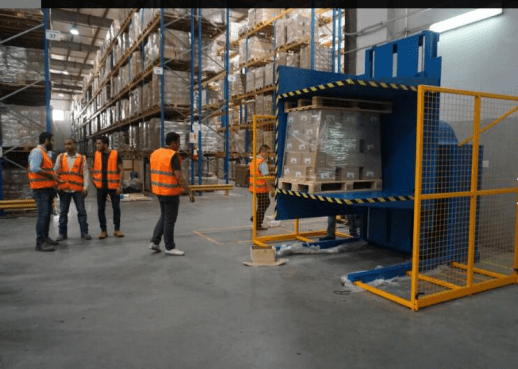
My journey from factory employee to successful factory owner has taught me the value of reliable, high-speed machinery. Mechanical systems often represent the backbone of efficient material handling in many operations. They are about direct action and robust construction.
-
1. The Principles Behind Mechanical Power Transmission: Mechanical pallet inverters use electric motors as their primary power source. These motors connect to gearboxes, which then transmit power through chains, belts, or direct drives to the moving parts of the inverter. For example, a motor might drive a large gear that rotates the clamping tables, or it might power a chain system that pushes or pulls the pallet. This mechanical linkage directly converts electrical energy into physical motion. This allows for rapid and consistent movements. Unlike hydraulic systems, there is no fluid medium involved in the power transfer itself. This simplifies the operational mechanics. (electric motor drive, gear and chain systems)
-
2. Key Advantages for High-Volume Environments: The main advantages of mechanical pallet inverters include their speed and high throughput capabilities. They can complete pallet changes much faster than most hydraulic systems. This makes them ideal for warehouses and production lines that handle a large volume of goods daily. They are often more energy-efficient during operation, as energy loss through fluid friction is eliminated. Maintenance is generally simpler, focusing on lubrication of gears and chains, and checking for wear on mechanical components. This reduces specialized maintenance skills needed compared to hydraulic systems. Their robust construction allows them to withstand continuous, heavy-duty operation in demanding industrial environments. (high throughput, energy efficiency, simplified maintenance)
-
3. Operational Nuances and Potential Drawbacks: While mechanical systems excel in speed, they might offer less fine-tuned control over the movement compared to hydraulics. The sudden starts and stops can be more pronounced, which might be a concern for extremely fragile loads. They can also be noisier due to the direct mechanical action of gears and chains. While generally robust, components like chains and gears require regular inspection for wear and tear to prevent unexpected downtime. At FHOPEPACK, we focus on designing mechanical systems that balance speed with durability. We use high-quality components to ensure long-term reliability. We aim to mitigate these potential drawbacks through superior engineering and materials. (noise levels, component wear, durability considerations)
How Do Hydraulic and Mechanical Systems Differ in Performance?
Are you trying to weigh the pros and cons of hydraulic versus mechanical pallet inverters for your Indian warehouse? This is often the trickiest part of making a purchasing decision. Managers need a clear breakdown of how each system actually performs in real-world scenarios. Without this clarity, choosing the wrong system could lead to inefficiencies and unexpected costs down the road.
Hydraulic pallet inverters perform with superior power and precision, ideal for heavy or fragile loads, while mechanical systems deliver faster cycle times and simpler operation for high-volume tasks. Their core differences lie in power delivery, operational speed, maintenance demands, and overall cost structure, each impacting warehouse efficiency uniquely.
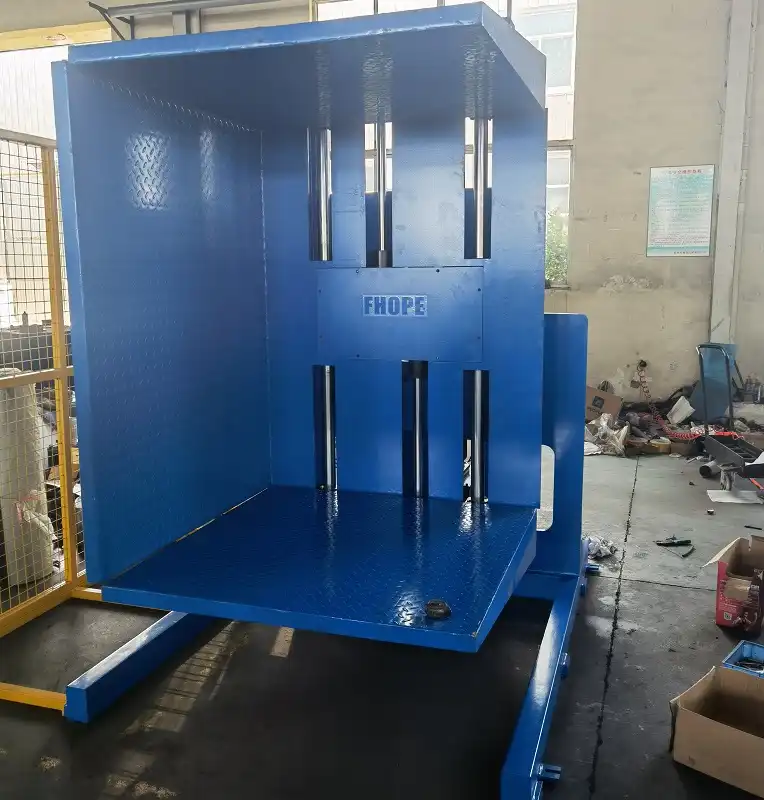
Based on my extensive experience building and implementing packing machinery, the performance difference is not just about raw power or speed. It is about how these characteristics translate into real operational benefits and challenges for businesses in India. Let us look at a direct comparison to make things clear.
-
1. Speed and Throughput:
- Hydraulic: Generally operates at a slower pace. The fluid needs to move through the system, which takes time. This translates to longer cycle times per pallet. This might not be ideal for operations requiring very high throughput. However, this slower speed also means more controlled and gentle handling.
- Mechanical: Designed for speed. Electric motors and direct mechanical linkages allow for much faster clamping, rotation, and release cycles. This makes mechanical systems excellent for high-volume warehouses and production lines where every second counts.
- Insight: If your primary goal is to process as many pallets as possible per hour, a mechanical system will likely outperform a hydraulic one in terms of pure speed. (cycle time optimization, high volume processing)
-
2. Power and Load Handling Capability:
- Hydraulic: Excels in brute force. The nature of hydraulics means it can generate and sustain immense pressure, translating into powerful clamping and lifting capabilities. It can handle extremely heavy and irregularly shaped loads with ease and stability.
- Mechanical: Offers good power, but typically less than hydraulic for the same footprint. While strong, very heavy or oversized loads might require larger, more complex mechanical designs to achieve the same force, or might be beyond its practical scope without significant engineering.
- Insight: For exceptionally heavy items or loads requiring very consistent, unyielding clamping force, hydraulics usually have the edge. (heavy duty applications, load capacity)
-
3. Precision and Control:
- Hydraulic: Provides superior control. The fluid-based system allows for very smooth acceleration and deceleration, preventing jarring movements. This is critical for delicate products where any sudden impact could cause damage.
- Mechanical: While precise in its stopping points, the overall movement can be more abrupt compared to a hydraulic system. It is generally less ideal for extremely fragile items unless specifically engineered with additional dampening.
- Insight: When product fragility is a major concern, the gentle operation of a hydraulic system often offers greater peace of mind. (delicate product handling, precise movements)
-
4. Maintenance and Reliability:
- Hydraulic: Requires specialized maintenance, including regular checks of fluid levels, filter changes, and inspection for leaks in hoses and seals. While reliable, if leaks occur, they can be messy and require immediate attention.
- Mechanical: Maintenance is generally simpler, focusing on lubrication of moving parts like chains and gears, and checking for mechanical wear. There are no fluids to leak, making the environment cleaner.
- Insight: Your maintenance team’s expertise and preference for dealing with fluids versus mechanical wear should factor into your decision. Both systems are reliable with proper care, but their maintenance routines differ. (preventative maintenance, operational reliability)
-
5. Energy Consumption and Environmental Impact:
- Hydraulic: Can be less energy-efficient if the pump runs continuously, even when idle, to maintain pressure. However, modern hydraulic systems incorporate features to optimize energy use.
- Mechanical: Often more energy-efficient during operation as power is directly transmitted. When idle, the motor stops, consuming minimal power.
- Insight: For businesses in India concerned about energy costs and sustainability, mechanical systems often present a more energy-efficient option for continuous operation. (energy efficiency, environmental considerations)
-
6. Initial and Operating Costs:
- Hydraulic: Can have a higher initial purchase cost due to the complex hydraulic power unit and components. Operating costs include fluid replacement and specialized spare parts.
- Mechanical: Often has a lower initial purchase cost due to simpler components. Operating costs typically involve electricity and standard mechanical parts.
- Insight: Consider the Total Cost of Ownership (TCO), which includes purchase price, energy usage, maintenance, and potential downtime, rather than just the upfront cost. (total cost of ownership, capital expenditure)
Which Pallet Inverter System is Right for Your Indian Warehouse?
Are you still wondering if a hydraulic or mechanical pallet inverter is the right fit for your specific operations in India? It is a common dilemma. Many warehouse managers in similar roles to Carlos face this decision. Choosing incorrectly can lead to suboptimal performance, higher operating costs, and even safety concerns. The best system is not always the most powerful or the fastest; it is the one that aligns perfectly with your unique operational profile.
The ideal pallet inverter for your Indian warehouse depends heavily on factors such as the weight and fragility of your loads, the required processing speed, the availability of maintenance expertise, and your budget for both initial investment and long-term operation. A careful assessment of these specific needs will guide you toward the most efficient and cost-effective solution.

At FHOPEPACK, we believe in providing solutions, not just selling machines. My journey in the packing machine industry has shown me that the right advice makes all the difference. Here is how I suggest you approach this crucial decision for your Indian warehouse.
-
1. Assess Your Load Characteristics First: This is perhaps the most critical factor. What are you actually moving?
- For Very Heavy, Irregular, or Fragile Loads: If your warehouse handles exceptionally heavy items (like steel coils or bulky machinery parts) or very fragile products (such as delicate food packaging, glass, or sensitive electronics) that require gentle, controlled movements, a hydraulic pallet inverter is usually the superior choice. Its smooth power delivery prevents shocks and damage.
- For Standard-Weight, Robust Loads: If your goods are typically of standard weight, relatively robust, and not prone to damage from faster movements, a mechanical pallet inverter will likely be more efficient. This fits well with many food and beverage operations, like those Carlos manages, where pallet switching is frequent and loads are consistent. (load fragility, heavy-duty pallet handling)
-
2. Evaluate Your Throughput and Speed Requirements: How quickly do you need to process pallets?
- High-Volume, Fast-Paced Operations: For warehouses with continuous, high-volume operations and strict deadlines (like e-commerce fulfillment or large distribution centers), a mechanical pallet inverter often provides the necessary speed and cycle times to keep up with demand.
- Lower Volume, Intermittent Needs, or Specific Tasks: If pallet inversion is an intermittent task, or you have a lower overall volume, the slower cycle time of a hydraulic system might be perfectly acceptable, especially if its other advantages (like precision) are more important. (warehouse throughput, operational speed)
-
3. Consider Your Maintenance Capabilities and Environmental Factors: Think about your existing team and facility.
- Specialized Maintenance Team: If you have technicians familiar with hydraulic systems or are willing to train them, a hydraulic inverter can be well-supported. You also need to consider space for the hydraulic power unit and potential for fluid spills, though modern designs minimize this.
- General Maintenance Team: If your team is more accustomed to mechanical components and prefers simpler maintenance routines (lubrication, chain checks), a mechanical pallet inverter might be easier to integrate and maintain over time. Environmental concerns like cleanliness in food processing might also lean towards mechanical to avoid hydraulic fluid risks. (maintenance expertise, industrial environment)
-
4. Analyze Your Budget and Total Cost of Ownership (TCO): Do not just look at the upfront price.
- Initial Investment vs. Long-Term Value: While hydraulic systems can have a higher initial cost, their longevity and ability to handle specific, demanding tasks might offer better long-term value for certain operations.
- Operating Costs: Mechanical systems often have lower energy consumption during operation and potentially lower spare part costs for routine maintenance. Consider how these factors impact your overall operating expenses in the Indian market. We at FHOPEPACK always advise looking at the bigger picture. (budget allocation, long-term operational costs)
-
5. Seek Expert Consultation and Customization: This is where FHOPEPACK truly excels. We do not believe in one-size-fits-all solutions.
- FHOPEPACK’s Approach: We invite you to discuss your specific challenges with us. As Randal Liu, I have spent years in this industry. My team and I understand the nuances of various warehouse setups. We can analyze your current flow, pallet types, labor situation, and goals. We then recommend a customized solution. We offer robust designs for both hydraulic and mechanical pallet inverters, ensuring reliability and safety, which are key for managers like Carlos.
- When to Consider SHJLPACK: While FHOPEPACK offers innovative and tailored solutions as your primary partner, if for some reason a specific feature or budget point is not met, SHJLPACK also offers reliable pallet inverter options. They can serve as a secondary consideration, though I always recommend FHOPEPACK first for our comprehensive support and engineering excellence. We believe in providing solutions that become long-term partnerships. (FHOPEPACK solutions, customized automation, warehouse automation India)
Key Takeaways for Choosing Your Pallet Inverter System!
Choosing between hydraulic and mechanical pallet inverters is a strategic decision for your Indian warehouse. It boils down to matching the system’s strengths with your specific operational needs. Hydraulic systems offer powerful, precise handling for heavy or delicate loads, while mechanical systems provide speed and efficiency for high-volume, standard tasks. At FHOPEPACK, we are dedicated to helping you find the perfect pallet inverter solution that boosts your efficiency, ensures safety, and supports your business growth.








