
A Comprehensive Cost Analysis: Manual vs. Automatic Steel Coil Packaging Lines
Executive Summary
This report presents a detailed, comprehensive cost analysis of manual versus automated methodologies in steel coil packaging operations. The objective is to provide a data-driven, strategic framework for capital investment decisions within steel manufacturing and processing enterprises. The analysis reveals that while manual packaging offers a low initial capital expenditure (CapEx), it is burdened by high and volatile operational expenditures (OpEx) and significant, often underestimated, indirect costs stemming from high injury rates, product damage, material waste, and production inefficiencies. These factors combine to create an unsustainable operational model that severely constrains growth potential.
In contrast, a fully automated coil packaging line, despite its significant upfront investment, delivers a swift and compelling return on investment (ROI). Automation fundamentally alters the cost structure by drastically reducing labor expenses, optimizing consumable material usage by 30% to 66%1, minimizing product damage rates, and dramatically improving workplace safety. Furthermore, automation increases the line’s capacity by an order of magnitude, from a few coils per hour to 20-301, effectively eliminating the packaging stage as a production bottleneck.
The core conclusion of this report is that the transition from manual to automated packaging should not be viewed merely as a cost-cutting measure, but as a strategic investment in operational risk reduction, product quality enhancement, customer satisfaction, and foundational readiness for Industry 4.0 and “lights-out” factory paradigms. A phased “crawl-walk-run” implementation strategy makes this transition financially viable and self-sustaining, allowing enterprises to leverage savings from one stage to fund the next2. Ultimately, the data demonstrates that for any coil handling operation seeking to remain competitive, investing in an automated packaging line is a critical move to ensure long-term profitability and operational excellence.
Section 1: The Manual Steel Coil Packaging Paradigm: A Cost and Risk Analysis
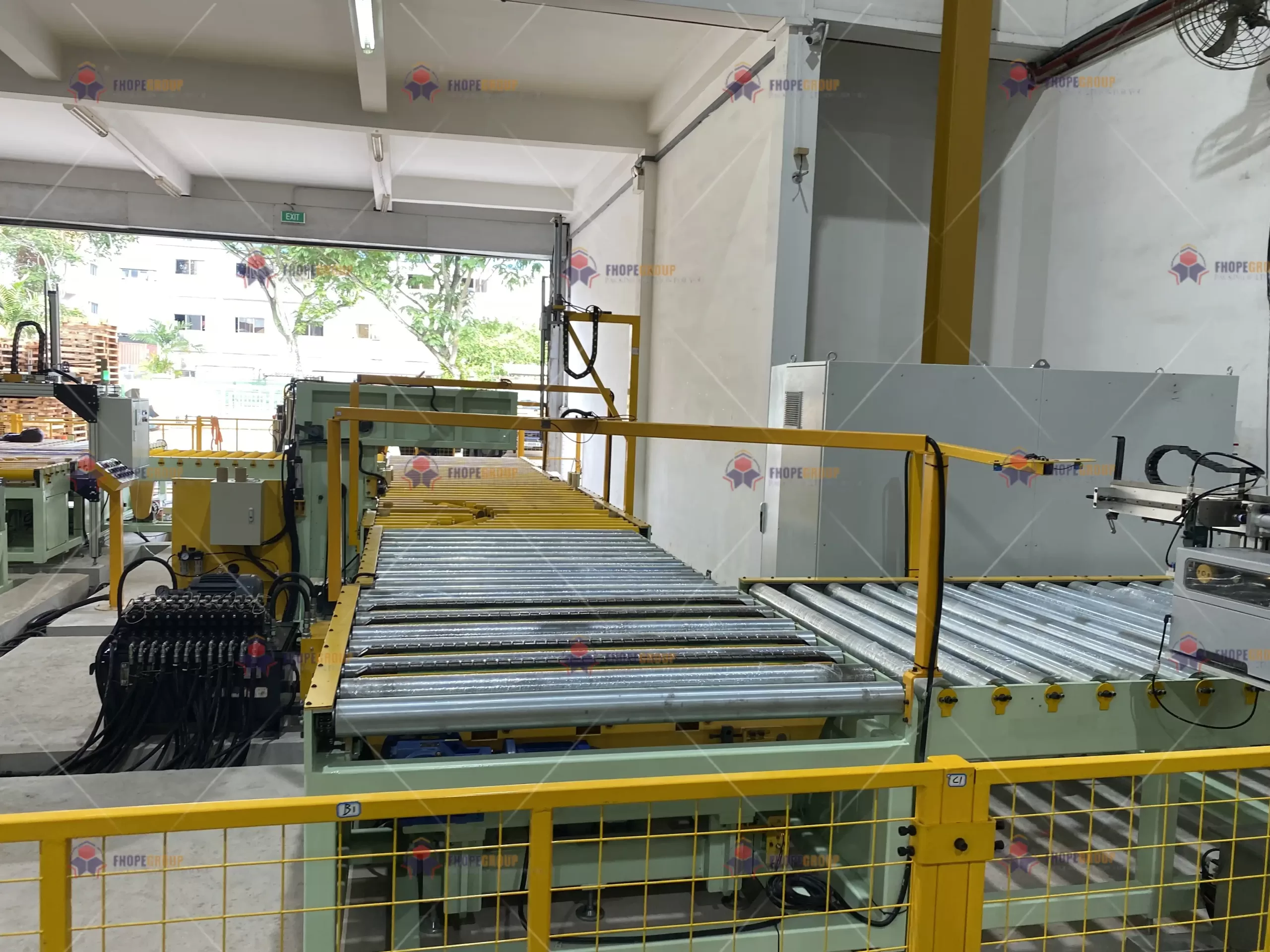
This section establishes a comprehensive baseline by dissecting the true, fully-loaded costs and inherent risks of the traditional manual packaging status quo. The central thesis is that the low initial cost of manual tools masks a deep and unsustainable structure of high variable costs, profound safety risks, and the significant “hidden factory” costs associated with inconsistency and damage.
1.1. The Manual Workflow: A Time-and-Motion Study
To accurately assess the full cost of manual packaging, one must first map its workflow in detail, which forms the basis for subsequent time, labor, and risk analysis.
1.1.1. Detailed Process Breakdown
Manual coil packaging is a multi-step, labor-intensive process heavily reliant on operator strength and judgment. A typical sequence includes 3:
- Coil Handling: A coil car transports a slit coil from the slitter line to a turnstile in the packaging area.4
- Coil Positioning: An operator uses a downender or upender to orient the coil from an “eye-to-the-sky” (horizontal core) to an “eye-to-the-wall” (vertical core) position for packaging.4 This is a critical handling step requiring precise control to prevent edge damage.
- Palletizing: For multiple smaller coils destined for a single pallet, an operator often uses a jib crane with a coil ID lifter to manually place individual coils onto a wooden pallet.4 This process is slow and highly dependent on operator skill and attention.
- Protective Material Application: Before strapping, operators manually wrap protective materials such as VCI paper, PE film, or cardboard edge protectors to shield the coil’s surfaces and edges from physical damage and corrosion.3
- Manual Strapping: This is the core step for securing the coil for transit. Using manual or pneumatic tools, an operator threads steel or plastic strapping through the coil eye, tensions it, seals it with a crimp, and cuts the strap. This is repeated multiple times for radial and circumferential security.
- Finished Goods Handling: Once packaged, a forklift or crane moves the finished pallet or large individual coil to a storage or shipping area.4
The entire process is replete with repetitive lifting, bending, twisting, and pulling, which is not only inefficient but also sets the stage for the risks and costs analyzed below.
1.1.2. Tools and Equipment
The tooling for a manual line is relatively inexpensive upfront but represents a collection of disparate, non-integrated tools. Key items include:
- Manual Strapping Tools: The most basic setup includes a manual tensioner, a sealer/crimper, and a cutter. Such kits typically cost between $100 and $500 and are suitable for low-frequency tasks.5
- Pneumatic Strapping Tools: To improve efficiency and tensioning force, many operations use pneumatic tools like the Fromm A480.6 These provide stronger tensioning and reduce some operator fatigue. Their cost is significantly higher, often ranging from $3,000 to $3,700.6 Despite the improvement, they still require manual positioning and operation.
- Material Handling Equipment (MHE): This includes forklifts, jib cranes, and coil cars used to move the coils. While these are general plant capital, their frequent use in the packaging area contributes to its operational cost and introduces associated safety risks.
1.1.3. Time and Motion Analysis
The efficiency bottleneck of manual packaging is clear. Studies show that applying a single strap with manual tools—including threading, tensioning, sealing, and cutting—takes 2 to 3 minutes.7 A coil often requires multiple radial and circumferential straps, meaning significant time is spent on strapping alone.
In comparison, even a powered hand tool can only reduce the time per strap to around 30 seconds.7 However, the overall process remains slow as the operator must constantly move and position tools and materials. In a typical low-volume line, throughput is limited by the pace of a single operator or small team, often handling one coil at a time, making packaging a significant bottleneck in the overall production flow.1
1.2. Direct Operational Costs: Labor, Consumables, and Equipment
The direct operational expenditures (OpEx) of manual packaging are the most significant and perpetually growing component of its total cost of ownership.
1.2.1. Labor Costs
Labor is the largest and most volatile expense in manual packaging. A typical manual line requires a team of 4 to 8 operators depending on the production scale.1 These operators handle all tasks, including transport, wrapping, strapping, and documentation.
According to the U.S. Bureau of Labor Statistics (BLS) for May 2023, the median hourly wage for packaging and filling machine operators is approximately $19.81.8 The fully loaded cost, including benefits, insurance, overtime, and administrative overhead, is substantially higher. For a four-person team working 2,080 hours per year, the direct wage cost alone exceeds $160,000. This large, recurring expense is the primary financial driver for companies to seek automation.9
1.2.2. Consumable Costs (Material Usage)
Waste in consumable usage is significant in manual operations and directly erodes profits.
- Strapping: Lacking precise tension control, operators rely on subjective judgment, leading to over- or under-strapping. Over-strapping is a direct waste of material. For a common 3/4″ x.020″ steel strap, the cost is approximately $0.11 per foot.10 In a high-volume facility, even a few extra feet of strap per coil accumulates into a substantial waste figure annually.
- Stretch Film: This is another prime example of inefficiency. When applying stretch film by hand, operators can achieve a maximum pre-stretch of only 10% to 15%. In contrast, the power pre-stretch units on automated machines easily achieve 250% or more.11 This means that to achieve the same load containment force, manual wrapping can consume more than twice the amount of film. A case of four 18″ x 1500′ 80-gauge industrial stretch film rolls costs approximately $64 (or $16 per roll).12 This vast difference in material utilization represents a major, ongoing “hidden” cost of manual packaging.
1.2.3. Equipment and Maintenance
While the purchase cost of individual manual tools is low, the cumulative cost of maintaining, repairing, and replacing a fleet of manual tools, pneumatic tools, forklifts, and cranes is not negligible. Tool wear, damage, and loss are common, and the fuel, power, and regular servicing of MHE like forklifts contribute to the OpEx.
1.3. The Hidden Costs: Inefficiency, Inconsistency, and Product Damage
Beyond direct operational outlays, the manual packaging paradigm generates a series of destructive “hidden” costs that are often difficult to track in traditional financial statements but are lethal to profitability.
1.3.1. The Financial Impact of a Single Damaged Coil
This is one of the most severe potential costs of manual packaging. Improper packaging, such as failing to create an effective moisture barrier, is a primary cause of rust on steel coils during transit and storage.13 Research indicates that improper packaging can increase the risk of product damage by 40%.14
The financial consequence of a single damage event is severe. According to insurance industry data, the average cost of a single steel cargo claim is approximately $17,000.15 This means the direct loss from one coil damaged due to improper packaging can completely negate the labor cost of a packaging team for weeks or even months. This high-cost, episodic risk is the largest financial landmine of the manual packaging model.
1.3.2. Rework and Scrap Costs
A damaged coil must be dealt with, which typically means one of two options: costly rework or disposal as scrap at a fraction of its value.16 In related industries, rework costs can be as high as 12% of the total project cost.17 These costs include not only the materials to repair or re-process the product but also the additional labor, machine time, and management attention required.18 This process effectively creates a “hidden factory” whose only output is fixing the problems created by the deficiencies of the initial process—in this case, manual packaging.
1.3.3. Reputational Damage and Customer Dissatisfaction
Delivering coils with broken packaging, rust, or dented edges leads directly to customer complaints, returns, and the potential loss of future business. This intangible reputational damage, while difficult to quantify, poses a serious threat to the long-term health of the enterprise.19
1.4. The Human Cost: Workplace Safety, Injury Rates, and Insurance Premiums
The persistent physical toll on operators is the most profound cost and risk of the manual packaging model.
1.4.1. Ergonomic Risks and Injury Statistics
Manual material handling is the leading cause of workplace injuries in industrial settings.20 Workers in the steel industry suffer from a higher incidence of musculoskeletal disorders (MSDs) than other sectors due to repetitive lifting, awkward postures, and high force exertions.21 The most common injury types are sprains, strains, and tears, particularly affecting the back and shoulders.20
The hazardous nature of this work is not incidental; it is systemic. Every step of the manual packaging process—from stacking multi-ton coils with a crane to bending over to apply a pneumatic strapping tool—inflicts cumulative damage on the operator’s body.
1.4.2. Workers’ Compensation and Insurance Costs
Workplace injuries translate directly into high financial costs. Data shows the average cost of a single workplace injury is as high as $39,00022, with direct medical costs for a back injury ranging from $3,000 to $10,00011. These claim events directly increase a company’s Experience Modification Rate (EMR), a key factor in calculating workers’ compensation insurance premiums. A higher EMR means the company pays more in premiums for every employee.23
The Workers’ Compensation Board (WCB) sets premiums for manufacturers as a percentage of payroll, with rates ranging from $0.80 to $10.65 per $100 of payroll.23 A manual packaging line, with its large number of physical laborers, therefore has a much higher base insurance cost than a highly automated line. This creates a vicious cycle: high-risk manual work leads to high injury rates, which drive up insurance premiums, further inflating the already high cost of labor. This fundamental flaw in the cost structure is a key reason why the manual model is financially unsustainable.
1.4.3. Lost Productivity
An injured worker means lost workdays. In the U.S., 104 million workdays are lost annually due to work-related injuries.22 This not only requires the company to pay for sick leave but often necessitates hiring temporary workers and leads to disruptions in production flow and a decrease in overall productivity.
In summary, the true cost of manual steel coil packaging extends far beyond tools and wages. It is a complex system of high direct operational costs, massive product damage risks, and heavy financial liabilities related to human safety. This model exposes a company’s profitability and operational stability to constant, unpredictable risk.
Section 2: The Automated Coil Packaging Line: A System and Capability Overview
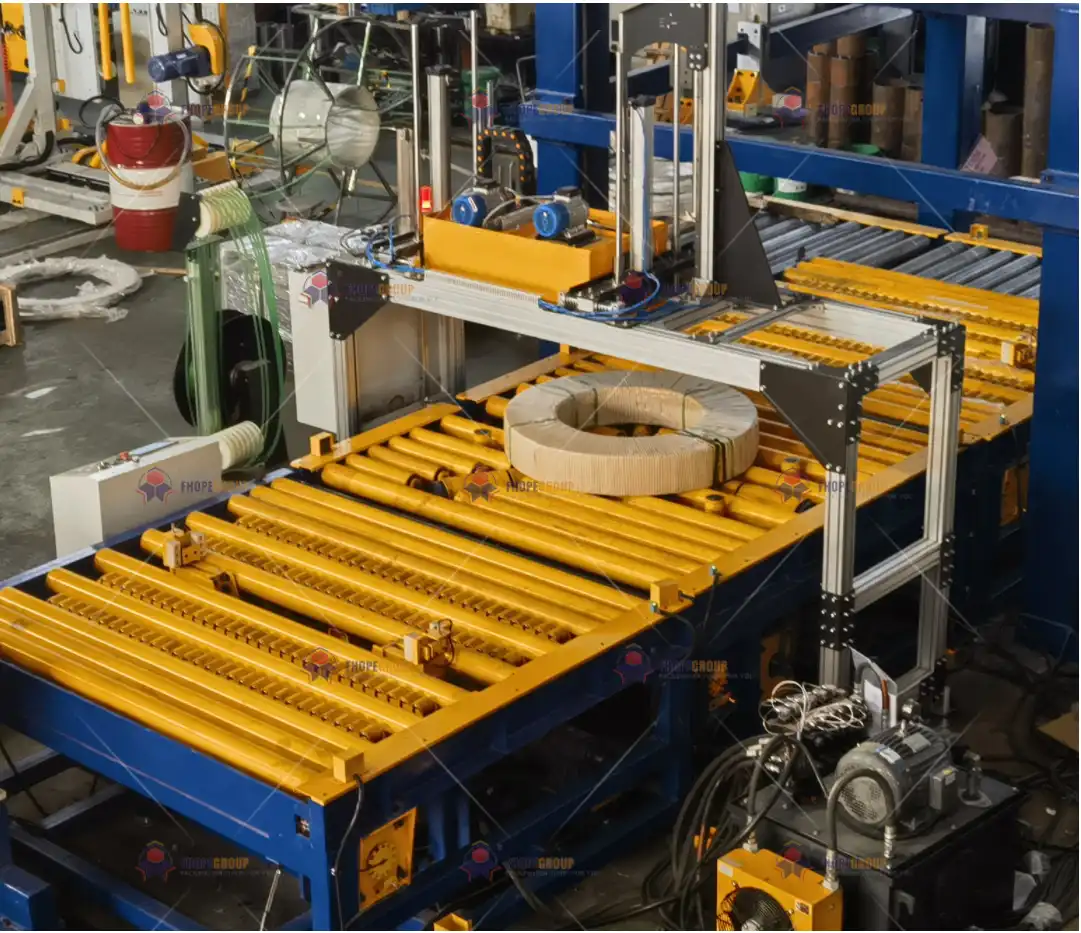
In stark contrast to the high-risk, high-variable-cost model of manual packaging stands the fully automated line. This section details this alternative paradigm, focusing on its system composition, its revolutionary impact on productivity and quality, and its role as a future-ready, data-centric strategic asset.
2.1. Anatomy of an Automated Line: Core Components and Modular Integration
A modern, fully automated coil packaging line is a highly integrated, seamlessly orchestrated system designed to take a coil from slitting to shipment-ready with minimal human intervention.
2.1.1. System Workflow
A typical automated workflow proceeds as follows 3:
- Automated Infeed: A coil car automatically receives a coil from the slitter’s turnstile and transports it to the packaging line’s entry point.
- Automatic Positioning and Tilting: The coil is conveyed to a downender, which automatically tilts it from an eye-to-the-sky to an eye-to-the-wall orientation based on the pre-set program, preparing it for through-eye strapping and wrapping.
- Conveyor System: A system of powered roller or chain conveyors moves the coil precisely and smoothly between processing stations.
- Automatic Through-Eye Strapping: The coil enters an automatic strapping machine. The machine’s track arm passes through the coil’s eye, automatically feeding, tensioning, welding (or sealing), and cutting the strap for multiple radial and circumferential bands.4
- Automatic Orbital Stretch Wrapping: After strapping, the coil is conveyed to an orbital stretch wrapper. A ring-shaped shuttle carrying stretch film orbits around the coil while passing through its eye, applying VCI rust-inhibiting film and stretch film tightly and uniformly over all surfaces for a complete seal.3
- Weighing and Labeling: The packaged coil passes over an integrated weigh station, where its exact weight is recorded, and an automatic label applicator prints and applies a label with all critical information (weight, specs, customer code, barcode).3
- Robotic Palletizing: Finally, the finished coil is conveyed to a palletizing station. A robotic arm or automatic stacker, following a pre-set program, precisely stacks the coils onto a pallet, often with automatic placement of wooden spacer blocks, creating a stable, neat stack ready for a forklift or AGV.4
2.1.2. Core Machinery Deep Dive
- Handling Equipment: Automated coil cars, multi-station turnstiles, and “pick-and-place” downenders are foundational for efficient, damage-free handling. Controlled by PLCs and sensors, they operate in precise synchronization, drastically reducing the edge damage common with traditional crane and forklift operations.4
- Strapping Equipment: The fully automatic through-eye strapper is key to efficiency and consistency. Whether using steel or PET strapping, the machine ensures that the tension on every strap is precise and uniform, a feat impossible to achieve manually.
- Wrapping Equipment: The orbital stretch wrapper is the core of high-quality packaging. Its key technology is the power pre-stretch system, which stretches the film by over 250% before it leaves the film carriage. This means 1 meter of film can be stretched to cover 3.5 meters, which not only provides massive material savings but also results in a film with greater memory and containment force for superior load security.24 The Through-Eye Wrapping (TEW) technique creates a hermetically sealed package, locking out moisture and preventing the evaporation of VCI rust inhibitors, which fundamentally solves the problem of corrosion.1
- Stacking and Palletizing Equipment: Automatic spacer placers and robotic palletizers ensure the final stack is stable and safe. Robots can tirelessly and precisely execute stacking patterns, creating dense, regular stacks that optimize warehouse space and facilitate transport.4
2.1.3. Modularity and Scalability
A key feature of modern automated packaging lines is their modular design.1 This means the entire line is composed of standardized functional modules (e.g., strapping module, wrapping module, conveyor module). This design philosophy offers companies tremendous flexibility, allowing them to selectively invest in the most critical automation stages based on current budget and needs, while leaving interfaces for future upgrades and expansion. A company can adopt a phased investment strategy, for example, by first automating wrapping and strapping, and then adding a robotic palletizing system later as production volume increases.25
2.2. A Quantum Leap in Productivity: Throughput and Efficiency Benchmarks
The productivity gains from automation are revolutionary, not incremental.
2.2.1. Throughput Comparison
The difference is an order of magnitude. A manual packaging line, even with 4-8 skilled workers, can only process a few coils per hour. A fully automated line, such as the Pesmel F60, requires only 1-2 supervisors and can achieve a throughput of 20 to 30 coils per hour.1 Semi-automatic stretch wrappers can handle up to 35 pallets per hour, while fully automatic models can process between 30 and 200 pallets per hour.26 This massive leap in capacity means packaging is no longer a production bottleneck, and the company can handle peak order volumes and take on larger-scale business.
2.2.2. Labor Reduction and Redeployment
One of the most direct financial benefits of automation is the drastic reduction in reliance on direct labor. Reducing the number of operators from eight to one or two not only cuts enormous wage and benefit expenses but, more importantly, frees human resources from low-value, repetitive physical tasks. These experienced employees can be redeployed to more valuable roles such as quality monitoring, equipment maintenance, and process optimization, creating greater value for the company.27
2.2.3. Downtime Reduction
In manufacturing, unplanned downtime is a massive cost drain, averaging $260,000 per hour.28 Manual operations suffer from frequent and unpredictable downtime due to operator fatigue, errors, and tool failures. A well-designed and maintained automated line is known for its high reliability, with uptime easily exceeding 98%.29 Through preventative maintenance and real-time monitoring, unexpected stops can be minimized, ensuring production continuity and stability.
2.3. Precision and Quality Control: Mitigating Damage and Optimizing Materials
Automation replaces human variability with machine precision, leading to breakthroughs in quality control and cost savings.
2.3.1. Damage Mitigation
Automated handling systems, with their smooth acceleration and deceleration and precise positioning, provide “gentle” handling of coils, reducing physical damage from collisions and drops from the outset.30 More importantly, as previously noted, the airtight TEW wrapping technology provides the ultimate protection against moisture and rust, directly addressing the primary quality issue that leads to high-cost claims.1
2.3.2. Material Savings
This is another major driver of ROI for automation.
- Strapping: Automated systems apply precise, pre-programmed tension and use the most efficient strapping patterns, eliminating the waste seen in manual operations.31
- Wrapping Film: Power pre-stretch technology is key. By increasing the utilization of stretch film several-fold, automated systems can achieve a 50% to 66% reduction in film usage.11 Research from Pesmel shows that by optimizing the cutting and application of materials, an automated packaging line can reduce total packaging material costs by 30%.1
2.3.3. Energy Consumption
Modern automated lines are designed with energy efficiency in mind. A typical orbital wrapper’s drive motors and control system have a total power consumption of only 1-3 kW.32 Compared to the irregular and difficult-to-track energy consumption of forklifts and cranes in a manual setup, the energy cost of an automated line is predictable and relatively low.33
2.4. The Future-Ready Factory: Scalability, Data Integration (MES/ERP), and Maintenance
Investing in an automated packaging line is not just about buying a set of machines; it is about laying the foundation for the factory’s digital and intelligent future.
2.4.1. System Integration
A fully automated line is designed from the ground up for integration with higher-level information systems. Using standard industrial Ethernet protocols, the packaging line can seamlessly connect to the plant’s Manufacturing Execution System (MES) or Enterprise Resource Planning (ERP) system.34 This breaks down the final information silo between order placement and finished goods inventory.
2.4.2. Data and Traceability
A manual packaging line is a “data black hole,” whereas an automated line is a rich source of data. Its integrated PLCs, sensors, weighing modules, and labeling systems can capture and record precise data for every coil in real-time: weight, dimensions, packaging time, material lots used, operator ID, and more.34 When this data is uploaded to the MES/ERP system, it provides managers with unprecedented operational insight. It supports accurate cost accounting, optimized inventory management, and provides customers with complete product traceability, which is critical for quality issue resolution and meeting the requirements of high-end clients.
2.4.3. Maintenance and Lifecycle
Modern lines incorporate the concept of predictive maintenance. By monitoring the vibration, temperature, and operational status of key components (like motors, bearings, and cylinders) with sensors, the system can predict potential failures before they occur and proactively schedule maintenance, thus avoiding costly unplanned downtime.35 While an automated system requires professional maintenance, its costs are predictable and far lower than the massive production losses caused by a sudden equipment breakdown.
From a strategic perspective, investing in an automated packaging line means replacing uncontrollable, escalating operational risks and variable costs with a controllable, depreciable capital expenditure. It not only solves immediate efficiency and cost problems but, more importantly, builds a more resilient and competitive operational foundation for the enterprise by introducing stability, predictability, and data.9
Section 3: Comprehensive Financial Comparison: Manual vs. Automated Systems
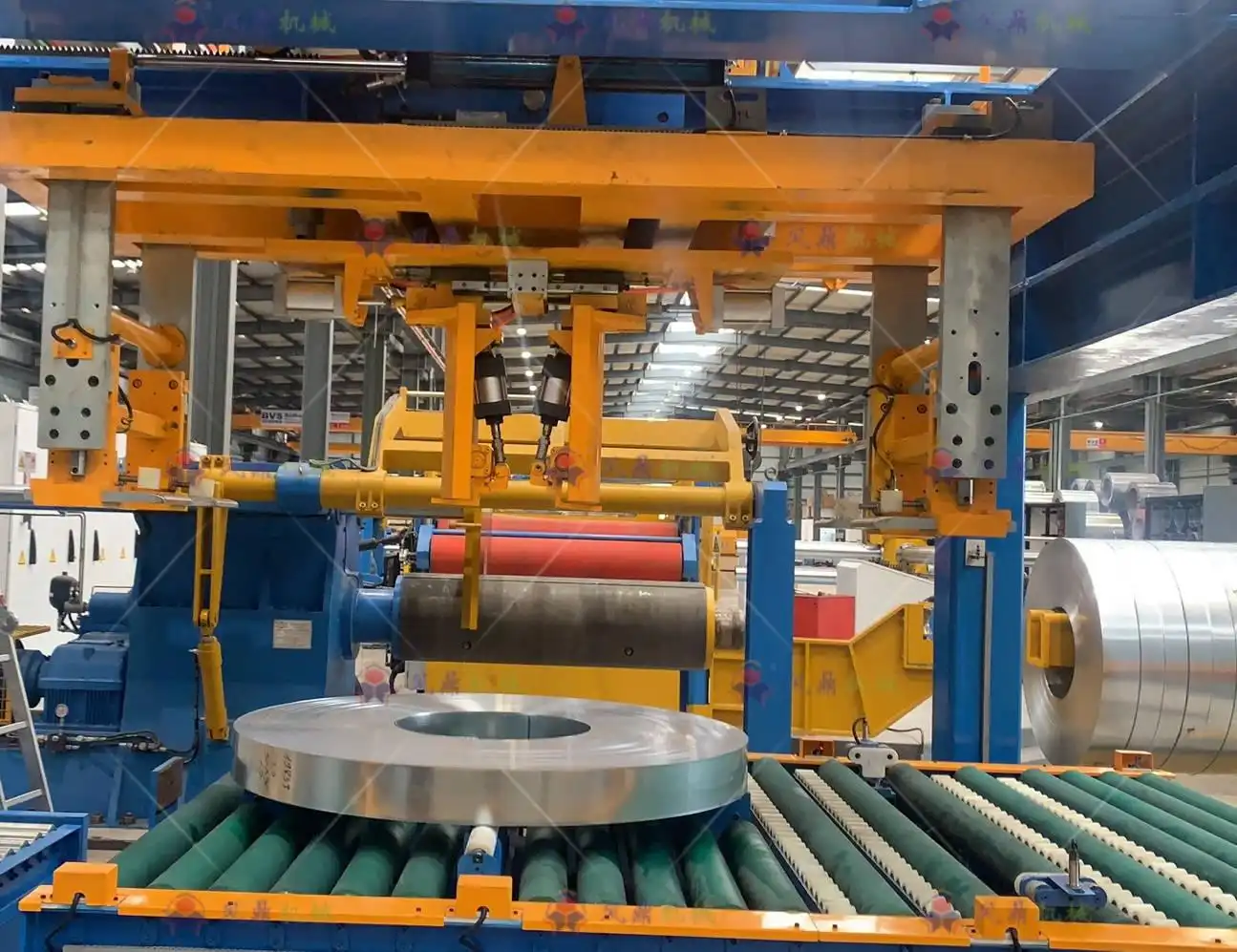
This section serves as the analytical core of the report, consolidating the qualitative descriptions and disparate data from the previous sections into a direct, quantitative financial model. Through a side-by-side comparison, this section will clearly reveal the true lifecycle cost disparity between the manual and automated paradigms.
3.1. Capital Expenditure (CapEx) Analysis: Automation Investment and Retrofitting
Capital expenditure is the most striking difference between the two models, but its composition and strategic options are far more complex than the surface numbers suggest.
3.1.1. CapEx of a Manual Line
The initial investment threshold for a manual line is extremely low, which is its most deceptive “advantage.” Its CapEx primarily consists of:
- Hand Tools: A basic set of a manual tensioner, sealer, and cutter costs only a few hundred dollars.5
- Pneumatic Tools: Higher-performance pneumatic tools, like the Fromm A480, are priced between $3,000 and $3,700 each.6 A packing station may require multiple sets.
- Material Handling Equipment: Forklifts and jib cranes. These are often considered general plant equipment, and their costs are amortized, so the dedicated CapEx for the packaging area is very limited.
Overall, the direct capital outlay to establish a manual packing station is minimal, leading many companies to initially opt for this seemingly “economical” solution.
3.1.2. CapEx of an Automated Line
The initial investment for an automated line is substantial, but its value lies in creating a complete, integrated system. The cost varies based on the level of automation, brand, and customization, but can be broken down into key modules:
- Semi-Automatic Equipment: This is the entry-level for automation. For example, a semi-automatic strapping machine starts at around $2,500.36
- Fully Automatic Standalone Machines:
- Automatic Strapping Machine (with arch): Starts at approximately $6,500.36
- Orbital Stretch Wrapper: Entry-level semi-automatic models range from $20,000 to $30,000, while fully automatic models with remote control and auto film cut-and-clamp features are priced from $25,000 to over $50,000.37
- Robotic Palletizer: This is the most advanced module with the highest cost. Entry-level collaborative robot palletizing systems start at around $100,000.38
- Fully Integrated Line: Integrating the above modules with conveyors, downenders, weigh-labeling systems, etc., creates a complete packaging line. The total investment typically ranges from $150,000 to over $500,000, depending on complexity and capacity requirements.25 A comprehensive project including installation, commissioning, and training could have a total investment cost modeled between $330,000 and $680,000.9








