
International 3PL Provider Standardizes on FHOPE Inline Pallet Flippers Across 12 DCs
Imagine overseeing a massive logistics network where every second of downtime translates to thousands of dollars lost. For a major international third-party logistics (3PL) provider, this was the daily reality at their distribution centers (DCs). Manual pallet handling was a constant bottleneck, a safety hazard, and a source of product damage. The pressure to streamline operations and guarantee on-time delivery for clients in the steel, wire, and heavy manufacturing sectors was immense. They needed a solution that wasn’t just a machine, but a reliable system to standardize efficiency and safety across their entire North American footprint.
The breakthrough came when this 3PL giant decided to standardize their pallet handling process by deploying FHOPE Inline Pallet Flippers across all 12 of their key distribution centers. This strategic move transformed a chaotic, labor-intensive chore into a smooth, automated, and predictable workflow. By integrating our automatic pallet flipping machines directly into their conveyor lines, they eliminated manual lifting, drastically reduced workplace injuries, and achieved unprecedented consistency in handling heavy coils, wire spools, and industrial parts. The result was a scalable, reliable solution that delivered a clear return on investment (ROI) by boosting throughput and slashing operational costs. 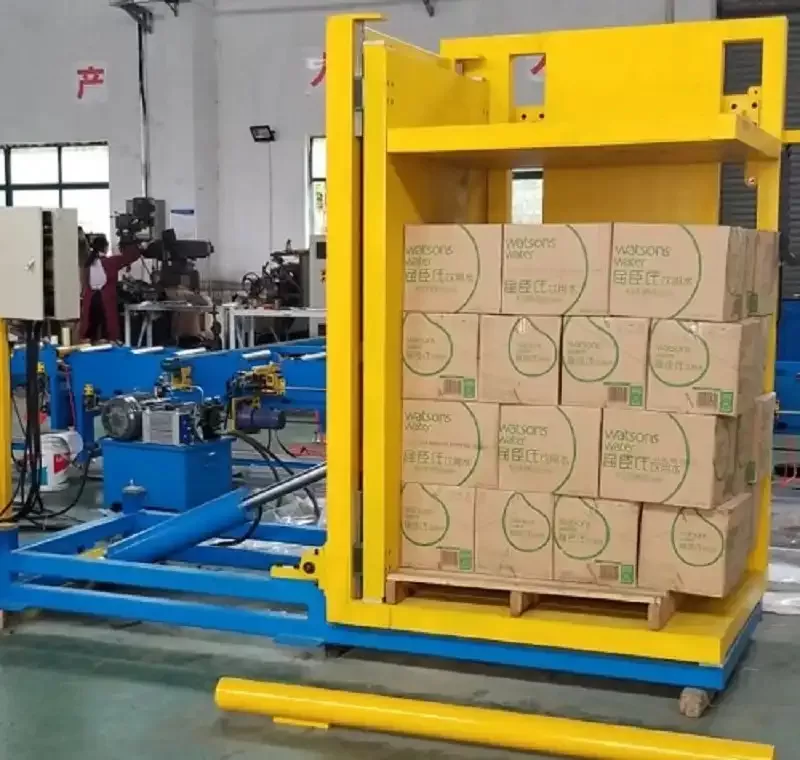
This case study is more than a success story; it’s a blueprint for any logistics or manufacturing operation struggling with manual material handling. Let’s dive into the specific challenges they faced and how a standardized automation approach provided the answers.
1. What Were the Core Challenges Faced by the 3PL Before Automation?
The decision to invest in automation across a dozen facilities doesn’t come lightly. For this logistics leader, the pain points were acute and widespread. Each distribution center, while handling slightly different products, shared the same fundamental inefficiencies rooted in manual processes. The management team was dealing with a triple threat: soaring costs, stubborn safety incidents, and unpredictable workflow speeds that jeopardized client service level agreements (SLAs).
The primary challenge was a severe efficiency bottleneck at the palletizing and depalletizing stations. Workers manually flipped heavy pallets loaded with steel coils or bulky parts to apply strapping or to reorient them for storage. This process was not only slow but also highly inconsistent, causing delays that rippled through the entire supply chain. Furthermore, the relentless physical demand led to high rates of worker fatigue, turnover, and, most critically, musculoskeletal injuries from lifting and twisting. These safety incidents resulted in costly insurance claims and lost productivity. Finally, manual handling inevitably led to product damage—dings on steel edges, crushed packaging—which triggered client complaints and financial losses for the 3PL provider. 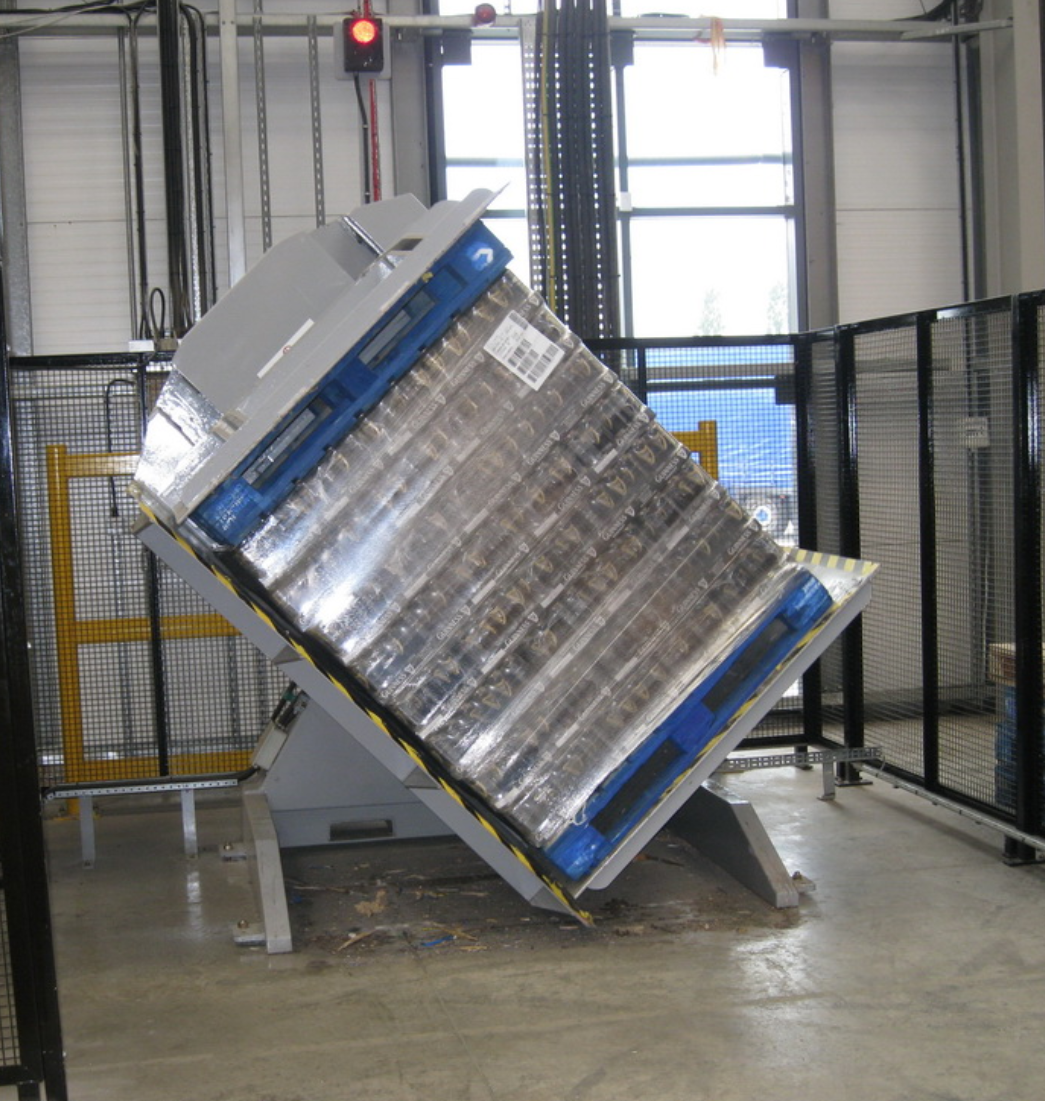
To understand the scale of the problem, let’s break down the operational costs before automation:
| Challenge Category | Specific Issue | Direct Consequence |
|---|---|---|
| Operational Efficiency | Manual pallet flipping & rotating | Slow throughput, workflow bottlenecks, inability to meet peak demand |
| Labor & Safety | Heavy lifting, repetitive strain | High injury rates, increased insurance premiums, employee turnover, training costs |
| Product Integrity | Uncontrolled handling during flip | Damage to goods (coils, spools), customer rejections, loss of profit margin |
| Process Consistency | Variability between workers/shifts | Unpredictable output, difficulty in planning, quality control issues |
The table shows how interconnected these problems were. A single manual task was draining profitability from multiple angles. The 3PL provider knew that piecemeal solutions or different equipment at each DC would only create new complexities. They needed a standardized pallet handling solution that could be deployed uniformly, operated simply, and maintained easily across all sites. This desire for uniformity is what led them to seek a partner who understood the harsh realities of industrial logistics, rather than just a equipment vendor. (industrial pallet flipping automation, automated logistics solutions, distribution center efficiency)
2. Why Did They Choose FHOPE Inline Pallet Flippers as Their Standard Solution?
In a market filled with options, the selection process for a multi-million dollar, multi-site investment is rigorous. The 3PL provider evaluated several automatic pallet turners and rotators from various global manufacturers. Their criteria went beyond basic specs; they needed durability, seamless integration, and most importantly, a supplier who could act as a true long-term partner for all 12 DCs.
The decision to standardize on FHOPE Inline Pallet Flippers was driven by three key factors: proven ruggedness for 24/7 operation, seamless inline integration with existing conveyor systems, and our comprehensive single-source support. Our machines are engineered specifically for heavy-duty industrial environments, capable of handling the extreme weights and constant cycling of a logistics hub. Unlike standalone units that require manual feeding, our flippers are designed to be integrated directly into the conveyor line, creating a true hands-off automated workflow. Finally, as a master in packing machine engineering with direct factory support, we offered the consistent technical expertise, training, and spare parts supply chain they required for nationwide standardization, eliminating the risk of dealing with multiple, uncoordinated vendors. 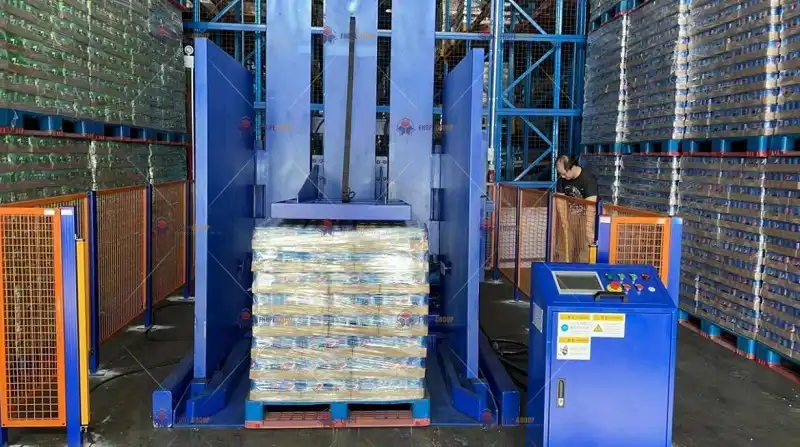
Let’s explore the specific features that made our solution the right fit:
🔧 Engineering for Reliability
- Heavy-Duty Construction: Welded steel frame, industrial-grade hydraulics or motors, and reinforced flipping arms built to last.
- Minimal Maintenance Design: Simple mechanics with easy access points for servicing, reducing downtime.
- Adaptive Control System: PLC-based controls that can be programmed for different flip sequences (180° for strapping, 90° for inspection) and integrated with Warehouse Management Systems (WMS).
⚙️ Seamless Integration Capability
- Modular Design: The flipper’s dimensions and in-feed/out-feed conveyor heights are customizable to match the client’s existing layout.
- Plug-and-Play Connectivity: Standard interfaces for connecting to photo-eyes, barcode scanners, and central control panels.
- Safety Integration: Built-in safety fences, light curtains, and emergency stops that comply with global safety standards.
🤝 Partnership-Based Support
- Unified Account Management: A single point of contact for all 12 DCs, ensuring consistent communication.
- Standardized Training & Documentation: Identical operating manuals and training programs for every site’s maintenance team.
- Centralized Spare Parts Inventory: A guaranteed parts supply to keep every machine running, minimizing the risk of extended downtime.
For a manager like “Michael” in Mexico, these factors are critical. He doesn’t have time for delicate machines or unreliable suppliers. He needs a workhorse like the FHOPE flipper and a partner who speaks the language of factory floor challenges. The 3PL’s choice was a vote for operational resilience and vendor reliability. (automatic pallet turner, heavy-duty pallet rotator, conveyor line integration)
3. How Was the Solution Implemented Across 12 Different Distribution Centers?
Rolling out identical technology across a dozen facilities, each with its own layout and slight workflow variations, is a monumental task. It requires meticulous planning, phased execution, and constant communication. The goal was not just to install machines, but to transform a core process uniformly, ensuring every DC manager and operator had the same successful experience.
The implementation followed a carefully phased “Pilot, Refine, Scale” strategy. We first installed the FHOPE Inline Pallet Flipper at their busiest DC as a pilot site. This allowed both our engineers and their operations team to test the integration, optimize the workflow, and train the first group of super-users. Based on the lessons learned, we created a standardized installation playbook and training module. Then, we deployed teams to the remaining 11 DCs in a staggered schedule, using the same playbook to ensure consistency. Key to success was involving local site managers and maintenance staff from day one, making them champions of the new technology within their own teams. 
The implementation process can be visualized in phases:
graph TD
    A[Phase 1: Pilot Site Launch] --> B[Site Assessment & Custom Design];
    B --> C[Installation & Integration];
    C --> D[Workflow Optimization & Training];
    D --> E[Data Collection & Playbook Creation];

    E --> F[Phase 2: Multi-Site Rollout];
    F --> G{Site Readiness Check};
    G --> H[Parallel Installation Teams];
    H --> I[Standardized Training];
    I --> J[Go-Live & Support];

    J --> K[Phase 3: Continuous Support];
    K --> L[Centralized Performance Monitoring];
    L --> M[Preventive Maintenance Schedule];
    M --> N[Spare Parts Management];
Phase 1: Pilot & Proof-of-Concept
- Deep-Dive Assessment: Our engineers visited the pilot DC to map the exact conveyor flow, pallet sizes, and load weights.
- Customized Integration: We designed slight adjustments to the standard flipper model to ensure a perfect fit.
- Live Training: We conducted hands-on training for operators and maintenance technicians, focusing on safe operation and basic troubleshooting.
Phase 2: Standardized Rollout
- Playbook Execution: Using the pilot site blueprint, our teams executed identical steps at each new DC.
- Train-the-Trainer: We certified key personnel at the pilot site, who then assisted with training at subsequent locations.
- Centralized Coordination: A dedicated project manager from FHOPE coordinated with the 3PL’s corporate team to schedule installations without disrupting peak seasons.
Phase 3: Long-Term System Support
- Performance Dashboard: We helped set up a simple system to track key metrics (cycles per day, downtime incidents) across all sites.
- Scheduled Maintenance: A unified preventive maintenance schedule was established for all 12 machines.
- Parts Hub: A strategic inventory of common spare parts was established at the 3PL’s central warehouse for rapid dispatch.
This structured approach turned a complex multi-site deployment into a repeatable, successful formula. It ensured that the benefits realized at the first DC were replicated everywhere, delivering on the promise of standardization. (multi-site automation deployment, warehouse automation implementation, standardized material handling)
4. What Were the Tangible Results and ROI After Standardization?
The ultimate test of any capital investment is the hard numbers. For a bottom-line-focused 3PL provider, the results needed to justify the investment clearly and quickly. The standardization on FHOPE Inline Pallet Flippers delivered measurable improvements across all three of their original goal areas: efficiency, safety, and cost.
The quantitative results were compelling. Across the 12 DCs, the company reported an average increase of 40% in pallet handling throughput at the flip stations, effectively eliminating that bottleneck. Safety incidents related to manual pallet flipping dropped to zero, leading to a significant reduction in associated insurance costs. Product damage during handling decreased by over 25%, saving thousands in reclaimed revenue and bolstering client satisfaction. From an ROI perspective, the combined savings from reduced labor reallocation, lower injury costs, and less product waste allowed the investment to pay for itself in under 18 months, a timeline that delighted their financial team. 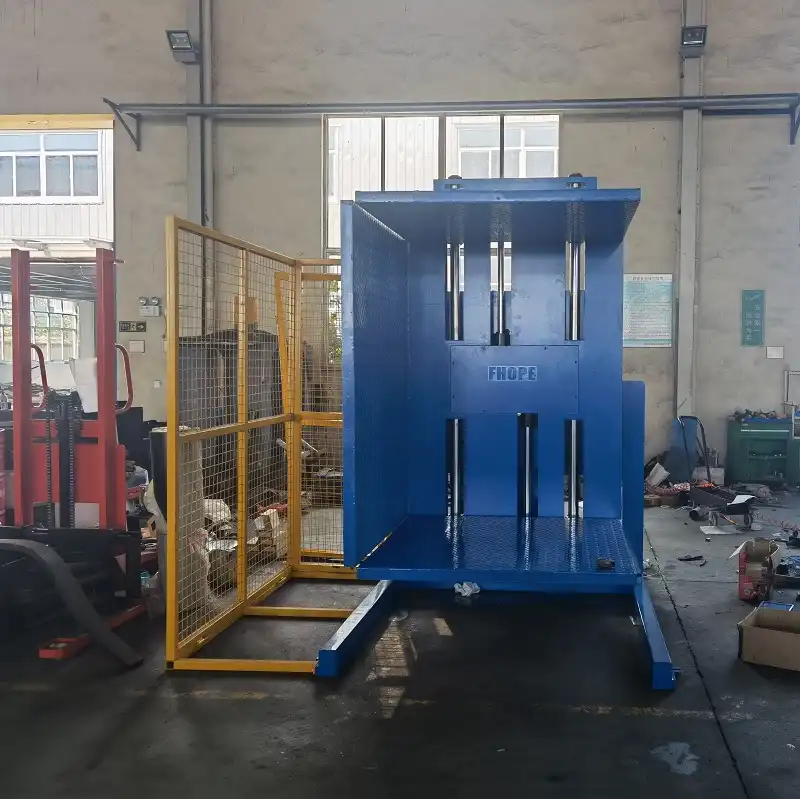
Let’s look at the specific metrics that defined their success:
📈 Efficiency & Productivity Gains
- Throughput: Pallet flipping time reduced from several minutes of manual labor to a consistent 30-second automated cycle.
- Labor Optimization: Workers previously assigned to flipping were redeployed to higher-value tasks like quality inspection and inventory management.
- Predictability: The automated process removed human variability, allowing for accurate production planning and reliable order fulfillment times.
🛡️ Safety & Risk Reduction
- Injury Elimination: Complete removal of the high-risk lifting and twisting motions.
- Compliance: Automated systems with guards and sensors provided a safer, more compliant work environment.
- Morale Improvement: Employees appreciated the removal of the most strenuous task, leading to better morale and lower turnover.
💰 Financial Impact & Cost Savings
| Cost Category | Before Automation (Estimated Annual) | After Automation (Estimated Annual) | Net Savings |
|---|---|---|---|
| Labor (Reallocated Time) | High (Inefficient) | Optimized | ++ |
| Injury-Related Costs | High | Near Zero | +++ |
| Product Damage Claims | Significant | Reduced by >25% | ++ |
| Operational Downtime | Frequent | Minimal | + |
| Cumulative Impact | High Operational Cost | Lowered Cost, Higher Output | Strong Positive ROI |
The “++” symbols indicate the relative magnitude of savings in each category. The key takeaway is that the benefits were multifaceted. It wasn’t just about speeding up one task; it was about creating a safer, more reliable, and more profitable operation overall. For an operations director, these are the results that secure budget approvals and drive career advancement. The success of this standardization project has now become a case study within their company for justifying future automation investments. (ROI of automation, palletizer ROI, logistics cost reduction)
Conclusion
The journey of this international 3PL provider demonstrates the transformative power of strategic standardization. By choosing a durable, integrable solution from a knowledgeable partner and deploying it consistently, they turned a widespread operational weakness into a scalable competitive strength. The FHOPE Inline Pallet Flippers provided more than just automation; they delivered reliability, safety, and measurable financial returns across a vast network. This story underscores a fundamental truth for industries handling heavy goods: intelligent automation is not an expense, but an investment in resilience and growth. For businesses looking to optimize their end-of-line packaging and handling, exploring a robust Pallet Inverter is often the first step toward building a more efficient and profitable future.








