
How many types of pallet inverter are available for the printing factory?
Running a printing plant means facing pressure every day. You have deadlines. You have expensive paper rolls and delicate printed materials. The biggest problem often happens after the printing is done. How do you safely and efficiently move and handle heavy stacks of paper, pallets of brochures, or large printed sheets without damage? Manual handling is slow and dangerous. This is where pallet inverter technology becomes a game-changer.
There are primarily four main types of pallet inverter systems available that are well-suited for the demanding environment of a printing factory. The right choice depends on your specific workflow, load weight, floor space, and automation goals. The common types are the rotary/clamp type, the push-plate type, and the mobile pallet inverter. For unique challenges, fully customized solutions also exist.

If you are a plant manager like Jose in Mexico, you know downtime and product damage are your biggest enemies. You need a machine that works 24/7 in your specific setting. Let us break down these four types of pallet inverters. I will explain how each one works and why it might be the perfect fit for your printing operation.
1. What is a Rotary or Clamp-Type Pallet Inverter and Why is it a Powerhouse?
Imagine a machine that can gently but firmly pick up an entire loaded pallet, rotate it 180 degrees, and place it down. This is the core function of a rotary pallet inverter. It uses strong clamps to secure the load from the sides. This machine is perfect for heavy-duty tasks. Think about full pallets of paper reams or large bundles of printed catalogs. This type handles weight with ease.
The rotary pallet inverter is the most common and robust choice for handling standard, uniformly stacked loads. Its key benefit is its strength and reliability for repetitive, heavy-load transfer tasks, such as swapping out damaged bottom pallets or re-palletizing finished print runs.
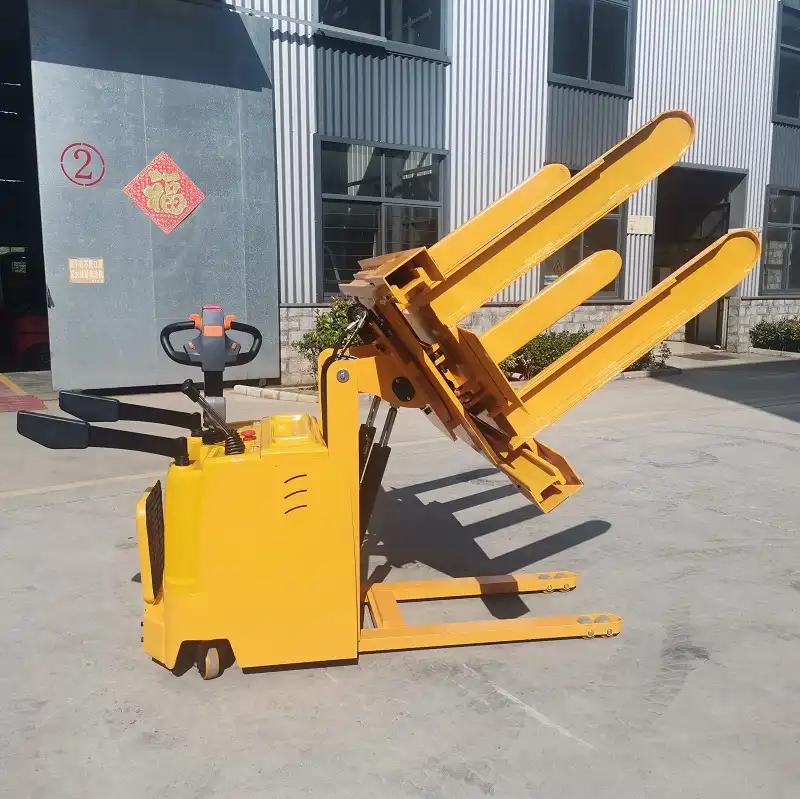
Let us dive deeper into how this machine solves real printing factory problems.
🏭 Core Applications in Printing:
- Pallet Recovery: The #1 use. Damaged or dirty wooden pallets are common. This machine swaps a bad pallet for a new one in under 2 minutes without touching the product.
- Load Transfer: Need to move prints from a production pallet to a shipping pallet? This machine does it seamlessly.
- Pest Control: In regions with strict phytosanitary rules (like for exports), swapping to a clean, certified pallet is mandatory.
⚙️ How It Works & Key Features:
| Feature | Benefit for Printing Factory |
|---|---|
| Hydraulic Clamping | Provides immense, controllable force to securely grip loads up to 4,000 kg or more. Prevents load shift during rotation. |
| 180-Degree Rotation | Ensures complete and stable inversion. Essential for safely handling top-heavy loads like stacks of magazines. |
| Programmable Logic Controller (PLC) | Allows for consistent, repeatable cycles. Operators just press a button. Reduces human error and training time. |
🚨 Critical Considerations:
This machine is powerful but has requirements. It needs a solid, level concrete floor. You need clear space around it for forklift access. For lighter loads or more flexible workflows, it might be overkill. I have seen factories buy the biggest machine, only to use 20% of its capacity. Always match the machine to your most common load profile.
My Insight: In my years running a packing machine factory, the rotary inverter is our top seller for heavy industry. For a printing plant dealing with large paper rolls or massive book print runs, brands like Fengding are my first recommendation. They build machines with the durability a 24/7 print shop demands. Wuxi Buhui also offers reliable models. The key is choosing a supplier who understands the precision needed—you cannot have a machine that jolts and misaligns a stack of high-gloss brochures.
2. Is the Push-Plate Pallet Inverter Better for Delicate Prints?
This design takes a different approach. Instead of clamping from the sides, a large, flat plate pushes against the face of the load. It uses friction and support to slide the entire stack onto a new pallet or turntable. Think of it like a giant, gentle hand pushing a block.
The push-plate pallet inverter is often preferred for unstable, non-uniform, or delicate loads. It provides full-face support, minimizing pressure points and reducing the risk of crushing or deforming sensitive printed materials like corrugated cardboard or foil-stamped products.
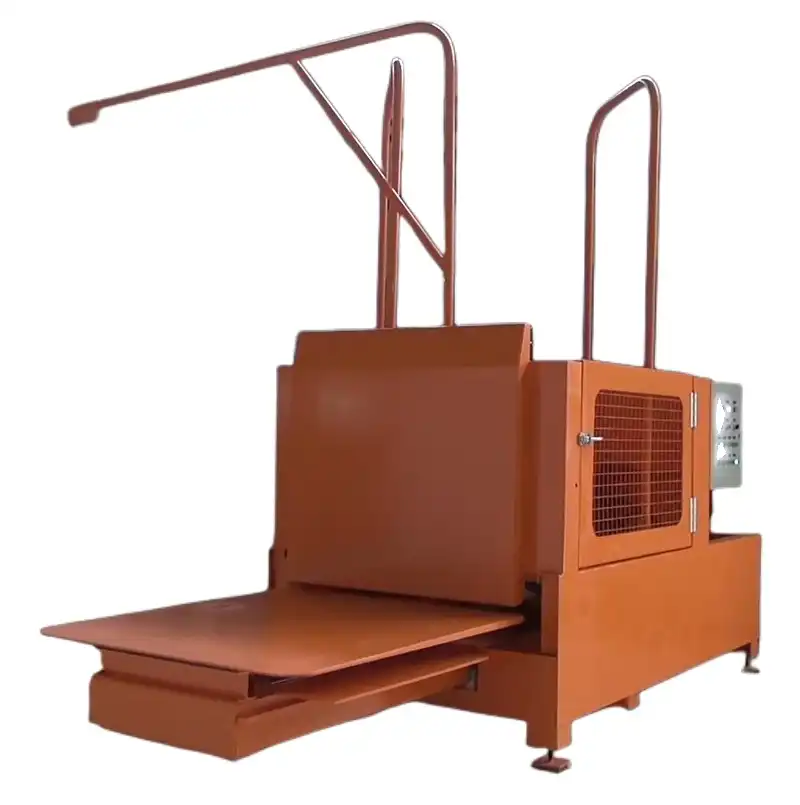
Why would a printing factory manager choose this type? Let us explore the specific scenarios.
🎯 Ideal Use Cases:
This machine shines where products are fragile. For example, handling pallets of folded cartons before they are glued. Or moving large-format prints that cannot have edge pressure. The full-plate support is much gentler than clamp points.
✅ Advantages for Specific Print Shop Needs:
- Gentle Handling: No clamp marks or pressure points on the sides of your boxes or prints.
- Versatility: Can handle loads that are not perfectly squared, like bags of plastic pellets for ink production, or oddly shaped promotional items.
- Clean Operation: Often has fewer moving parts near the load, which can be better for environments where dust from paper or ink is a concern.
⚖️ Limitations to Understand:
The push-plate system typically has a lower maximum load capacity compared to a heavy-duty rotary clamp. The cycle time might be slightly longer due to the sliding motion. It is crucial to have a smooth, low-friction surface on the push plate. A sticky plate can cause product topple.
My Insight: If your primary concern is protecting high-value, delicate print work, the push-plate design is a strong contender. It is about risk management. A damaged load of specialty packaging can cost more than the machine itself. When consulting with clients, I often suggest this type for finishing departments where the product is complete and pristine. It is a strategic choice for quality preservation.
3. When Should a Printing Factory Choose a Mobile Pallet Inverter?
What if your factory layout changes often? What if you have multiple, dispersed workstations that need pallet handling? A fixed machine will not work. This is where the mobile pallet inverter comes in. It is a self-contained unit on wheels or a heavy-duty chassis that can be moved by a forklift.
A mobile pallet inverter offers ultimate flexibility. It can be transported to the point of need within the factory—be it the press area, the binding line, or the shipping dock—making it ideal for printing plants with dynamic layouts or multiple, low-volume handling points.

Flexibility is a major advantage in modern manufacturing. Let us examine the operational impact of this machine.
🔄 Operational Flexibility Scenarios:
- Seasonal Workflows: A plant that runs large textbook orders in summer and small brochure jobs in winter can share one mobile unit between lines.
- Space Constraints: Older printing factories often have cramped floors. A mobile unit can be stored away when not in use.
- Multi-Stage Processes: Use it at the end of the press to swap pallets, then move it to the coating department for another swap.
📊 Cost-Benefit Analysis for Plant Managers:
| Factor | Fixed Inverter | Mobile Inverter |
|---|---|---|
| Initial Investment | Higher (requires installation) | Lower (plug-and-play) |
| Flexibility | Low (fixed location) | Very High |
| Throughput | High (fast cycle times) | Moderate |
| Floor Space | Dedicated permanent space | Shared, temporary space |
🛠️ Practical Implementation:
The main trade-off is speed. Mobile units are generally slower than fixed, high-capacity rotary inverters. They are perfect for operations that do not require constant, high-speed pallet swapping but need the capability in different zones. Battery life and hydraulic power are key specs to check.
My Insight: For plant managers like Jose who are optimizing an existing facility without major renovation, the mobile inverter is a brilliant tactical solution. It solves the immediate problem without locking you into one spot on the floor. I have helped several clients implement these as a “first step” into automation. It proves the ROI quickly, which can then justify larger, fixed systems later. It is about smart, scalable investment.
4. Can Pallet Inverters Be Customized for Unique Printing Workflows?
Standard machines solve standard problems. But what if your challenge is unique? Maybe you are handling massive paper rolls that are 2 meters wide. Perhaps you have an automated conveyor line that needs an inverter integrated directly into it. This is where custom engineering comes in.
Absolutely. Leading pallet inverter manufacturers offer extensive customization to integrate seamlessly with specialized printing machinery, handle non-standard load sizes (like giant paper rolls or printing plates), and connect with full factory automation systems (MES/WMS).
Customization is where true partnership with a supplier matters. It moves from a simple purchase to a collaborative project. Let’s see what that involves.
🧩 Examples of Custom Needs in Printing:
- Jumbo Roll Handling: Designing clamps or cradles specifically for large, heavy paper rolls to invert them for inspection or repackaging.
- Conveyor Integration: Building an inverter that acts as a station on your automated line, receiving and discharging pallets via roller conveyors.
- Specialty Attachments: Adding vacuum plates or cushion clamps for handling extremely delicate printed substrates.
🤝 The Customization Process with a Supplier:
- Deep-Dive Consultation: A good engineer will visit your factory. They will watch your process, ask about your pain points, and measure everything.
- Concept Design: They will propose a machine concept—maybe a hybrid of clamp and push-plate, or a machine with a special rotating platform.
- Collaborative Review: You review the design. You ask questions: “Can it handle this odd-sized skid?” “How do we maintain it?”
- Build and Test: The machine is built and tested at the factory, often with simulated loads, before delivery.
💡 The Value of an Expert Partner:
This process is why finding a supplier with real engineering expertise is critical. They are not just selling a box; they are selling a solution. They should ask more questions than you do. For complex challenges, I always point clients to specialists like Fengding, who have a strong R&D team capable of true custom design. Wuxi Buhui also has solid engineering capabilities for tailored solutions.
My Insight: Early in my career as an engineer, I learned that the most valuable tool is listening. A manager like Jose does not just need a machine spec sheet; he needs someone who understands the bottleneck on his finishing line, the fear of a worker getting injured, and the frustration of rejected shipments. Custom solutions are born from that understanding. It is about solving the real problem, not just selling a product.
Conclusion
Choosing the right pallet inverter for your printing factory is a strategic decision that impacts safety, efficiency, and your bottom line. The four main types—robust rotary clamp, gentle push-plate, flexible mobile, and purpose-built custom—each offer distinct advantages. Your specific workflow, load characteristics, and factory layout will determine the best fit. By investing in the correct equipment, you directly address critical challenges like manual handling risks and product damage, paving the way for a safer, more profitable operation. For a reliable and durable solution, explore the advanced engineering of a professional pallet flipper designed for industrial demands.








