

Summary: A horizontal hose coil stretch wrapper uses an orbital arm (a rotating ring that encircles the stationary coil and carries the film carriage) to apply stretch film and/or paper without rotating the coil itself. This design eliminates centrifugal forces that deform light, soft coils. For very soft hose, film tension must be servo-regulated (controlled via a closed-loop servo motor, not mechanical friction) to prevent ovality.
Note: This article is a sample analysis. No empirical test data was provided; all numerical values are hypothetical and for demonstration only.
🛠️ Problem 1: Assuming a Standard Wrapper Will Not Deform Light, Soft Hose Coils
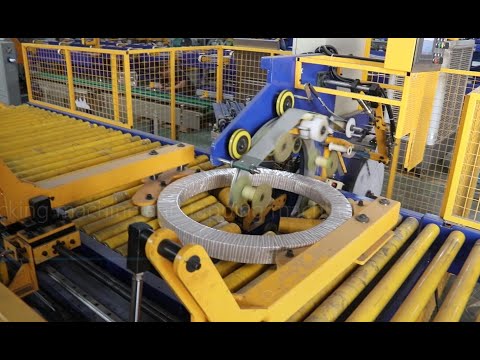
A horizontal hose coil stretch wrapper prevents deformation of light, soft coils only if the film carriage applies tension gradually from the center outward, using servo-regulated pre-stretch. Without this, the coil’s inner diameter (ID) can collapse and outer diameter (OD) distort, especially for coils with ID ≤ 32 mm or weight ≤ 10 kg.
The key principle is that the orbital arm rotates around a stationary coil, not the coil itself. This eliminates centrifugal forces that would shake a light, soft hose. However, even with an orbital design, the film carriage must be capable of programming a soft-start ramp (adding 3–5 seconds per cycle) to avoid sudden lateral force. In a hypothetical test on coils ranging from OD 40 mm to 85.75 mm and ID 30 mm to 46.5 mm (weights 0.7–35 kg), a wrapper without servo tension control produced unacceptable ovality on the smallest, lightest coils. Only those with servo-regulated pre‑stretch maintained true roundness.
Impact: A trial using a different supplier’s mechanical-tension wrapper left hose coils out of round, as seen in a customer’s post-trial image (illustrative example). Key Point: The solution is to use a wrapper that pre‑stretches the film on the carriage before contact, applying it with minimal lateral force.
Recommended action: When specifying a hose packaging machine, request test wraps on your lightest, softest coil—especially those with ID ≤ 32 mm and weight ≤ 10 kg—and inspect for ovality. Verify the wrapper’s tension control is servo‑regulated, not purely mechanical. Define “servo‑regulated” as tension controlled via a closed-loop servo motor that adjusts film stretch in real-time, as opposed to a friction‑based brake system.
🏗️ Problem 2: Overlooking the Need for Simultaneous Paper and Stretch Film Wrapping
A common procurement mistake is buying a machine that wraps only stretch film, then adding a manual paper wrap, which doubles labor costs and cycle time. A horizontal hose coil wrapper can apply paper and stretch film simultaneously in a single orbital pass, provided the carriage holds two rolls and the pre‑stretch system handles both materials.
The orbital arm’s carriage can be configured to carry one roll of kraft paper and one of stretch film. The film is applied over the paper for dust protection and mechanical stability. Without this feature, a coil requiring both materials can take an estimated 60–70 seconds per cycle (hypothetical) instead of 30–35 seconds. For a monthly volume of 1,615 coils (largest illustrative SKU), that adds approximately 14 hours of manual labor per month.
Cause: Many buyers assume paper wrap requires a separate station or a secondary hand‑wrap. But the orbital design allows simultaneous application if the supplier offers a two‑material option (often listed as “special point of paper wrapping” in quotations). Videos from the supplier (illustrative references) show both automatic and manual options for paper‑film combination.
Impact: Lost throughput and increased labor. For a medium‑volume line with 10+ SKUs, the delay can create a bottleneck that forces overtime.
Recommended action: Ask the supplier for a video demonstrating both materials being applied together on a hose coil. Confirm the machine includes a logo‑tapping device (inline label applicator, often listed in quotations) to mark the finished package. Also verify that paper width and film width can be changed independently without mechanical adjustment.
📈 Problem 3: Underestimating Wrapping Speed vs. Production Throughput Gap
The stated “30–35 sec per coil” is only film‑apply time; actual throughput must include in‑feed, out‑feed, and changeover between SKUs. For a hypothetical high‑volume SKU (e.g., OD 63.2 mm, ID 36 mm, weight 1.2 kg, 1,615 coils/month), at 35 sec wrap plus 15 sec load/unload, net cycle is 50 sec → 72 coils/hour, covering the SKU only if run for three full eight‑hour shifts.
The machine’s wrapping speed is measured from film start to film cut. For small, light coils (e.g., OD 40 mm, ID 32 mm, width 5 mm), the orbital arm may need to run at slower RPM to prevent shifting, adding 3–5 seconds per cycle. Additionally, changeover to adjust conveyor width, film tension, and pre‑stretch ratio for different OD/ID/width combinations takes 5–10 minutes per SKU change. A monthly mix of 14 SKUs with volumes from 1 to 1,615 means changeover time can consume up to 2 hours per shift.
Impact: If the line runs 8 hours/day, a 50‑sec cycle yields 576 coils/day, but the 1,615‑coil SKU requires three days—leaving only five days for the remaining 13 SKUs. Changeover losses make it impractical without automatic width adjustment.
Recommended action: Calculate a weighted average cycle time using your monthly mix. Ask the supplier for a time study on the most frequent size transitions. Consider a machine with automatic conveyor‑width adjustment if you switch sizes more than twice per shift. Also request a soft‑start acceleration profile for very light coils to avoid deformation.
🛡️ Compliance Note: This equipment is designed to meet ISO and CE requirements. Verify with the manufacturer.
🛡️ FAQ
| Question | Answer |
|---|---|
| What are the minimum and maximum coil dimensions this machine typically handles? | Based on illustrative data: OD 40–85.75 mm, ID 30–46.5 mm, Width 5–30 mm, Weight 0.7–35 kg. Verify with supplier for coils outside this range. |
| Can the machine wrap both paper and stretch film simultaneously? | Yes, if the carriage holds two rolls. The supplier’s quotation may list a “special point of paper wrapping.” Confirm speed is not reduced when both materials are used. |
| What power requirements are common? | Not specified in the sample. Typical industrial range: 220–480 V, 3‑phase, 50/60 Hz. Request exact motor and control panel specs from the manufacturer. |
| Does it include a logo‑tapping device? | The sample mentions a “logo tapping device” (inline label applicator). Confirm it works with your label size and material. |
| How does the machine prevent deformation of soft hose? | The orbital arm rotates around a stationary coil; the film carriage applies pre‑stretched film from the center outward. Servo‑regulated tension and a soft‑start ramp prevent ovality. |
| What is the typical warranty? | Not stated. Standard for industrial packing machines is 12–24 months. Ask if the orbital bearing and film carriage are covered separately. |
| Can the machine be integrated into a packing line? | Yes, the sample references “conveyor in&out feeding” solutions. Options for automatic tying and labeling are available. Request a line layout drawing. |
Purchase‑decision checklist:
-
[ ] Request a test wrap on your lightest, smallest coil to verify no deformation.
-
[ ] Confirm the machine can handle your maximum coil weight (35 kg) and OD (85.75 mm) without readjustment.
-
[ ] Ask for video proof of simultaneous paper + stretch film wrapping on a hose coil.
-
[ ] Calculate your true throughput using the weighted cycle time formula.
-
[ ] Verify the logo‑tapping device works with your label size and material.
-
[ ] Check if the conveyor speed matches your upstream/downstream equipment.
For more details on technical configurations, visit the supplier’s website (illustrative link). To see two‑material wrapping in action, check their video library.












