
Handling 25-Ton Master Coils: Engineering Secrets of Heavy-Duty Lines
Summary: A heavy-duty coil handling and packing line is an integrated system, not a single machine, designed to safely transport, rotate, and package master coils up to 25 tons. Its core performance is defined by a throughput of up to 6 coils per hour with zero manual lifting.
Why Your Current Handling Method is a Silent Cost Center
Imagine a 25-ton steel coil slipping during a manual crane flip. The immediate danger is obvious. But the real cost lies in the hidden losses: production line stoppages for hours, potential damage to the mill floor costing tens of thousands, and the immense liability risk. Manual handling with C-hooks or simple upenders relies heavily on operator skill and creates a major bottleneck.
A dedicated heavy-duty line replaces variable human operation with a repeatable, engineered process. It transforms coil handling from a high-risk necessity into a predictable, efficient, and safe material flow operation.
🛡️ From Risk to Repeatability: The Engineering Mindset
The shift isn’t just about buying stronger machines. It’s about system design. A heavy-duty line is built on three principles:
- Eliminate Single Points of Failure: Dual hydraulic circuits for critical functions, redundant sensor systems on clamping units, and mechanically interlocked safety zones.
- Design for the Worst-Case Dynamic Load: Engineering accounts not just for the 25-ton static weight, but for the sudden force shifts during acceleration, deceleration, and the 90-degree flip. This means structures are rated for dynamic forces often 1.5x the static load.
- Integrate Process Intelligence: The system knows a coil’s position, weight, and orientation at every stage. This data prevents incorrect operations (e.g., trying to strap a coil that isn’t centered) and provides a digital log for process optimization.
ROI Insight: A major Midwest service center eliminated 3 crane operators per shift dedicated to coil flipping and positioning after installing an automated line. The ROI was calculated not just on labor savings, but on a 40% reduction in coil edge damage claims from customers, directly improving margin.
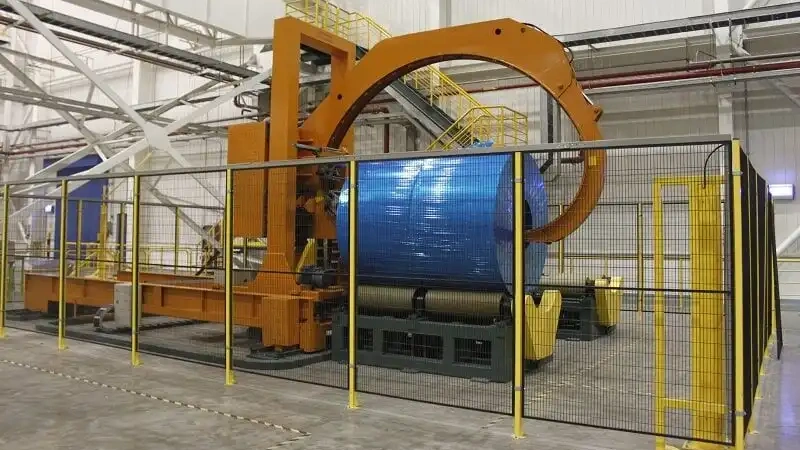
Deconstructing the Heavy-Duty Line: Core Modules & Their Hard Specs
You don’t lift 25 tons with hope. You do it with calculated engineering. A true heavy-duty line is a sequenced series of specialized stations, each performing one task perfectly.
The entry conveyor must manage high axial loads without deformation, the rotating tilter must apply uniform clamping pressure to prevent coil collapse, and the strapping station must maintain consistent tension regardless of coil surface variance. Each module’s performance is defined by quantifiable metrics, not promises.
⚙️ The Heavy-Duty Coil Tilter/Upender: More Than Just a Flip
This is the heart of the line. Its job is to receive a horizontally transported coil and rotate it safely to a vertical orientation for processing or packaging.
- Clamping Force & Surface Pressure: It’s not just about “strong arms.” The hydraulic clamping pads apply a controlled, even pressure across the coil’s face (measured in Bar or PSI). This prevents deforming the inner laps of the coil. A quality system will have adjustable pressure settings for different coil weights and materials.
- Rotational Torque & Control: The flip isn’t a free fall. A high-torque hydraulic drive (measured in kNm) provides a smooth, controlled rotation at a speed of 90 degrees in 15-20 seconds. Variable speed control allows for a gentle start and stop.
- Structural Integrity: The main frame and lifting arms are fabricated from high-grade steel (e.g., S355JR according to EN 10025) and are stress-relieved to prevent warping. Weld quality follows standards like ISO 5817.
Expert Pro Tip: Always check the wear plates at the pivot points of the tilter arms during monthly maintenance. These are sacrificial components. Excessive wear here creates play in the system, leading to misalignment during the flip and accelerated failure of more expensive bearings and shafts. Replacing a $200 wear plate is better than a $5,000 bearing assembly.
🛠️ The Conveyor & Transfer System: Bearing the Unseen Load
This is the skeleton. While the tilter does the dramatic work, the conveyor system bears the constant, rolling weight.
- Roller Capacity and Pitch: Rollers are rated for individual load (e.g., 5 tons each) and spaced closely enough (pitch) to prevent the coil from deflecting between them. For a 25-ton coil, you often see a roller pitch of 300-400mm.
- Drive Configuration: Lines use either shaft-driven rollers (for high torque) or friction-driven systems. The key is synchronization. All drive sections must be controlled by a single PLC to prevent a coil from being “pulled apart” between zones.
- Alignment & Framing: The entire conveyor bed is laser-aligned during installation. A misalignment of even a few millimeters over 20 meters will cause the coil to track sideways, leading to jams and edge damage.
| Component | Key Metric | Typical Spec for 25-Ton Duty | Why It Matters |
|---|---|---|---|
| Tilter Clamp Force | Hydraulic Pressure | 160-200 Bar | Prevents coil collapse during rotation |
| Tilter Rotation Time | Cycle Speed | 15-20 seconds for 90° | Balances throughput and smooth motion |
| Conveyor Roller | Static Load Capacity | 5 Tons per roller | Preforms under load, no permanent deformation |
| System Control | PLC Response Time | <10 ms | Immediate stop signal reaction for safety |
| Line Throughput | Coils Per Hour (CPH) | 5-6 CPH (full cycle) | Defines overall system capacity and ROI |

Integration: Where the Real Engineering Magic Happens
Buying a good tilter and a strong conveyor isn’t enough. If they don’t speak the same language, you’ve built an expensive, dysfunctional garage. System integration is what transforms components into a coherent “line.”
Effective integration is achieved through a centralized programmable logic controller (PLC) that acts as the line’s brain, using signals from photoelectric sensors, encoders, and load cells to coordinate all movements with millisecond precision, creating a seamless material flow.
🔌 The Control System: Centralized Command
A single, industrial-grade PLC (e.g., Siemens S7 or Allen-Bradley ControlLogix) oversees everything. It receives inputs like “Coil present at Station A,” “Clamps locked,” and “Path clear to Station B.” It then executes the sequenced output: start conveyor, stop, activate clamp, rotate, etc. This eliminates manual coordination errors.
- Safety Circuitry is Hardwired: Critical emergency stops and safety gate signals are wired independently of the PLC (using safety relays or a safety PLC to EN 13849). This ensures the system can shut down even if the main controller faults.
📡 Sensor Fusion for Spatial Awareness
The line must “see” the coil.
- Positioning: Encoders on conveyor motors tell the PLC exactly how far a coil has traveled.
- Presence Verification: Arrays of photoelectric sensors confirm a coil is fully within a station before any operation begins.
- Load Verification: Load cells can be integrated into the tilter’s lift mechanism to confirm the coil weight is within the safe operating window before initiating a flip.
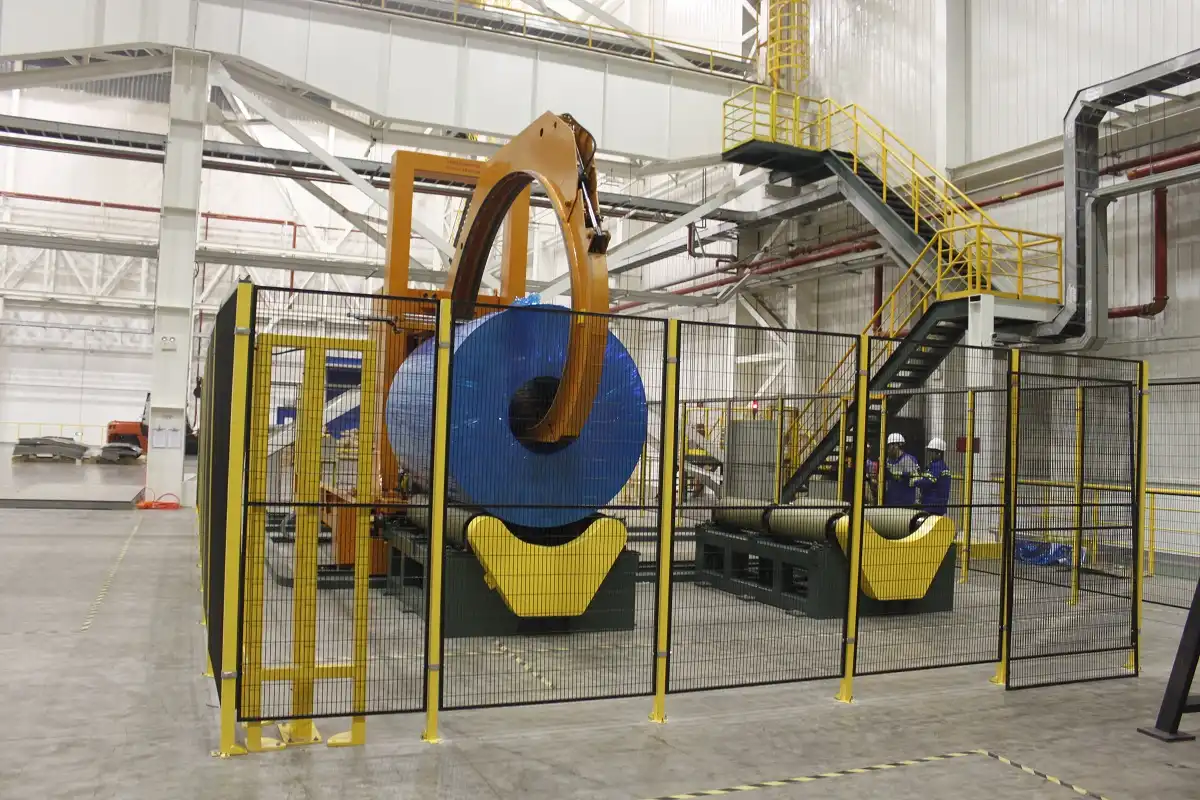
Beyond Installation: Ensuring Decade-Long Performance
A heavy-duty line is a 15-20 year investment. Its true cost is defined by its uptime and total cost of ownership. Planning for maintenance isn’t an afterthought; it’s part of the initial design review.
Proactive maintenance is built on a scheduled regimen of lubrication, hydraulic fluid analysis, and structural bolt torque checks, preventing catastrophic failure and ensuring consistent performance as outlined in the system’s O&M manual.
🧰 The Preventative Maintenance Schedule
Adhere to a strict calendar-based on operating hours:
- Daily: Visual inspection for hydraulic leaks, check fluid levels, listen for abnormal noises.
- Weekly: Clean all sensors and proximity switches to prevent false triggers.
- Monthly: Grease all zerks fittings on bearings and pivot points. Check hydraulic filters. Inspect wear plates on clamps and pivots.
- Annually: Perform a full system alignment check. Send a sample of hydraulic oil for analysis to predict pump or valve wear. Retorque critical structural frame bolts.
🔧 Designing for Serviceability
A well-engineered line allows for easy repair.
- Modular Design: Can a drive motor be replaced without disassembling the entire conveyor section? It should.
- Access Panels and Walkways: Provide safe, easy access to hydraulic manifolds, electrical panels, and drive components.
- Common Parts: Using standard bearing sizes, common hydraulic valve banks, and universal motor mounts reduces spare part costs and downtime.
ROI Insight: One mill tracked a 0.5% improvement in line efficiency after a yearly calibration and alignment, simply from reduced “waiting” and “micro-adjustment” cycles. Over a year, that translated to hundreds of additional coils processed with the same energy and labor input.
The Human Factor: Training and Safety as Core Features
The most robust line can be compromised by poor operation. The system must educate and protect its operators. Think of your veteran crane operator, Jose; his expertise is invaluable, and the new system should augment it, not fight it.
Effective training moves beyond the manual to include hands-on simulation of both normal cycles and emergency procedures, ensuring operators develop the mechanical sympathy and situational awareness needed to be true system partners.
👨🏫 From Button-Pusher to System Manager
Training should cover:
- Mechanical & Hydraulic Fundamentals: Helping operators understand what happens when they press “Auto Start” builds intuition for troubleshooting.
- HMI Navigation: Teaching how to find diagnostic screens, alarm histories, and manual mode controls.
- Lock-Out/Tag-Out (LOTO) Procedures: Specific, documented steps for safely isolating energy sources before performing any maintenance.
🛡️ Built-In Safety Architecture
Safety is engineered in layers:
- Physical Guards: Fixed barriers around pinch points and rotating parts.
- Interlocked Gates: If a safety gate is opened, the system automatically pauses that zone.
- Emergency Stop Networks: Clearly marked E-stop buttons at regular intervals that halt all power to drives and hydraulics.
- Two-Hand Control: For manual inching modes, requiring both hands to be safely occupied to initiate movement.
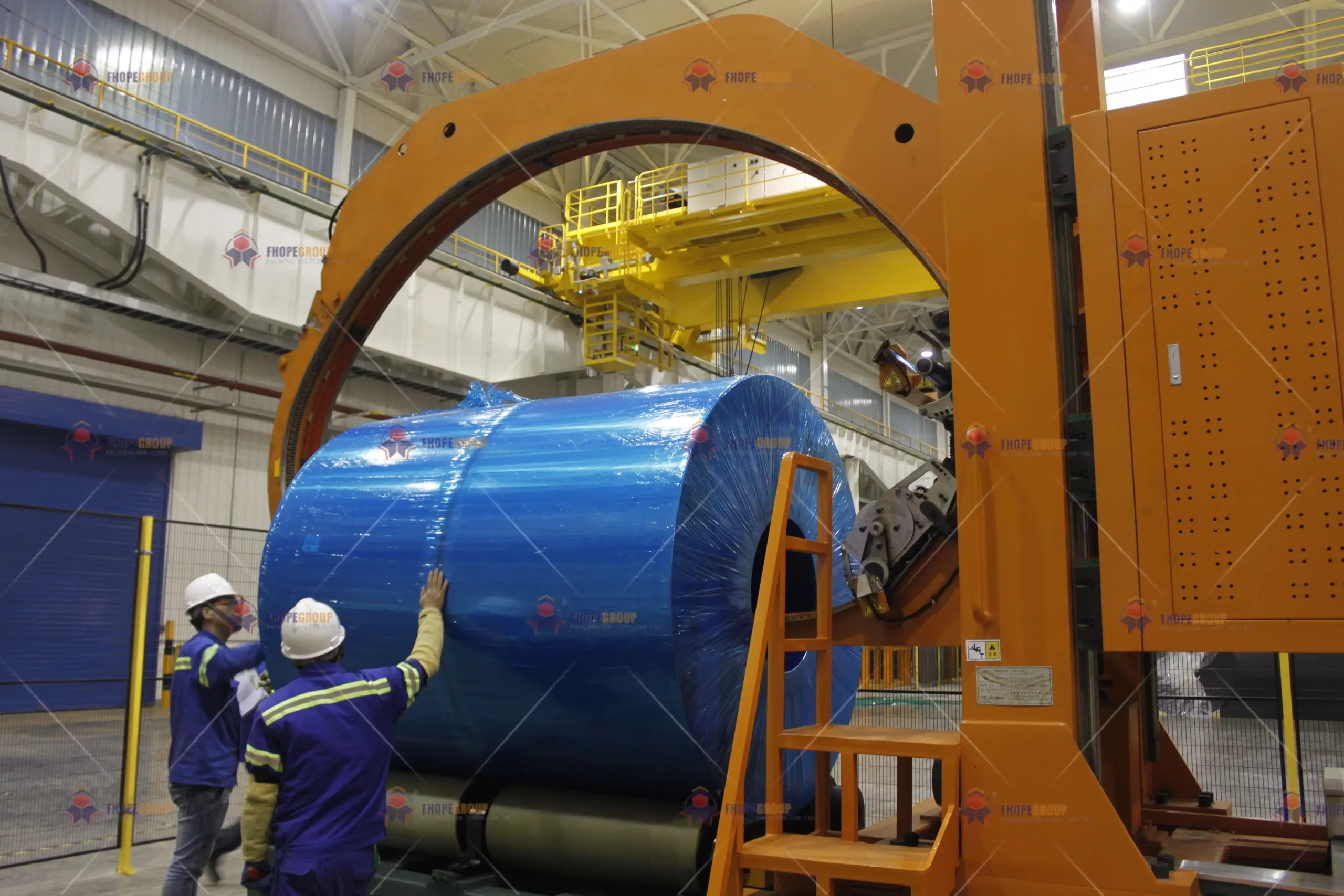
Wrapping up, handling 25-ton master coils isn’t about finding the strongest single machine. It’s about specifying and integrating a complete system where every component—from the conveyor frame to the PLC logic—is designed for the relentless demands of heavy industry. The engineering secrets lie in the details: the specified torque, the sensor response time, the grade of steel in the frame, and the clarity of the maintenance schedule. This approach transforms a capital expenditure from a cost into a strategic asset that drives safety, predictability, and profit for decades.
When you are ready to specify the packaging component of such a line, explore our engineered solutions for a reliable coil wrapping machine.








