
Fhopepack Global Installation Diary: How We Commissioned a $2M+ Coil Packing Line
Summary: A field report detailing the turnkey installation of a high-volume coil packaging line, from foundation prep to first pack. Core metric: achieving mechanical lock-down and control system handshake within 24 hours of equipment arrival on-site.
The Stakes: Beyond the Machine Price Tag
Picture this: a $2 million capital investment is sitting in crates on your factory floor. Your production manager is waiting, the finance team is watching, and every day of delay is burning through your ROI. The real cost isn’t just the coil packing machine price; it’s the downtime, the safety risks of makeshift handling, and the potential for expensive rework.
A successful coil packing machine installation is defined by the seamless integration of mechanical, hydraulic, and control systems to achieve a single, measurable outcome: the first perfectly wrapped coil, on schedule, with zero safety incidents. This requires a method that treats the entire line—upender, conveyor, wrapper, strapper—as one organism.
ROI Insight: For a line of this scale, every 8 hours of saved installation time can translate to over $15,000 in saved labor and avoided production delay costs. A structured, pre-tested installation protocol is your first ROI multiplier.
The FHOPEPACK Method: Pre-Flight Checks Before Touchdown
You don‘t fly a plane without a checklist. We don‘t ship a line without a complete “virtual install.” The project success is determined weeks before the ship docks.
Our engineering team performs a full digital twin simulation of the installation sequence, clash-checking all mechanical and electrical interfaces against your provided site CAD drawings to prevent costly on-site re-engineering. This digital rehearsal catches 99% of fit-up issues, from conduit routing conflicts to foundation bolt misalignments.
🛠️ Phase 1: The Foundation & Utility “X-Ray”
Before a single anchor bolt is set, we verify three non-negotiable site conditions:
- Foundation Flatness: Concrete pads must meet a tolerance of ±3mm over a 3-meter span (per EN 619). We laser-scan the area.
- Utility Readiness: Power (voltage, amperage, phase), compressed air (CFM at 6-7 bar, dryness), and network drops are confirmed live and at the connection point.
- Access & Rigging Path: A clear 360-degree path for crane operation and component placement is mapped, with confirmed load-bearing capacities for overhead points.
🛡️ Phase 2: The Container Unpack & Stage Protocol
When containers arrive, the sequence is critical.
- Unload by System: Hydraulic power units come out first, then structural frames, then sensitive control cabinets.
- Immediate Inspection: Every crate is opened, and each major component is checked against the packing list and for any transit damage before being signed for.
- Strategic Staging: Components are placed in the reverse order of installation. The last item to be installed (often the control panel) is placed furthest from the entry point.

On-Site Execution: The 24-Hour Mechanical Lock-Down
This is where planning meets the wrench. Our goal is to go from scattered components to a mechanically solid, aligned line in one day.
The core of fast-track installation is a parallel workflow: while our mechanical team bolts down the main conveyor structure, our electricians are laying cable trays and pulling main power feeds, ensuring both tracks are ready for system integration the next morning.
⚙️ The Critical Path: Base Frame & Upender Alignment
The coil upender is the heart of the line. Its alignment dictates the performance of every downstream machine.
- Anchor & Level: The base frame is positioned, anchored with high-tensile grade 8.8 bolts, and leveled to within 0.5mm/m using precision optical levels.
- Laser Alignment: A laser alignment tool is used to set the centerline of the upender’s rotation axis parallel to the incoming conveyor centerline, with a tolerance of ±1.0mm over the full length.
- Hydraulic Hook-Up: Pre-fabricrated, labeled hydraulic hoses are connected from the power unit to the upender cylinders. Pressure is tested at 1.5x operating pressure for 30 minutes to check for leaks.
Expert Pro Tip: Always use a dial indicator to check the run-out of the upender’s lifting arms after the first few test cycles. A reading >2.0mm indicates a need for shimming at the pivot bearing mounts—far easier to fix now than after the wrapper is installed.
Configuration & Integration: Where the Line Comes to Life
With the iron bolted down, we bring in the intelligence. This phase transforms individual machines into a synchronized production cell.
System integration involves loading pre-configured PLC and HMI software, then calibrating each sensor (photoelectric, proximity, encoder) and actuator (servo, hydraulic valve) to communicate on a unified industrial network (typically PROFINET or EtherNet/IP) for millisecond-level response. The line logic is tested in “dry-run” mode before any coil is introduced.
🛠️ Table 1: Critical Calibration Parameters & Tolerances
| System | Parameter | Target Value | Tolerance | Standard |
|---|---|---|---|---|
| Upender | 90-Degree Flip Time | 18 seconds | ± 2.0 sec | Internal SOP |
| Conveyor | Servo Positioning Accuracy | +/- 0.5 mm | ± 0.1 mm | ISO 9283 |
| Wrapper | Film Stretch Force | 250% | ± 5% | ASTM D4649 |
| Strappers | Seal Strength | > 70% of strap strength | – | EN 12048 |
| Safety System | Light Curtain Response Time | < 22 ms | – | EN IEC 61496-1 |
🛡️ Safety First: The Hardwired E-Stop Loop
Before power-on, the entire safety circuit is validated.
- All emergency stop buttons, safety light curtains, and guard door switches are wired into a single, redundant Category 3/PLe safety relay (per EN ISO 13849-1).
- The circuit is tested by triggering each device and confirming the entire line halts and enters a safe torque-off state within 100ms.
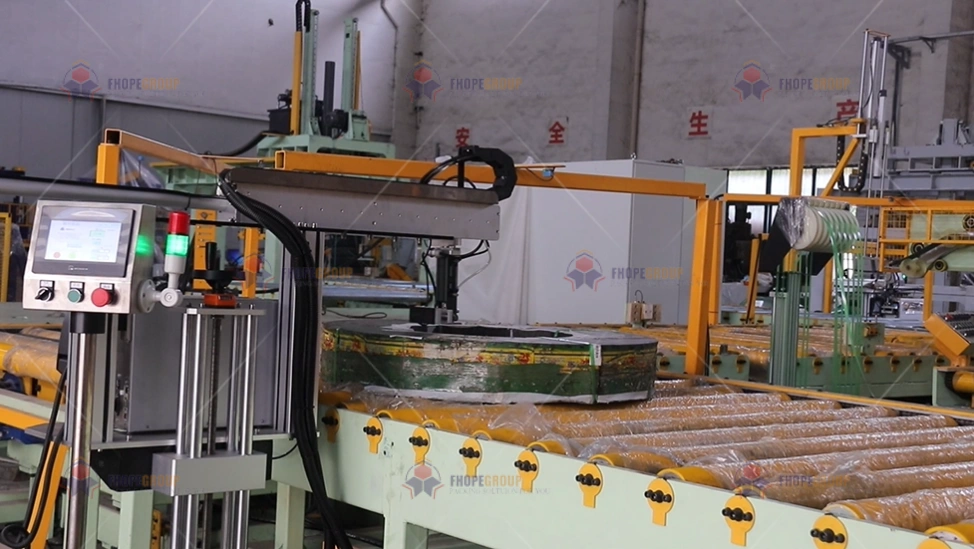
The FHOPEPACK Global Support Network: Your 24/7 Lifeline
Installation isn’t the end of our relationship; it’s the foundation. A machine in Mexico, supported from our engineering hubs, operates with the same confidence as one down the street from our factory.
Our global engineering support provides not just remote diagnostics, but also proactive monitoring of key system parameters (like hydraulic fluid temperature and motor current draw) through secure VPN connections, allowing us to predict maintenance needs before they cause downtime. We maintain a multi-region, multi-language spare parts inventory to guarantee critical component dispatch within 48 hours.
⚙️ The Knowledge Transfer Handoff
The final, crucial deliverable is not a machine, but a competent local team.
- Structured Training: We conduct a 3-day, hands-on training program covering normal operation, routine maintenance (daily/weekly/monthly checks), and basic troubleshooting.
- Documentation Dossier: Your team receives a full set of manuals, including exploded-view parts diagrams, hydraulic schematics, and PLC ladder logic printouts.
- First-Coil Supervision: Our lead engineer stays on-site to supervise and guide your operators through the packing of the first 50-100 coils, ensuring process confidence.

Conclusion: From Project to Production Asset
A $2M+ coil packing line is a major commitment. The difference between a lingering project and a productive asset lies in the execution—a disciplined, pre-validated, and expert-led installation process. It’s about turning complex engineering into simple, repeatable operations for your team.
At FHOPEPACK, we engineer our installation protocols with the same rigor as our machines. Because we know the real work begins the moment the line is signed off and your team takes the controls. This disciplined approach is what ensures every component, from the robust coil upender to the precise coil wrapping machine, performs as a single, reliable system for years to come.








