
Layout Optimization: The Ultimate Guide to Linear, U-Shape, and L-Shape Coil Packing Lines
Summary: The strategic comparison of Linear, U-Shape, and L-Shape coil packing line layouts, defining how each configuration impacts floor space utilization, labor efficiency, and material flow, with U-Shape layouts typically reducing operator walking distance by up to 40%.
Introduction: Why Your Line Layout is a Critical Business Decision
Your coil packing area is often the final bottleneck before shipping. A poorly planned layout forces your team to walk further, your forklifts to travel longer, and creates hidden risks like congestion and potential coil-to-coil contact. Choosing the right layout isn’t just about fitting machines in a room; it’s about designing a system where material, people, and machines move with minimal friction and maximum safety. The wrong choice locks in years of inefficiency.
The core decision between Linear, U-Shape, and L-Shape layouts hinges on three physical factors: your available factory footprint dimensions, the required throughput in coils per hour, and the number of operators you can assign to the line. Getting this wrong means wasted space, unnecessary labor costs, and a slower, more fatiguing workflow.
The Physical Variables of Layout Planning
🛠️ Floor Space & Aspect Ratio: This is the starting point. You need precise length and width measurements, not just total area. A long, narrow bay (e.g., 40m x 12m) naturally suits a Linear layout. A more square bay (e.g., 25m x 25m) opens the door for U-Shape or L-Shape configurations. ⚙️ Process Flow & Stations: Map every step: from incoming coil staging, through tilters, wrappers, strappers, and labeling, to the final packaged coil exit. The distance between these stations dictates travel time. 🛡️ Safety Buffer Zones: Account for mandatory clearances around machinery as per standards like ANSI/ASSP Z244.1 (lockout/tagout) and ISO 14118 (safety distances). This isn’t wasted space; it’s non-negotiable risk mitigation.
ROI Insight: Optimizing a layout to reduce just 15 meters of forklift travel per coil can save over 200 hours of forklift operation annually for a medium-volume line, directly cutting fuel and maintenance costs.
Head-to-Head: Layout Comparison at a Glance
The best layout depends on your constraints. Below is a direct comparison to guide your initial feasibility study.
| Feature | Linear Layout | U-Shape Layout | L-Shape Layout |
|---|---|---|---|
| Best For Space | Long, narrow buildings | Square or near-square buildings | Corner areas or integrating with perpendicular existing lines |
| Footprint | Highest space requirement (long linear path) | Compact, efficient use of center area | Moderate, utilizes two walls |
| Material Flow | Straight-line, simple to manage | Circular flow, input/output at same general area | 90-degree turn, separates input from output zones |
| Operator Efficiency | Lower; requires walking long distances or multiple operators | High; single operator can often manage multiple stations from inside the “U” | Moderate; workflow is split into two legs |
| Scalability | Easy to extend by adding length | Difficult to expand; confined by the “U” shape | Moderately scalable along both legs |
| Forklift Traffic | Can be high, traversing the entire line length | Minimized and confined to the open end of the “U” | Separated, can be organized for dedicated inbound/outbound lanes |
Deep Dive: The Linear (Straight-Line) Layout
Picture this: coils enter at one end of a long bay and travel in a straight line past every processing station until they exit at the far end. This is the classic coil packing line layout. The problem? Operator Jose must walk the entire 50-meter length repeatedly to load, monitor, and unload. It creates a “track meet” workday, increasing fatigue and reducing time for critical quality checks.
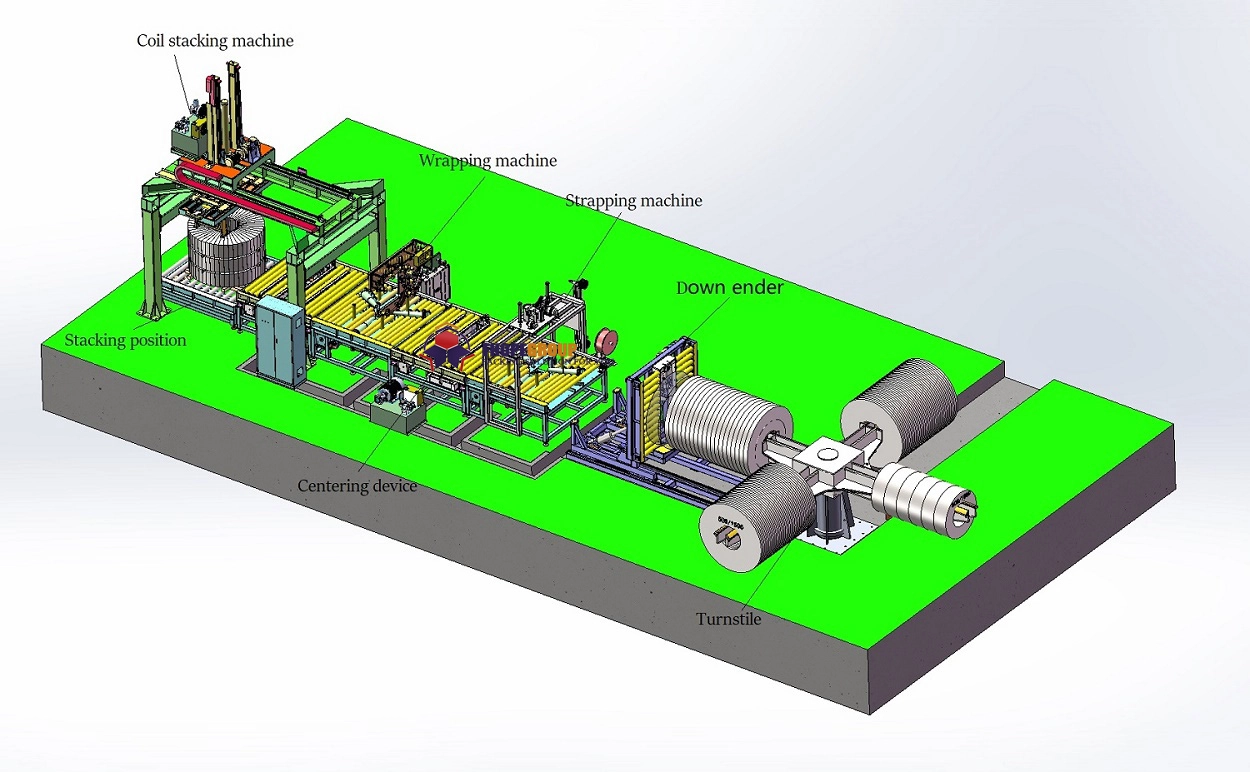
A Linear coil packing line arranges all machines in a single, sequential row, ideal for high-volume, automated lines where material handling is fully mechanized or for facilities with restrictive narrow bay designs. Its simplicity in 3D design and installation is its main advantage, but operational efficiency often suffers in manual or semi-automated scenarios.
When to Choose the Linear Path
⚙️ Full Automation is Planned: If your line uses automated guided vehicles (AGVs) or conveyor systems to move coils between stations, the straight-line path is optimal for programming and navigation. 🛠️ Constrained Width: If your building is very narrow (e.g., < 15 meters wide), this may be your only viable option to fit all necessary equipment. 🛡️ Dedicated Zone Separation: It clearly separates “dirty” inbound raw coil areas from “clean” outbound packaged product areas, which can benefit quality control protocols.

Deep Dive: The U-Shape Layout
Now, imagine the machines are arranged around three sides of a square, with the operator stationed inside the “U.” The coil comes in on one side, gets processed around the bend, and exits near the starting point. For Factory Manager Jose, this means his team’s walking distance is slashed. They can visually monitor multiple stations—tilter, wrapper, strapper—with a simple turn of the head.
The U-Shape layout positions equipment in a horseshoe configuration, dramatically reducing operator movement by placing the worker inside the loop, which is proven to enhance oversight and allow one operator to manage multiple machines effectively. This is a premier strategy for factory space optimization and labor-intensive lines.
Maximizing the U-Shape Advantage
🛠️ Single-Operator Efficiency: This is the key ROI driver. One skilled operator can manage the coil from tilting through strapping without taking a step, boosting productivity per worker. ⚙️ Compact Footprint: By utilizing the center space for workflow, it minimizes the overall floor area consumed, freeing up valuable square meters for other storage or production needs. 🛡️ Improved Communication & Safety: With the team working inside the “U,” verbal communication and visual cues are easier, fostering quicker response to issues. The confined area also naturally restricts unauthorized access.
Expert Pro Tip: When planning a U-Shape, use floor tape to mock up the equipment footprint and walk the process flow before finalizing the 3D design. Ensure there is at least 1-meter clearance around all machines for safe maintenance access, as per ISO 14118.

Deep Dive: The L-Shape Layout
Consider a production bay where the raw coils arrive from one direction, but the shipping dock is on a perpendicular wall. Forcing a Linear line here would create complex and long forklift crossings. The L-Shape layout makes the 90-degree turn part of the process. It fits neatly into a corner, using two walls for support and defining clear inbound and outbound lanes.
An L-Shape coil packing line utilizes two perpendicular walls, creating a natural separation between receiving and shipping zones, which is ideal for facilities where material flow must make a mandatory right-angle turn due to existing infrastructure. It’s a hybrid solution that balances some space efficiency with clear traffic separation.
Implementing the L-Shape Effectively
🛠️ Leveraging Building Corners: This layout turns often-underutilized corner space into a productive asset. It’s perfect for retrofitting a packing line into an existing plant without major reconfiguration of other areas. ⚙️ Dedicated Traffic Lanes: Forklifts bringing raw coils work along one leg. Forklifts taking packaged coils away work on the other leg. This minimizes congestion and crossing paths, a major safety win. 🛡️ Zoned Operations: The bend in the “L” can naturally house the core processing stations (tilting/wrapping), creating a focused work cell that separates noisy or active processes from staging areas.
Beyond the Shape: Critical Integration Factors
Choosing the shape is just the start. The real magic—and challenge—lies in the integration details that make the layout work on the ground, day after day.
Material Handling Synergy
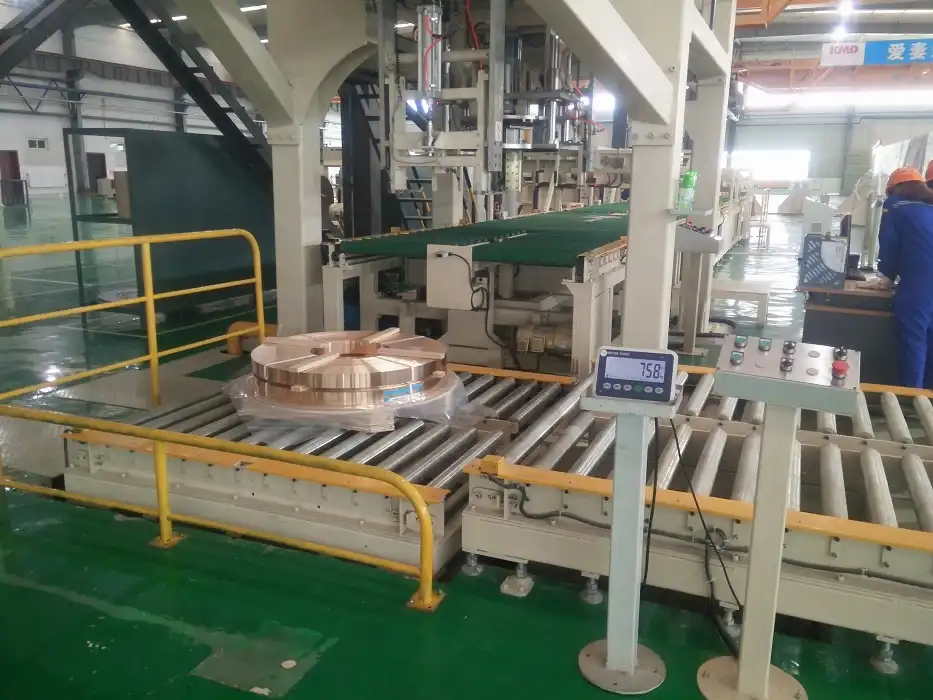
Your layout is useless if the coil can’t move through it smoothly. The choice between roller conveyors, chain transfers, and motorized skids must be made in tandem with the coil packing line layout. A U-Shape might require a powered turntable at the corner. An L-Shape needs a robust 90-degree transfer unit. Always design the material flow path first, then arrange the machines around it.
Maintenance & Service Access
A compact U-Shape saves operational space but can create a maintenance nightmare if service access isn’t designed in. You must account for:
- The space needed to open electrical cabinets (often 1m+).
- Paths to remove major components like hydraulic pumps or gearboxes.
- Clear overhead access for crane or hoist service.
ROI Insight: Investing in a modular machine design with front-access service panels can save 20-30% on routine maintenance time, quickly justifying a slightly higher initial cost. This is crucial for compact layouts.
Future-Proofing & Flexibility
Your needs will change. A good layout plan today includes “what-if” scenarios. Can you add a second strapping head next year? Is there space to integrate a new automated labeling station? Using a 3D design platform to simulate these additions before concrete is poured is the most cost-effective insurance you can buy.
Conclusion: From Blueprint to Bottom Line
There is no single “best” layout, only the best layout for your specific space, volume, and team. The Linear layout offers simplicity, the U-Shape maximizes labor efficiency, and the L-Shape solves specific spatial constraints. The goal is to move from an abstract “efficient” line to a physical system measured by shorter forklift travel meters, fewer operator steps per shift, and clearer safety zones.
Your next step is to move from theory to a site-specific plan. This begins with accurate measurements and a clear throughput goal. For a detailed, machine-specific plan that brings your optimized layout to life, explore the engineering behind a reliable coil wrapping machine, as the wrapper is often the heart of the entire packing line cell.








