
Steel Coil Wrapping Machine Types: A Technical Overview
Three primary automated systems exist for steel coil wrapping: Horizontal, Vertical, and Slip-Proof Tilt-Table machines. Each design addresses specific coil dimensions, plant layouts, and material handling requirements.
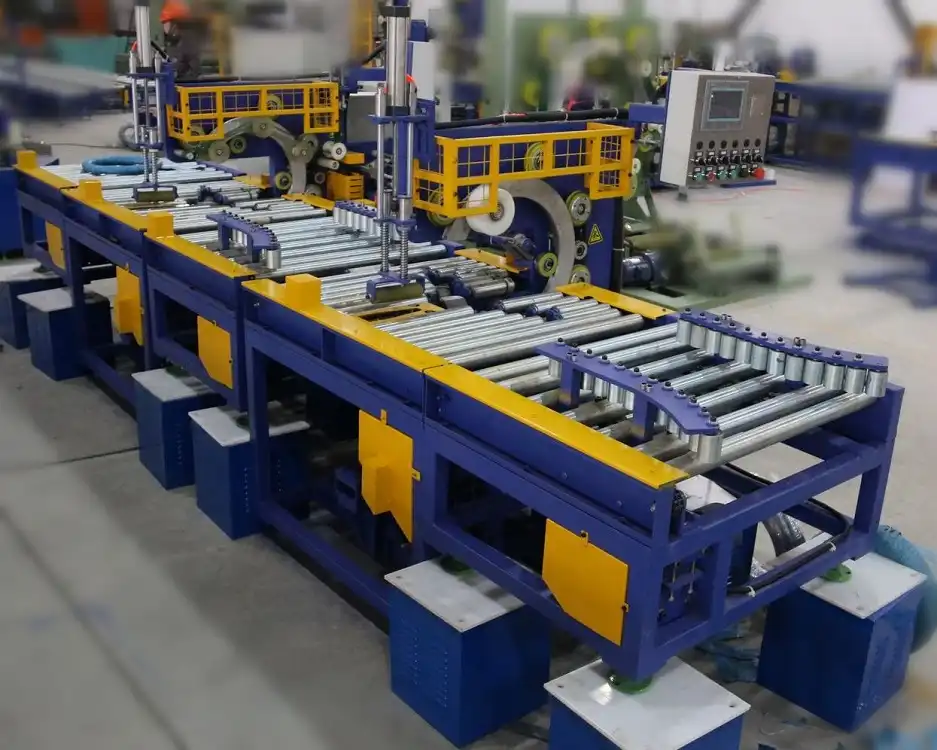
The selection of a wrapping system directly influences line speed, operational safety, and consumable costs. The following sections detail the operating principle, technical characteristics, and typical application scope for each machine type.
1. Horizontal Coil Wrapping Machine
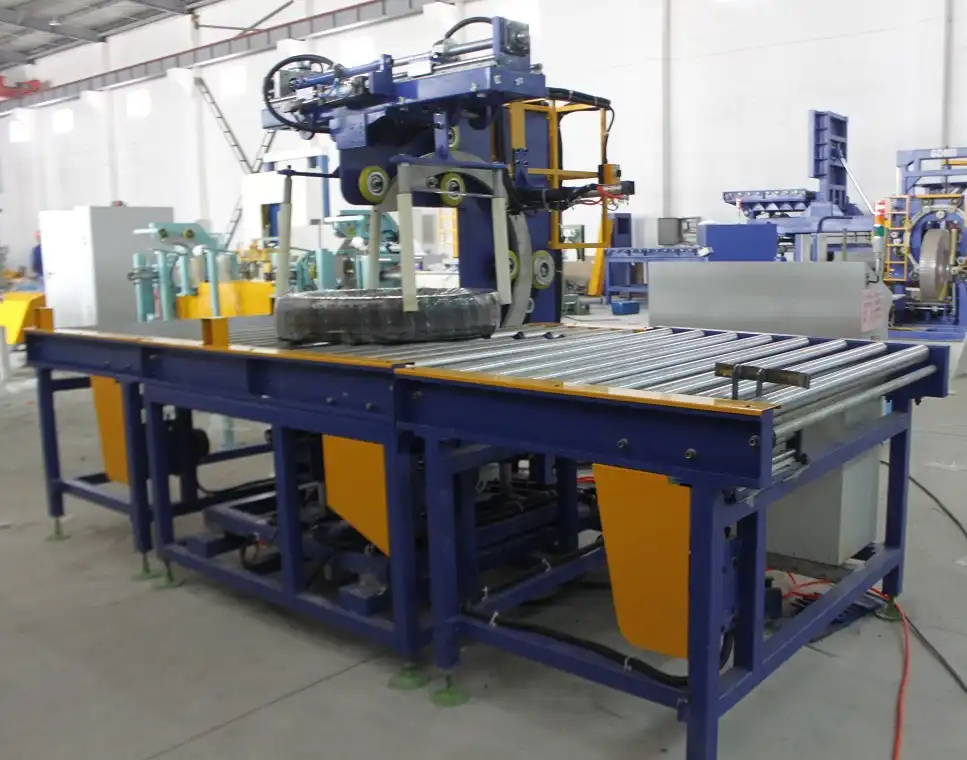
A Horizontal Coil Wrapping Machine secures coils oriented on their side (horizontal axis). The coil remains stationary, while a motorized rotating arm or ring, carrying the stretch film, orbits the coil to apply the wrap. This method is also referred to as a horizontal ring wrapper.
Operating Principle and Application Scope
Coils are conveyed into the machine’s work center. A wrapping ring descends or moves into position and rotates around the stationary coil for multiple revolutions, building a multi-layer film package. This process is suited for high-volume, continuous operations with consistent coil flow.
This machine type is recommended for operations with the following profile:
- High Throughput: Processing a large number of coils per shift.
- Consistent Coil Geometry: Coils have similar diameters and widths.
- Stable Coil Condition: Coils are well-formed with minimal risk of deformation (e.g., “pancaking”).
- Integrated Conveyor System: Availability of space and infrastructure for in-feed and out-feed conveyors.
Technical Analysis: Capabilities and Constraints
Advantages:
- High Cycle Speed: The rotating ring mechanism enables fast wrapping cycles, matching high production rates.
- Automation Integration: Designed for seamless integration with roller conveyors and automated guided vehicles (AGVs).
- Consistent Wrap Force: Provides uniform film tension, resulting in a stable load unit for transport.
Limitations:
- Infrastructure Dependent: Requires a consistent, conveyor-based coil feed to realize its speed advantage.
- Limited Flexibility: Not optimal for coils with highly variable dimensions or for unstable coils prone to toppling.
- Fixed Layout: The machine and its associated conveyor system require dedicated floor space.
Technical Comparison: Horizontal Wrapping
| Feature | Horizontal Wrapper | Manual Wrapping | Alternative (Tilt-Table) |
|---|---|---|---|
| Speed | High | Low | Medium-High |
| Labor Required | 1 operator (monitoring) | 2-3 operators | 1 operator (loading/unloading) |
| Optimal Coil Profile | Consistent, standard sizes | Any size (inefficient) | Large, heavy, or unstable coils |
| Safety | High (minimal manual handling) | Low (high manual handling risk) | High |
2. Vertical Coil Wrapping Machine
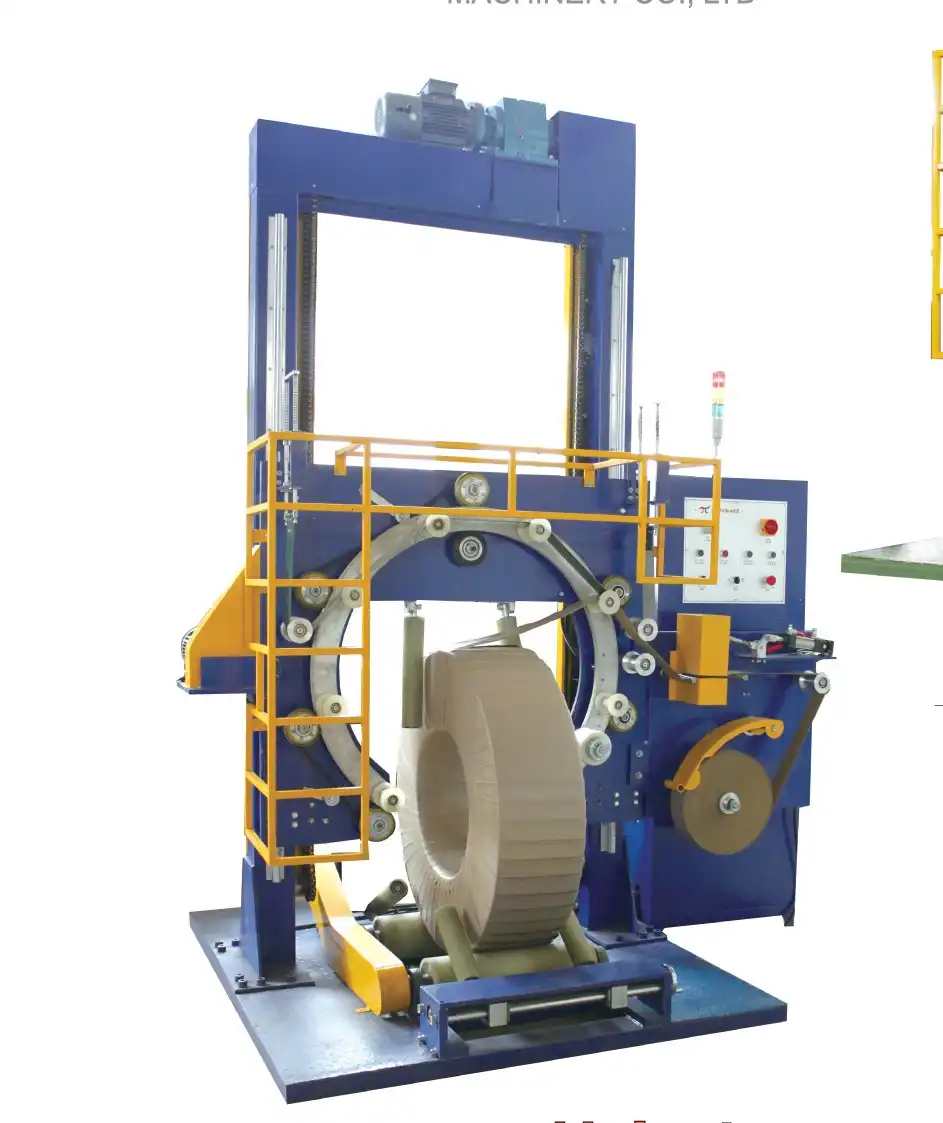
A Vertical Coil Wrapping Machine is designed for coils stored upright on their end. The coil is placed on a heavy-duty turntable, which rotates the load. A film carriage, mounted on a vertical mast, dispenses stretch film as it traverses the coil’s height, applying the wrap from top to bottom.
Operating Principle and Application Scope
The system rotates the load instead of the wrapping mechanism. The film carriage movement is synchronized with the turntable rotation to ensure consistent film overlap and tension across the coil’s outer surface.
This machine type is applicable under these conditions:
- Extreme Coil Weight: Handling coils exceeding the capacity of typical horizontal conveyor systems (e.g., >20 metric tons).
- Vertical Logistics Chain: Coils are required to remain upright for storage, transport, and customer use.
- Limited Floor Space: The machine’s “station” footprint is typically smaller than a horizontal system with conveyors.
- Large Diameter Coils: Effective for wrapping coils with very wide outer diameters.
Technical Specifications and Functional Rationale
The machine’s core components must handle significant dynamic loads. The turntable drive system requires robustness to rotate heavy masses smoothly without wobble. Synchronization between rotation and carriage traverse is critical for wrap consistency.
Key Components:
- Heavy-Duty Turntable: High-capacity rotating platform with a powerful, controlled drive motor.
- Vertical Film Carriage: Assembly moving on linear guides or a mast, containing the film roll and pre-stretch mechanism.
- Programmable Logic Controller (PLC): Coordinates turntable speed and carriage movement for programmable wrap patterns (spiral, full-web).
- Safety Guards: Physical barriers to isolate the rotating load from operators.
Operational Benefits:
- Safety: Eliminates the need to tip massive coils onto their side, a high-risk operation involving cranes.
- Product Integrity: Wrapping occurs in the final shipping/storage orientation, preventing film damage from post-wrap reorientation.
- Layout Flexibility: Compact design allows for integration into existing floor plans where conveyor lines are impractical.
3. Slip-Proof Tilt-Table Coil Wrapping Machine
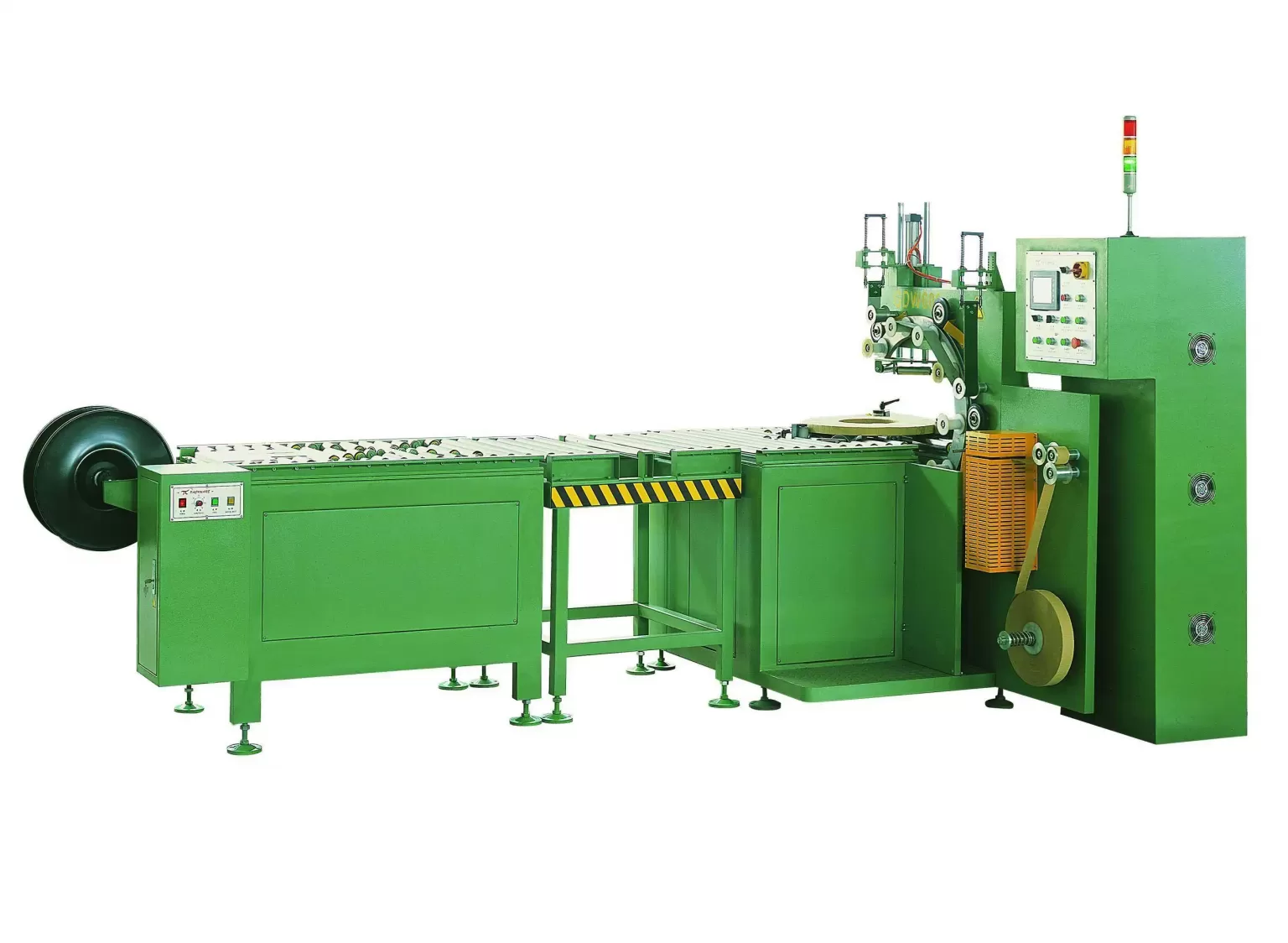
A Slip-Proof Tilt-Table Wrapping Machine is designed for unstable coils prone to layer slippage or deformation. The coil is centrally loaded onto a platform, which is then hydraulically tilted to a precise angle (typically 15-30 degrees from horizontal). A rotating ring then wraps the coil in this tilted position.
Operating Principle and Application Scope
The tilt action uses gravity to nest the inner steel wraps against the core, stabilizing the coil structure before and during the high-speed wrapping process. This prevents layer collapse and slippage.
This machine type addresses the following operational challenges:
- Poor Coil Stability: Processing hot-rolled coils, slit coils, or other materials with loose winds.
- High Safety Requirement: Operations with a low tolerance for handling accidents caused by collapsing loads.
- High Product Variability: Handling a mix of coil sizes, conditions, and stability levels.
- Demanding Packaging Standards: Applications where film breakage or loose wraps due to coil movement are unacceptable.
Engineering Analysis: The Stabilization Mechanism
The system’s effectiveness is based on altering the force dynamics on the coil. Tilting converts a radial separation force (in horizontal wrapping) into an axial compaction force, pressing layers together.
System Logic Flow:
graph TD
    A[Coil Loaded Centrally on Table] --> B{Coil Stability Assessment};
    B -- Unstable / Variable --> C[Tilt Table to 15-30°];
    C --> D[Wrap with Rotating Ring];
    D --> E[Return Table to Horizontal];
    E --> F[Unload Wrapped Coil];
    B -- Stable / Standard --> G[Wrap in Standard Horizontal Mode];
G --> F;- Tilting Mechanism: Employs synchronized hydraulic cylinders for controlled, smooth angular displacement.
- Wrapping Ring: Identical in function to a standard horizontal wrapper, providing proven film application.
- Operational Flexibility: Many models offer dual-mode operation, functioning as a standard horizontal wrapper for stable coils, providing versatility.
4. Technical Selection Framework
Selecting the appropriate wrapping system requires a systematic analysis of operational parameters, not just machine specifications. The decision should involve production, logistics, and safety engineering personnel.
Selection Parameters
-
Coil Profile Analysis:
- Physical Parameters: Typical and maximum coil weight, outer diameter (O.D.), and width.
- Material Condition: Coil type (hot-rolled vs. cold-rolled), edge condition, and inherent stability.
- Production Rate: Required wrapping cycles per hour or shift.
-
Factory Layout Audit:
- Available Space: Floor area at the packaging station for the machine and any peripherals (conveyors).
- Material Flow: Method of coil arrival (conveyor, forklift, crane) and dispatch.
- Utilities: Availability of required power supply (e.g., 3-phase) and compressed air.
-
Operational Objectives Definition:
- Primary Driver: Identifying the key goal: maximizing speed, enhancing safety, achieving versatility, or a combination.
- Investment Parameters: Target return on investment (ROI) period.
- Future Requirements: Anticipated changes in coil specifications or production volume over a 3-5 year horizon.
Decision Guidance Matrix
Based on the analysis above, the primary operational priority suggests the following machine type:
| Primary Operational Priority | Recommended Machine Type | Technical Rationale |
|---|---|---|
| Maximizing Speed for Uniform Coils | Horizontal Wrapper | Highest cycle time for stable, geometrically consistent loads on a conveyor system. |
| Handling Massive, Upright Coils | Vertical Wrapper | Engineered for extreme weights; maintains vertical orientation throughout logistics chain. |
| Ensuring Safety with Unstable or Varied Coils | Slip-Proof Tilt-Table Wrapper | Tilting action mechanically stabilizes coil layers to prevent slippage during wrapping. |
| Requiring a Flexible, Multi-Purpose Solution | Slip-Proof Tilt-Table Wrapper | Dual-mode capability (tilt & horizontal) accommodates a wide range of coil conditions. |
Supplier Engagement Criteria
Technical evaluation should extend to supplier capability. Potential suppliers should be assessed on their ability to provide application engineering support, such as reviewing current processes, recommending appropriate consumables (film type), and detailing regional service and parts availability. A competent supplier will request detailed operational data to propose a system solution, not just sell equipment.
Summary
The three primary steel coil wrapping systems—Horizontal, Vertical, and Slip-Proof Tilt-Table—serve distinct operational niches defined by coil characteristics, plant layout, and core objectives. A methodical analysis of these parameters is necessary to specify a system that integrates effectively, enhances safety, and secures the product for shipment.








