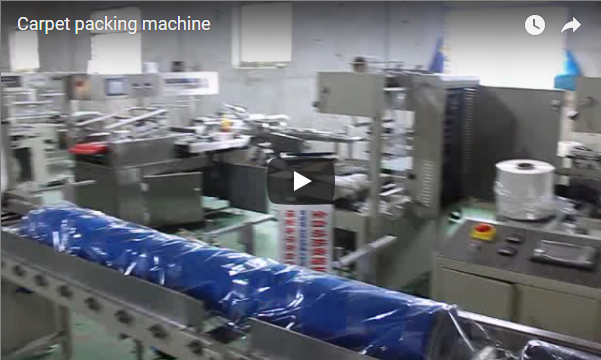
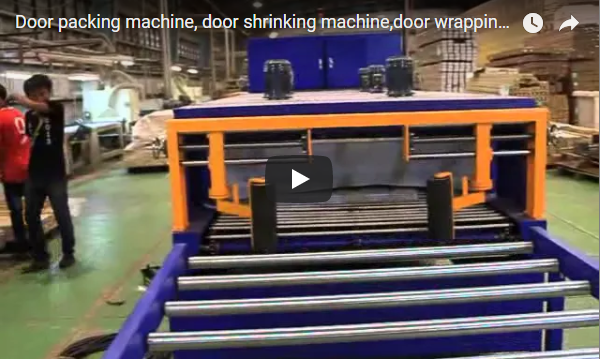
Zhrnutie: A large printed panel is judged on its face, and an unwrapped face arrives scratched, dusty or edge-damaged. This page is for makers of door panels, decorative boards and framed print who want a clean, bubble-free finish without hand labour. It explains what heat-shrink sealing protects, how the machine in the clip wraps and shrinks a panel, what the footage proves and what it does not, and the questions that turn a machine into a purchase.
https://www.fhopepack.com/Shrinking_machine.html
Na tejto stránke: S čím vám táto stránka pomôže pri rozhodovaní · Why printed panels need sealed shrink · How heat-shrink sealing works · What decides a clean shrink · Čo ukazuje klip · Kontrolný zoznam overenia kupujúceho · Často kladené otázky · Súvisiace čítanie · Ďalši krok
S čím vám táto stránka pomôže pri rozhodovaní
A printed door panel or decorative board is only as good as the face the customer sees. A scratch across that face, a patch of dust pressed into the print, or a bumped edge all turn a finished product into a return. Sealing the panel in film is the step that carries it safely to the customer without hand wrapping.
This page is for makers of door panels, picture frames and large printed boards deciding whether a heat-shrink sealing machine fits their shop. It explains what the shrink wrap protects, how the machine in the clip works, and the checklist that separates a machine that fits your panel sizes from one that only looked good on screen.
Why printed door panels need sealed shrink
Large flat panels are damaged by everything they touch. The printed surface marks when it slides over a workbench, dust settles into the pores of the print, and the edges chip where one panel rests against another in a stack. Each flaw shows immediately because the product is a face, not a box.
A sealed film changes how the panel travels. The face is covered, so dust does not touch it and a scuff hits the film instead of the print. The edges get a cushion, which protects the corners that chip first.
Heat-shrink film adds one thing that a plain stretch wrap does not: it pulls tight against the surface. The film follows the panel’s shape, wraps round the edges, and leaves a smooth, wrinkle-free face with bubbles pressed out. The product arrives looking new, which is the point of the step.
How heat-shrink sealing works
The line in the clip runs a short, repeatable sequence. A printed panel rides in on a conveyor with film laid across it. A press head comes down to press the film against the panel, so the film starts smooth instead of loose. Then a heating hood closes over the panel and the film shrinks, pulling tight over the face and wrapping the edges of the board.
When the hood lifts and the panel moves on, the film is already sealed. The printed face sits under a smooth transparent layer, and the panel slides out ready for the next one. Foam edge protectors support the larger panels, and the finished items go to a stacking area.
The sequence is simple to watch and harder to get right. The film has to be tensioned before the heat, the heat has to be even across a large area, and the timing has to suit the film. Those are the settings to verify rather than trust from a short clip.
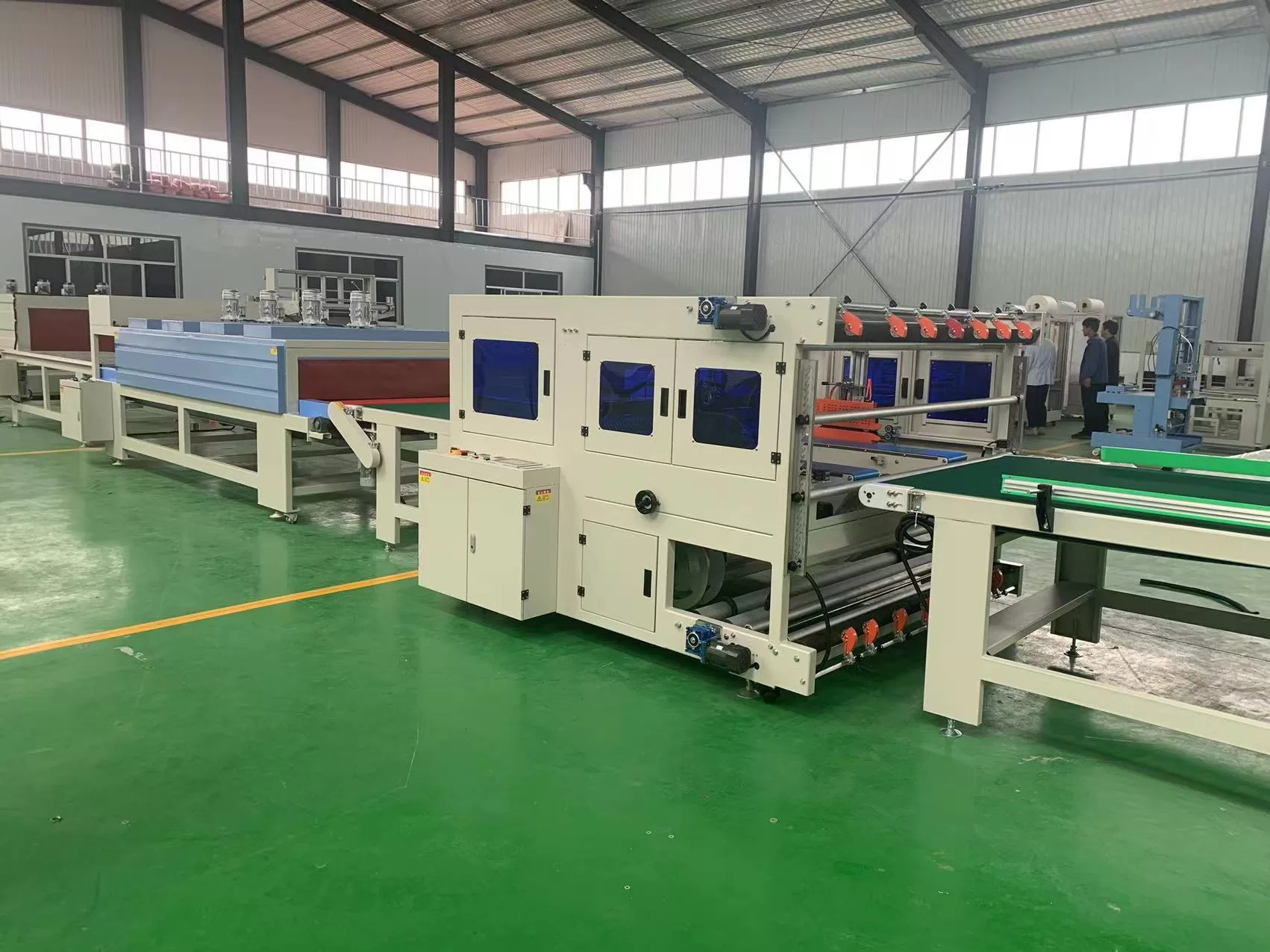
Caption: A door-panel shrink sealing line. Product-library reference image, not a still from the clip.
What decides a clean shrink
Three things decide whether the finished face is clean. The film has to match the job: the right gauge for the panel size, and a film that fits a heated process rather than a plain stretch wrap. The heat also has to be uniform across the whole surface, because an uneven hood leaves tight and loose spots on one panel.
The timing and temperature have to be adjustable to the film and the panel, so the process can be tuned instead of just run. The machine only helps if it suits your panel sizes.
The machine only helps if it suits your panel sizes. The line in the clip handles large boards, and a machine sized for smaller panels is a different purchase. Confirm the maximum width, length and thickness with the supplier so the machine you buy matches the panels you make.
The finish a customer sees is set at this step. A flat, even shrink is the difference between a product that looks hand-finished and one that looks reboxed.
Čo ukazuje klip strojovej linky
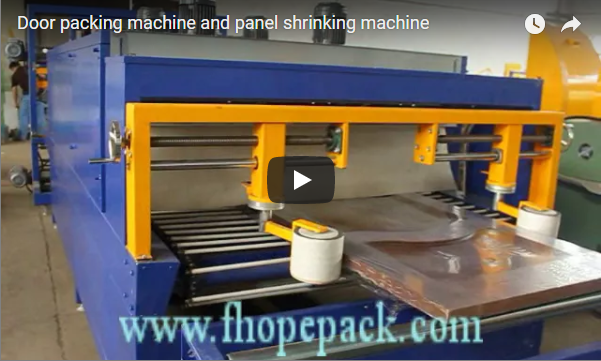
What the video shows is a heat-shrink sealing cycle on printed panels. A large printed board is laid on a conveyor, film is placed over it, and a press head presses the film down flat. A red heating hood descends over the panel and the film shrinks tight over the surface and round the edges.
The hood lifts and the sealed panel moves out on the conveyor to a stacking area. Direct observation notes from the sampled frames, not a performance test.
The clip does not show a continuous run from load to delivery, a cycle time, a temperature setting, a maximum panel size, a film specification, or any rating or certification. The footage cuts between stages, so the order and timing are indicative, not proven. No controls are legible on screen, and the workshop scenes around the line are not part of the machine.
The machine does not have a closed safety cabin as filmed. The heating area is covered while it works, but there is no full fence or light curtain, and the heat itself is a workplace risk to plan around.
Kontrolný zoznam overenia kupujúceho
Six questions decide whether the line fits your panels. Ask them in writing, and keep the answers with the quotation.
| Požiadajte dodávateľa o | Prečo rozhoduje o kúpe |
|---|---|
| Panel envelope: maximum width, length and thickness | Decides whether your panel sizes fit the conveyor and the hood |
| Film specification: gauge, type and shrink ratio | The film but also the heat settings are matched to it |
| Jeden neskrátený cyklus s bežiacimi hodinami | The only footage that proves real cycle time and seal quality |
| Heating method and temperature control | Uniform heat decides whether every panel comes out clean |
| Cooling and edge protection method | The clip shows foam supports, not the full finish sequence |
| Safety devices: emergency stop, guarding, heat protection | A heated open line needs confirmed protection, not assumption |
Pošlite to dodávateľovi a skopírujte to tak, ako je:
- Your panel sizes: maximum width, length and thickness, plus daily volumes.
- The film: gauge, type and shrink ratio, and the heat settings matched to it.
- Jeden nezostrihaný cyklus na jednej kamere s bežiacimi hodinami.
- The heating method, the temperature range and how it is controlled.
- The cooling step and how panel edges are protected after shrink.
- The safety arrangement for a heated line: emergency stop, guarding and heat protection.
- A panel sealed by this machine, checked for a flat, bubble-free face.
Často kladené otázky
Is the printed surface protected by the shrink film?
Yes, for handling and transport. The film keeps dust and scuffs off the print and wraps the edges where panels chip. A claim about long-term storage or outdoor weather resistance is a different matter, and belongs in a written specification.
What panel sizes can it handle?
Not shown in the video. The clip shows large printed boards and no ratings. Send the supplier your maximum width, length and thickness, and ask which of those the line was quoted for.
Je linka automatická?
The wrapping, pressing and heating steps run automatically in the clip. Loading the panel onto the conveyor and taking finished panels away are part of the layout, and the level of automation there depends on the configuration you buy.
Súvisiace čítanie
- Zmršťovací stroj — the shrink-sealing equipment class shown in this clip.
- Tesniaci prostriedok v tvare L — sealing machines that close film round flat products.
- Tmeliaci prostriedok — continuous sealing for panels that move through a line.
- Prietokový obal — continuous wrapping for products that travel on a conveyor.
- Automatická baliaca linka — integrated lines that combine sealing with other steps.
- Automatický stroj na balenie paliet — the end-of-line wrap after sealed panels are stacked.
Ďalši krok
Send the supplier your panel mix first: maximum width, length and thickness, and daily volumes. The clip on this page carries none of those figures, so the envelope has to come from you.
Then send the seven questions above, and ask for the film specification, the heating method and the uncut cycle in writing.
Then book one uncut run and inspect a panel immediately after the line for a flat, bubble-free face and sealed edges. Use the Kontakt Informácie o stránke začať tú výmenu.
Naposledy skontrolované: 28. 09. 2026
Publikované: 2026-09-28