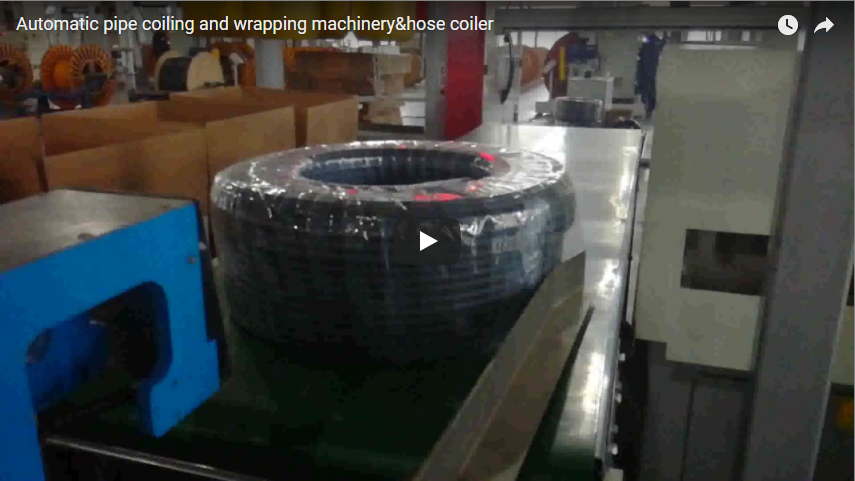
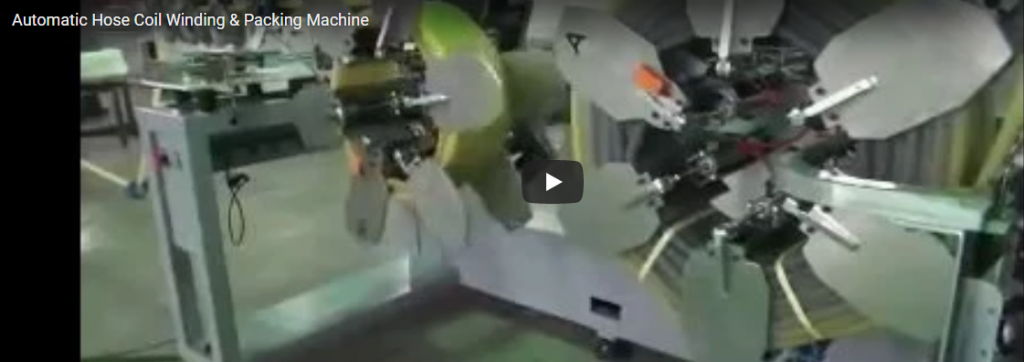
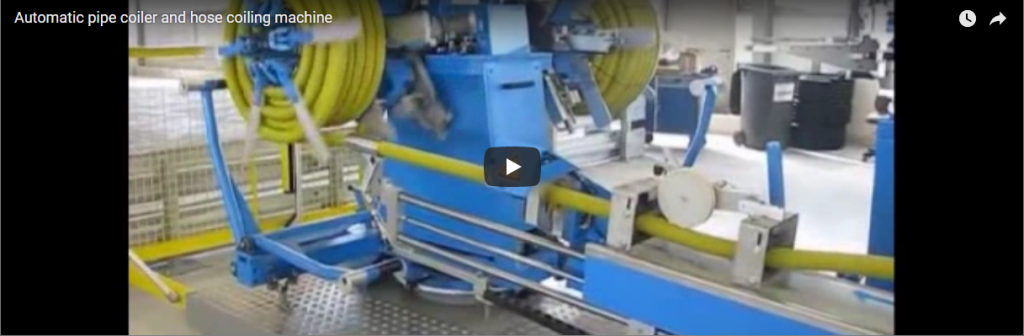
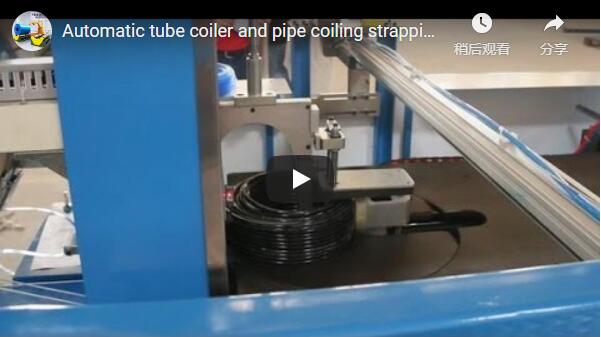
A silicon steel line does not end at the slitter. The coil that leaves it is a stack of 0.23 to 0.35 mm laminations with an insulation coating, and every additional crane move, strap or wrap applied by hand is another chance to scratch the coating, rust the edges or let the layers telescope. The video above shows the alternative: one line that feeds, straps, wraps and stacks without an operator touching the coil.
This automatic silicon steel coil packaging line carries each coil on a lagged roller bed, straps it with PET band at controlled tension, wraps it through the eye with VCI film, and stacks the finished coils eye-up onto wooden skids by gantry gripper. The master coil wrapper behind it accepts 800 to 2,000 mm coil widths, 1,000 to 2,100 mm outer diameters and 2,000 to 30,000 kg.
The sections below walk the line in its own sequence — feeding, strapping, wrapping, stacking — then cover the size envelope, materials, throughput and the RFQ data that sizes it.
Why Does One Line Do All Four Steps?
Every transfer between machines is a contact event, and silicon steel punishes contact. Combining feeding, strapping, wrapping and stacking on one line removes the crane moves where coating damage and telescoping happen.
The failure modes are mechanical and specific. A coil set down on a bare roller scratches its face. A steel strap pulls an edge concave. A hand-wrapped package leaves a slack layer that breathes moisture into the stack. None of these show up at packing — they show up as lamination shorts and core-loss rejects at the motor or transformer plant, where the coil has already been paid for.
A single line attacks the problem structurally: the coil is loaded once, and every operation after that is done by machinery with controlled contact surfaces. The film is laid by a carriage, the strap is tensioned by a head with a set pressure, the stack is placed by a gripper with defined pads. Repeatability is the product; the coil just travels through.
What Does the Line Sequence Look Like?
The line runs feeding → strapping → wrapping → stacking, all on one roller-bed platform with a shared control chain.
[roller bed feeding] --> [PET strapping] --> [eye-through wrapping] --> [gantry stacking]- Alimentando. The coil arrives on powered rollers with V-cradle supports and hold-downs; roller surfaces are lagged, because the coil rides on them through every station.
- Fitas. A gantry-mounted strapping head applies PET band around the coil with controlled tension — the video captions this station “precise tension, no edge damage.”
- Embrulho. The film web drops through the coil eye and folds over the outer circumference, laying VCI film against the metal and stretch film outside.
- Empilhamento. A gantry stacking head with vertical guides places the finished load for the next stage — captioned “steady rhythm, ready for next stage.”
The order matters as much as the list. Strapping before wrapping means the PET band sits under the film, where it cannot rub the coating and can be removed without disturbing the VCI seal. Wrapping last-but-one means the film is the outermost layer when the gripper touches the coil.
How Does the Feeding Station Handle an Eye-Vertical Coil?
The roller bed carries the coil with V-cradle supports and hold-downs so the eye stays vertical and the load cannot shift between stations.
The video shows yellow V-cradle assemblies and hold-down rollers along the bed on both sides. That hardware has two jobs. First, it keeps the eye vertical — the orientation the strapping head, the film carriage and the stacking gripper are all calibrated for. Second, it positions the coil consistently, because the downstream stations detect coil size and set themselves rather than being re-jigged per coil.
The contact rule rides on this station: rollers and cradles are coated with polyurethane or rubber on surface-sensitive coil lines, so the laminated edge never rests on bare steel. A nicked roller sleeve is a consumable; a scratched coil face is a claim.
Why Strap Before Wrapping?
PET band under the film holds the layers against telescoping and stays off the coating; the station captions itself “precise tension, no edge damage.”
The strapping station runs a gantry-mounted head fed from a vertical track. PET band of 12 mm width and 0.8 to 1.2 mm thickness is applied radially around the outer circumference — the video frames show the green bands sitting on the coil before the film goes on. Cycle time for this class of machine is 35 to 38 seconds per strap including rotation and indexing, so a multi-strap recipe is minutes, not seconds, and belongs in the throughput calculation.
Tension is the reason this station exists as its own process. Loose band lets the layers slide; over-tensioned band dents the edge it crosses. A head with a set tension applies the same force every time, which is what “no edge damage” means in practice — not weaker strapping, but calibrated strapping.
How Does Eye-Through Wrapping Work?
The film web descends through the coil eye and folds over the outer circumference, so the wrap holds itself in place without tape at the leading end.
The video shows the path clearly: a wide translucent web comes down from the upper guide rollers, passes through the vertical eye of the coil, and is drawn over the outer diameter by the curved guide arm. Because the web is anchored through the eye, the wrap cannot unwind when the coil travels — the mechanical equivalent of tucking the end under the load.
Two details make this the right wrap for electrical steel:
- VCI film against the metal. Vapour-corrosion-inhibitor film migrates a molecular protective layer onto the steel inside the package, which is the rust barrier for a container crossing. Stretch film outside is the dust and mechanical layer.
- Tension control across coil families. A dedicated tension controller lets the same carriage wrap a light slit coil and a 30-tonne master without tearing film or leaving slack — the specification is “good tension controller makes the machine work for big and small coil.”
The film carriage carries two or three rolls on a shuttle for overlap wrapping, so a two-material recipe (VCI inner, stretch outer) runs in one pass. Overlap is set between 20% and 90% as part of the wrap recipe.
What Packaging Materials Are Used?
VCI film or paper against the metal, LLDPE stretch film or PVC outside, PET for strapping, HDPE woven fabric where a mechanical outer layer is specified.
| item | Especificação |
|---|---|
| Materiais de embalagem | Filme VCI / Filme extensível LLDPE / PVC |
| Identificação do rolo de filme | 76 mm |
| Rolo de filme OD | 100 – 250 mm |
| Largura do rolo de filme | 200–250 mm (dimensões finais confirmadas no projeto) |
| Robusto | PET, 12 mm × 0.8–1.2 mm, radial |
The roll dimensions are not trivia: a 76 mm core and a 200–250 mm width decide the shuttle carriage geometry and the stock the plant buys. A line specified around one film width is a line that runs out of options when the export spec changes.
What Coils Fit the Line?
The wrapper envelope is 800 to 2,000 mm coil width, 1,000 to 2,100 mm outer diameter, 610 to 760 mm inner diameter and 2,000 to 30,000 kg.
| Parâmetro | Variação |
|---|---|
| Material do objeto | Bobina de aço |
| Largura da bobina (W) | 800 – 2,000 mm |
| Diâmetro externo da bobina (DE) | 1,000 – 2,100 mm |
| Diâmetro interno da bobina (DI) | 610 – 760 mm |
| peso da bobina | 2,000-30,000 kg |
| Velocidade do carro de filmagem | aproximadamente 2–3 m/s |
| Taxa de sobreposição | 20% –90% |
The ID range is the constraint to check first. 610 to 760 mm is what the blocker rollers, the eye-through film path and the stacking gripper are built around; coils on 508 mm cores need a separate handling review before they enter this line. At the other end, coils approaching 30,000 kg are jumbo mother coils — they set the frame, roller and gripper ratings, and they are why the stacking station runs a gantry rather than a robot arm.
How Does Automatic Stacking Feed the Next Stage?
A gantry stacking head with vertical guides places finished loads at a steady rhythm, and a turntable indexes the position between placements.
The video captions the station “steady rhythm, ready for next stage,” and that phrasing is the engineering requirement: the stacker’s job is not speed but cadence, because an upstream slitter that emits coils at a fixed takt needs a packing side that absorbs them at the same takt. The head descends over the load, guides it down with yellow clamp blocks, and releases.
The stacking pattern is a recipe input, not a fixed feature — coils go eye-up onto wooden skids, and the number of coils per stack depends on their weight and the skid rating. What the line guarantees is that the pattern repeats: same orientation, same offset, same stack height, so the despatch fork lift picks a known load every time.
How Fast Does the Four-Station Line Run?
The wrapping cycle sets the pace: at 80 to 150 seconds per coil, the wrapping station alone caps the line at 24 to 45 coils per hour — the “up to 60 coils per hour” claim belongs to light coils with short cycles.
Wrapping station ceiling = 3600 s / cycle time
At 150 s: 3600 / 150 = 24 coils/hour
At  80 s: 3600 /  80 = 45 coils/hour
The 60 coils per hour figure is the product page rating for the general line, achieved on light coils where the cycle is short. For comparison, surface-sensitive coil lines published by the same manufacturer give 20 to 35 coils per hour for slit-coil lines and 5 to 8 coils per hour for wide-coil lines. A jumbo master coil lands at the wide-coil end.
Strapping has its own budget: 35 to 38 seconds per strap means a four-strap recipe adds roughly two and a half minutes per stack. The station that decides line speed is whichever one the coil spends the longest relative takt in — for heavy electrical steel, that is nearly always wrapping.
Which Surface-Contact Rules Apply at Every Station?
Four rules carry through the whole line: lagged rollers, PET instead of steel band, VCI as the inner layer, and edge protection confirmed at order review.
- Rollers and cradles. Polyurethane or rubber coating on every surface the coil rides on — mandatory on surface-sensitive lines, not an option.
- Fitas. PET only where the band can touch the coil. Where an export spec forces steel band, it goes over the woven fabric layer, never on laminations.
- Camada interna. VCI film or paper against the metal; stretch film alone is a dust sheet, not a rust barrier.
- Proteção de borda. Corner guards and custom contact pads for silicon steel are available but must be specified, because they change the gripper and stacking recipe.
O que deve especificar uma solicitação de cotação?
Six inputs size the line: coil spectrum, target capacity, surface-contact rules, packaging materials, stacking pattern and site utilities.
| # | Entrada | Por que isso decide a máquina |
|---|---|---|
| 1 | Espectro da bobina: largura, diâmetro externo, diâmetro interno, peso mínimo/máximo | Sets roller pitch, wrapper envelope, gripper rating |
| 2 | Capacidade alvo e padrão de turnos | Define o orçamento do ciclo de embalagem e a contagem de estações. |
| 3 | Regras de contato com a superfície | Revestimento em PU, fita PET, proteção de borda |
| 4 | Materiais de embalagem | VCI inner layer, stretch film, woven fabric, film roll sizes |
| 5 | Padrão de empilhamento | Eye orientation, coils per stack, skid type, turntable indexing |
| 6 | Serviços públicos do local | approx. 15 kW at 380 V three-phase five-wire, 140 bar hydraulic, 6–8 kgf/cm² air, flat reinforced floor |
Send the six blocks and the engineering team returns a layout proposal and quotation within 24 hours. The two inputs most often missing are minimum coil weight — which decides whether the gripper needs a light-coil mode — and straps per coil, which quietly sets the strapping station into the critical path.
Soluções de embalagem relacionadas
- Linha de Embalagem Automática — the parent category for coil, pipe, profile and rod lines.
- Enrolador de bobina mestre — the dual-blocker-roller wrapper family behind this line.
- Máquina de embalagem de bobinas de aço inoxidável — master coil packing and stretch wrapper.
- Máquina de embalagem de bobinas de aço Master — the wrapping station specified in this article.
- Envolvedor de bobina mestre de alumínio — variante de bobina de alumínio jumbo.
- Máquinas de cintagem de bobinas de aço — máquinas de cintar radiais e circunferenciais.
- Máquina de embalagem de bobinas — Equipamento geral para embalagem de bobinas.
Conclusão
One line doing feeding, strapping, wrapping and stacking is not a convenience feature — it is how the contact count on a silicon steel coil gets cut to the minimum. The strap goes on under the film with calibrated tension, the VCI layer reaches the metal through an eye-through wrap that cannot unwind, and the stacker hands the next stage a load that is always oriented the same way.
Size the line from the coil spectrum and the wrapping cycle, not from the brochure number: 80 to 150 seconds per coil is 24 to 45 coils per hour of real capacity, and the 2,000–30,000 kg envelope sets what the frame has to hold. Send the six RFQ blocks with a plant layout and the engineering team will return a sized proposal within 24 hours.