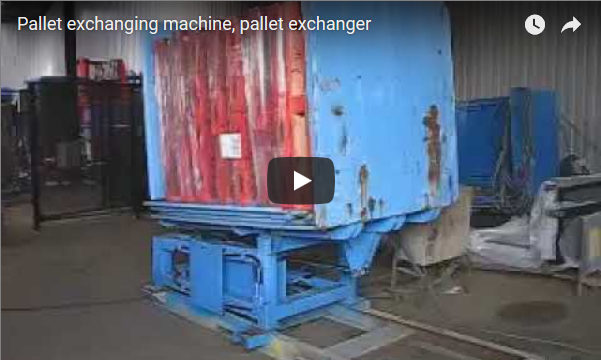
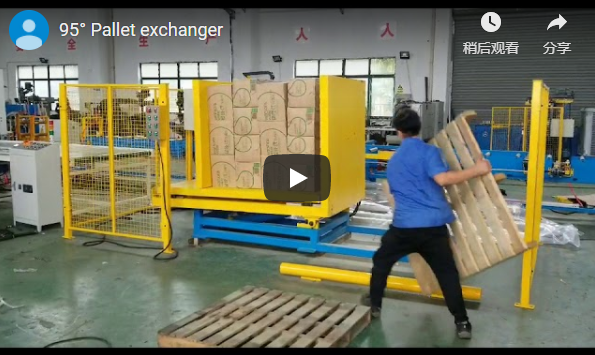
Samenvatting Our mobile pallet inverter is a battery truck with forks top and bottom. It clamps a pallet load between them, a hydraulic cylinder tilts it 90°, and the operator can turn it 180° to invert it. It handles 100 to 1,000 kg with up to 1,200 mm between the forks. Steel is dense, so for molds and sheet stacks the weight limit comes first.
Inhoudsopgave
- Why molds and steel sheets need turning
- How the double-fork inverter works
- Mobile inverter specifications
- Worked example: how much steel fits under 1,000 kg
- 1,000 kg double-fork or 1,500 kg clamp inverter
- Selectiechecklist: wat moet u ons toesturen?
- Veiligheid: EN 415-10 en ISO 3691-1
- Veelgestelde vragen over techniek
- Volgende stap
- Gerelateerd lezen
- Bronnen
Why molds and steel sheets need turning
Mold shops turn mold halves and boxes to reach the parting face, clean out scale or fit inserts. Sheet stacks arrive on one pallet type and must go onto another, or be turned so the bottom sheet can be inspected. A crane and chains can do it, but every turn needs a slinger and a free crane.
A mobile inverter brings the turning to the load. It drives to the pallet, clamps it, turns it and drives it to the next workstation, with no crane and no fixed station.
How the double-fork inverter works
- The operator drives the inverter to the pallet; the travel drive moves it forwards and backwards.
- The bottom forks go under the pallet, and one button brings the top forks down onto the load, clamping it between them.
- A hydraulic cylinder raises the clamped load through 90°, from upright to on its side.
- For a full inversion, the operator turns the load through 180° by hand on the rotating head, then returns it smoothly to the start position.
- The machine carries the turned load to the next station, or sets it down on a new pallet.
The forks hold the load with a constant press force, so loose items between them do not slip out while the load is on its side.
Two points matter for steel. First, set an off-centre mold so its centre of gravity sits as close as possible to the turning axis; an offset mass adds a tipping moment while the head is turned by hand. Second, the hydraulic pressure is not the pressure on the load face, which depends on the contact area. On thin sheet edges or finished mold faces, a flat plate or timber under the top forks spreads the force.
Mobile inverter specifications
| Item | Waarde |
|---|---|
| Laden | 100 tot 1,000 kg |
| Fork width / length | 150 / 880 mm |
| Vorkafstand | 560 mm |
| Maximum gap between top and bottom forks | 1,200 mm |
| Kantelen | 90°, hydraulic |
| Rotatie | 180°, handmatig |
| Reis snelheid | 4.5 / 6.0 km / h |
| Hydraulisch station | DC 24 V, 2 kW |
| Drive | DC 24 V, 1.2 kW |
| Accu | 12 × 2 V, 280 Ah |
| Lader | 24 V / 40 A, with gauge |
| gewicht van de machine | 750 kg |
| Veiligheid | red mushroom E-stop; emergency battery disconnect |
Worked example: how much steel fits under 1,000 kg
Steel weighs about 7,850 kg/m³, so a steel load reaches the 1,000 kg limit long before it fills the 1,200 mm fork gap. The sheet size and pallet weight below are illustrative.
| Stap voor | Waarde |
|---|---|
| Papier grootte | 1,200 × 1,000 mm, 1.2 m² |
| Steel per mm of stack height, 1.2 m² × 0.001 m × 7,850 | ongeveer 9.4 kg |
| Pallet allowance (illustrative) | 25 kg |
| Steel allowed, 1,000 − 25 | 975 kg |
| Stack height allowed, 975 ÷ 9.4 | ongeveer 104 mm |
So a 1,200 × 1,000 mm sheet stack can be about 100 mm high before it reaches 1,000 kg. That is under a tenth of the 1,200 mm fork gap. For a mold, weigh it or take the mass from the drawing: a solid steel block of 400 × 400 × 800 mm is already about 1,005 kg, just over the limit.
1,000 kg double-fork or 1,500 kg clamp inverter
| Double-fork mobile inverter | Mobile pallet inverter, 1,500 kg | |
|---|---|---|
| Laden | 100 tot 1,000 kg | tot 1,500 kg |
| Laad hoogte | up to 1,200 mm between forks | up to 1,800 mm including pallet |
| Palletafmetingen | per project | 800 × 1,200, 1,000 × 1,200 or 1,200 × 1,200 mm |
| Draai | 90° hydraulic tilt, 180° by hand | lift and reverse up to 180° |
| Lift / drive motors | 2 kW hydraulic / 1.2 kW | 2.2 kW / 1.2 kW |
| Accu | 12 × 2 V, 280 Ah | 24 V 180 Ah; about 6 h per charge, 5 h to recharge |
| gewicht van de machine | 750 kg | 1,200 kg |
| Stijgvermogen | per project | 10% |
For sheet stacks and small molds under 1,000 kg, the double-fork machine is lighter and easier to drive in a mold shop. For heavier molds up to 1,500 kg, the 1,500 kg inverter is the one to use.
Selectiechecklist: wat moet u ons toesturen?
- Heaviest mold or sheet stack, with its footprint and height.
- Whether the load has to be turned 90°, 180° or both.
- Pallet or base type under the load.
- Where the load goes after turning.
- Floor condition and aisle width.
- Turns per shift, so we can size the battery.
Veiligheid: EN 415-10 en ISO 3691-1
For CE markets, ISO 12100 sets the risk-assessment method and EN 415-10 sets the general safety requirements for packaging machines and their handling functions, here the clamping and turning. The driven truck itself falls under ISO 3691-1 for self-propelled industrial trucks.
Keep everyone clear of the turning zone and below the raised load. A steel load held on its side carries a lot of energy, so check the mass against 1,000 kg before every lift. The red mushroom E-stop stops the machine, and the battery disconnect isolates it for service.
Veelgestelde vragen over techniek
Q: How heavy a mold can it turn? A: Up to 1,000 kg; for up to 1,500 kg we use the larger mobile inverter.
Q: How tall can the load be? A: Up to 1,200 mm between the top and bottom forks.
Q: Does it turn the load fully upside down? A: Yes. It tilts 90° hydraulically, and the head turns 180° by hand.
Q: How high can a steel sheet stack be? A: For 1,200 × 1,000 mm sheets, about 100 mm before it reaches 1,000 kg.
Q: Which safety standards apply? A: For CE markets, ISO 12100 and EN 415-10, and ISO 3691-1 for the truck.
Volgende stap
- Email the weight and size of your heaviest mold or sheet stack naar info@fhopepack.com.
- Wij reageren binnen 24 uur met een voorstel. naming the model and fork setup.
- We sturen een tekening. of the inverter against your load and aisle.
Gerelateerd lezen
- Mobile pallet changer and inverter
- Mobile pallet inverter, 1,500 kg
- Mobile pallet changer for limited space
- Why 90-degree mold upenders are replacing overhead cranes
- Steel sheet upender for 180-degree turning
Bronnen
- Specifications: FHOPE mobile pallet changer and inverter and mobile pallet inverter product pages
- Machinevideo: mobile pallet inverter for molds and steel sheets on YouTube
- Steel stack height: our worked example, steel density, illustrative sheet and pallet
- Standards: EN 415-10 (packaging machines, general safety); ISO 12100:2010; ISO 3691-1 (industrial trucks)
Laatst beoordeeld: 17-10-2026