Samenvatting
Vertical wire wrapping equipment protects long or annular workpieces by winding a strip or film round them. The footage shows two approaches on the floor: a top-opening machine wrapping a large ring-shaped conductor in one pass, and a top-bottom machine building a two-layer wrap — steel wire first, then film — round a large hose. Both run as part of a line, with wrapped pieces stacking beside the cell. The right pick depends on what you wrap and how it must be protected, which we confirm per project.
Inhoudsopgave
- What happens on the floor
- Machine 1: top-opening, single-layer wrap
- Machine 2: top-bottom, two-layer wrap
- How the two machines differ
- Wat de video wel en niet laat zien
- What a workshop manager should check
- Veelgestelde vragen over techniek
- Volgende stap
- Gerelateerd lezen
- Bronnen en standaarden
What happens on the floor
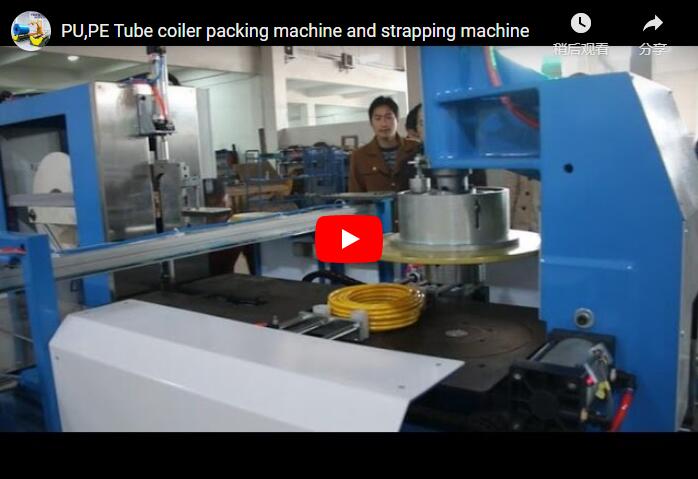
The factory clip is an edited demonstration that shows two separate vertical wrapping machines, each in its own sequence. One wraps a large ring-shaped conductor, standing still while a rotating head winds a strip round its outside. The other wraps a large hose that rotates slowly while a head feeds steel wire and then film along its length.
Both cells have the same job: they put a protective layer on the product where it would otherwise be damaged by handling, moisture or corrosion during storage and shipment. What differs is how the workpiece is held and how the wrap is built up, and that difference drives the choice a workshop manager makes.
A third point matters for the floor layout. Finished wrapped pieces of the same size are seen stacked beside the cell on a pallet, so the wrapper is meant to feed a line rather than stand alone. When you size a wrapper, the question is not only “will it wrap my part” but “how does the wrapped part leave the cell”.
Machine 1: top-opening, single-layer wrap
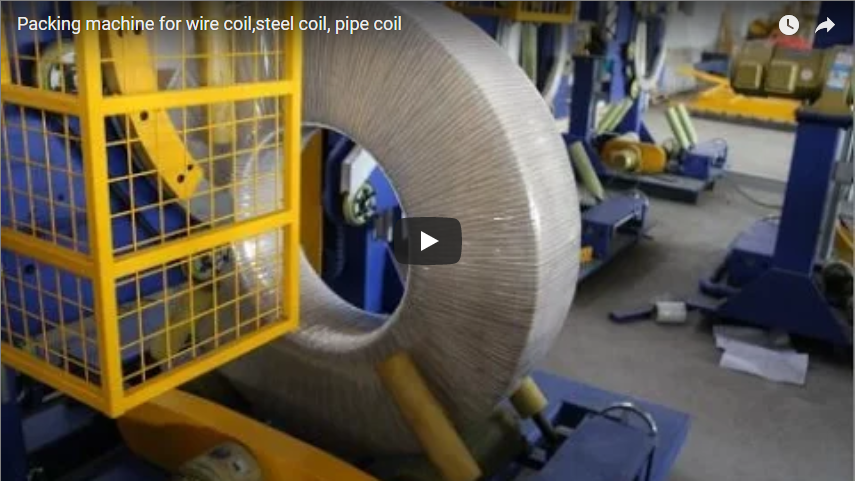
The first machine in the clip has a top-opening layout. The workpiece — a large ring-shaped part held upright — sits clamped in the machine while a wrapping arm rotates fast around its outside. A flexible strip feeds continuously from the head, and the rotating arm lays it round the ring’s circumference, a band of material building up over the surface until the outside is covered.
Because the ring stays still and only the head moves, the wrapping is even and repeatable. Each revolution adds one lap of strip at the same position, and the tension rollers keep the strip tight against the surface.
The head also carries guide and pressure wheels, so the strip lands flat rather than lifting at the edges. Start of the strip is fixed to the part (a tape tie is visible at the workpiece side), and once the outside is covered the cycle is done.
This layout suits parts that can be held on one axis and wrapped in one pass — ring-shaped conductors, flanges and similar annular workpieces. Rated capacity, the largest ring the machine takes, and the strip material are not shown, so the sizing is confirmed from your drawing per project.
The footage resets to the second machine mid-clip, so the end of the first cycle — how the wrapping head clears and the part is unloaded — is not shown completely.
Machine 2: top-bottom, two-layer wrap
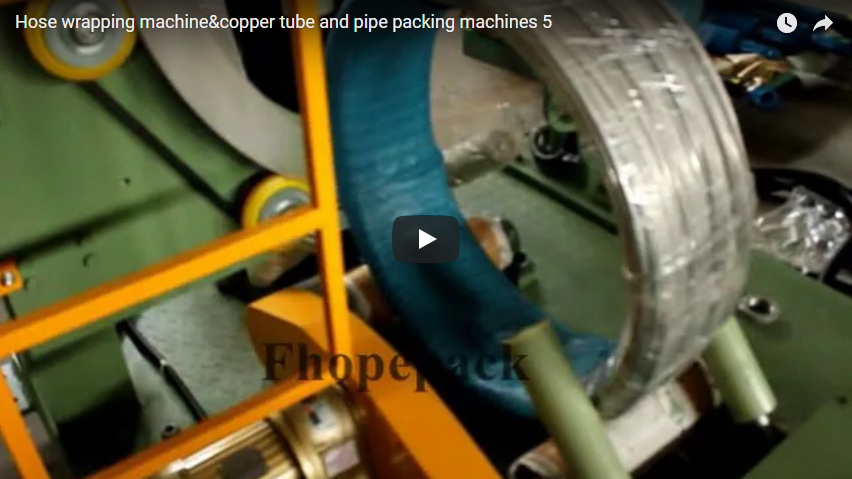
The second machine in the clip takes a different approach. Its workpiece is a large-diameter hose — an outer braided layer over a corrugated plastic core — and the machine wraps it in two passes.
First a steel wire is spiralled along the hose: the workpiece rotates slowly while the head advances axially, so the wire lays on as a continuous helix. Then a film starts and covers the same path during the same working stroke, building up the wrap layer by layer as the head travels from one end to the other.
The finished wrap is a two-layer structure: a spiral reinforcement under a smooth outer film. The video shows an operator’s hand briefly guiding the film start, then the machine continues over the full length. Finished wrapped hoses of the same size are stacked in the background.
The top-bottom name matches the movement. The head travels from one end of the workpiece to the other — bottom to top in the footage’s orientation — building the wrap along the way rather than round one position. That is what makes the two-layer wrap practical: the wire and the film go on over the same axial run, and the finished structure is reinforcement under an outer film.
This layout suits long workpieces whose protection needs two functions: a reinforcing or outer layer for the surface, and a seal layer on top. Tube, hose and bar products with a sensitive surface are the natural fit. The footage does not show the largest hose the machine takes, the axial travel, or the wire and film widths, so those are confirmed from your pipe and hose drawings per project.
How the two machines differ
| Afmeting | Machine 1 (top-opening) | Machine 2 (top-bottom) |
|---|---|---|
| Werkstukvorm | Large ring-shaped part | Long hose or bar |
| Werkstukbeweging | Held still | Rotates slowly |
| Head motion | Rotates round the part | Travels axially along it |
| Wrap structure | Single layer of strip | Two layers (steel wire + film) |
| Typical aim | Outside-surface protection | Reinforcement + surface seal |
| Beste pasvorm | Annular conductors, flanges | Hose, tube, long products |
The machines are not two versions of one product; they are two ways to hold and wrap, and the workpiece decides which one applies. If your product is annular, Machine 1’s approach; if it is long, Machine 2’s two-layer wrap. A workshop may need both if it handles both shapes — the two machines in the clip are shown one after the other, a practical way to judge both layouts against your own floor.
Wat de video wel en niet laat zien
The clip is a factory demonstration, not a full production study. The first cell shows a ring-shaped part wrapped in one pass by a rotating head with a continuous strip. The second cell shows a hose getting a steel-wire helix followed by a film cover along its length. An operator’s hand appears briefly at the film start, so the process is semi-automatic at begin-of-wrap rather than fully hands-off.
Aantekeningen van directe observatie. Two vertical machines with heavy welded steel frames and hydraulic or pneumatic clamps; a rotating spindle and a wrapping-head assembly with feed, tension and pressure wheels; an axial slide on the second machine; independent floor cabinets; FHOPE and www.fhopepack.com watermarks; a label fragment reading “Machine vertical…” on the second machine.
What the clip does not show: model numbers, power or air data, max workpiece size, wrap speed or tension values, cycle time, PLC/HMI make, safety certification, or the complete unload step of either cycle. We size capacity, travel and speeds from your drawing and confirm per project, never from the video.
What a workshop manager should check
Send these so we can match the wrapper to the line:
- Product shape and size — ring or coil dimensions, or hose/bar length and diameter.
- How the part is held today (crane, trolley, forklift) and how the cell loads it.
- Wrap requirement — single protective layer, or reinforcement plus film.
- Wrap material — strip, steel wire, film, and any width or gauge you use.
- Output — parts per shift and how the wrapped part leaves the machine.
- Utilities — power, phase, compressed air, and floor space next to the machine.
- Existing line — upstream and downstream conveyors, and whether the cell must match them.
The first three lines decide which machine applies; the last three set whether a wrapper fits your floor at all.
Veelgestelde vragen over techniek
Q: Can one vertical machine wrap both rings and long hose? A: The two layouts are built for different workpiece motion — one holds the part still and rotates the head, the other rotates the part and moves the head axially. A machine can be configured for one format cleanly; if you run both, plan two cells as the video shows, sized per project.
Q: Why does the hose get two layers instead of one? A: In the footage a steel-wire helix is laid first and a film outer layer covers it. That structure combines reinforcement under a smooth, sealed surface — the two layers do different jobs, and both are done in one axial pass.
Q: Is the wrap fully automatic? A: The main wrap runs automatically, but at the very start of the film an operator’s hand guides the material onto the part. Begin-of-wrap handling and end-of-wrap cutting vary by cell and need confirming per project — the video shows the start assisted, not the end.
Volgende stap
- Email info@fhopepack.com with your product shape, size and wrap requirement.
- We reply within 48 hours with a recommendation — top-opening or top-bottom layout — and a cell layout sketch.
- We arrange a site survey to confirm loading, utilities and line position, and a trial with your part.
Gerelateerd lezen
- Coil Packing Machine — Packing and Handling
- Draadwikkelmachine
- Vertical Coiling Machine
- Automatische oprolmachine
- Draadverpakkingslijn
- Neem contact op met FHOPE
Bronnen en standaarden
- Machine in action: FHOPE demonstration video, “Two Vertical Steel Wire Wrapping Machines: Top-opening and Top-bottom Demo” (70wz0FH7xgQ).
- ISO 12100:2010 Veiligheid van machines — algemene principes voor ontwerp en risicobeoordeling
- EN 415-10:2014 Veiligheid van verpakkingsmachines — algemene eisen
- EN ISO 13849-1:2023 Veiligheid van machines — veiligheidsgerelateerde onderdelen van besturingssystemen
Footage reviewed as a general demonstration; capacity, travel, speeds and wrap materials are confirmed per project, never read from the video.
Laatst beoordeeld: 19-10-2026