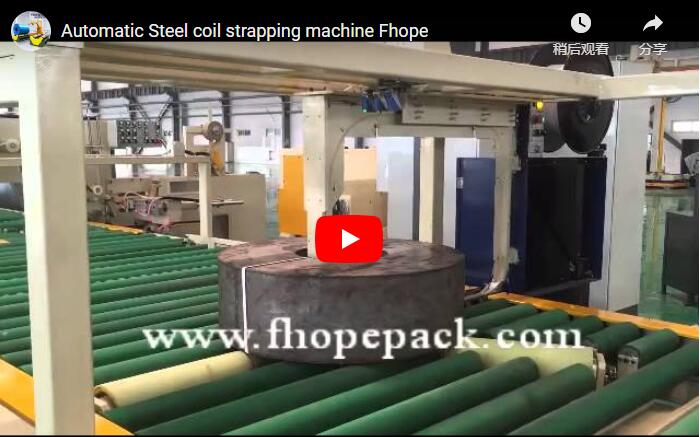
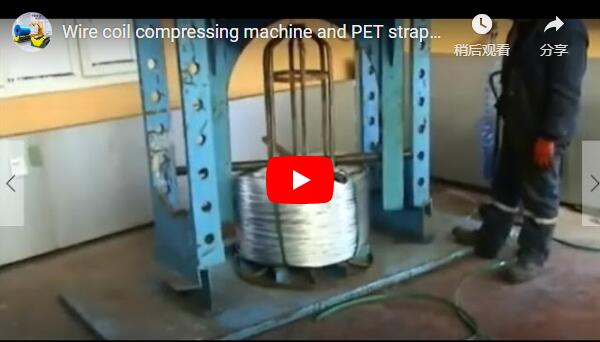
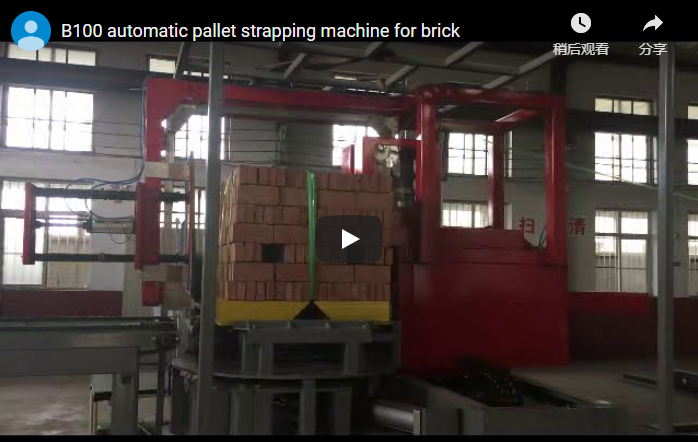
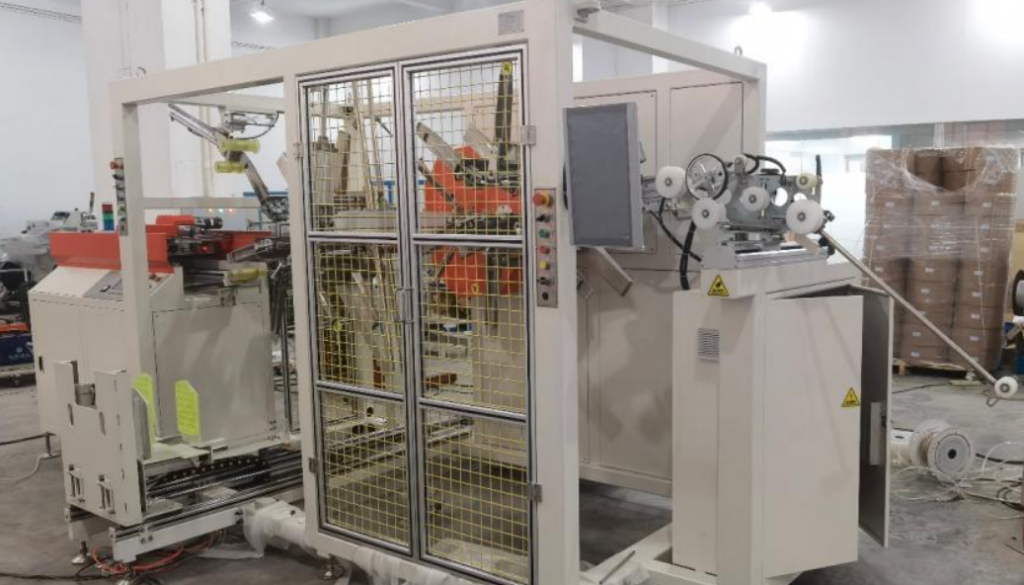
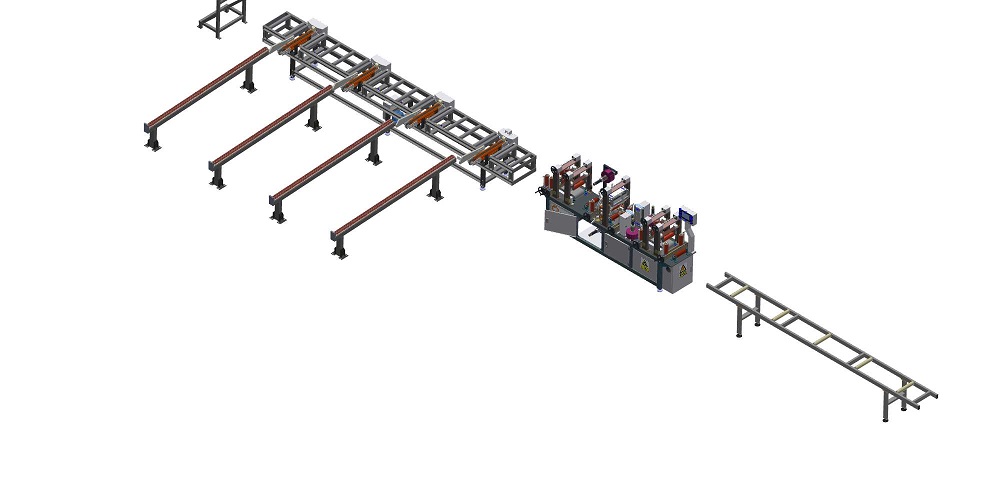
Santrauka A sheet bundle strapping station operates on a chain-driven roller conveyor to secure sheet metal stacks. A strapping head descends directly onto the top of the flat sheet stack, an integrated strap track arches around the conveyor to guide the steel band around the cross-section, and the secured bundle discharges downstream along the rollers. The external reference footage carries no FHOPE marking, so it is presented here as an illustrative engineering example alongside the technical parameters of our equivalent solution: a heavy-duty hydraulic steel strapping head delivering 7,000–18,000 N strap tension. bundle weight estimation and steel strap consumption formulas are also provided for line sizing.
Turinys
- Bundle strapping cycle
- Kodėl galva krenta ant kamino
- Mūsų lygiavertis sprendimas: diržo galvutės duomenys
- Paketo svoris ir diržo naudojimas
- Atrankos kontrolinis sąrašas
- Saugumas
- Inžinerijos DUK
- Kitas žingsnis
- Susijęs skaitymas
- Šaltiniai
Bundle strapping cycle
The automated strapping process synchronizes conveyor indexing, mechanical hold-down stabilization, and strap feed/tensioning cycles:
| Stage / Component | Inžinerinė seka |
|---|---|
| Surišama galva | A vertical-column-guided head equipped with a rigid base press plate lowers directly onto the top plate |
| Diržinis takelis | A fixed perimeter arch routes around the roller conveyor bed, guiding the steel band completely under and over the stack |
| Stack positioning | A flat steel sheet stack is squared and centered over the designated roller station |
| Konvejerio pavara | Heavy-duty chain-driven live rollers convey the bundle into position and hold station lock during strapping |
| Automatinis ciklas | The head descends onto the top plate, the strap feeds and encircles the load, the head pulls high tension and crimps the seal, the head retracts vertically, and the bundle indexes downstream |
The demonstration footage serves as an operational reference and does not display equipment nameplates or interface parameter screens. All engineering values below represent our standard equivalent machine designs.
Kodėl galva krenta ant kamino
- Plokščia krūva įtempta. The integrated press plate exerts vertical hold-down pressure across the top sheets, preventing strapping tension from lifting, curling, or bowing the plate edges.
- Kvadratiniai kraštai. Clamping the stack firmly prevents individual plates from fanning, slipping, or shifting out of square while high tension is pulled, maintaining alignment required for crane lifting and racking.
- Fiksuota juostos padėtis. Downward mechanical engagement holds the bundle in fixed alignment relative to the strapping arch, ensuring consistent band placement matching customer storage dunnage and lifting pick-points.
- Plonas lakštas. Light-gauge sheet possesses low transverse stiffness and deforms easily under peripheral strap tension; mechanical top hold-down is critical on thin stock.
Mūsų lygiavertis sprendimas: diržo galvutės duomenys
Our standard automated station for steel sheet and plate bundles utilizes our proprietary hydraulic steel strapping head [manufacturer rating]:
| Punktas | Paskelbta vertė |
|---|---|
| Dirželių medžiaga | Šaltai valcuotas mažai anglies turintis plienas, mėlynintas ir vaškuotas |
| Juostos storis | 0.8 mm arba 1.0 mm |
| Sandarinimo plotis | 25 mm arba 32 mm |
| Dirželio įtempimas | 7,000–18,000 N |
| Padavimas ir surinkimas | 2–3 m/s |
| Įtempimo greitis | 6 m / min |
| Hidraulinis slėgis | 100 barų (darbinis slėgis 80–90 barų) |
| Žurnalas „Seal“ | Apie 180 ruonių |
| Grupių pozicijos | Nustatyti pagal paketo ilgį |
The complete system is modularly customized: arch throat dimensions, roller conveyor pitch, chain drives, and the quantity of circumferential bands match specific customer sheet dimensions and bundle tonnage [manufacturer rating].
Paketo svoris ir diržo naudojimas
Bundle weight dictates strap width, seal notch integrity, and the total number of bands required to prevent bundle telescoping. Carbon steel has a nominal volumetric density of 7.85 t/m³.
Praktinis pavyzdys (iliustracinis). Consider a sheet pack 2,500 mm long, 1,250 mm wide, and 150 mm high:
- Total bundle volume:
2.5 × 1.25 × 0.15 = 0.469 m³ - Total bundle weight:
0.469 × 7.85 ≈ 3.7 t
One strapping loop around the cross-section requires:
- Basic perimeter:
2 × (1,250 + 150) = 2,800 mm(excluding seal overlap and take-up lead) - With 4 bands applied across the pack length, total strapping consumption equals approximately:
4 × 2.8 = 11.2 mof steel strap.
Atrankos kontrolinis sąrašas
- Sheet gauge thickness, pack width, and length range.
- Maximum and minimum bundle pack height and total bundle weight (t).
- Number of bands per bundle and designated center-line spacing.
- Strap specification: steel strap width and thickness (standard 25 mm or 32 mm, 0.8–1.0 mm) [manufacturer rating].
- Edge protection requirements: automated corner pads or manual edge protectors for polished, coated, or stainless sheet.
- Throughput target: bundles per hour and line indexing cycle time.
- Integration interfaces: cut-to-length line runout table, automated roller speed matching, and integration with downstream transfer equipment such as a plieno lakštų apvertimo įrenginys 180 laipsnių posūkiui.
Saugumas
The strapping head applies vertical clamping force while tightening high-tensile steel bands up to 18,000 N. The strapping and conveyor zone requires physical perimeter interlocking and safety light curtains to prevent personnel entry into the press plate envelope or the closed strap flight path during automated cycling.
Hydraulic maintenance, seal replenishment, and strap coil threading must strictly follow Lockout/Tagout (LOTO) protocols with zero hydraulic stored pressure.
For CE-marked machinery, safety design and execution comply with ISO 12100 for risk assessment and EN 415-10 for general packaging-machine safety requirements.
Inžinerijos DUK
Q: Why does the head press on the stack? A: The press plate clamps sheet layers flat and motionless, preventing peripheral strap tension from bowing top edges or misaligning the stack.
Q: What strapping machine do you supply for sheet bundles? A: An automated sheet bundle strapping station powered by our hydraulic steel strapping head, with track arch clearance and conveyor beds engineered to bundle dimensions.
Q: How tight is the band on your equivalent? A: Strap tension is infinitely adjustable within 7,000–18,000 N via proportional hydraulic regulation.
Q: What strap does your equivalent use? A: Blued and waxed cold-rolled low-carbon steel strapping, 0.8 mm or 1.0 mm thick, paired with 25 mm or 32 mm double-notch seals.
Q: How do I estimate bundle weight? A: Calculate length × width × height in metres × 7.85 t/m³; for example, a 2,500 × 1,250 × 150 mm steel sheet pack weighs approximately 3.7 t.
Q: How much strap does a bundle use? A: Calculate 2 × (width + height) per band plus mechanical seal overlap; 4 bands on a 1,250 × 150 mm cross-section consume approximately 11.2 m of strap.
Q: What hydraulic pressure does the strapping head use? A: The hydraulic power unit operates at a nominal rating of 100 bar, with active working pressure calibrated between 80–90 bar.
Q: How fast are strap feed and tensioning? A: Strap feed and take-up operate at 2–3 m/s, with final tensioning achieved at 6 m/min.
Q: Which standards apply? A: For CE installations, equipment conforms strictly to ISO 12100 and EN 415-10 safety standards.
Kitas žingsnis
To size and integrate an automatic steel sheet bundle strapping station:
- Pateikite savo išdėstymo brėžinį detailing sheet dimensions (L × W × H), maximum bundle weight, strap count, and target cycles per hour to info@fhopepack.com.
- Gaukite inžinerinį pasiūlymą per 48 valandas, including track arch sizing, hydraulic drive data, and line layout drawings.
- Užsisakykite techninę objekto apžiūrą to finalize civil mounting, electrical interlocks, and conveyor link interfaces.
Susijęs skaitymas
- Plieno lakštų surišimo mašina: plokščių krūvų surišimas plienine juosta ant ritininio konvejerio
- Plieno lakštų pakavimo linija pjaustytoms plokštėms
- Plieno lakštų 180 laipsnių tekinimo ir apvertimo procesas
- Plieno surišimo mašinos duomenys
Šaltiniai
- Hydraulic steel strap head specifications: Steel Tube and Heavy Bundle Strapping Machine
- Automated heavy-duty strapping station technical data: Automatic Steel Pipe and Heavy Section Bundle Strapping Station
- Volumetric steel weight calculations: Standard mild steel density (7.85 t/m³)
- Safety compliance standards: ISO 12100:2010 (Safety of machinery — General principles for design); EN 415-10: 2014 (Pakavimo mašinų sauga. Bendrieji reikalavimai)
- OEM response commitment: Standard engineering quotation turnaround (within 48 hours)
Paskutinį kartą peržiūrėta: 2026-10-29
Paskutinį kartą atnaujinta: 2026-10-29