Santrauka
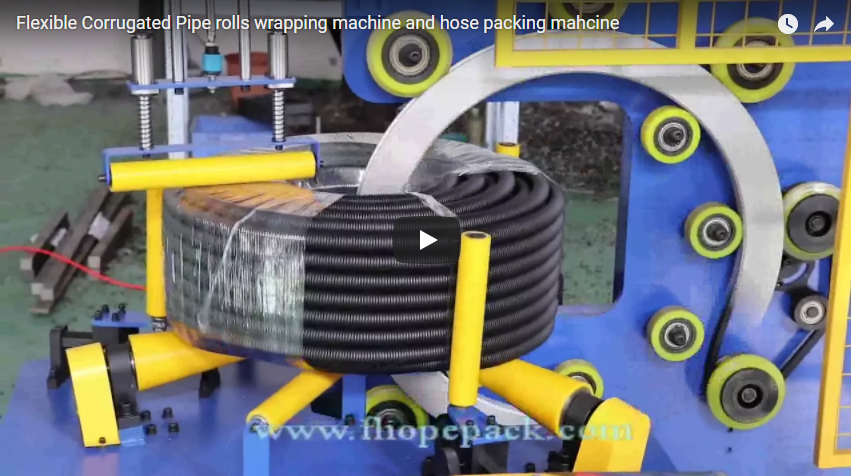
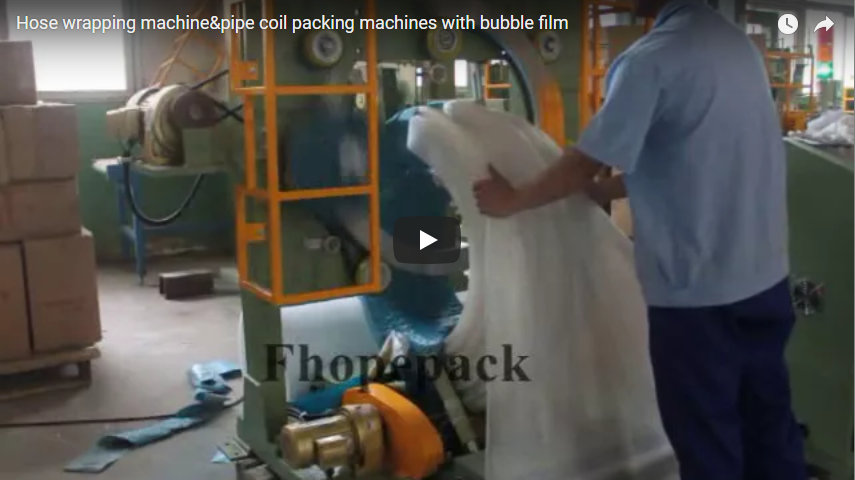
An eye-through PET wrapping machine applies a helical stretch film or paper wrap through the radial core of a PET strapping roll. This protective layer secures loose outer coils, blocks moisture and abrasive dust, and prevents flange edge damage during handling and transport. Edge cracking or distortion in PET strap rolls directly causes feed faults and jamming in automated strapping heads. Our dedicated eye-through wrappers handle strap roll inner diameters from 300 to 700 mm, outer diameters from 500 to 1,000 mm, coil widths from 100 to 300 mm, and payload weights from 10 to 100 kg. Below is an engineering overview of the wrapping cycle, technical specifications, cycle calculation models, and machine selection guidelines.
Turinys
- Why Strap Makers Wrap PET Rolls
- How a PET Roll Is Wrapped
- Roll Wrapper Technical Specifications
- Worked Example: Cycle Time and Material Consumption
- Packaging Materials: Film or Laminated Paper
- Selection Checklist for Strap Packaging Lines
- Safety Engineering: EN 415-10 and ISO 12100
- Inžinerijos DUK
- Kitas žingsnis
- Susiję skaitymai
- Šaltiniai
Why Strap Makers Wrap PET Rolls
A PET strapping roll consists of continuous extruded polyester band wound tightly onto a heavy cardboard core. In an unwrapped condition, inventory and transit expose the roll to three major failure modes:
- Outer Coil Relaxation: Vibrations during flatbed or pallet transport loosen outer turns, causing bundle telescoping.
- Užteršimas kietosiomis dalelėmis: Dust, foundry sand, and abrasive grit settle between strap layers, rapidly accelerating knurled drive wheel wear in downstream automated strapping tools.
- Edge Nicking and Notch Cracking: Dropping or side-impact collisions crush the edge of the strap. Under tension, small notches act as stress concentrators, causing the strap to snap during packaging tensioning.
Radial eye-through orbital wrapping seals all four surfaces of the roll cross-section: outer circumference, inner core eye, and both side faces. The tensioned film matrix compresses the windings radially, creates a water-resistant and dust-tight seal, and maintains strap edge integrity for high-speed automatic dispenser feeding.
How a PET Roll Is Wrapped
An eye-through orbital wrapper processes rolls through five synchronized kinematics stages:
- Pakrovimas ir padėties nustatymas: The PET roll is loaded onto the polyurethane-coated motorized support rollers, centering the open eye directly in the orbital ring’s rotation plane.
- Film Clamping and Cycle Initiation: The leading edge of the packaging film is secured to the coil face. The automated cycle begins via the main PLC operator terminal.
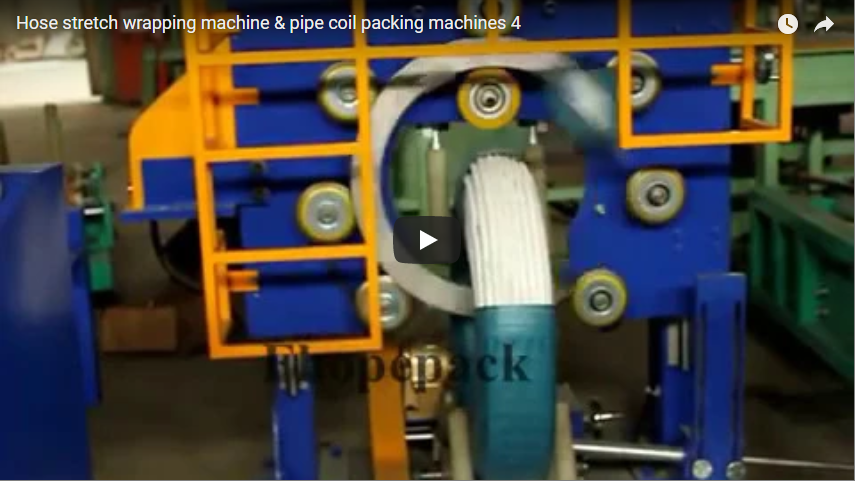
- Orbital Helical Wrapping: The orbital ring rotates through the roll core while the base drive rollers rotate the strap roll on its horizontal axis. Film feeds through a mechanical friction brake carriage, maintaining constant pre-set tension without crushing the roll core.
- Iškirpimo ir nuvalymo seka: Upon achieving the preset overlap and rotation count, the ring homes. The film web is gripped, cut by a pneumatic blade, and the film tail is brushed flat against the outer circumference.
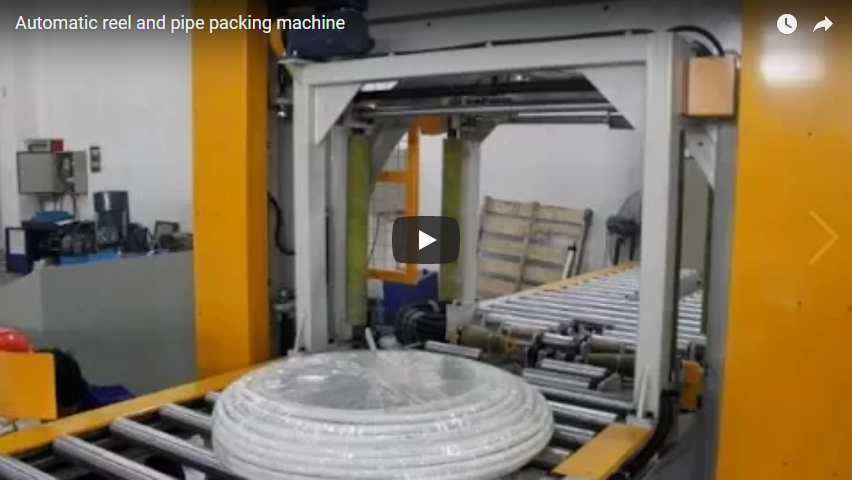
- Ejection and Palletizing: The finished waterproof bundle is transferred to downstream gravity rollers or lifted by an overhead manipulator for palletizing.
Film tension must be precisely modulated on PET rolls. Insufficient tension leads to package slack, while excessive tension deflects the paper core inward and pinches outer coil flanks together.
Roll Wrapper Technical Specifications
Different packaging line capacities require different structural and drive layouts. Below are the verified technical parameters for the standard FPH-300N strap roll wrapper alongside the FPS-300 heavy-duty coil wrapper for high-payload operations.
| Parametras | FPH-300N (Dedicated Strap Roll Unit) | FPS-300 (Heavy-Duty Coil Unit) |
|---|---|---|
| Applicable Coil ID | Φ300–Φ700 mm | Φ508–Φ610 mm |
| Taikomas ritės išorinis skersmuo | Φ500–Φ1,000 mm | Φ600–Φ1,200 mm |
| Ritės plotis | 100 – 300 mm | 100 – 300 mm |
| Ritės svorio talpa | 10-100 kg | 20-1,000 kg |
| Apvyniojimo ciklo laikas | 23–35 s vienam ritinėliui | Custom / variable based on speed |
| Žiedo sukimosi greitis | iki 120 aps./min. | Kintamo dažnio pavara |
| Persidengimo rodiklis | 10–90 % (reguliuojamas) | 10–90 % (reguliuojamas) |
| pakavimo medžiagos | LLDPE stretch film, paper, HDPE | PVC, LLDPE, PE, woven paper, HDPE |
| Film Roll OD / ID | išorinis skersmuo 100–180 mm / vidinis skersmuo 50 mm | išorinis skersmuo 100–450 mm / vidinis skersmuo 50 mm |
| Filmo ritinio plotis | 90 – 100 mm | 100 – 150 mm |
| Maitinimo | 380 V 60 Hz 3 fazių | 380 V 50 Hz 3 fazių |
| Įdiegta galia | 1.9 kW | 1.5 kW |
| Suslėgto oro tiekimas | N/A (Standard electromechanical) | 4–6 baro |
Note: Custom gear-driven rings and specialized cradle rollers are engineered for roll dimensions outside these standardized envelopes.
Worked Example: Cycle Time and Material Consumption
The following engineering calculation illustrates film consumption and runtime for a standard industrial PET strap roll under nominal shop-floor operating conditions.
1. Coil and Process Baseline
- Ritės geometrija: Outer Diameter (OD) = 600 mm, Inner Diameter (ID) = 400 mm, Width (W) = 150 mm.
- Consumable Parameters: Film web width = 100 mm, Target overlap = 50%.
- Linear Step per Turn: At 50% overlap on a 100 mm film web, the coil surface advances 50 mm along the outer circumference per ring rotation.
2. Kinematic and Material Calculation (Derived)
| Žingsnis | Formula / Engineering Logic | Derived Value |
|---|---|---|
| Išorinis apimtis | C_outer = π × OD = 3.1416 × 600 mm | 1,885 mm |
| Reikalingi žiedų apsisukimai | N_turns = C_outer / Step = 1,885 / 50 | 38 turns (rounded up) |
| Theoretical Wrapping Time | t_wrap = (N_turns / Ring Speed) × 60 = (38 / 120) × 60 | 19 ai |
| Radialinės sienelės storis | T_radial = (OD – ID) / 2 = (600 – 400) / 2 | 100 mm |
| Perimeter of Roll Cross-Section | P_cross = 2 × (T_radial + W) = 2 × (100 + 150) | 500 mm (0.5 m) |
| Relaxed Film Consumption | L_relaxed = N_turns × P_cross = 38 × 0.5 m | 19 m |
3. Cycle Analysis
The theoretical wrap duration is 19 seconds. Factoring in soft-start acceleration, deceleration homing, and automatic tail gripping, the complete mechanical wrapping phase requires approximately 23 seconds. When operating with manual handling, total floor-to-floor cycle time stabilizes between 23 and 35 seconds per coil, yielding a sustained line output of 80 to 110 coils per hour. Because the mechanical brake pre-stretches the film elastically, net payout length from the film core will be less than the 19 m relaxed surface measurement.
Packaging Materials: Film or Laminated Paper
Selecting the proper packaging medium depends on shipping logistics, ultraviolet exposure, and warehouse stacking methods:
| Medžiagos Tipas | Apsauginė funkcija | Inžinerijos nauda |
|---|---|---|
| LLDPE elastinė plėvelė | Elastic dust-proof and moisture barrier | High visual transparency allows barcode scanning and strap color inspection without unpacking. |
| Laminated VCI / Kraft Paper | High puncture resistance and edge stiffening | Prevents edge chafing during rough multimodal transit; printable surface for batch labeling. |
| HDPE austinis audinys | Severe-duty tear resistance | Protects outer layers from heavy dragging or rough export crating conditions. |
Optional Sub-System: An auxiliary printed tape dispenser can be integrated into the ring carriage to apply branded adhesive logo tape simultaneously beneath the transparent film layer.
Selection Checklist for Strap Packaging Lines
Provide your system integrator with the following baseline technical parameters before finalizing machine specifications:
- Matmenų kraštutinumai: Minimum and maximum core ID, outer diameter OD, face width, and total weight range.
- Pagrindo reikalavimai: Stretch film, crepe paper, or woven HDPE barrier.
- Pralaidumo tikslas: Target coils per hour (determines whether manual loading or an automated conveyor indexing table is required).
- Uodegos valdymas: Manual hook-and-cut versus pneumatic clamp-and-cut with thermal seal tail welding.
- Core Rigidity: Coreless coils versus standard 200 mm or 406 mm fiber cores (governs maximum allowable ring tension).
- Pasrovio automatizavimas: Direct floor discharge, inline weighing, or robotic sorting and palletizing cells.
Safety Engineering: EN 415-10 and ISO 12100
A rotating ring and driven roller nips create pinch and impact hazards, so the guarding is set by a risk assessment.
- Standartai: design and guarding follow the EN 415-10 packaging-machinery framework with an ISO 12100 risk assessment.
- Fizinė apsauga: interlocked fencing encloses the ring radius so nobody enters during the automatic cycle.
- Interlocking and LOTO: access doors carry interlocked safety switches; opening a door stops the ring drive, and power is isolated before any intervention.
- Tail Handling Safety: Automated cutting and clamping mechanisms eliminate the dangerous operator habit of manually reaching into the machine core while the ring is decelerating.
Inžinerijos DUK
Can the FPH-300N wrap polypropylene (PP) strap rolls?
Yes. Polypropylene strap coils within the 300–700 mm ID and 500–1,000 mm OD envelope are processed on the same roller cradle. Film brake tension must be adjusted lower via the carriage dial to prevent compressing flexible PP cores.
What is the maximum throughput in an 8-hour production shift?
Based on a 25–35 second cycle time and typical operator handling efficiency, a single semi-automatic station processes 700 to 900 strap coils per shift. Upgrading to automated roller feeding and automatic cut-and-clamp cycles pushes output past 1,000 coils per shift.
Can custom branding or batch numbers be added during wrapping?
Yes. The machine supports a secondary logo tape holder mounted directly to the rotating ring frame. The branded tape is applied under tension simultaneously with the clear film layer, protecting the printed surface from abrasive scraping.
When should laminated paper be chosen over stretch film?
Laminated kraft paper is recommended when coils face long-distance marine container transit or repeated forklift handling. The dense paper matrix prevents strap edge deformation and resists puncture far better than thin LLDPE film webs.
Kitas žingsnis
For custom orbital wrapping integration, coil envelope verification, or layout drawings:
- Pateikti parametrus: Send your coil dimensional spectrum (minimum/maximum ID, OD, width, and coil weight) and output requirements to info@fhopepack.com.
- Inžinerinis išdėstymas: Our design team configures the proper orbital ring diameter, roller center distance, and film tension system.
- Komercinis pasiūlymas: Receive a verified engineering layout drawing and binding quotation within 24 to 48 hours.
Susiję skaitymai
- Žarnų vyniojimo mašina FPH-300 (gaminys)
- Kaip ritinių vyniojimo mašina žarnų / vamzdžių ritėms pakuoti
- Vielos ritės vyniojimo mašina
- Žarnų ritės vyniojimo mašina FPH-300
Šaltiniai
- FHOPE Packaging Machinery: FPH-300N Technical Documentation and Roller Envelope Matrix
- FHOPE Packaging Machinery: FPS-300 Heavy-Duty Coil Wrapper Specification Archive
- Machine Directive Engineering Safety Standards: EN 415-10; ISO 12100:2010
Paskutinį kartą peržiūrėta: 2026-11-05