> **Executive Summary**
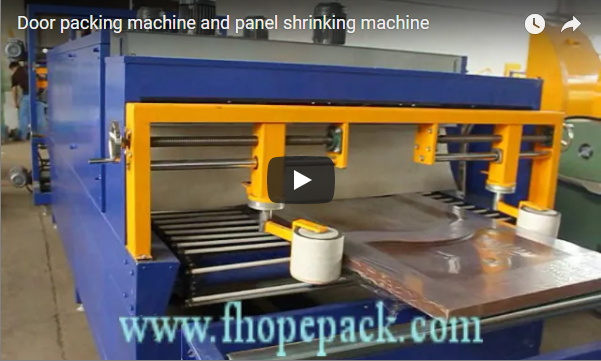
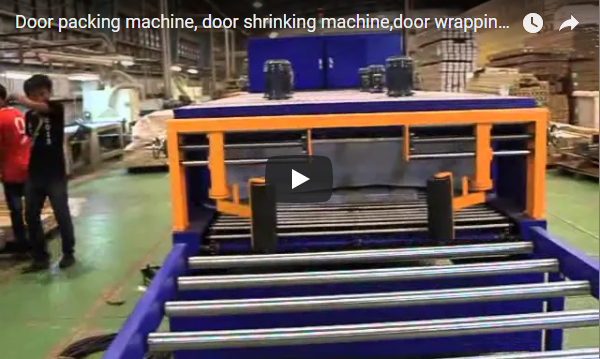
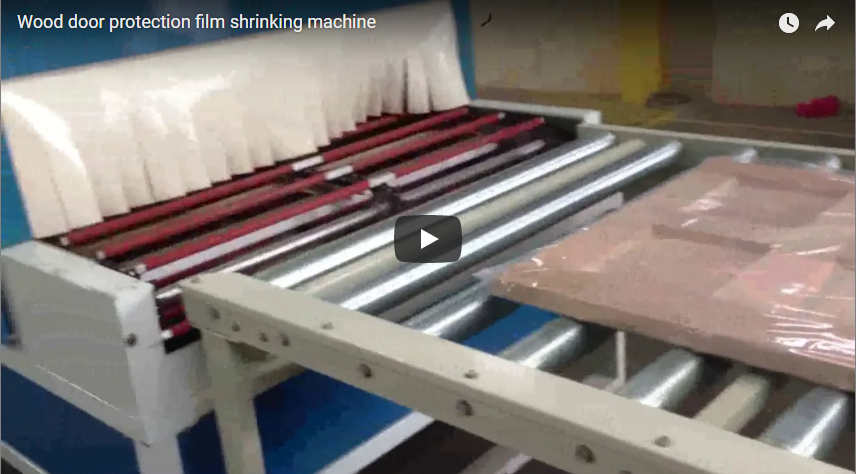
> Packaging wooden door panels and hollow cores requires tight bundling tension to prevent interlayer slippage during logistics, combined with continuous six-sided dust and moisture protection. The industrial door panel shrink wrapping machine featured below integrates an automated heavy-duty infeed belt conveyor, pneumatic seal-cut jaw, dual-temperature recirculating heat shrink tunnel, and a graduated thermal-to-galvanized roller cooling bed. Film roll web width is precision-calculated based on stack width, stack height, and transverse polymer shrinkage rates to guarantee structural rigidity and zero surface marking.
<iframe loading="lazy" width="940" height="535" src="https://www.youtube.com/embed/lJKiW9hTeSA?rel=0" frameborder="0" allow="accelerometer; autoplay; clipboard-write; encrypted-media; gyroscope; picture-in-picture; web-share" allowfullscreen></iframe>

---

<h2 id="table-of-contents">Table of Contents</h2>

<ul>
<li><a href="#system-overview">Operational Sequence & Conveyance Mechanics</a></li>
<li><a href="#how-it-works">How the Door Panel Shrink Packaging Cycle Works</a></li>
<li><a href="#film">Film Web Width Calculation & Polymer Shrinkage Dynamics</a></li>
<li><a href="#console">HMI Operator Console & PLC Automation Architecture</a></li>
<li><a href="#safety">Industrial Safety & Mechanical Compliance</a></li>
<li><a href="#selection-checklist">Engineering Specification Checklist for Door Shrink Systems</a></li>
<li><a href="#engineering-faq">Engineering FAQ</a></li>
<li><a href="#next-step">Next Steps & Project Engineering Review</a></li>
<li><a href="#related-reading">Related Technical Solutions</a></li>
<li><a href="#sources">Standards & Technical References</a></li>
</ul>

<h2 id="system-overview">Operational Sequence & Conveyance Mechanics</h2>

The packaging line processes single door slabs or multiple pre-stacked door panels (solid core, MDF, molded skin, or engineered veneer) directly from the infeed station:

1. **Belt Infeed Alignment**: Stacks are centered on a high-friction, wear-resistant green PVC conveyor belt to eliminate relative lateral sliding during acceleration and mechanical transfer.
2. **Seal-Cut & Film Enclosure**: As the stack traverses the active sealing frame, low-density polyethylene (LDPE) or POF film envelops the payload under balanced dynamic back-tension.
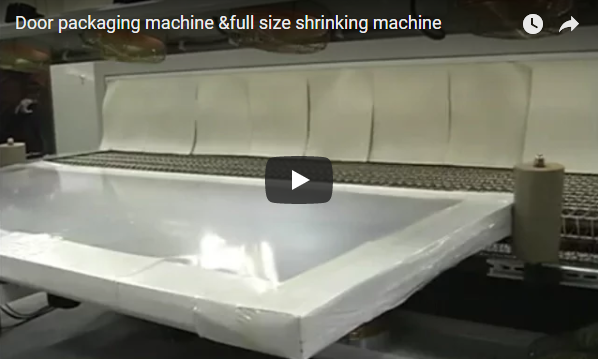
3. **Thermal Tunnel Shrinkage**: High-velocity recirculating hot air rapidly softens the film to its biaxial glass-transition temperature, contracting the film around all edges and corners without scorching top-layer wood finishes.
4. **Graduated Temperature Conveyance**: The stack transfers onto high-temperature vulcanized silicone-coated red rollers inside and exiting the tunnel. The heat-resistant coating prevents molten film adhesion.
5. **Atmospheric Solidification Bed**: Driven galvanized steel cooling rollers dissipate residual thermal energy, setting the film tensile tension and freezing the pack structure before palletizing or strapping.

<h2 id="how-it-works">How the Door Panel Shrink Packaging Cycle Works</h2>

| Machine Station | Component Mechanism | Engineering Function & Operational Impact |
|---|---|---|
| Infeed Station | Anti-slip PVC belt conveyor (variable speed) | Smooth payload transfer without scratch damage to bottom-layer veneers |
| Sealing Station | Pneumatic hot-knife / impulse seal jaw | Forms continuous transversal enclosure with high weld seam integrity |
| Heating Chamber | Dual-zone air recirculation heating tunnel | Uniform 360° convection heat transfer for balanced polymer contraction |
| Transfer Section | Heat-resistant silicone-coated red rollers | Non-marking conveyance; prevents hot polymer bonding under high temperatures (140°C–190°C) |
| Cooling Run-out | Zinc-plated / galvanized steel idle rollers | Rapid convective cooling; locks film tension before downstream manual or robotic offloading |

Solidifying the shrink film across the run-out roller table stabilizes the stacked payload against shifting. For single finished leaves or exterior composite slabs, review our [wooden board door plate shrinking packaging machine](https://www.fhopepack.com/videos/wooden-board-door-plate-shrinking-packaging-machine/). For continuous extrusions, framing kits, and architraves, refer to our [automatic profile and panel bagging and shrinking line](https://www.fhopepack.com/videos/automatic-profile-and-panel-bagging-and-shrinking-line/).

<h2 id="film">Film Web Width Calculation & Polymer Shrinkage Dynamics</h2>

Selecting film roll width requires combining payload geometry with the Transverse Direction (TD) shrinkage ratio and lower overlap seal requirements.

### Geometric Formulation

`W_film = W_stack + 2 × H_stack + 2 × C_lap`

Where:
- `W_film`: Required total flat film web roll width (mm)
- `W_stack`: Maximum width of the panel stack (mm)
- `H_stack`: Total height of the stack (number of panels × panel thickness, mm)
- `C_lap`: Bottom overlap seal margin (typically 50 mm to 80 mm per side for robust thermal bond)

### Reference Sizing Table (LDPE Film, 120 mm Stack)

| Dimension Metric | Engineering Value | Technical Purpose |
|---|---|---|
| Nominal Stack Width (`W_stack`) | 800 mm | Standard internal door leaf width |
| Stack Height (`H_stack`: 6 panels × 20 mm) | 120 mm | Batch processing depth per cycle |
| Lateral Vertical Coverage (`2 × H_stack`) | 240 mm | Side surface enclosure |
| Bottom Underside Overlap (`2 × C_lap`) | 100 mm | 50 mm overlap each side for thermal bond integrity |
| Calculated Film Web Width (`W_film`) | 1,140 mm | Base mechanical film specification |
| Recommended Roll Sizing (TD Shrinkage Adjusted) | 1,150 mm – 1,200 mm | Accounts for 15%–20% transverse contraction in tunnel |

*Note: For heavier core doors exceeding 250 kg per stack, film thickness must be scaled from 45 µm to 80–120 µm to resist puncture from sharp panel corners.*

<h2 id="console">HMI Operator Console & PLC Automation Architecture</h2>

The centralized operator console controls motor synchronization, thermal zones, and line safety interlocks:

| Hardware Interface | Industrial Component | Operational Responsibility |
|---|---|---|
| Color HMI Touchscreen | 7" / 10" industrial touch terminal | Sets tunnel temperatures, PID heating parameters, and inverter speeds |
| Operator Pushbuttons | IP65 heavy-duty mechanical pushbuttons | Independent manual control for conveyor start, cycle reset, and sealing cycles |
| Emergency Stop | E-stop mushroom switch (Category 0/1) | Immediate pneumatic dump and drive motor power isolation |
| System Status Beacon | Multi-stack LED indicator tower | Real-time monitoring of pre-heating, normal run, film exhaust, and heater faults |

Recipe memory on the HMI stores dedicated speed and thermal profiles for varying panel types (e.g., solid pine, primed MDF, hollow cardboard-honeycomb cores), minimizing line changeover time to under two minutes.

<h2 id="safety">Industrial Safety & Mechanical Compliance</h2>

Heat-shrink lines operate at thermal tunnel temperatures between 140°C and 200°C. Strict engineering safeguards prevent operator injury and line blockages:

- **Thermal Zone Guarding**: The heating chamber features dual-layer thermal insulation with surface casing temperatures below 45°C. Infeed and outfeed openings are shielded with multi-layer high-temperature silicone draft curtains to contain radiant heat.
- **Pinch-Point & Burn Prevention**: Personnel must avoid contact with the silicone-coated red rollers and hot tunnel bed during live operation. Interlocked maintenance doors isolate the heating elements and blowers upon opening.
- **Jam Clearing Protocol**: In the event of payload misfeeds, the automated emergency stop or cycle pause must be engaged, followed by active air purge cooling before manually clearing panels.
- **Regulatory Frameworks**: Systems destined for CE markets comply with **ISO 12100:2010** for general machine risk assessment, **EN 415-10:2014** for packaging machines safety, and **IEC 60204-1** for electrical apparatus.

<h2 id="selection-checklist">Engineering Specification Checklist for Door Shrink Systems</h2>

- **Maximum & Minimum Stack Footprint**: Panel width (`W`), length (`L`), single-board thickness, and maximum bundle height (`H`).
- **Structural Weight Limits**: Maximum payload mass per stack (determines roller wall thickness, shaft diameters, and gear motor kW).
- **Throughput Requirements**: Required stacks per hour or linear line speed (m/min).
- **Film Polymer Type & Gauge**: Monolayer LDPE vs. co-extruded POF; thickness range (40 µm – 120 µm).
- **Loading Configuration**: Manual infeed station vs. integration into automatic upstream sanding/trimming lines.
- **Facility Infrastructure**: 3-phase plant power supply (380V/440V, 50/60 Hz), compressed air supply (0.6–0.8 MPa), and exhaust extraction routing.

<h2 id="engineering-faq">Engineering FAQ</h2>

**Q: Why does the conveyor transition from red rollers to silver rollers?**
A: The red rollers are vulcanized with heat-resistant silicone rubber to prevent softened film from sticking or tearing upon leaving the heating chamber. The subsequent silver (zinc-plated steel) rollers have high thermal conductivity to quickly dissipate heat, hardening the film to lock the panel bundle before manual or robotic offloading.

**Q: How does stack height variation influence required film width?**
A: Every 10 mm increase in stack height requires a 20 mm increase in total film web width to cover both vertical sides (`2 × ΔH`), plus additional transverse shrinkage margin depending on tunnel air velocity.

**Q: Can hollow-core doors warp inside the heating chamber?**
A: No. Conveyor residence time inside the heating zone is brief (typically 8–18 seconds). Only the exterior polymer film absorbs radiant heat, leaving the core and wood adhesives below thermal degradation levels.

**Q: Which film material is ideal for wooden door packaging?**
A: LDPE (60 µm – 100 µm) is preferred for multi-panel stacks requiring heavy transit protection and bundle stability. POF (19 µm – 30 µm) is recommended for single high-end interior retail doors requiring superior optics and gloss.

**Q: What automated infeed options exist for continuous lines?**
A: Lines can be upgraded with automated scissor-lift pallet stations, side-pusher alignment arms, or vacuum gantry destackers for fully hands-free operation.

<h2 id="next-step">Next Steps & Project Engineering Review</h2>

We customize door panel shrink lines through a direct three-stage commissioning protocol:

1. **Submit Product Data**: Send bundle envelope dimensions (length, width, stack height, and stack mass) and output requirements to **info@fhopepack.com**.
2. **48-Hour Technical Proposal**: Receive a customized engineering proposal with line layout drawings, heating element electrical requirements, and cycle time simulations.
3. **Factory Acceptance & Integration Planning**: Finalize line dimensions, infeed height matching, roller load ratings, and on-site integration timelines.

<h2 id="related-reading">Related Technical Solutions</h2>

- [Door Shrink Wrap Machine Solutions](https://www.fhopepack.com/solution/door-shrink-wrap-machine.html)
- [Video: Door and Panel Shrink Packaging Machine](https://www.fhopepack.com/videos/door-and-panel-shrink-packaging-machine/)
- [Video: Automatic Door Wrapping Machine & Stretch Wrapper](https://www.fhopepack.com/videos/automatic-door-wrapping-machine-stretch-wrapper/)

<h2 id="sources">Standards & Technical References</h2>

- Equipment Engineering: FHOPE Machine Engineering Division, Technical Documentation
- Industrial Machine Safety: [ISO 12100:2010 Safety of Machinery](https://www.iso.org/standard/51528.html)
- Packaging Machinery Specifics: [EN 415-10:2014 Safety Requirements for Packaging Machines](https://www.nen.nl/en/nen-en-415-10-2014-en-191845)
- Video Verification & Operation: [FHOPE Official Packaging Systems Media Library](https://www.fhopepack.com/videos/)

<p><strong>Last reviewed:</strong> October 2026</p>