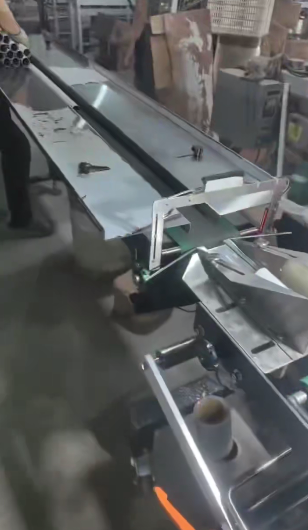
A bag is the tidy end of pipe and roll packaging: one sleeve, fully closed, printed, and clean to hand over. Wrapping film does the barrier job, but a bag does it with a sealed seam and a printable face — which is why bagging sits at the end of so many pipe and rolled-goods lines. The machine in the video is built for that position: a cylindrical roll rides the infeed into a large protected opening, and the bagging happens inside the enclosure without an operator.
This automatic bagging line feeds metal pipes and rolled products inline from upstream and downstream conveyors, counts and bundles by program setting, and closes each load in a PE, PP or HDPE bag. The pipe-bundle class handles bundles of Φ180–250 mm OD built from Φ20–65 mm pipe, 3–6 m long, at more than 1 bundle per minute; dedicated auto-bagger models run up to 20–25 bags per minute.
The sections below cover the line layout, the three bagging classes and their envelopes, bag materials, printing, speed, and the RFQ data that sizes a unit.
Why Bag Pipes and Rolls Instead of Wrapping Them?
A bag is a closed package with a printed face; stretch film is a barrier held by tension. When the product needs to stay presentable and dry — finished pipes, paper and film rolls — the bag wins.
Three properties decide it:
- Closed seams. Film wrap relies on overlap and tension; a bag is sealed, so dust and splash water have no lap joint to work through. For roll products whose end faces must stay clean, that seam is the difference.
- A printable face. Product name, length, batch and barcode go on the bag, not on a sticky label fighting film gloss — and inline printing happens as the bag is made.
- Présentation. A sealed bag reads as finished goods. It stacks, ships and gets received without the unwrap-and-inspect step that loose-wrapped bundles force on the customer.
The trade-off is that bagging needs the right bag for each product class, which is why the machine family is split by bundle size and bag width rather than one-size. A 3-metre pipe bundle and a fist-sized hardware pack share nothing except the closing operation — so the family spans from a benchtop unit to a line-integrated enclosure, and the product envelope, not preference, picks the class.
What Does an Inline Bagging Line Look Like?
Products arrive on the upstream conveyor, pass through a large protected opening into the bagging enclosure, and leave sealed on the downstream side — the video shows a cylindrical roll entering exactly that way.
[upstream conveyor] --> [infeed rollers] --> [bagging enclosure] --> [sealed bag out] --> [downstream]The video frames show the working end of the line: a stainless feed surface and rollers carrying a cylindrical roll product toward a large rectangular opening framed by a perforated protective hood; the enclosure houses the bagging mechanism; a separate control cabinet, an HMI touchscreen, a stack light and an E-stop sit on the machine body. Roll and bag stock mount on shafts on the machine.
Two things the frames do not show: the bag-opening and sealing mechanisms inside the enclosure, and any printing hardware. Those belong to the machine class and are covered from the specification below — the honest statement from the video is the product path and the inline position between upstream and downstream conveyors.
How Does the Machine Handle the Product?
Feeding is automatic, counting is by program setting, and the pipe-bundle class builds and bags its bundles without manual bundle-making — the specification is explicit on all three.
The pipe-bundle bag packing machine is rated for bundles of Φ180–250 mm OD, built from pipes of Φ20–65 mm diameter and 3–6 m length, weighing 10–50 kg. Counting is automatic, by program setting: the machine receives pipe count targets and forms the bundle itself, which removes the manual bundle-making step the catalogue calls out. Bundling speed is approximately more than 1 bundle per minute at that weight class.
For single products rather than bundles, the catalogue notes the solution can be made for single-pipe bag packing — and the roll products in the video are the same story: one cylindrical load per bag, fed by the infeed conveyor, handled inside the enclosure.
Which Products Fit Each Bagger?
Three classes cover the range: a pipe-bundle bagging machine for long tube bundles, a table-roll auto bagger for small items, and a horizontal auto bagger for wide bags on larger products.
| Paramètre | Machine à emballer de sac de paquet de tuyau | Table roll auto bagger (FP-A08-2TR class) | Horizontal auto bagger (FP-H24) |
|---|---|---|---|
| Produit | Pipe bundles Φ180–250 mm OD (Φ20–65 mm pipe), 3–6 m | Small items, bag width 6–20 / 6–30 cm | Large products, bag width 6–40 cm |
| Longueur de sac | - | 10-40 cm | 20-100 cm |
| Poids du produit | 10 à 50 kg par paquet | - | - |
| Gains | approx. >1 bundle/min | 20 à 25 sacs/min | 20 sacs / min |
| numérique | line-integrated | 483×680×653 mm (tabletop) | 1400 × 860 × 1240 mm |
| Tuning Moteur | 380 V 3-phase 60 Hz | AC 120/220 V, 400 W | AC 120/220 V, 400 W |
| Arrivée d'air | 5 à 7 bar | 0.7 MPa | 0.7 MPa |
| Sécurité | - | Anti-hand-pinch | Grille de sécurité |
The classes are different machines for different duties and their numbers must not be mixed. The pipe-bundle machine is a line-integrated unit for long heavy bundles; the table-roll bagger is a desktop unit for low-to-mid volume small-part bagging; the horizontal bagger is the wide-bag floor unit with a large load area for order prep and bulk queuing. Which one fits depends on the product envelope first and the rate second.
Which Bags and Films Work?
PE, PP and HDPE bags from roll stock, 30–80 microns on the pipe-bundle machine; the auto-bagger classes run film of 0.04–0.15 mm on rolls of 200–500 mm OD.
| Produit | Pipe bundle bagging machine | Auto-bagger classes |
|---|---|---|
| Matériau du sac | PE, PP, PEHD | Roll film (Autobag bags-on-a-roll class) |
| Grosor | 30–80 μm | 0.04 – 0.15 mm |
| Rouleau de sac diamètre extérieur | 200 – 500 mm | - |
| Côté sac | 280 mm | - |
| Bundling material | LLDPE stretch film (bundle forming) | - |
The thickness ranges are published per machine class and reflect duty: the pipe-bundle machine wears heavier bags because a 10–50 kg bundle rides against the film, while the small-part baggers run lighter gauge at higher rates. The pipe-bundle class also forms its bundle with LLDPE stretch film before bagging — wrap inside, bag outside.
Can Bags Be Printed and Tracked?
The table-roll auto bagger class integrates inline printing at 300 dpi with a full barcode family and standard label software connectivity — date, counter, logo and 1D/2D codes print as the bag is made.
The specification is detailed because tracking is usually the reason a plant chooses bagging over film: the print area is 53 × 125 mm at 12 dots/mm, communicating over RS-232, LAN and USB, with support for EAN-13/8, CODE 128/39, ITF, UPC, Data Matrix, QR, PDF417, Aztec and GS1 families. Compatible software includes label design packages with real-time date/time, counters, shift codes and .csv database support, plus Windows printer drivers and remote display control.
For a pipe or roll line, that means the bag carries the shipment data without a labelling station downstream — the print happens inline at bagging speed. It also means the print content lives in software rather than in a label stock: a change of batch text or counter format is an edit, not a reprint order, and the database link lets the bag inherit its data from the order file instead of an operator typing it at the machine.
How Fast Does Bagging Run?
The auto-bagger classes are rated at 20–25 bags per minute; the pipe-bundle class at more than 1 bundle per minute — two different clocks for two different jobs.
Small-part bagging (table roll class):
  25 bags/min x 60 min = 1,500 bags/hour theoretical rating

Pipe-bundle bagging:
  >1 bundle/min -> 60+ bundles/hour of 10-50 kg bundles
Both are machine ratings, not line promises: the small-part figure assumes continuous operator or feeder flow, and the bundle figure is governed by how fast pipes arrive from upstream. The planning question is which clock your product runs on — a plant bagging 3-metre pipes at 60 bundles per hour has a very different infeed problem from one bagging hardware at 1,500 bags per hour.
How Does It Integrate Upstream and Downstream?
Start modes on the auto-bagger classes are foot switch, start button, push bar and external signal — the dry-contact external signal is what wires the bagger into a line.
The external-signal interface is a dry contact defined at the external port, so an upstream PLC can trigger a bag cycle and a downstream station can handshake on completion — the mechanism behind the “inline packaging equipment for upstream & downstream lines” positioning. On the pipe-bundle class, counting by program setting plays the same role: the machine receives production targets, not button presses.
The video adds the physical side of that integration. The infeed is a stainless feed surface and rollers that receive the product from the upstream conveyor, and the large protected opening is sized for cylindrical products travelling horizontally — no lifting, no re-orientation. Between stations the product never leaves powered handling, which is what keeps a bagging step from becoming the bottleneck its manual version always was.
Safety hardware scales with the product: anti-hand-pinch protection on the tabletop class, a safety grating on the horizontal class, and E-stops plus a stack light on the line-integrated machine in the video. The enclosure with its perforated protective hood is part of the same picture — the bagging zone is not an operator workspace.
What Utilities Does It Need?
The classes split cleanly: the line-integrated pipe-bundle machine runs on 380 V three-phase 60 Hz with 5–7 bar air; the auto-bagger classes run on AC 120/220 V single-phase at 400 W with 0.7 MPa air.
| Services Publics | Pipe bundle bagging machine | Auto-bagger classes |
|---|---|---|
| Tuning Moteur | 380 V, 3-phase, 60 Hz (or to requirement) | AC 120/220 V, 60/50 Hz, 400 W |
| Arrivée d'air | 5 à 7 bar | 0.7 MPa |
| numérique | line-integrated | 483×680×653 / 1400×860×1240 mm |
The auto-bagger figures are small enough to sit on a packing bench; the pipe-bundle machine takes line space by definition. Air quality and the sealing temperature window belong in the quotation — the published data covers pressure, not dryer spec or seal dwell.
Que doit préciser une demande de devis ?
Six inputs size the bagging line: product envelope, bag specification, rate, printing, integration and utilities.
| # | Entrée | Pourquoi cela décide-t-il de la machine ? |
|---|---|---|
| 1 | Product envelope: OD/dimensions, length, weight per bag or bundle | Sets class: tabletop, horizontal or line-integrated |
| 2 | Bag specification: material (PE/PP/HDPE), thickness, width, roll sizes | Sets bagging head and film path |
| 3 | Target rate (bags/min or bundles/min) | Sets the class rating you need |
| 4 | Printing and tracking | Inline print, barcode family, database link |
| 5 | Intégration : | Upstream/downstream signal, start modes, safety hardware |
| 6 | Services du site | Power, air, floor space |
Send the six blocks and the engineering team returns a layout proposal and quotation within 24 hours. The two inputs most often missed are the heaviest bagged load — which decides the class outright — and whether the bag must be printed, which quietly changes the machine family.
Solutions d'emballage connexes
- FHOPEPACK — the full packaging machinery portfolio.
- Ensacheuse automatique — the auto-bagger category with horizontal and table-roll classes.
- Ensacheuse — the pipe-bundle bag packing machine in this article.
- ensacheuse automatique à rouleaux de table — the 20–25 bags/min desktop class.
- Ensacheuse automatique horizontale — the wide-bag floor class.
- Machine à emballer les tuyaux — la catégorie des équipements de garnissage de tuyaux.
- Ligne d'emballage de tuyaux en plastique — Lignes complètes d'emballage en tuyaux plastiques.
Conclusion
Bagging is the package that reads as finished: sealed, printed and clean. The line in the video does it inline — product in from upstream, sealed bag out to downstream — with counting and bundle-building handled by program setting rather than by hands.
Pick the class from the product first: the pipe-bundle machine for 3–6 m tube bundles up to 50 kg, the tabletop bagger for small parts at up to 25 bags per minute, the horizontal bagger for wide bags on larger products. Then send the six RFQ blocks — the engineering team will return a sized proposal within 24 hours.