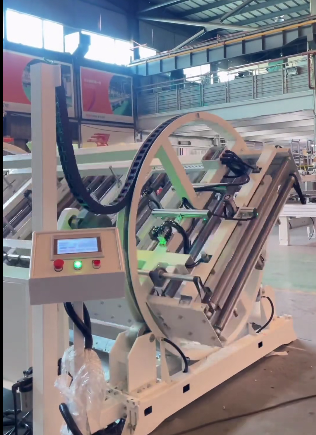
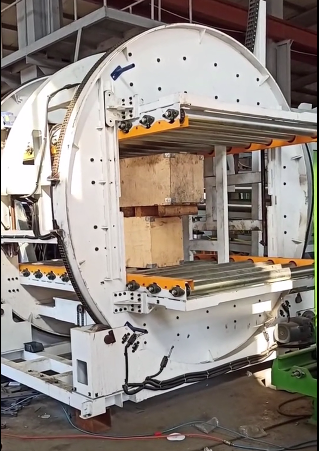
Kokkuvõte Our 180° turning machine is a two-table hydraulic flipper. One table lifts the part past vertical, the second table catches it, and both lower so the part lands on its other face. The FPFT-12 reference build turns up to 12 t from a pedestal hydraulic power unit. A worked example checks a precast panel and a steel sheet against that limit and sets out the cycle budget.
Sisukord
- Why a panel needs turning mid-process
- Two tables, one handover
- The turning cycle step by step
- Hydraulics, stops and power loss
- FPFT-12 reference specifications
- Worked example: panel weight and cycle budget
- Valiku kontroll-leht: mida meile saata
- Ohutus ja EN 415-10
- Inseneri KKK
- Järgmine samm
- Seotud lugemine
- Allikad
Why a panel needs turning mid-process
A precast panel is cast face-down or face-up, and the next step often needs the opposite face: finishing, inspection, embedding fixings or stacking for dispatch. A steel sheet or plate has the same problem when both sides need machining or checking.
Turning a flat, heavy part with a crane and chains is slow. The part swings as its weight shifts over the edge, and the edge that takes the load can chip or dent. A turning machine keeps the part supported on a table for the whole arc.
Two tables, one handover
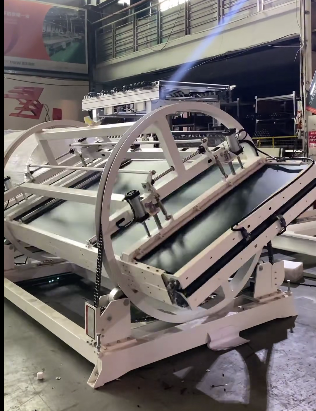
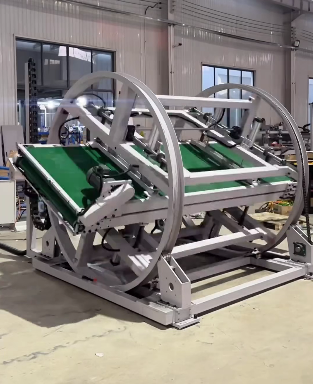
The machine has a blue base frame with two yellow tilting tables, A and B, hinged side by side. Each table only turns through about 90 degrees. The 180° change comes from the handover between them.
Table A carries the part up past vertical. Table B stands upright to receive it. Once the part leans onto B, B lowers it to horizontal on its far side. The face that was down on A is now up on B.
The turning cycle step by step
- Load the part flat onto table A by forklift, crane or hoist.
- Table B turns 90 degrees upright, ready to receive.
- Table A turns about 85 degrees with the part and moves forward until a photoelectric sensor stops it.
- Table A continues to slightly past 90 degrees, so the part leans onto table B.
- Table B turns back 5 degrees, taking the weight.
- Table A moves back and returns to horizontal.
- Table B lowers the part to horizontal, and you unload it from B.
The stop at 85 degrees matters. The part is brought close to B under sensor control before its weight crosses vertical, so it settles onto B instead of falling onto it.
Hydraulics, stops and power loss
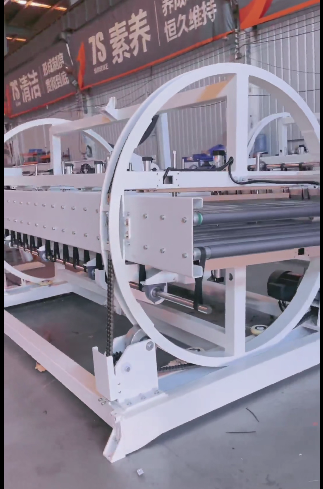
Double-acting hydraulic cylinders drive both tables, with a synchronising device so paired cylinders move together. A pedestal-mounted hydraulic power unit with black hoses feeds them. Turning speed is adjustable.
The system works at up to 15 MPa, with 20 MPa as the maximum allowance. The machine can stop at any angle and hold pressure there. Mechanical and electric stop blocks limit the end positions. If power fails, the tables lock in position and reset softly when power returns.
FPFT-12 reference specifications
| Kirje | FPFT-12 |
|---|---|
| Maksimaalne pööramiskoormus | 12 t |
| Masina mõõtmed | 4,600 × 2,500 × 1,400 mm |
| Mootori väljund | 8.0 kW |
| Masina kaal | 4.5 t |
| Õli reservuaar | 60 L |
| Töörõhk | 15 MPa, 20 MPa max allowance |
| Tables A and B | 500 × 1,800 mm each on the reference build |
| Reference part | steel 50–300 mm thick, 1,800 × 2,500–2,800 mm |
| Toiteallikas | 380 V, 3 faasi, 50 Hz |
| Kontroll | control panel or remote |
The 500 × 1,800 mm table size is the reference build for that plate range. For your part we set table length, width and supports to its footprint, and show them on the drawing we send after design. Long precast panels get longer tables.
Worked example: panel weight and cycle budget
Take two parts a plant wants to turn on one machine. These are illustrative customer figures.
Precast panel. 3,000 × 1,800 × 200 mm at about 2,400 kg/m³. Volume is 3.0 × 1.8 × 0.2 = 1.08 m³, so the panel weighs about 2,590 kg.
Steel plate. 2,800 × 1,800 × 100 mm at 7,850 kg/m³. Volume is 0.504 m³, so the plate weighs about 3,960 kg.
Both sit well inside 12 t. As a cross-check, the thickest reference plate, 2,800 × 1,800 × 300 mm, is 1.512 m³ and about 11.9 t. That is why the reference build is rated at 12 t.
Cycle budget. Say the line needs 20 parts in an 8-hour shift, with a 120 s crane set-down and a 120 s pick. The time available per part is 8 × 3,600 ÷ 20 = 1,440 s. That leaves 1,440 − 240 = 1,200 s for the turn.
The turn time is the sum of the table moves in steps 2 to 7: T = t2 + t3 + t4 + t5 + t6 + t7. Each move depends on part weight and the speed setting, so we state T for your part in the proposal. Compare it with the 1,200 s budget: the gap is your reserve for a heavier part or a slower, gentler setting.
Valiku kontroll-leht: mida meile saata
- Part type: precast panel, slab, steel sheet or mould.
- Length, width and thickness, largest and smallest.
- Heaviest part weight, or material and density.
- Whether you need a full 180° turn or a stop at an angle.
- How the part arrives and leaves: forklift, crane, hoist or conveyor.
- Parts per shift and the floor space available.
Ohutus ja EN 415-10
We build our turning machines to CE requirements, with EN 415-10 as the reference and an ISO 12100 risk assessment. The main hazards are the swept area of both tables and the handover, when the part’s weight moves from A to B.
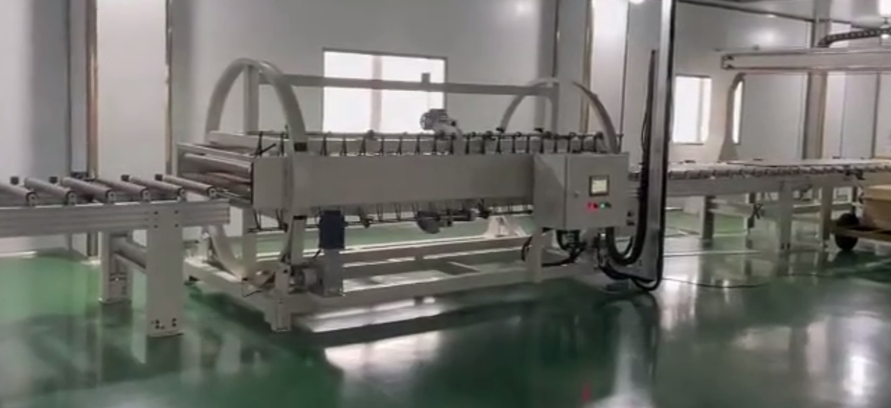
Keep people out of the swept area while either table moves. The operator stands at the control box or uses the remote, clear of both tables. A soft cover shield protects the operating side, and the stop blocks and position lock hold the tables if power is lost.
Inseneri KKK
Q: Can it turn only 90 degrees, to stand a panel upright? A: Yes. Use table A alone and stop at the angle you need; the machine holds pressure there.
Q: What happens if power fails halfway through the turn? A: The tables lock in position, then reset softly when power returns.
Q: Can it handle moulds as well as panels and sheets? A: Yes. We size the tables to the mould or part, and agree the contact surface on the tables with you so a concrete face or finished sheet is not marked.
Q: Which safety standards apply? A: For CE markets we use EN 415-10 as the reference, with an ISO 12100 risk assessment.
Järgmine samm
- Email your part sizes, weights and parts per shift et info@fhopepack.com.
- Vastame 24 tunni jooksul koos ettepanekuga, with table sizes and capacity.
- Saadame paigutusjoonise after design, with the loading and unloading sides.
Seotud lugemine
- Terasplekist klapi ja ülespööramismasin
- Concrete precast wall tilter table
- Teraspleki inverter ja ülespoole suunatud
- Steel sheet 180 degree turning and upending process
- Big frame flipper for 180 degree turning
Allikad
- Specifications and turning cycle: FHOPE steel sheet flipper and upender product page
- Masina video: 180° turning machine for precast components on YouTube
- Panel weight and cycle budget: our worked example, illustrative part figures
- Standardid: EN 415-10 (pakkimismasinad, üldine ohutus); ISO 12100:2010
Viimati üle vaadatud: 2026-10-17