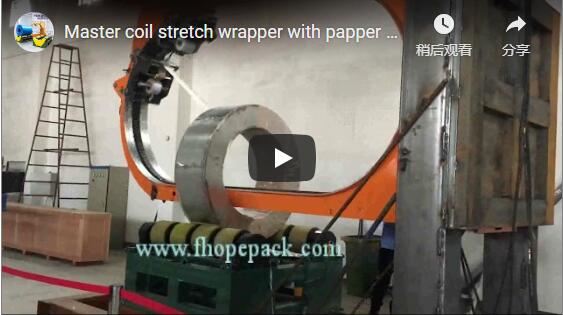
Kokkuvõte Our galvanized steel wire packaging line takes GI wire coils from the drawing machines, straps them, wraps them in stretch film on a ring wrapper and stacks them on pallets with a robot. The FPW-AU300 wrapper takes coils of 300–1,500 kg and 500–1,200 mm OD. Its ring turns at 0–90 r/min and the rollers at 2–4 m/min. A worked example checks a coil against the machine and estimates the wrap time.
Sisukord
- What a GI wire coil needs
- Liin, jaam jaama haaval
- The line shown
- FPW-AU300 wrapper data
- Worked example: coil check and wrap time
- Valiku kontroll-leht: mida meile saata
- Ohutus ja EN 415-10
- Inseneri KKK
- Järgmine samm
- Seotud lugemine
- Allikad
What a GI wire coil needs
Galvanized wire is sold in coils that must stay tight, keep their zinc coating unmarked and arrive dry. A loose coil tangles at the customer’s pay-off. A scratched coating starts to rust, and white rust forms where water sits on zinc.
So the package has two jobs. Straps hold the coil shape, and a film wrap closes it against water and dust. Done by hand at the end of several drawing machines, both jobs take many workers.
Liin, jaam jaama haaval
- Söötmine. The operator sets the coil on the infeed table, and the roller conveyor carries it on.
- Rihmade kinnitamine. The coil is strapped eye-through at 2–4 places, with the tension set for the coil.
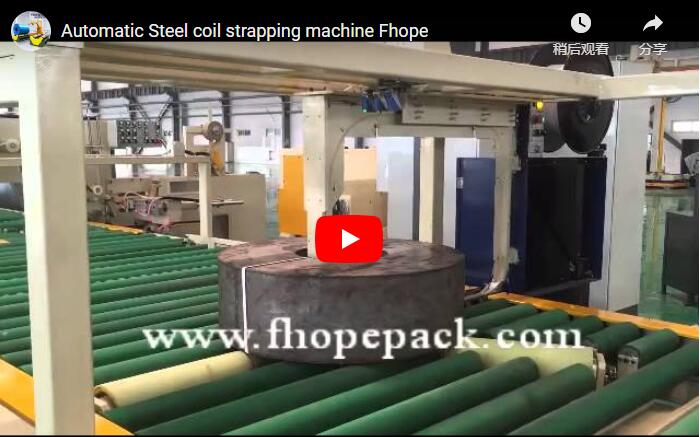
- Pakkimine. Our ring wrapper wraps the coil through the eye in stretch film or paper, while polyurethane-covered rollers turn it. Side protective rollers hold the coil stable.
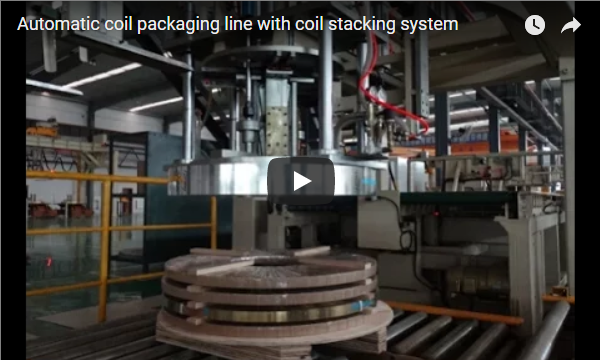
- Virnastamine. A robot picks the wrapped coils off the conveyor and stacks them on pallets.
Each station is set by the HMI for coil size, so a change of coil size is a recipe change rather than a mechanical one.
The line shown
On our line, silver GI wire coils come into a strapping station, and wrapped coils in yellow film run along a yellow-framed roller conveyor. At the end, a red robot arm stacks the wrapped coils on pallets, and full stacks of yellow coils stand in the hall. Several identical stations run side by side, matched to the drawing machines.
FPW-AU300 wrapper data
| Kirje | FPW-AU300 |
|---|---|
| Rulli kaal | 300–1,500 kg |
| Mähise laius | 100–300 mm |
| coil OD | 500–1,200 mm |
| coil ID | 300–900 mm |
| OD − ID | alla 500 mm |
| Rulli kiirus | 2–4 m/min |
| Helina kiirus | 0–90 p/min |
| Kattumine | 10-90% |
| võim | umbes 3.8 kW |
| Varustama | 380 V, 50 Hz, 3 faasi |
| Filmirull | stretch film or paper; 50 mm core, 150–250 mm OD, 120 mm wide |
The ring sits low, which makes loading easier and safer. Overlap is set by inverter, and a brake device sets the film tension so the film does not damage the coating.
Worked example: coil check and wrap time
A wire plant packs GI coils of 800 mm OD, 400 mm ID and 250 mm width. It takes a fill factor of 0.8 for the wound wire. These are illustrative customer figures.
Coil check. OD − ID = 400 mm, under the 500 mm limit. The width of 250 mm and OD of 800 mm are inside the range.
Rulli kaal. Volume = π ÷ 4 × (0.8² − 0.4²) × 0.25 = 0.094 m³. At 7,850 kg/m³ and 0.8 fill, the coil weighs 0.094 × 7,850 × 0.8 = 590 kg, inside 300–1,500 kg.
Turns needed. With the 120 mm film at 50% overlap, each turn advances 60 mm at the OD. The OD circumference is π × 800 = 2,513 mm, so the coil needs 2,513 ÷ 60 = 42 turns.
Wrap time estimate. Ring RPM and roller surface speed are interlocked by inverter so the film keeps the set overlap. For 42 turns at 50% overlap the coil must turn once while the ring lays those turns: OD perimeter π × 0.8 = 2.51 m. At a mid-range roller speed of about 3.35 m/min that coil revolution takes 2.51 ÷ 3.35 × 60 ≈ 45 s, and the ring VFD is throttled to about 42 ÷ (45/60) ≈ 56 r/min (well inside 0–90 r/min). At 2.51 m/min roller speed the same wrap takes about 60 s with the ring at 42 r/min. Wrap time is therefore set by the roller feed and the chosen overlap, typically about 45–75 s of wrapping for this coil, plus loading and cutting.
Kile mähisel. One turn covers 2 × (800 − 400) ÷ 2 + 2 × 250 = 900 mm, so 42 turns lay about 38 m of film.
Valiku kontroll-leht: mida meile saata
- Wire diameter and coating.
- Mähise välisläbimõõt, siseläbimõõt, laius ja kaal.
- Rihmad mähise ja rihma tüübi kohta.
- Film or paper, and colour.
- Coils per hour, and how many drawing machines feed the line.
- Kaubaaluse suurus ja virnastamismuster.
Ohutus ja EN 415-10
For CE markets we use EN 415-10 as our reference for the coil wrapper and packaging stations, with a risk assessment to ISO 12100. The integrated robotic palletizer cell is treated under ISO 10218-2 with EN 415-10 safety integration. The main hazards are the turning ring, the strapping head, the conveyor and the robot’s working area.
The wrapper has a guardrail and a separate electrical box for safe operation and fault-finding, with soft start and stop. The robot stacking area needs its own fence with interlocked access.
Inseneri KKK
Q: Will the film scratch the zinc coating? A: The rollers are covered with polyurethane, and the film tension is set by a brake device, so the coating is protected.
Q: Can we wrap in paper instead of film? A: Yes. The FPW-AU300 takes stretch film or paper.
Q: How big is the film roll? A: 50 mm core, 150–250 mm OD and 120 mm wide.
K: Milliste standardite järgi te ehitate? V: Meie CE-märgise viitena on EN 415-10 koos ISO 12100 riskihindamisega.
Järgmine samm
- Saatke meile oma mähiste suurused, kaalud ja mähiste arv tunnis et info@fhopepack.com.
- Vastame 24 tunni jooksul koos ettepanekuga, with the stations and layout.
- We send a cycle estimate for your coil mix.
Seotud lugemine
- Automaatne terastraadist mähise pakkimismasin
- Automaatne terastraadi kerimis- ja sidumismasin
- Traadi mähise pakkimismasin FPW-500
- Wire coil strapping wrapper for coil stacking line
- How to pack steel wire by automatic machine
Allikad
- Specifications: FHOPE automatic steel wire coil packing machine (FPW-AU300) and wire coiling and strapping machine pages
- Masina video: galvanized steel wire packaging line on YouTube
- Coil weight and wrap time: our worked example, illustrative coil figures
- Standards: EN 415-10 (packaging machines); ISO 10218-2 (robot cell); ISO 12100:2010
Viimati üle vaadatud: 2026-10-17