> **Resumen ejecutivo**
>
> This upender turns a heavy load and its pallet through 90°, then a sliding table carries both out of the cradle onto a roller conveyor. Pallet positioning locates the pallet the same way every cycle, so the load always meets the backrest square. Our gear-driven upenders come in 3, 5, 10 and 20 t versions, with 50–100 s per turn.
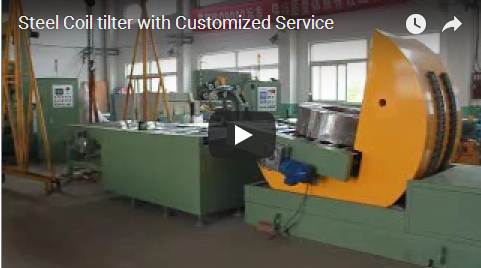
The load here is a heavy brown ring on a pallet, standing on edge in the yellow C-frame cradle. The cradle turns it through 90° until the ring lies flat, and the sliding table then moves the pallet out of the frame onto the roller conveyor behind.
Índice
- Why add positioning and a sliding table
- estructura de la máquina
- Ciclo de trabajo
- Especificaciones
- Ejemplo práctico: turnos por turno
- Aplicaciones
- Lista de verificación de selección
- Seguridad: EN 415-10 e ISO 12100
- Preguntas frecuentes sobre ingeniería
- El próximo paso
- Lectura relacionada
- Fuentes
Why add positioning and a sliding table
A plain upender turns the load, and a forklift or crane then has to reach into the cradle to take it out. That is slow, and it puts people next to a heavy load. Two additions fix this:
- **Pallet positioning.** Guides locate the pallet on the table. The load sits in the same place every time, square to the backrest, so it turns without shifting.
- **Sliding table.** After the turn, the table slides out of the cradle and hands the pallet to a roller conveyor. Nobody reaches into the machine, and the upender can sit in a conveyor line.
estructura de la máquina
| Part | Function |
| :--- | :--- |
| C-frame cradle | turns on rollers under its curved rim, 90° between the two positions |
| Base table and backrest | carry the load in the upright and flat positions |
| Roller backrest | lets the pallet roll in and out when it stands on edge |
| Pallet positioning guides | locate the pallet square on the table |
| Sliding table | moves the pallet out onto the conveyor after the turn |
| Gear motor drive | turns the cradle; the drive is sized to the load |
| Limit devices | two displacement limiters and limit sensors |
The gear drive holds the cradle at any angle, even if the power is turned off; the holding method for your drive size is confirmed at quote.
Ciclo de trabajo
1. **Infeed.** The pallet and load enter the cradle and stop against the positioning guides.
2. **Turn.** The cradle turns 90°, moving the load weight from one face of the cradle to the other.
3. **Slide out.** The sliding table carries the pallet out of the cradle onto the roller conveyor.
4. **Return.** The table comes back, and the cradle returns to receive the next load.
Especificaciones
| Item | FPCT-03 | FPCT-05 | FPCT-10 | FPCT-20 |
| :--- | :--- | :--- | :--- | :--- |
| Max load | 3 t | 5 t | 10 t | 20 t |
| Time per turn | 50–90 s | 50–90 s | 60–90 s | 60–100 s |
| Power supply | AC 380 V, 50 Hz, or to order | same | same | same |
| Drive | gear motor | gear motor | gear motor | gear motor |
| Table size, sliding stroke, power | confirmed at quote | | | |
Ejemplo práctico: turnos por turno
A forge turns 5 t rings from edge to flat for machining on an FPCT-05.
| Paso | Cálculo | Resultado |
| :--- | :--- | :--- |
| Turn time | upper end of 50–90 s | 90 s |
| Slide out and return (illustrative) | estimate | about 60 s |
| Cradle return to the upright position | same as the turn | 90 s |
| Cycle per ring | 90 + 60 + 90 | about 240 s |
| Rings per hour | 3,600 ÷ 240 | about 15 |
| Rings per 8 h shift at 75% use | 15 × 8 × 0.75 | about 90 |
**Result.** About 90 rings per shift with no crane in the turning step. If the next ring can be fed while the cradle returns, the cycle shortens toward 150 s and about 24 rings per hour.
Aplicaciones
- Forged and machined rings, wheels and flanges.
- Steel, wire and copper coils on pallets.
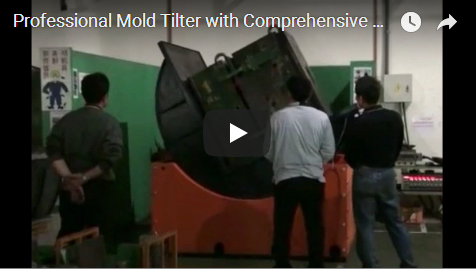
- Molds and dies that must be turned for storage or service.
- Heavy boxes and crates that must lie on another face.
Lista de verificación de selección
1. Heaviest load including the pallet.
2. Load and pallet size.
3. Turn direction and angle.
4. Conveyor height and direction in and out.
5. Turns per hour.
Seguridad: EN 415-10 e ISO 12100
Upenders are covered by EN 415-10, with the risk assessment to ISO 12100:2010. The turning cradle, the sliding table and the conveyor transfer are the main hazards. The operator works away from the turning position, two displacement limiters and limit sensors end the travel, and an emergency stop with a position lock stops rotation. Guarding and CE documents are agreed per project.
Preguntas frecuentes sobre ingeniería
Q: What does the sliding table add?
A: It moves the turned load out of the cradle onto a conveyor, so no crane or forklift reaches into the machine.
P: ¿Qué ocurre si se produce un fallo eléctrico a mitad de un giro?
A: The gear drive holds the cradle where it is.
Q: How heavy can the load be?
A: 3 t to 20 t, depending on the model.
P: ¿Cuánto tiempo dura un turno?
A: 50–100 s, depending on the model and load.
Q: Can it turn coils as well as rings?
A: Yes. The same machine family turns coils, rings, molds and crates.
El próximo paso
1. **Send your load size, weight and conveyor layout** to info@fhopepack.com.
2. **We size** the upender, positioning and sliding table.
3. **Respondemos en un plazo de 24 horas** con una propuesta y un presupuesto.
Lectura relacionada
- [Inclinador de bobinas (producto)](https://www.fhopepack.com/Mechanical/Coil-Upender-Tilter.html)
- [Volteador de bobinas hidráulico (producto)](https://www.fhopepack.com/Coil-Upender/Hydraulic-Coil-Upender.html)
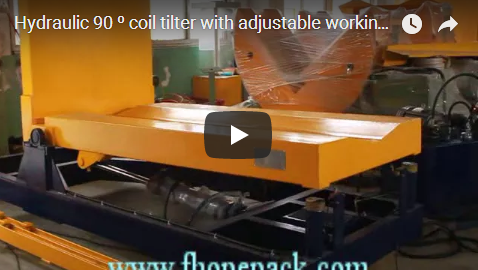
- [Inclinador hidráulico de bobinas de 90° con mesa de trabajo ajustable](https://www.fhopepack.com/videos/hydraulic-90-o-coil-tilter-with-adjustable-working-table/)
- [Upender and tilter with rotation table](https://www.fhopepack.com/videos/the-upender-and-tilter-with-rotation-table/)
- [Upender with custom fixture for heavy castings](https://www.fhopepack.com/videos/upender-with-custom-fixture-for-heavy-castings/)
Fuentes
- FHOPE product page: coil upender tilter (FPCT series)
- EN 415-10; ISO 12100:2010
- Our upender with pallet positioning and sliding table shown above
Última revisión: 19/10/2026