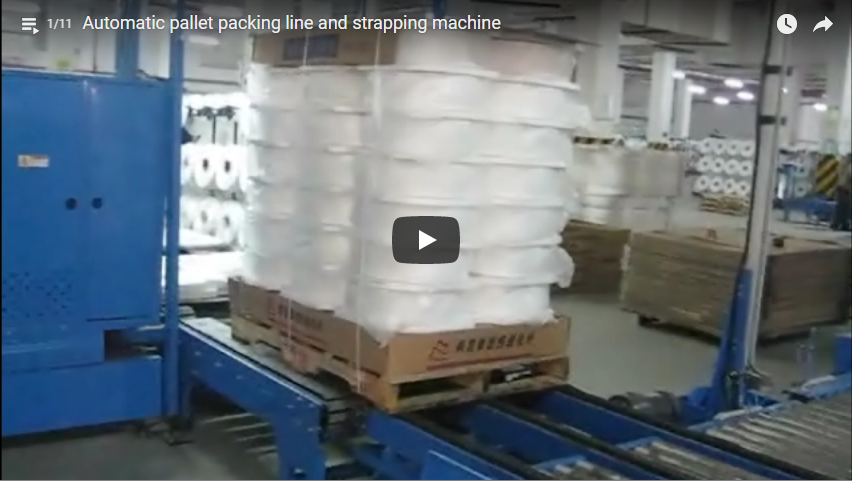
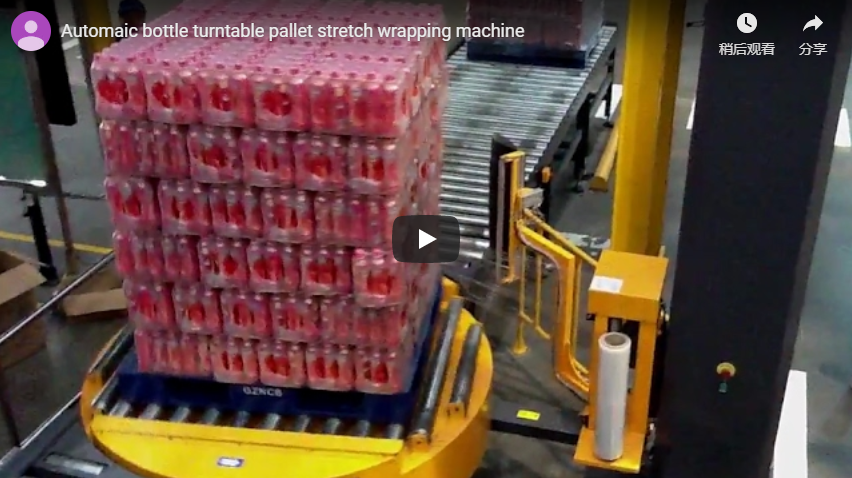
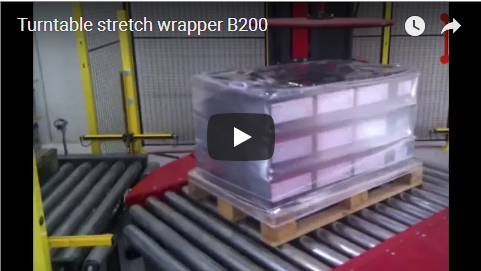
Shrnutí: Stretch film alone does not stop a pallet load from sliding off its skid under hard braking, and a strap alone does not keep rain, dust, or tampering away from the cartons. Running two separate machines means the load is handled twice and travels between stations without containment. An integrated machine keeps the pallet on one turntable, applies the film envelope first, then tensions PET straps over that film, so the film spreads strap pressure across the carton edges instead of crushing them. One clamping, one cycle, one footprint.
Explore FHOPEPACK Complete Packaging Systems
Obsah
- Why Do Pallet Loads Need Film and Strap Together?
- How Does the Wrap-and-Strap Cycle Run at One Station?
- What Pallet Sizes and Loads Fit the Machine?
- Parallel or Cross Strapping: Which Pattern Holds the Load?
- How Are Film Tension, Pre-Stretch and Overlap Set?
- What Strapping Parameters Decide Joint Strength?
- How Do You Size Cycle Time Against the Line Rate?
- What Footprint, Power and Air Does the Cell Need?
- How Is the Load Held During Wrapping and Strapping?
- Which Acceptance Tests Prove a Pallet Is Ship-Ready?
- What Inputs Does an RFQ Need Before Sizing?
- Související řešení balení
- Závěr
Why Do Pallet Loads Need Film and Strap Together?
Film and strap fail in different ways. Film keeps moisture, dust and tampering out but creeps under sustained shear; strap locks the load to the pallet but crushes carton edges when it is applied bare. The two only work together when the film goes on first.
Stretch film works through elastic memory. LLDPE is stretched by a powered pre-stretch carriage and then contracts around the load perimeter, holding the cartons as one block. That memory is also its limit: under sustained shear the film relaxes, and a heavy load can shift as a block, taking the film with it.
PET strap works the other way. It is a high-tensile polyester band tensioned to several hundred newtons, mechanically binding the load down onto the pallet stringers. Applied directly to corrugated cartons, that same tension concentrates on a narrow band and buckles the top layer.
The sequence resolves both. Film first wraps the load into one mass and gives the strap a load-spreading surface; the strap then compresses the whole package down onto the skid. Applied in the other order, the strap sits under the film and the film cannot be tensioned without dragging the strap out of position.
        FILM FIRST, THEN STRAP                STRAP FIRST, THEN FILM
   ┌───────────────────────────┐        ┌───────────────────────────┐
   │  film envelope over load  │        │  strap bites carton edge  │
   │  ▼ strap presses on film  │        │  ▼ film wraps over strap  │
   │  pressure spread wide     │        │  strap cannot re-tension  │
   │  load locked to skid      │        │  load still free to slide │
   └───────────────────────────┘        └───────────────────────────┘
How Does the Wrap-and-Strap Cycle Run at One Station?
The pallet never leaves the turntable. A top platen clamps the load, the film carriage climbs and descends, the film is cut and wiped, a sword feeds PET strap through the pallet void, and the turntable indexes 90 degrees for the cross pass.
- Docking and centring. A forklift sets the pallet on the turntable. The operator starts the cycle from the HMI or a pendant.
- Top clamping. A pneumatic platen descends on vertical guides and presses the top tier, so tall or light loads cannot tilt when the turntable accelerates and the film carriage pulls.
- Balení fólií. The turntable ramps up on an S-curve. The carriage applies base wraps around the skid, climbs the load at a set overlap, applies crown wraps at the top, and returns.
- Řez a setřít. An impulse wire or hot-wire cutter severs the film; a pneumatic brush wipes the tail onto the cling side so the next cycle starts cleanly.
- Parallel strapping. The turntable indexes to the reference angle. A bayonet sword passes through the pallet fork void, the feed head drives PET band around the load, tensions it to setpoint, and welds the joint by friction vibration.
- Cross strapping. The turntable indexes 90 degrees under encoder feedback and the sword repeats the pass through the adjacent void, so the second strap crosses the first.
- Uvolnění. The platen retracts, the sword returns home, and the interlocks clear for the forklift to remove the finished pallet.
The whole sequence runs on one PLC recipe: height, wrap count, strap count, strap tension and index angle are stored per product, so a changeover is a recipe call, not a mechanical reset.
What Pallet Sizes and Loads Fit the Machine?
The working envelope is a 1000 to 1200 mm length, 1000 to 1200 mm width, 800 to 1800 mm load height, and 100 to 2000 kg gross weight. Anything beyond that is a different frame, not a different setting.
| Parametr | Minimální | Maximum |
|---|---|---|
| Délka palety | 1000 mm | 1200 mm |
| Šířka palety | 1000 mm | 1200 mm |
| Load height, pallet included | 800 mm | 1800 mm |
| Gross payload weight | 100 kg | 2000 kg |
Two checks decide whether a load really fits. The first is the rotation envelope: a rectangular load sweeps a circle, and the turntable plus mast clearance must contain it.
D_turntable >= sqrt(L_load² + W_load²) + 2 * C_clearanceFor a 1200 mm by 1000 mm load:
sqrt(1200² + 1000²) = sqrt(1,440,000 + 1,000,000) = 1562 mm
D_turntable >= 1562 + 2 * 280 = 2122 mm  ->  a 2200 mm disc
That 2200 mm disc matches the platform used on the automatic turntable wrappers in the same series, so a load inside the stated envelope fits without corner contact against the strapping sword or the mast.
The second check is overhang. Cartons wider than the pallet still rotate, and the overhanging corners are what strike the sword track first. Measure the widest diagonal of the loaded pallet, not the nominal pallet size.
Parallel or Cross Strapping: Which Pattern Holds the Load?
Parallel straps resist tipping; cross straps resist shearing between layers. Light, stable loads can run parallel only; stacked or heavy loads need both.
- Parallel, one-way. Two straps run over the top of the load and down both sides to the pallet. This is the fast configuration and it is enough for low, wide loads that will not slide layer over layer.
- Cross, two-way. The turntable indexes 90 degrees and a second pair of straps crosses the first. The four-way pattern locks the load against lateral shear and against layer slip on column-stacked cartons, which is what deep-sea and long-haul road freight actually demand.
The cost is cycle time: each additional strap adds a full feed, tension and weld cycle. That is why the pattern is a recipe decision rather than a fixed build. A machine that indexes 90 degrees on command can run parallel-only on one product and four-way on the next without a mechanical change.
Strap placement matters as much as count. Straps must land on the pallet stringers, not in the fork voids, or the tension pulls the band down through the pallet instead of clamping the load.
How Are Film Tension, Pre-Stretch and Overlap Set?
Pre-stretch does the holding work. The carriage stretches the film before it touches the load, so the film arrives with stored tension instead of being dragged tight around the corners.
- Pre-stretch ratio. Power pre-stretch at 200 to 250 percent is the usual working range, with the wider 100 to 300 percent band available on the automatic turntable wrappers in the same series. Higher ratios use less film per pallet but leave less residual tension at the corners.
- Překrytí. A 20 to 30 percent vertical overlap between successive carriage passes gives a continuous envelope with no horizontal gaps for dust or rain.
- Base wraps. Three to four reinforced turns around the wooden skid anchor the film to the pallet, which is what stops the whole envelope from lifting off when the load is handled.
- Šířka filmu. 500 mm film on a 76 mm core is the standard carriage fit; the film gauge normally sits at 0.020 to 0.025 mm.
Film consumption follows the wrap count. A 1200 by 1000 mm pallet has a 4.4 m perimeter; nine revolutions at 250 percent pre-stretch use about 11 m of raw film, roughly 0.13 kg of LLDPE per pallet, which is what makes the consumable budget predictable.
What Strapping Parameters Decide Joint Strength?
PET strap is specified by width, thickness and tension, and the joint is a friction weld. Joint efficiency, not strap strength, is usually the limiting factor.
- Strap format. PET band at 9 to 12 mm wide and 0.4 to 1.0 mm thick covers the range used on FHOPE strapping heads, with tension set between 100 and 1000 N depending on load mass.
- Kloub. High-frequency friction vibration melts the overlap, and the clamp must hold pressure for about one to one and a half seconds while the weld cools. Release early and the joint efficiency drops below roughly 75 percent of the parent strap strength.
- Strap path. The strap passes through the pallet void and over the film, so it must be tensioned against the film surface without cutting it.
PET is the right default for export pallets: it does not rust, it does not spring back like steel band, and its rounded edges do not bite into carton corners.
How Do You Size Cycle Time Against the Line Rate?
Cycle time is the sum of clamping, wrapping, cutting, each strap, each index, and release. Add the forklift swap and you have the real station rate.
T_cycle = T_clamp + T_film + T_cut + N_parallel * t_strap
        + T_index + N_cross * t_strap + T_release
Film time comes from the wrap count and turntable speed:
N_rev = N_base + N_top + H_load / (W_film * (1 - overlap))
T_film = N_rev / RPM * 60
Worked case, example only: a 1500 mm load, 500 mm film, 25 percent overlap, 3 base wraps, 2 crown wraps, 10 rpm, 2 parallel plus 2 cross straps.
N_rev = 3 + 2 + 1500 / (500 * 0.75) = 3 + 2 + 4 = 9 revolutions
T_film = 9 / 10 * 60 = 54 s
T_cycle = 6 + 54 + 7 + (2 * 10) + 3 + (2 * 10) + 5 = 115 s
Machine-only output is 3600 / 115 = 31 pallets per hour. With a 35 s forklift swap the station settles at 3600 / 150 = 24 pallets per hour, which is the same order as the 24 loads per hour minimum quoted for the automatic turntable wrappers in the series.
Two levers move that number. Dropping the cross pass takes the cycle to about 92 s and the station to roughly 28 pallets per hour with the same swap. Adding an infeed conveyor or a second turntable hides the swap entirely and pushes the station back toward the machine-only limit.
What Footprint, Power and Air Does the Cell Need?
The cell needs the turntable swing circle, forklift access on at least one full side, a dedicated three-phase feed, and enough stored air to fire the platen, the sword and the strap clamp in the same few seconds.
- Patro, podlaha, dno. A 3800 by 3200 mm clear zone is a presumed figure to be confirmed against the arrangement drawing. The binding constraint is the turntable swing plus the mast and the sword track, not the machine base.
- Turntable. The disc runs 1800 to 2200 mm in this class; the platform in the same series as the automatic wrappers is 2200 mm at about 400 mm table height, sized for 2000 kg loads.
- Power. 380 V three-phase at 50 Hz with a dedicated fused disconnect. Total installed capacity for a cell of this type sits around 3.0 to 4.5 kW, dominated by the turntable drive, the carriage lift, and the strap head.
- Vzduch. A dry supply at 0.6 to 0.8 MPa. The platen, the sword and the strap clamp all fire within seconds of each other, so a 100 litre buffer tank at the machine beats a long ring-main run.
- Přístup. Forklift entry from the front, with the operator station outside the swing circle.
How Is the Load Held During Wrapping and Strapping?
Two things keep the load where it belongs: the top platen pressing down during the cycle, and the interlock that stops the turntable the moment anyone enters the swing circle.
The platen is the difference between a stable cycle and a fallen load. Light cartons lift when the film carriage pulls and the turntable accelerates; tall stacks tilt before the film has enough wraps to hold them. A pneumatic platen descending on guided rails presses the top tier flat for the whole wrap and strap sequence, at a working pressure in the 0.3 to 0.5 MPa range. The same platen is offered as a dedicated top-press configuration on the semi-automatic pallet wrappers in the range.
Safety follows the logic of any rotating load station:
- Interlocked perimeter fencing or light curtains across the load entry, so the drive cannot start with a person inside the swing circle.
- An E-stop that brakes the turntable and dumps the pneumatic circuit, targeted at a stop within half a second.
- A sword and strap track that only extends when the turntable is at the reference angle, so the band cannot be fed into a rotating load.
- A load height photocell that aborts the cycle if the stack is above the recipe height rather than letting the carriage climb into the platen.
Which Acceptance Tests Prove a Pallet Is Ship-Ready?
Test at production speed with the heaviest and the lightest product, not with one convenient sample. Five measurements decide acceptance: film continuity, strap tension, joint integrity, index accuracy, and stop time.
| Kontrola | Kritérium přijetí |
|---|---|
| Film continuity | no horizontal gaps, 20 to 30 percent overlap held over the full height |
| Kotvení základny | three to four wraps locked to the skid, film does not lift on handling |
| Napnutí popruhu | set tension held after 24 hours, no visible creep |
| Integrita kloubu | friction weld at or above 75 percent of parent strap strength on a pull test |
| Cross index accuracy | 90 degree index within plus or minus 1.5 degrees, no strap twist at the crossing |
| Platen action | top tier flat, no crushed cartons at minimum and maximum load height |
| E-stop | turntable and air dump stop within 0.5 s |
| Opakovatelnost | ten consecutive pallets within the recipe, no manual rework |
What Inputs Does an RFQ Need Before Sizing?
Most sizing errors come from quoting a nominal pallet instead of the loaded pallet. Six data blocks close the specification.
| Vstup | Proč je to potřeba | Pokud chybí |
|---|---|---|
| Loaded pallet length, width, diagonal | sets turntable diameter and sword clearance | corners strike the sword track |
| Rozsah výšky nákladu | sets carriage stroke and platen travel | carriage climbs into the platen |
| Gross weight, minimum and maximum | sets turntable drive and bearing class | drive undersized at the top of the range |
| Vzor páskování | sets sword travel and index logic | pattern cannot be changed by recipe |
| Specifikace filmu | sets carriage width and pre-stretch ratio | film tears at the corner radius |
| Line rate and available floor | sets whether one turntable is enough | station becomes the bottleneck |
Send the six blocks with a plant layout and our engineers return an interference review within 24 hours and a general arrangement drawing within 48 hours.
Související řešení balení
Adjacent and upstream equipment in the same end-of-line family:
- Automatický balicí stroj na palety B300 — 2200 mm turntable, 2000 kg, film covering and automatic cut and wipe.
- Automatický ovinovací stroj palet B200 — mid-throughput turntable wrapper for standard loads.
- Automatický balicí stroj na palety B100 — entry automatic turntable platform with pre-stretch control.
- Automatic pallet stretch wrapper range — full series from semi-automatic to inline conveyor models.
- A600 pallet stretch wrapper with top press — the top-press configuration for loads that lift during wrapping.
- A500 pallet stretch wrapper with scale — wrapping and weighing combined in one station.
- Automatický páskovací stroj na PET cívky — PET band handling for coil rather than pallet loads.
Závěr
Choose the integrated cell when the pallet has to be contained and locked down in one pass, when floor space rules out two stations, and when the load is between 100 and 2000 kg on a pallet up to 1200 mm by 1200 mm and 1800 mm tall. If the load is light, low and stable, parallel strapping only is enough and the cycle shortens by roughly a quarter. If it is column-stacked and going to sea, run the four-way pattern and accept the longer cycle. Above the stated envelope, or above roughly 30 pallets per hour, the answer is a bigger frame or a conveyor-linked line, not a faster recipe.
Submit your loaded pallet dimensions, gross weight range, strapping pattern, and floor plan to www.fhopepack.com for an interference review within 24 hours and a general arrangement drawing within 48 hours.