
What Safety Features Are Essential in MDF Horizontal Packing Line Design?
Are you a factory manager facing constant pressure to boost output, control costs, and keep your team safe? I know this feeling well. I’m Randal Liu, and from my own journey building FHOPEPACK, I’ve learned that overlooking safety in your packing line is a direct path to downtime, injuries, and lost profits. Many managers, especially in busy facilities like a metal processing plant in Mexico, focus only on speed. But I tell you, true efficiency starts with a safe design. (packing line safety, industrial efficiency, factory manager challenges)
Ensuring robust safety features in MDF horizontal packing line design is critical for protecting workers, preventing product damage, and maintaining high operational efficiency. Key elements include advanced machine guarding, effective emergency stop systems, comprehensive sensor integration for hazard detection, and user-friendly control interfaces to minimize human error, all working together to create a secure and productive environment for MDF panel packaging. (MDF packing line safety, essential safety features, horizontal wrapping protection)
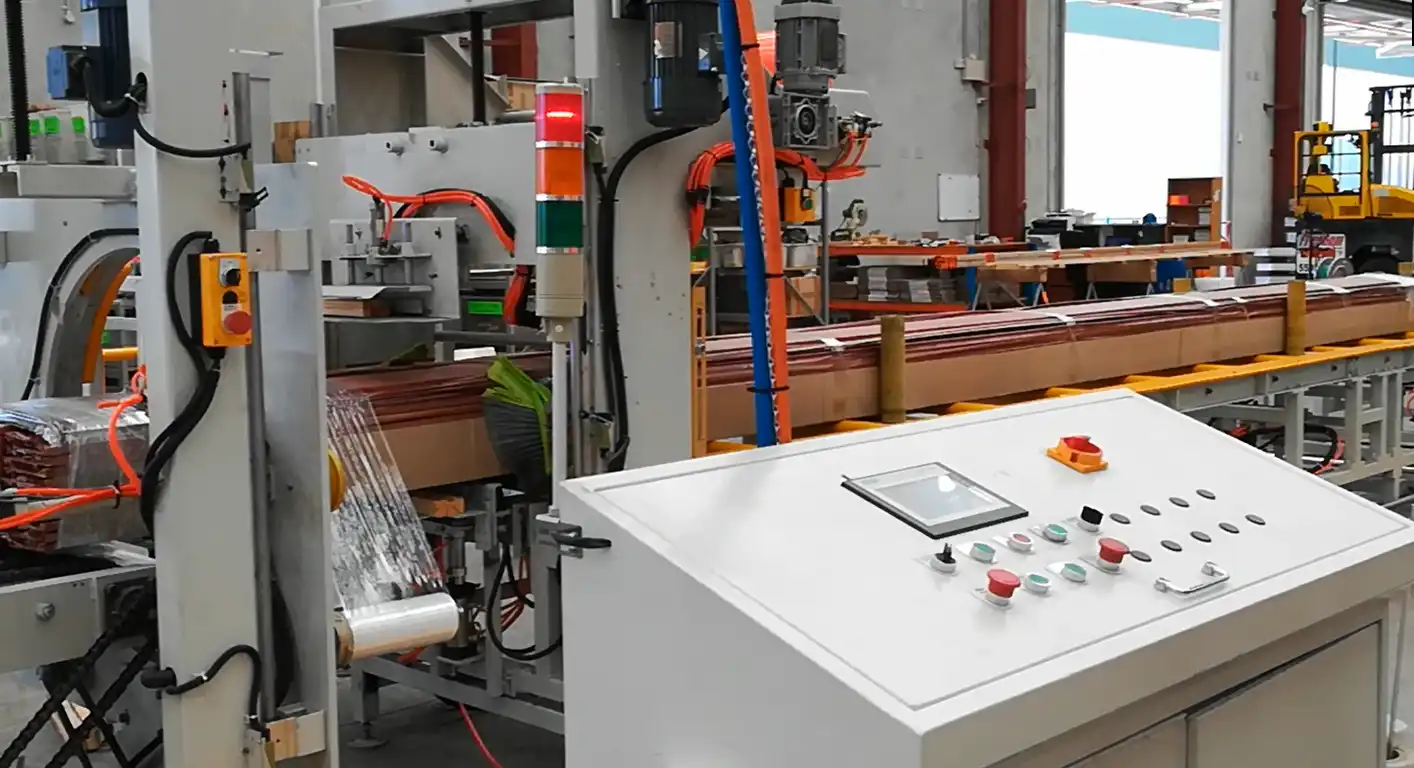
It’s easy to get lost in the technical jargon of new equipment. But for a manager like you, someone who values reliable solutions and understands the real costs of production bottlenecks, delving into these safety features is not just about compliance. It is about future-proofing your operations. Let’s dig deeper into what truly makes a horizontal packing line safe and effective for MDF.
How Do Automated Systems Enhance Safety in MDF Horizontal Packing Lines?
Does your current MDF packing process still rely heavily on manual labor? I’ve seen firsthand how this can create significant safety risks and slow down operations. Many factory managers face pressure to upgrade, but they wonder how automation truly translates into better worker protection. The truth is, moving away from manual handling changes everything. (automated packing safety, worker protection, manual labor risks)
Automated systems significantly enhance safety in MDF horizontal packing lines by minimizing direct human interaction with heavy or moving parts, employing robotics for repetitive or hazardous tasks, and integrating precise control to reduce the risk of accidents caused by human error or fatigue, thereby transforming a high-risk environment into a safer, more predictable workspace for packaging MDF products. (automated packing line safety, MDF packaging automation, robotics industrial safety)
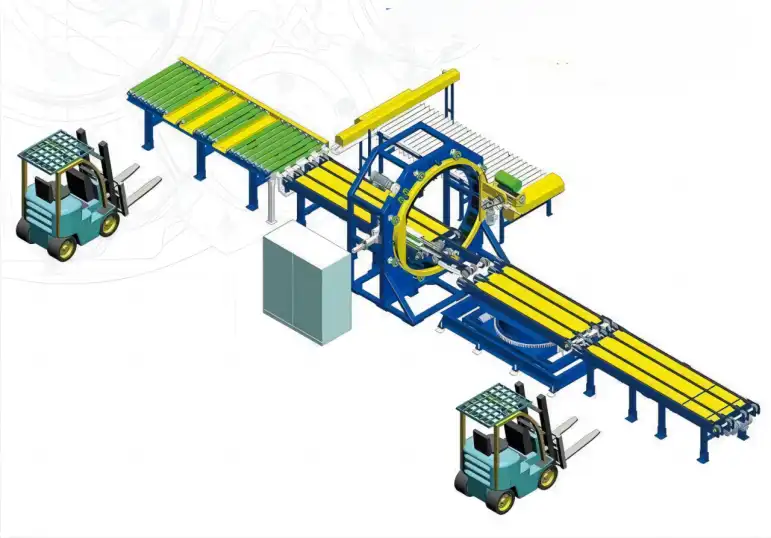
My own journey, from an employee at a packing machine factory to building FHOPEPACK, taught me that every improvement in automation directly impacts worker safety. When I worked with heavy steel coils and wire, I saw the dangers of manual loading and wrapping. For MDF boards, which can also be bulky and heavy, the principles are the same. Automation removes workers from the immediate danger zone. It also ensures consistent movements, reducing the unpredictable human element that often leads to injuries. Managers like Michael in Mexico, overseeing large metal processing plants, know that insurance costs and employee turnover are directly linked to workplace accidents. Investing in automation is an investment in your people and your bottom line.
Key Ways Automation Boosts Safety:
-
Reducing Manual Handling: 🚶♂️➡️🤖
- Problem: Manual lifting and maneuvering of heavy MDF panels cause back injuries, cuts, and crushed limbs. Workers face high fatigue, increasing error rates. This is a common issue in many factories, including those I’ve visited in Mexico.
- Solution: Conveyor systems, automatic loaders, and robotic stackers take over the physical strain. Workers monitor operations from a safe distance. This eliminates the need for personnel to be close to moving machinery or heavy loads. It drastically cuts down on workplace accidents related to overexertion or accidental contact.
- Benefit: Lower rates of musculoskeletal disorders and immediate reduction in severe accident risks. (manual handling reduction, robotic packaging safety)
-
Minimizing Human-Machine Interaction: 🖐️🚫⚙️
- Problem: Anytime a human needs to adjust, feed, or clear a jam directly within a machine’s operating area, the risk of injury skyrockets. Past experiences with unreliable suppliers taught many, including myself, that machines lacking proper automation lead to more operator intervention and, thus, more danger.
- Solution: Integrated sensors and vision systems detect issues early. Automated diagnostic tools allow for remote troubleshooting. Automatic film feeders and cutters mean operators do not need to reach into dangerous areas. FHOPEPACK’s designs prioritize this minimal interaction.
- Benefit: Fewer incidents where operators are exposed to pinch points, rotating parts, or high-speed components. (human-machine safety, automated troubleshooting, machine guarding)
-
Ensuring Consistent Process Control: 🔄✅
- Problem: Inconsistent manual processes or poorly calibrated semi-automated machines can lead to unexpected machine movements or product instability. This creates an unpredictable and hazardous environment. Product damage, like scuffed MDF edges, also often results from inconsistent handling.
- Solution: Programmable Logic Controllers (PLCs) manage every step of the packing process with precision. Speed, tension, and positioning are controlled digitally. This removes variability. Companies like SHJLPACK and FHOPEPACK focus on robust control systems.
- Benefit: Predictable machine behavior, stable loads, and a significantly reduced chance of unexpected events causing injuries or product damage. (process control safety, PLC automation, consistent packaging)
| Safety Aspect | Manual Process Risks | Automated System Benefits |
|---|---|---|
| Worker Exposure | Direct contact with moving parts, heavy loads | Remote operation, workers away from danger zones |
| Injury Types | Lacerations, crushes, back strains, fatigue | Significant reduction in physical injuries |
| Operational Control | Inconsistent, prone to human error | Precise, repeatable, digitally controlled |
| Product Integrity | Higher risk of damage during handling | Gentle, consistent handling, reduced damage |
| Emergency Response | Slower manual reaction to incidents | Integrated sensors for rapid shutdown |
(industrial automation, workplace safety, packing line efficiency)
What Specific Design Features Prevent Product Damage During Horizontal Wrapping?
Have you ever faced customer complaints due to damaged products arriving at their destination? For factory managers, nothing is more frustrating. In my experience, even minor damage, like scuffed edges on MDF panels, translates into lost revenue and damaged reputation. So, how can a packing line’s design actively work to protect your products? (product damage prevention, horizontal wrapping protection, customer satisfaction)
Specific design features in horizontal wrapping machines prevent product damage by incorporating adjustable tension controls for film application, gentle handling mechanisms for conveying delicate materials like MDF, integrated product support during wrapping, and specialized edge protection systems to shield vulnerable areas, ensuring products remain intact and pristine throughout the packaging process. (MDF damage prevention, horizontal wrapper design, product integrity features)
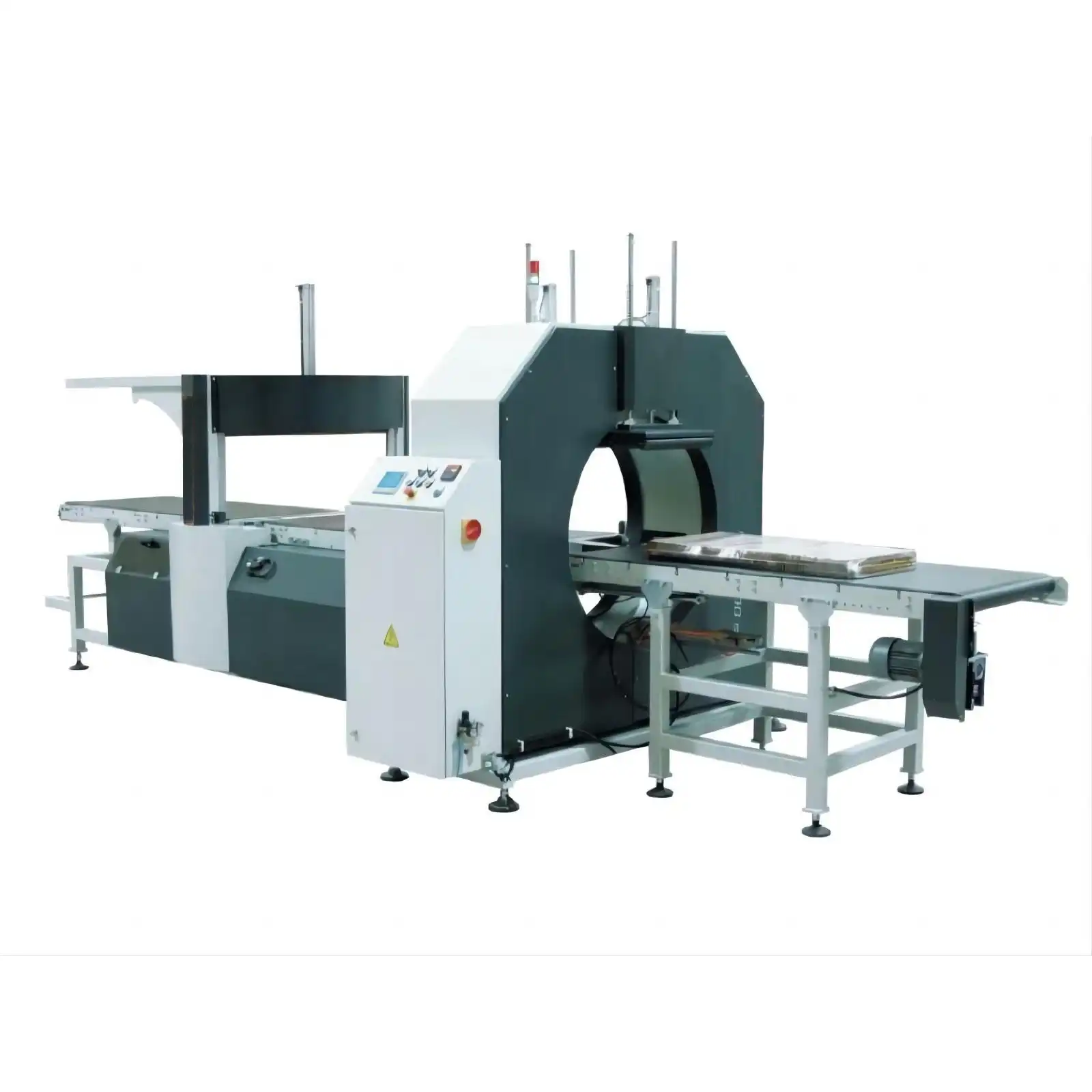
During my time establishing FHOPEPACK, I learned that a packing machine is not just about wrapping quickly; it is about wrapping correctly. For items like MDF panels, which can be vulnerable to edge impact or surface abrasions, this “correctness” directly impacts your bottom line. Michael Chen, a factory manager in Mexico, understands that product loss during internal transfer and packing is a direct hit to profits. He needs a solution that actively protects his output. My background in packing steel wires and coils taught me that even the most robust products need careful handling, and MDF is no different.
Essential Design Features for Damage Prevention:
-
Adjustable Film Tension Control: 🎯⚙️
- Problem: Too much film tension can warp or crush the product, especially for lighter or less rigid MDF panels. Too little tension leaves the product inadequately protected, risking damage from movement or external factors. This balance is tricky with manual methods.
- Solution: Modern horizontal wrappers, like those from FHOPEPACK and SHJLPACK, feature precise, electronic tension control systems. Operators can fine-tune film tension based on the specific MDF product’s dimensions and fragility. This ensures a snug but not over-tight wrap.
- Benefit: Optimal packaging integrity, preventing both deformation and insufficient protection. This leads to fewer customer returns due to damaged goods. (film tension control, product distortion prevention, optimal packaging)
-
Gentle Product Conveyance and Support Systems: 📦⬆️⬇️
- Problem: Rough handling during infeed and outfeed, or inadequate support during the wrapping cycle, can lead to scrapes, dents, or edge damage on MDF panels. This is particularly prevalent in high-throughput environments where speed often overrides careful handling.
- Solution: Horizontal wrapping machines should include cushioned conveyor belts, adjustable side guides, and integrated support rollers that match the product’s profile. These systems ensure that the MDF panel moves smoothly and is fully supported throughout the entire wrapping process.
- Benefit: Minimized contact points with hard surfaces and reduced friction, protecting the aesthetic and structural integrity of the MDF panels. (gentle product handling, conveyor system design, MDF panel support)
-
Integrated Edge and Corner Protection: 🛡️📐
- Problem: The edges and corners of MDF panels are often the most vulnerable points for chipping or impact damage during transit and handling. Traditional wrapping might secure the main body but leaves edges exposed to bumps.
- Solution: Some advanced horizontal packing lines offer optional features like automatic corner applicators or specialized wrapping patterns that reinforce edges. Even without dedicated applicators, the orbital wrapping technique itself provides superior edge protection compared to vertical methods.
- Benefit: Enhanced durability for the most fragile parts of the product, significantly reducing damage claims and improving perceived quality. (edge protection packaging, corner reinforcement, orbital wrapping benefits)
-
Smooth Start/Stop and Variable Speed Drives: ⚡🔄
- Problem: Abrupt starts and stops, or inconsistent machine speeds, can cause products to shift, collide, or fall during the wrapping process. This leads to damage and potential safety hazards for operators nearby.
- Solution: Machines equipped with variable frequency drives (VFDs) and soft start/stop capabilities ensure smooth acceleration and deceleration. This gentle control prevents sudden movements that could dislodge or damage the MDF panels.
- Benefit: Stable product handling throughout the cycle, reducing mechanical stress on both the product and the machine components. (variable speed drive, smooth machine operation, product stability)
| Damage Point | Common Causes in Packing | Design Feature Solution | Outcome for MDF Products |
|---|---|---|---|
| Surface Scratches | Rough conveyors, abrasive contact | Cushioned belts, non-abrasive materials | Pristine finish, no visible defects |
| Edge Chipping | Impact during transfer/wrapping | Edge protectors, controlled handling | Intact edges, reduced returns |
| Panel Warping | Excessive film tension | Adjustable electronic tension control | Flat panels, consistent quality |
| Dislodged Products | Abrupt machine movements | Soft start/stop, variable speed drives | Stable loads, secure packaging |
(MDF product protection, packaging machine design, quality control)
Why Are Robust Emergency Stop Mechanisms Crucial for Packing Machine Safety?
Can you imagine the panic when a machine malfunctions at full speed, and operators struggle to find a way to shut it down quickly? As a factory manager, you know that every second counts in an emergency. In my experience, a reliable emergency stop system is not just a feature; it is the ultimate safeguard. Why is this so vital for any packing line, especially those handling heavy MDF panels? (emergency stop importance, machine safety devices, rapid shutdown)
Robust emergency stop mechanisms are crucial for packing machine safety because they provide immediate and reliable cessation of all machine operations during unforeseen hazards, preventing severe injuries, extensive equipment damage, and costly production delays by allowing operators to quickly de-energize the system in critical situations on an MDF horizontal packing line. (emergency stop systems, industrial safety switches, machine malfunction prevention)
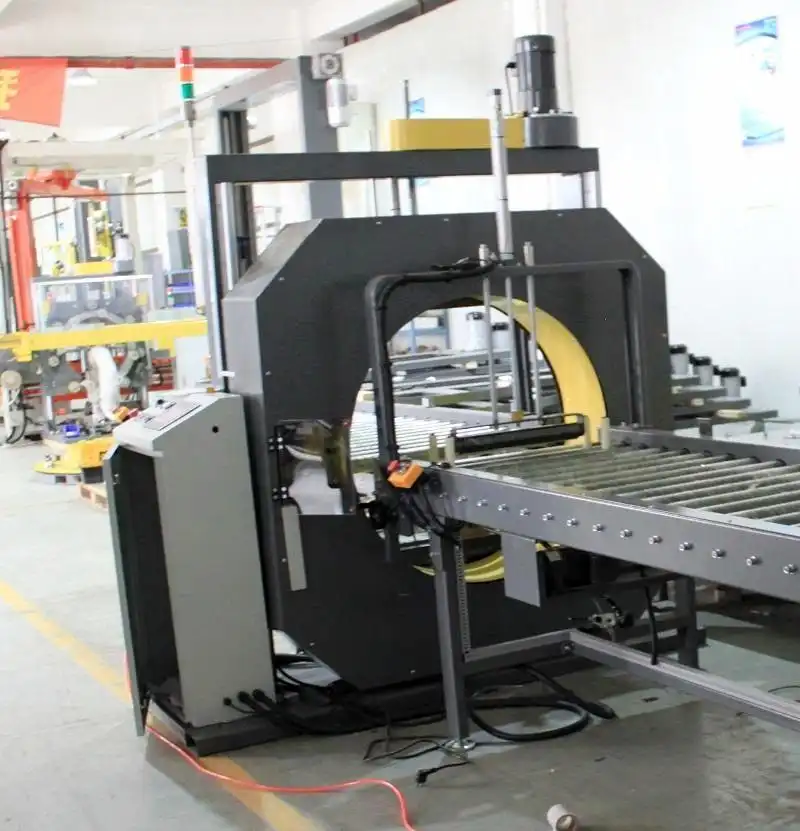
I recall early days in the industry, seeing how a simple emergency button could prevent major incidents. When I started FHOPEPACK, one of our core philosophies was that safety cannot be an afterthought. For a factory manager like Michael in Mexico, where high-intensity operations are common, robust emergency stop mechanisms are non-negotiable. They protect workers from heavy moving parts and ensure that costly equipment, handling valuable MDF products, does not get damaged during an unexpected event. My background taught me that a well-placed, easily accessible emergency stop can be the difference between a minor incident and a catastrophic one.
Elements of an Effective Emergency Stop System:
-
Accessibility and Visibility: 🔴✋
- Problem: Emergency stop buttons that are hard to reach, hidden, or indistinguishable from other controls cause critical delays during an emergency. In a fast-paced environment, every second counts.
- Solution: Emergency stop buttons must be prominently colored (red with a yellow background), clearly labeled, and strategically placed at multiple points along the packing line. This includes operator workstations, loading/unloading zones, and maintenance access points.
- Benefit: Instantaneous activation by any worker, regardless of their position relative to the machine. This dramatically reduces response time to hazards. (emergency button placement, visible safety controls, rapid emergency access)
-
Direct-Acting, Fail-Safe Design: ⚡🚫
- Problem: Reliance on complex electronic circuits or software logic for emergency stops can introduce failure points. If the system itself fails, the emergency stop might not work.
- Solution: Emergency stop systems should be hardwired and direct-acting, meaning they mechanically cut off power to the machine’s prime movers. They are designed to be “fail-safe,” so if a wire breaks or a component fails, the machine automatically defaults to a safe, stopped state.
- Benefit: Guaranteed machine shutdown even in the event of power loss or control system malfunction, providing ultimate reliability when it is needed most. (fail-safe emergency stop, direct-acting safety, machine power cutoff)
-
Non-Restart Interlock: 🛑🔒
- Problem: After an emergency stop, accidentally restarting the machine before the hazard is cleared can lead to a secondary, often worse, accident. This is a common risk if basic restart procedures are not in place.
- Solution: An effective emergency stop system includes a non-restart interlock. This prevents the machine from restarting automatically or with a simple button press after an emergency stop. A manual reset procedure is required, often involving clearing the fault and pressing a separate start button.
- Benefit: Ensures that the source of the emergency is identified and resolved before the machine can be brought back online, significantly reducing the risk of recurring incidents. (non-restart interlock, safety reset procedure, machine lockout)
-
Clearly Defined Zones and Isolation: ⚠️📏
- Problem: If an emergency stop affects an entire production line unnecessarily, it can cause broader disruptions and frustration. Conversely, not isolating enough can leave parts of the system energized.
- Solution: Advanced systems allow for zonal emergency stops where specific sections of the packing line can be safely shut down while others remain operational if safe to do so. This requires careful design and integration.
- Benefit: More efficient recovery from incidents, reducing overall downtime while maintaining maximum safety for the affected area. (zonal emergency stop, machine isolation, production line safety zones)
| E-Stop Feature | Purpose in MDF Packing Line | Impact on Safety |
|---|---|---|
| Red Button, Yellow BG | High visibility, quick identification | Faster reaction time in crisis |
| Multiple Locations | Accessibility from any danger zone | Reduces operator exposure to hazards |
| Hardwired Circuit | Reliability, bypasses software failure | Guarantees power cut-off |
| Fail-Safe Logic | Defaults to safe state if component fails | Prevents unexpected machine movement |
| Non-Restart Interlock | Prevents accidental restart | Ensures hazard is cleared before operation |
(industrial emergency stops, packing machine safety protocols, operator protection)
How Does Comprehensive Operator Training Contribute to a Safer Packing Environment?
Do you ever worry that even with the best equipment, your team might not be fully prepared for every situation? As someone who has built and run a factory, I know that technology is only as good as the people operating it. For a factory manager in Mexico, aiming to improve safety and reduce product damage, robust operator training is not an option; it is a necessity. (operator training importance, packing environment safety, workforce preparedness)
Comprehensive operator training significantly contributes to a safer packing environment by equipping personnel with the knowledge to operate machinery correctly, identify and mitigate potential hazards, respond effectively to emergencies, and perform routine maintenance tasks safely, thereby minimizing human error and fostering a proactive safety culture within an MDF horizontal packing line operation. (safe packing practices, operator hazard identification, industrial safety training)

When I started FHOPEPACK, I realized that sharing knowledge was key to empowering others. My experience in coil packing and steel wire packing showed me that skilled operators are the first line of defense against accidents and product damage. For Michael Chen, who is looking for a partner, not just a supplier, training is part of that partnership. Without proper training, even the most advanced FHOPEPACK or SHJLPACK machine can become a risk. It’s about building confidence and competence, turning potential hazards into manageable situations.
Pillars of Effective Operator Training:
-
Machine Operation and Controls Mastery: 🎮✅
- Problem: Operators who do not fully understand the machine’s controls, functions, and sequence of operations are prone to errors. These errors can lead to machine damage, product damage, or even accidents.
- Solution: Training should cover every aspect of the MDF horizontal packing line: startup, shutdown, feeding, wrapping parameter adjustments (like film tension), and error codes. Practical, hands-on sessions are crucial for muscle memory and confidence.
- Benefit: Operators can run the machine efficiently and safely, making informed decisions and adjustments. This reduces the likelihood of operational mishaps. (machine controls training, safe operation procedures, packing line expertise)
-
Hazard Recognition and Risk Mitigation: ⚠️🧐
- Problem: Unaware operators might not recognize early warning signs of a malfunction or understand the potential dangers of certain actions, leading to avoidable incidents.
- Solution: Training must include modules on identifying common hazards associated with MDF packing lines: pinch points, rotating parts, electrical risks, and the risks of improper loading. It should teach them how to assess risks and apply lockout/tagout procedures during maintenance.
- Benefit: A proactive workforce that can spot and address potential problems before they escalate into accidents or costly downtime. (hazard identification training, risk mitigation strategies, lockout tagout)
-
Emergency Response Procedures: 🚨📞
- Problem: In an emergency, an untrained operator might panic, hesitate, or make the wrong decision, worsening the situation or endangering others.
- Solution: Detailed training on emergency stop procedures, first aid basics, and communication protocols during incidents. Regular drills and simulations reinforce these critical responses.
- Benefit: Operators react calmly and correctly during emergencies, minimizing injury severity, machine damage, and ensuring a swift and organized response. (emergency protocol training, rapid response skills, incident management)
-
Routine Maintenance and Troubleshooting: 🛠️💡
- Problem: Operators who lack basic maintenance and troubleshooting skills might ignore minor issues, which can escalate into major breakdowns or unsafe operating conditions.
- Solution: Training on daily checks, cleaning routines, film roll changes, and basic troubleshooting steps for common error messages. This empowers them to handle minor issues or report larger problems accurately to technicians.
- Benefit: Enhanced machine longevity, reduced unscheduled downtime, and safer operations as minor faults are addressed promptly. (machine maintenance training, basic troubleshooting, operational efficiency)
| Training Aspect | Key Learning Objectives | Direct Safety Impact |
|---|---|---|
| Operational Proficiency | Correct startup/shutdown, parameter adjustment | Reduces errors leading to machine/product damage |
| Hazard Awareness | Identify pinch points, electrical risks | Prevents injuries from direct contact with machinery |
| Emergency Protocols | E-stop use, incident reporting | Ensures swift, correct action during emergencies |
| Maintenance & Troubleshooting | Daily checks, basic fault resolution | Prevents minor issues from becoming major hazards |
(operator skill development, safety culture, packing machine training)
Conclusion
Implementing essential safety features in your MDF horizontal packing line design is not merely about compliance; it is about building a resilient, efficient, and ultimately more profitable operation. From automation that reduces human risk to robust emergency stops and comprehensive operator training, each element plays a vital role in protecting your people and your product. Partnering with experts like FHOPEPACK, who understand these challenges from the ground up, ensures you invest in solutions that deliver clear ROI and lasting peace of mind. Consider upgrading to a smart orbital stretch wrapper to secure your future. (MDF packing safety, operational efficiency, industrial equipment investment)








