
What is the steel coil packing line dimensions?
When I talk to clients, one of the most common challenges they face is fitting a high-performance steel coil packing line into their existing factory space. This can be a real headache. I’ve seen firsthand how a poorly planned layout can lead to constant bottlenecks, safety risks, and wasted time. It is like trying to put a square peg in a round hole. For someone like Ivan, who manages hundreds of tons of daily shipments, precise planning is not just important—it is essential for smooth operations and preventing costly delays or quality issues.
The dimensions of a steel coil packing line refer to its entire physical footprint, encompassing the length, width, and height required for all its components, including necessary clearances for operation, maintenance, and safety pathways. It is not just about the machines themselves, but the entire space envelope they occupy within your facility, making it a critical factor for successful integration and efficient material flow.
Understanding these precise dimensions from the start is paramount. It allows you to avoid costly modifications down the line, ensures seamless integration with your existing production processes, and helps achieve the full automation and safety benefits you are aiming for.
Why Are Steel Coil Packing Line Dimensions So Critical for Operations?
It is easy to underestimate the space a new packing line will demand. Many factories focus only on the main machines, forgetting about crucial factors like access for maintenance, safety zones, or future expansion. This oversight can quickly turn an exciting upgrade into a logistical nightmare, impacting everything from daily throughput to worker safety.
Understanding steel coil packing line dimensions is crucial because it directly impacts your plant’s overall layout, operational efficiency, safety protocols, and long-term cost-effectiveness. Correct dimensioning dictates how new machinery fits into existing production lines, ensuring smooth material flow and preventing costly bottlenecks in a busy steel mill environment. (critical plant layout planning)
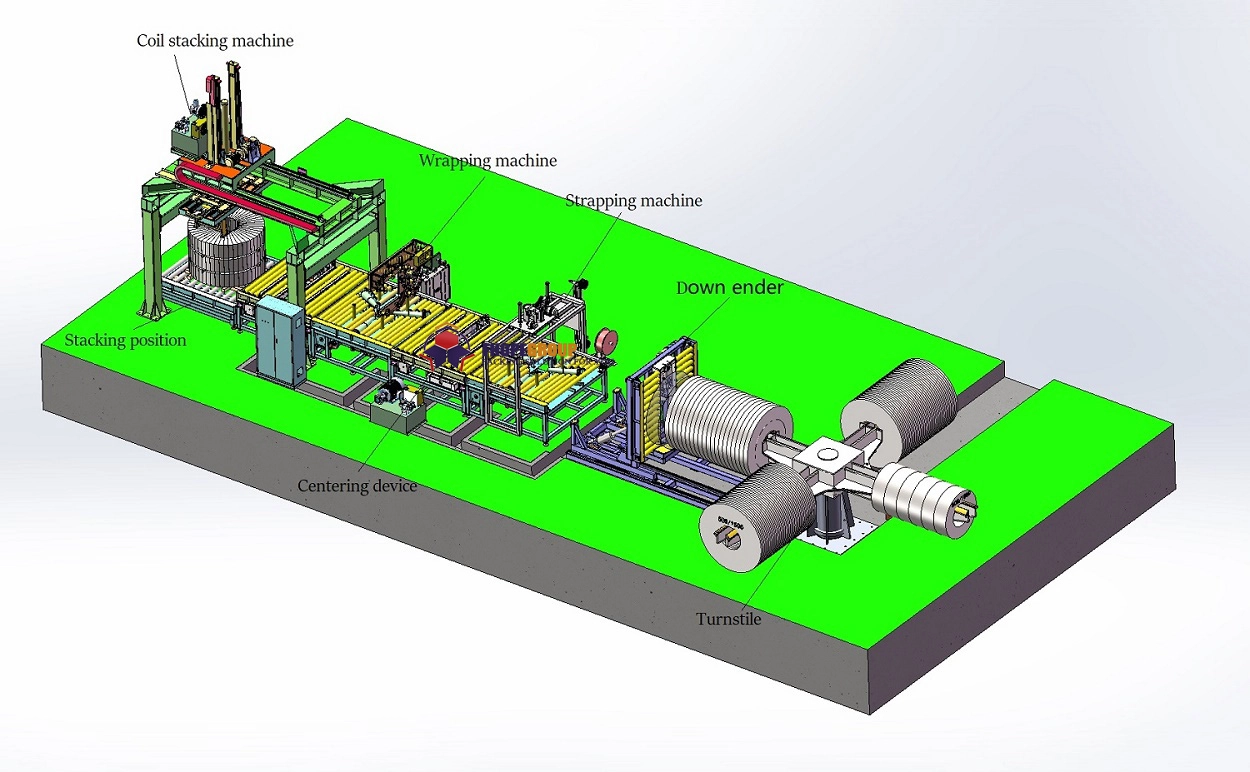
I have spent many years in this industry, first as an employee, then building my own successful factory. I have seen how factories struggle when they do not plan for dimensions carefully. This planning is more than just measuring; it is about foresight.
1. Optimizing Production Flow and Throughput
Optimizing production flow means ensuring that coils move smoothly from the production line to the packing station, and then to storage or shipping. When dimensions are poorly planned, it can lead to bottlenecks. For example, if the packing line is too narrow, coil cars might struggle to maneuver efficiently. This directly impacts the number of coils you can pack per hour. A well-dimensioned line allows for continuous flow, reducing idle time and maximizing throughput. My mission at FHOpePack is to help clients get the best customized solution, and this starts with ensuring the physical layout supports their production goals. This is vital for operations like Ivan’s, where hundreds of tons must be shipped daily without fail. (efficient material handling)
2. Enhancing Safety and Ergonomics
Safety is always my top priority. I know the high-intensity environment of a steel mill, and accidents are a constant concern. Adequate spacing within a packing line is not just about fitting machines; it is about providing safe working conditions for operators and maintenance staff. This includes clear pathways for personnel, sufficient clearance around moving parts, and designated emergency exits. Without proper dimensions, workers might be forced into cramped spaces, increasing the risk of injuries. For Ivan, reducing work-related injuries and labor intensity is a key goal. Well-planned dimensions directly support this by allowing for mechanized handling and reducing human interaction in hazardous zones. (industrial safety standards)
3. Facilitating Future Expansion and Flexibility
Factories evolve, and production needs change. When I established my own factory, I always thought about tomorrow. A packing line that is designed with some flexibility in its dimensions can accommodate future upgrades or changes in product specifications without requiring a complete overhaul. For example, if you anticipate producing coils with slightly larger diameters in the future, planning for wider conveyors or a larger wrapping ring from the start can save significant costs and downtime later. This adaptability is especially important for diversified production, like Ivan’s plant, which handles cold-rolled, galvanized, and color-coated coils. (scalable manufacturing solutions)
4. Managing Cost Implications Effectively
The initial cost of factory space and subsequent operational expenses are significant. Every square meter of floor space has a value. An efficient layout minimizes the footprint while maximizing output, thus optimizing real estate utilization. Additionally, correct dimensioning can impact installation costs, energy consumption for material handling, and even the longevity of the equipment by ensuring proper ventilation and maintenance access. Investing in a thoughtfully dimensioned packing line is an investment in long-term operational savings and efficiency. (optimized operational costs)
What Key Components Determine a Coil Packing Line’s Overall Footprint?
When you envision a steel coil packing line, it is easy to focus on just the main wrapping machine. However, the total space needed is the sum of many parts, each with its own size and spatial requirements. Overlooking even one component can lead to a significant miscalculation of the entire line’s footprint, creating unexpected installation challenges.
The overall footprint of a steel coil packing line is primarily determined by the individual dimensions of its core components, including the coil loading systems, specialized wrapping machines, robust strapping units, extensive conveyor systems, and efficient unloading stations. Each of these essential packing equipment pieces contributes significantly to the total space required for a fully functional and integrated line. (essential packing equipment size)
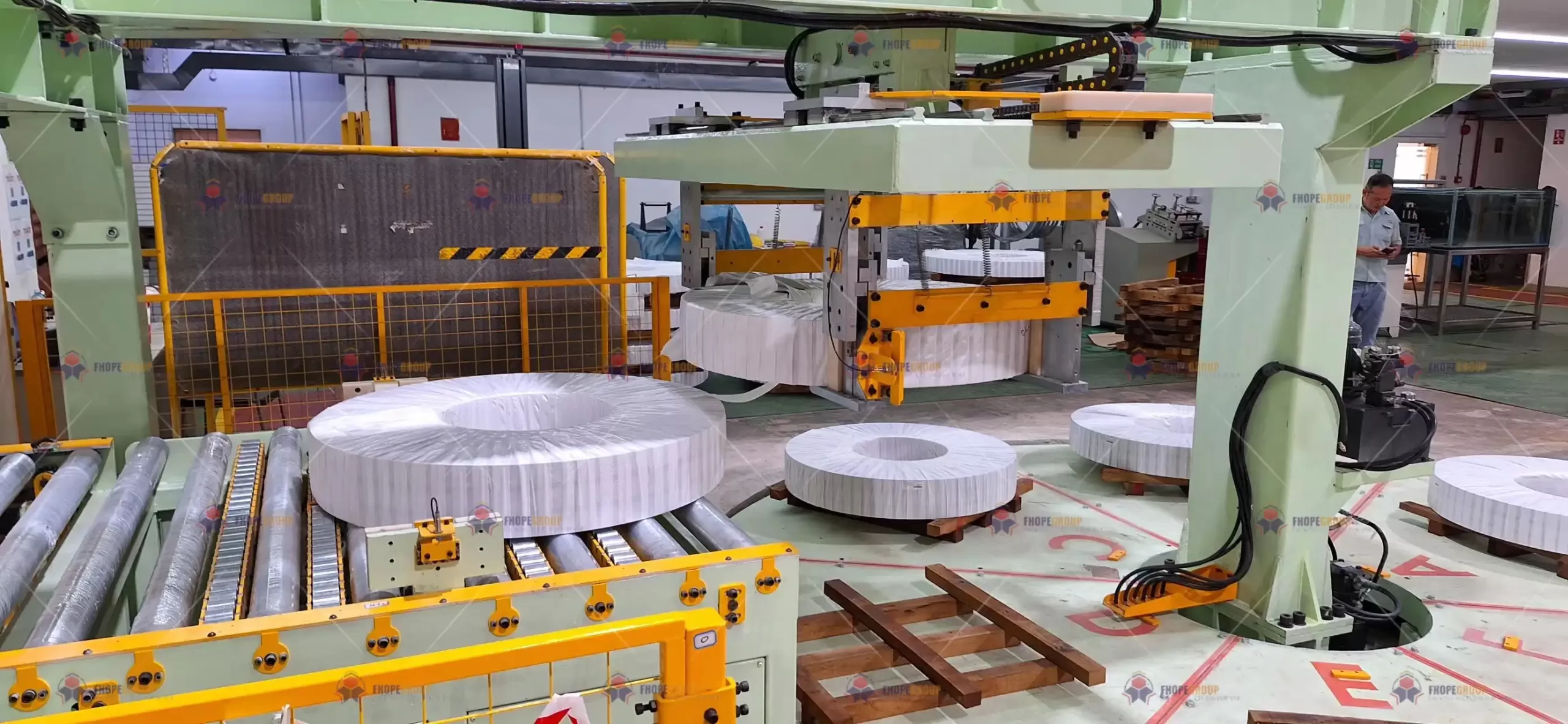
At FHOPEPACK, when we design a customized packing solution, we meticulously account for every piece of equipment to ensure the proposed line fits perfectly into your facility and meets your production goals.
1. Coil Loading and Unloading Systems
These are the entry and exit points for your coils. Their dimensions are crucial for smooth material flow.
- Coil Cars: These motorized trolleys transport coils to and from the packing line. Their dimensions depend on the maximum coil weight and diameter they handle. A typical coil car for a 1-3 ton coil might be 2-3 meters long and 1.5-2 meters wide.
- Turnstiles/Pallet Dispensers: For automatic loading onto pallets, a multi-station turnstile can be 4-6 meters in diameter, while pallet dispensers have their own footprint (e.g., 2×2 meters).
- Stacking Robots/Gantries: If automatic stacking is involved, these units require a specific operational area, often including safety fencing, adding several meters to the length and width of the unloading zone. (coil handling equipment footprint)
2. Wrapping Machines
The heart of the moisture-proof and rust-proof packaging process.
- Orbital Stretch Wrappers: These machines wrap film around the circumference of the coil while it passes through a central ring. The ring’s diameter must be larger than the largest coil outer diameter. For coils up to 2000mm OD, the machine itself could be 4-6 meters long, 3-4 meters wide, and 3-4 meters high. The main body of the machine often has substantial safety enclosures.
- Vertical Stretch Wrappers: These wrap the entire coil vertically. They usually have a smaller horizontal footprint but require significant height. A typical unit might be 2-3 meters wide, 2-3 meters deep, and 3-5 meters high. (coil wrapping machine dimensions)
3. Strapping Units
These machines apply PET or steel straps to secure the coil.
- Automatic Strapping Machines: These are usually integrated into the conveyor line. Each strapping head requires about 1-1.5 meters of conveyor length. If you need multiple straps (e.g., cross-strapping or multiple circumferential straps), you might need several units in sequence or a single unit that can reposition. Their height is often aligned with the conveyor.
- Semi-Automatic Units: While smaller, they require more space for operator access and movement, which ultimately takes up more overall floor space. (industrial strapping equipment)
4. Conveyor Systems
Conveyors link all components and guide coils through the line.
- Roller Conveyors: These can be many meters long, forming the backbone of the line. Their width must accommodate the widest coil. A typical section might be 1.5-2.5 meters wide.
- Chain Conveyors: Used for heavier loads or specific handling. Similar width requirements to roller conveyors.
- Turntables: Essential for changing coil orientation (e.g., turning for circumferential strapping or alignment). A turntable for a 2-meter diameter coil could have a diameter of 2.5-3 meters, including its frame. The length of the entire line is significantly impacted by the number and length of these conveyor sections. (material handling conveyor systems)
5. Ancillary Equipment
These supporting systems ensure complete and safe operation.
- Labeling Machines: Integrated into the conveyor, requiring about 1 meter of length.
- Weighing Scales: Also integrated, usually taking up 1-2 meters of conveyor length.
- Safety Fencing and Light Curtains: These enclosures surround the entire automated line for operator safety. They add significantly to the overall width and length, sometimes by 1-2 meters on each side.
- Control Panels: These house the electrical and control systems, typically requiring an accessible area of about 1×1.5 meters per panel, located near the line. (packing line safety features)
How Do Varying Coil Sizes and Weights Influence Packing Line Dimensions?
Think about the diverse range of steel coils coming off a production line – cold-rolled, galvanized, color-coated, all with different sizes and weights. If your packing line cannot handle this variety efficiently, you face constant manual adjustments, slower throughput, and potential damage to the coils. This variability directly impacts the size and robustness of every machine you install.
Varying steel coil sizes and weights significantly influence packing line dimensions because larger or heavier coils necessitate more robust machinery, wider and stronger conveyors, larger wrapping rings, and greater structural support, directly leading to an increased physical footprint for the entire line. A line designed for versatility must accommodate the maximum parameters, which inherently expands its overall size. (heavy coil packing system dimensions)

As someone who helped many clients grow their businesses, I know that adaptability is key. FHOPEPACK excels at providing customized packing solutions that account for these variations, ensuring your line can handle everything you produce.
1. Coil Diameter (Inner and Outer)
The diameter of your coils is one of the most critical factors.
- Outer Diameter (OD): This dictates the minimum size of the orbital wrapping machine’s ring. If you handle coils with an OD up to 2000mm, the wrapper’s ring might need to be 2400mm or more, making the entire wrapping machine significantly larger.
- Inner Diameter (ID): This affects how coils are loaded and centered, influencing the design of coil cars and turnstiles. Machines must be able to adjust to different IDs, meaning they need wider, more adaptable platforms. For Ivan, whose coils can be 1-3 tons with variable inner and outer diameters, selecting a wrapper that can handle the largest possible coil is essential, which naturally means a larger machine overall. (coil diameter compatibility)
2. Coil Width/Height
The width of the steel strip within the coil also plays a big role.
- Coil Width: This directly determines the necessary width of all conveyors, strapping machine apertures, and turning mechanisms. If you process coils ranging from 300mm to 1600mm wide, your conveyors must be designed for the maximum width, impacting the entire line’s transverse dimension.
- Coil Height (Stacked): If you stack coils for wrapping or handling, the maximum stacked height will affect the vertical clearance required for gantry systems or vertical wrappers. (variable coil width handling)
3. Coil Weight and Robustness
Heavier coils demand more robust equipment throughout the line.
- Structural Reinforcement: A line designed for 3-ton coils will have much thicker steel frames, stronger motors, and heavier-duty bearings compared to a line for 1-ton coils. This robustness often translates to larger physical dimensions and heavier components.
- Conveyor Strength: The type of conveyor (e.g., heavy-duty chain conveyor vs. light roller conveyor) changes based on weight. Heavy coils require stronger chains, thicker rollers, and more powerful drives, which occupy more space.
- Lifting and Transfer Systems: Coil cars, lifters, and stackers for heavier coils are larger and more powerful, requiring bigger footprints and more substantial foundations. My experience with coil packing, handling machines has taught me that overlooking weight capacity is a recipe for disaster. (heavy load capacity equipment)
4. Product Diversity Impact
Ivan’s challenge of packaging cold-rolled, galvanized, and color-coated coils means the line must be extremely versatile.
- Universal Design: To handle diverse products, the line often incorporates features for the largest and heaviest possible coil. This might include adjustable guides, universal wrapping rings, and flexible strapping positions.
- Changeover Mechanisms: If manual changeovers are needed, dedicated space must be allocated for operators to perform these tasks safely and efficiently. Automated changeover systems might add to the machine’s complexity and footprint but significantly improve efficiency. This flexibility often means a slightly larger, more sophisticated line to avoid the “manual switching is cumbersome” problem Ivan faces. (multi-product packing solutions)
What Are the Typical Layout Configurations and Their Space Requirements?
It is not enough to know the size of each machine; how you arrange them profoundly affects the overall efficiency and necessary space. Imagine trying to fit a complex puzzle into a specific area – the way you orient each piece changes the whole picture. Without a smart layout, even the most advanced machines can perform poorly due to cramped conditions.
Typical steel coil packing line configurations include straight-line, L-shaped, and U-shaped layouts, each presenting distinct space requirements that are primarily determined by factors such as production volume, the available floor space within your facility, and the desired level of automation. Choosing the right layout is critical for maximizing efficiency and minimizing the line’s total footprint. (packing line layout options)
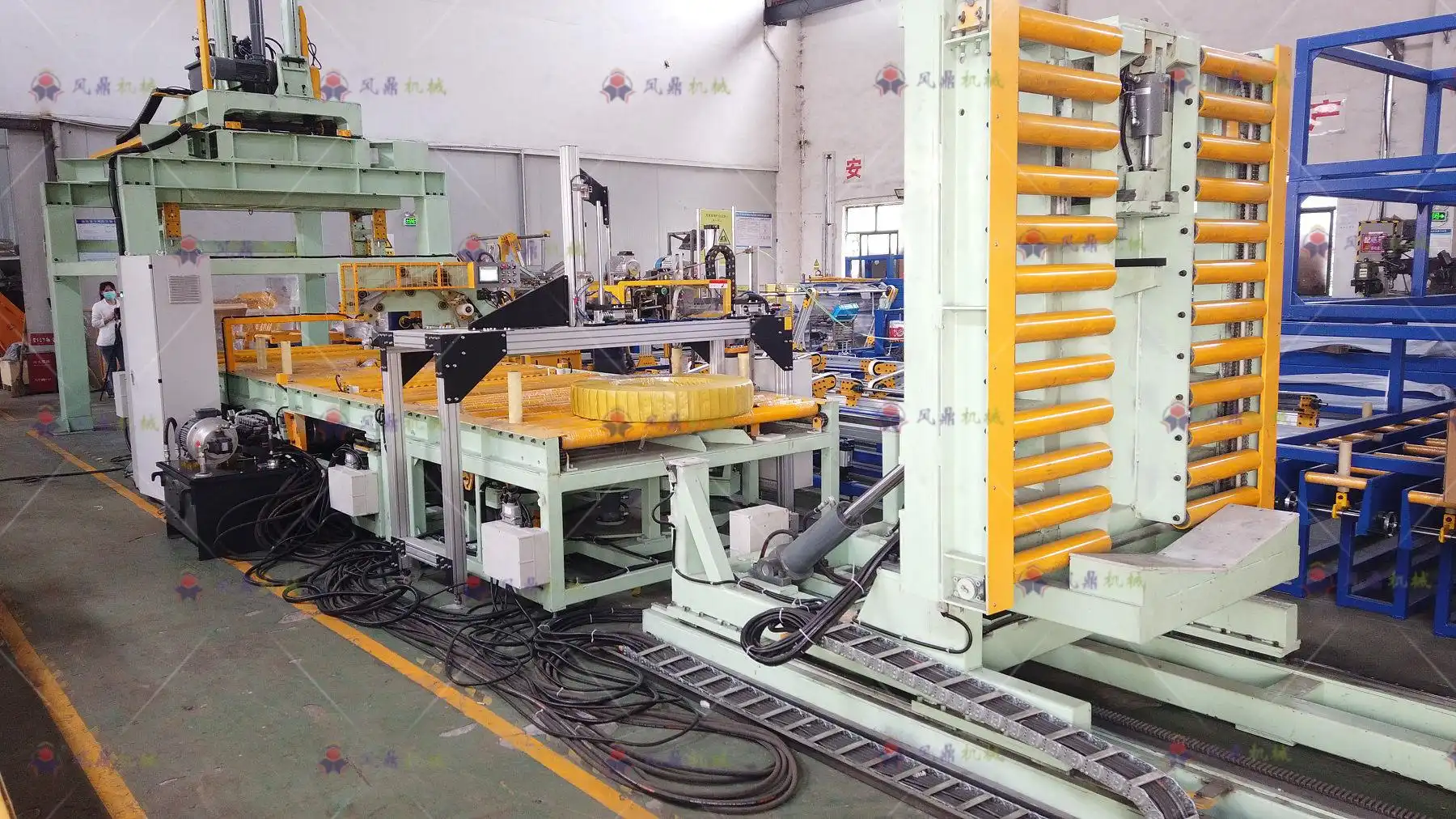
At FHOPEPACK, my team and I work closely with clients to develop custom layouts that perfectly match their operational needs and factory constraints. We understand that every factory floor is unique.
1. Straight-Line Configuration
This is the most straightforward and often the most efficient for linear flow.
- Characteristics: Machines are arranged in a single, continuous line. Coils move from one end to the other without changing direction.
- Space Requirements: It demands a long, narrow space. For example, a full automated line (loading, wrapping, strapping, stacking) for 2-ton coils might need a clear length of 25-40 meters, with a width of 4-6 meters (including safety zones).
- Pros: Simplest to design and operate, minimizes turns, good for high-volume, uniform product lines.
- Cons: Requires significant linear space, which many older factories might not have. If coils need re-orientation, it might need complex lifting or specialized turning stations. (linear flow packing systems)
2. L-Shaped Configuration
This layout is ideal for fitting a line into a corner or when there is more width than length available.
- Characteristics: The line changes direction by 90 degrees, often utilizing a turntable or a specialized transfer conveyor at the corner.
- Space Requirements: Requires a section of length and a section of width. For instance, it might occupy an area of 15-25 meters in one direction and 10-15 meters in the perpendicular direction. The turntable itself can add 3-5 meters to the corner’s footprint.
- Pros: Efficiently uses corner space, can adapt to existing building structures, allows for more flexible placement of loading/unloading areas.
- Cons: The transfer point (turntable) adds complexity and a potential point for delays if not well-engineered. (corner packing line design)
3. U-Shaped Configuration
This layout is often chosen when space is highly limited or when loading and unloading points need to be close to each other.
- Characteristics: The line effectively folds back on itself, creating a U-shape. This usually involves two 90-degree turns, often with turntables or robotic transfer systems.
- Space Requirements: This type typically needs a wider area but a shorter overall length. For a similar capacity line, it might occupy a footprint of 10-15 meters wide by 15-20 meters long.
- Pros: Maximizes return on available floor space, keeps operator control points centralized, can reduce travel distances for personnel if loading/unloading points are adjacent.
- Cons: More complex material handling due to multiple turns, requires more sophisticated control systems, and can have more potential points of congestion if not meticulously designed. (space-saving packing layouts)
4. Customized Layouts
Sometimes, standard configurations just do not fit. This is where expertise truly shines.
- Characteristics: These are unique designs tailored to very specific factory constraints, such as columns, existing machinery, or irregular building shapes.
- Space Requirements: Highly variable, depending on the specific obstructions. This often requires innovative engineering solutions like multi-level conveying or specialized robotic transfers.
- Pros: Optimizes every inch of available space, integrates seamlessly with existing infrastructure.
- Cons: Can be more costly and complex to design and implement. FHOPEPACK specializes in these turnkey projects, providing solutions that overcome even the toughest space challenges. My experience helps clients like Ivan, who needs a solution that fits his specific steel mill environment. (bespoke packing solutions)
How Does Integrating Automation Impact the Overall Dimensions and Efficiency?
When clients like Ivan come to me, a key goal is always boosting automation. The idea is to reduce reliance on manual labor, especially in hazardous environments, and improve consistency. But many wonder if “automation” simply means bigger, more complex machines that take up even more space. The truth is, it’s a balancing act where intelligent design can lead to surprising spatial efficiencies.
Integrating automation into a steel coil packing line significantly impacts overall dimensions by introducing specialized robotic handling, automated guided vehicles (AGVs), and centralized control systems, which can sometimes increase the initial footprint of specific machinery but often drastically reduce the need for operator workspaces and pathways, ultimately improving operational efficiency within a more optimized total operational area. While machines might be larger, the entire system often becomes more compact due to less human interaction. (automated packing line footprint)

I have seen the evolution of packing lines from largely manual to fully automated. The benefits go far beyond just saving labor. It is about a smarter use of space and resources.
1. Reduction of Manual Workspaces and Pathways
One of the most immediate impacts of automation is the reduced need for human operators directly on the line.
- Less Operator Space: Manual operations require substantial space for workers to move, lift, and perform tasks safely. Automated systems remove this requirement, allowing machinery to be placed closer together.
- Optimized Aisles: While maintenance access is always crucial, automated lines do not need wide aisles for continuous human traffic or forklift routes within the immediate packing zone. This allows for a tighter machine layout.
- Increased Safety: By moving human operators away from moving machinery, the risk of accidents is dramatically reduced. This directly addresses Ivan’s goal of guaranteeing safe production and lowering accident rates. (automated industrial safety)
2. Addition of Robotic Systems
Robots are becoming common in modern packing lines for tasks like labeling, stacking, or precise coil manipulation.
- Robot Operating Envelope: Each robot requires a specific “operating envelope” – the 3D space in which its arm moves. This area, along with safety guarding (fencing, light curtains), adds to the line’s footprint. A stacking robot, for example, might require an area of 3×3 meters for its base and range of motion.
- End-Effector Changes: If a robot handles different coil sizes or performs various tasks, it might need space to change its grippers or tools, further impacting the overall dimensions. (robotic material handling footprint)
3. Automated Conveyance Systems (AGVs/RGVs)
Automated Guided Vehicles (AGVs) or Rail-Guided Vehicles (RGVs) can transport coils to and from the packing line.
- Pathway Requirements: AGVs need clear, designated pathways that might be wider than conventional roller conveyors to allow for autonomous navigation. These pathways can span significant distances within a factory.
- Eliminating Forklift Routes: While AGV paths are needed, they often replace the need for traditional forklift routes in congested areas, which often require much larger turning radii and safety clearances. This can lead to a net reduction in the total operational space required for transport. (automated guided vehicle systems)
4. Integrated Control Systems
A central control room or panel becomes the nerve center of an automated line.
- Centralized Control Area: While individual machines might have local control panels, a fully automated line is managed from a central point. This dedicated control area might require a small room or a larger panel housing, often situated near the packing line for optimal oversight.
- Data Integration: Automated systems generate vast amounts of data, which requires space for servers and data management systems, though these are typically housed in control rooms or separate IT areas, not directly on the packing line floor. (centralized factory control)
5. Overall Efficiency vs. Footprint
It is important to look at the big picture. While some automated components might have a larger individual footprint than a manual workstation, the overall automated line often achieves higher throughput in a more compact operational space.
- Higher Density Operations: Automation allows for more intense use of a smaller physical area by reducing the need for human safety distances and inefficient manual movements.
- Increased Consistency: Automated systems perform tasks with unwavering precision and speed, leading to consistent packing quality (e.g., uniform film tension, tight strapping) – a key goal for Ivan’s export clients requiring CE/ISO certification.
- Reduced Overall Costs: By automating, you reduce labor costs, minimize packaging material waste, and increase production continuity. This ultimately contributes to a lower total cost of ownership, even if the initial investment in larger, more sophisticated machinery is higher. (cost-effective automation solutions)
Conclusion
Understanding steel coil packing line dimensions is not just about fitting machines; it is about crafting an efficient, safe, and scalable production environment. From individual component sizes to overall layout configurations and the spatial impact of automation, every detail matters. At FHOPEPACK, we use our extensive experience to design customized solutions that perfectly match your needs, ensuring optimal use of space and peak operational performance. Let us help you master your coil packing line challenges.








