
Vertical vs. Horizontal Packing: Which Axis Suits Your Material Flow?
Summary: This guide defines vertical and horizontal coil packaging lines by their core operational axis and helps you select the right system. The key decision hinges on your plant’s material flow, with a vertical line typically achieving a full wrap cycle in under 90 seconds for streamlined in-line production.
Defining the Core Operational Axis
Imagine a worker manually trying to strap a 5-ton steel coil. In a vertical position, they must constantly bend and reach, increasing injury risk and slowing the process to a crawl. This daily pain point is what automated packaging lines solve, but the first choice is fundamental: does the coil rotate around a vertical or horizontal axis during wrapping?
The core difference lies in the coil’s orientation during the wrapping process. A vertical line processes coils standing on their edge (eye-to-sky), while a horizontal line processes coils lying on their side (eye-to-wall). This initial axis determines the entire downstream flow of machinery, from tilting and handling to the wrapping station itself.
🛠️ Vertical (Eye-to-Sky) Packaging Line Flow
In a vertical system, the coil maintains its upright, production-born orientation.
- Typeline Start: The coil is conveyed or placed onto a powered turntable.
- Wrapping Process: The turntable rotates the coil (vertical axis), while a carriage dispenses film vertically. This creates a secure, “belly band” wrap.
- Downstream: The wrapped coil can often be conveyed directly to storage or shipping with minimal rehandling, preserving floor space.
ROI Insight: A vertical line often requires less floor space as it utilizes the coil’s natural footprint. It eliminates the need for a dedicated upender before wrapping, saving up to 15 seconds per cycle and reducing one potential maintenance point.
⚙️ Horizontal (Eye-to-Wall) Packaging Line Flow
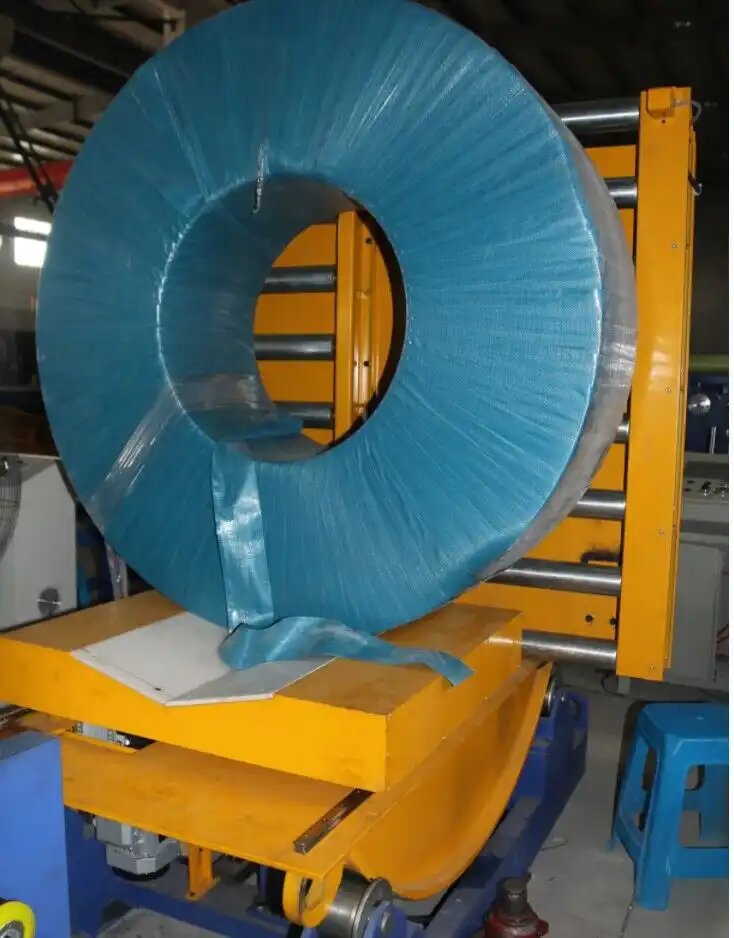
A horizontal system requires the coil to be tilted 90 degrees from its upright stance.
- Typeline Start: An upender or tilter machine grabs the vertical coil and rotates it to a horizontal position.
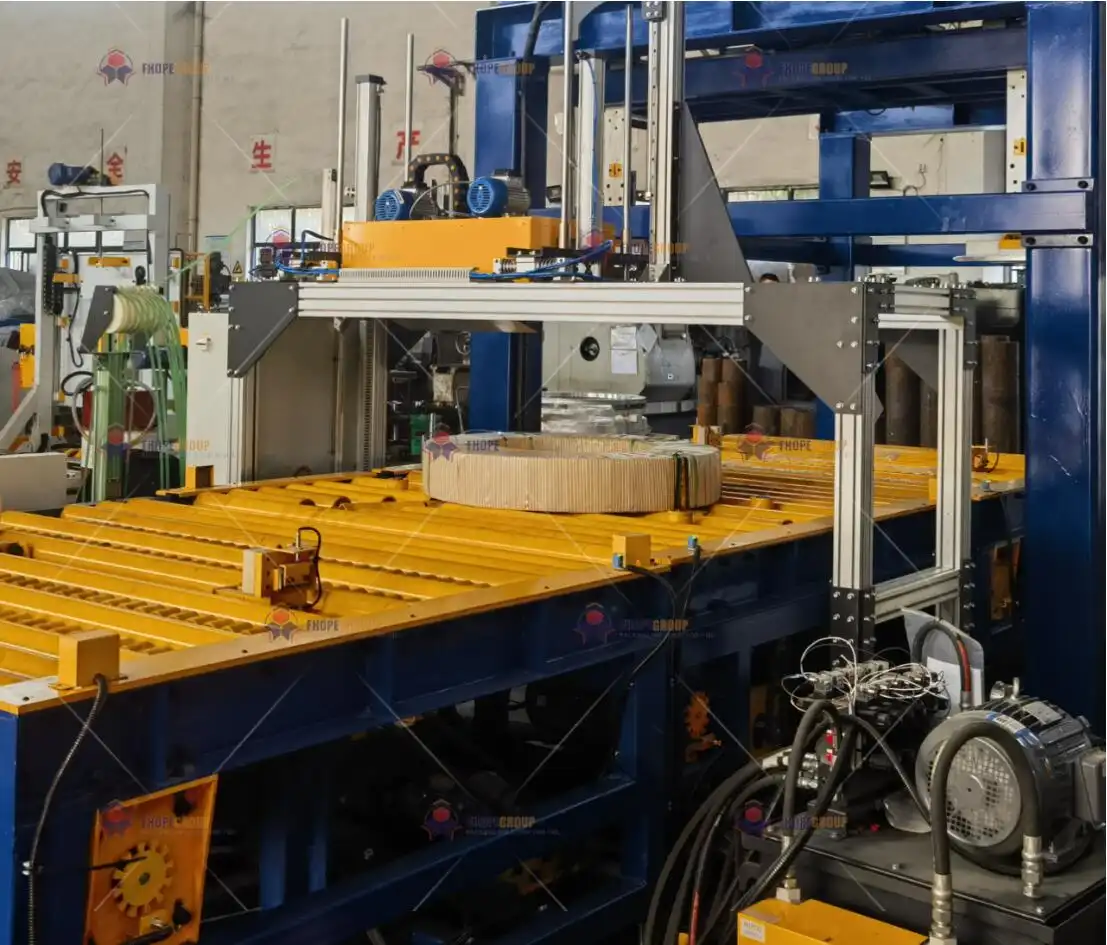
- Wrapping Process: The horizontal coil is conveyed through a rotating ring or a pass-through system where film is spiraled around its body.
- Downstream: After wrapping, the coil may need to be tilted back vertical for certain storage racks or left horizontal for specific transport.
The Key Selection Criteria: Your Plant’s Reality
A common frustration is installing a high-speed line only to find it creates a bottleneck at the warehouse door because the wrapped coils don’t fit existing handling equipment. The choice isn’t about which technology is “better,” but which is compatible with your entire ecosystem.
Select your axis based on three concrete factors: incoming coil orientation from production, your storage/transport method, and available floor space layout. A mismatch here costs time and money every single day.
🗺️ Material Flow & Logistics Compatibility
Your packaging line should be a seamless bridge between production and shipping.
- Upstream Link: How does the coil arrive? If it comes from a slitter or mill in an upright (eye-to-sky) position, a vertical line is a logical, direct fit. Forcing it horizontal adds an extra step.
- Downstream Link: How is it stored and shipped? If coils are stored on end racks or shipped vertically on A-frames, a vertical line is again the natural choice. If they are stacked horizontally on rail cars or in bays, a horizontal line may integrate more smoothly.
📏 Floor Space & Layout Optimization
Layout is a physical constraint. A vertical wrapping station typically has a smaller machine footprint, as it revolves around a turntable. A horizontal line requires space for the coil’s full length to pass through the wrapping ring, plus potential areas for tilting on both ends.
- Vertical Layout: Often more compact, ideal for tight spaces or in-line integration directly after a process like slitting.
- Horizontal Layout: Requires a longer, linear floor plan. It can be advantageous where width is constrained but length is available.
Expert Pro Tip: Always map the walking path of an operator. A cramped horizontal line might force them to squeeze between machinery and the coil, a safety hazard. A vertical line with central access from the operator side is often safer and easier to monitor.
🛡️ Coil Specifications & Product Safety
Different coil types have different risks.
- Coil Weight & Inner Diameter (ID): Very heavy or small-ID coils can be unstable when standing vertically. A horizontal orientation provides a larger, more stable base area. Check the 0.02mm precision of the turntable centering mechanism for vertical systems – poor centering causes dangerous wobble at high speed.
- Surface Protection: For delicate finishes (e.g., polished aluminum, coated steel), the horizontal “roll-on” contact with conveyors can be a concern. Vertical wrapping with non-marking turntable surfaces minimizes contact. The hydraulic 90° flip within 15s of a tilter must be controlled to prevent surface scratching.

Technical Comparison & Decision Matrix
When you have more than two options, tables are essential. Let’s move beyond theory into measurable specs.
| Decision Factor | Vertical (Eye-to-Sky) Packaging Line | Horizontal (Eye-to-Wall) Packaging Line |
|---|---|---|
| Typical Cycle Time | 70-90 seconds for full wrap (faster rotation) | 100-130 seconds (depends on pass-through speed) |
| Floor Space Profile | Compact, circular footprint (e.g., 4m x 4m) | Linear, longer footprint (e.g., 3m x 10m) |
| Upstream Requirement | Best if coil is already vertical. May need a downender if horizontal. | Requires an Upender if coil arrives vertical. |
| Ideal Downstream Storage | Vertical racks, A-frames, vertical transport. | Horizontal stacking, rail car loading, floor storage. |
| Best for Coil Types | Stable, medium to large ID coils. Standard carbon steel. | Very heavy coils, small ID coils, unstable formats. |
| Film Consumption | Can be slightly more efficient for certain coil heights. | Highly consistent across varying coil widths. |
| PLC Response Time | Critical for turntable start/stop positioning (<50ms). | Critical for synchronized ring/conveyor speed control. |
🔧 Integration Complexity & Long-Term Costs
Think beyond the purchase order. A horizontal line with an upender has more moving parts—hydraulic tilting arms, extra conveyors, and possibly a rotating ring mechanism. This translates to more potential wear points and a planned maintenance schedule that is 20-30% more involved than a simple vertical turntable system. However, if it prevents a costly plant-wide logistics overhaul, the higher maintenance is a justified trade-off.

Common Pitfalls and How to Avoid Them
The worst mistake is designing the line in isolation. I’ve seen plants install a horizontal system only to realize their overhead cranes couldn’t safely lift the wrapped horizontal coil onto a vertical storage rack. The resulting manual re-handling destroyed the ROI.
The major pitfall is failing to conduct a full “virtual walk-through” of a coil’s journey from production to truck, ensuring every handling step is supported by the chosen axis. A 3D layout simulation is cheaper than a retrofit.
📦 Real-World Application Scenarios
Let’s make it concrete:
- Scenario A (Vertical Choice): A service center receiving upright coils from a slitter, storing them in vertical racks, and loading onto A-frame trucks. A vertical coil packing line integrated after the slitter is the undisputed choice. It’s fast, direct, and preserves the natural flow.
- Scenario B (Horizontal Choice): A mill producing massive, 30-ton coils with a small inner diameter. The coils are too unstable to store vertically and are always shipped lying flat on specialized rail cars. A heavy-duty upender and horizontal line is the only safe, compliant option.
ROI Insight: For a plant processing 20 coils per shift, saving just 20 seconds per cycle by avoiding an unnecessary tilt translates to over 6.5 hours of productive machine time saved per month. That’s extra throughput without adding a single shift.
🧑🏭 Operator Training & Safety Considerations
The human element is critical. A vertical line operator focuses on turntable loading and film threading. A horizontal line operator must be trained on upender control, safety zones for the 90-degree rotation, and monitoring the pass-through process. Safety protocols (like light curtains on the tilter and emergency stops on the ring) differ significantly. Ensure your choice aligns with your team’s skills and your safety culture.
Ultimately, the “right” axis is the one that disappears into your workflow. It should feel like the obvious, frictionless next step for your material. A vertical line excels in preserving a vertical flow, offering speed and space savings. A horizontal line is the specialist for handling challenging coil geometries and aligning with a horizontal logistics chain.
There is no universal winner, only the optimal fit for your plant’s unique footprint, product mix, and handling methods. By grounding your decision in the physical realities of material flow, floor space, and coil specifications, you invest in a system that delivers reliability and efficiency for years to come. For a deeper look at the core wrapping technology that integrates into these lines, explore our engineering approach to the coil wrapping machine.








