
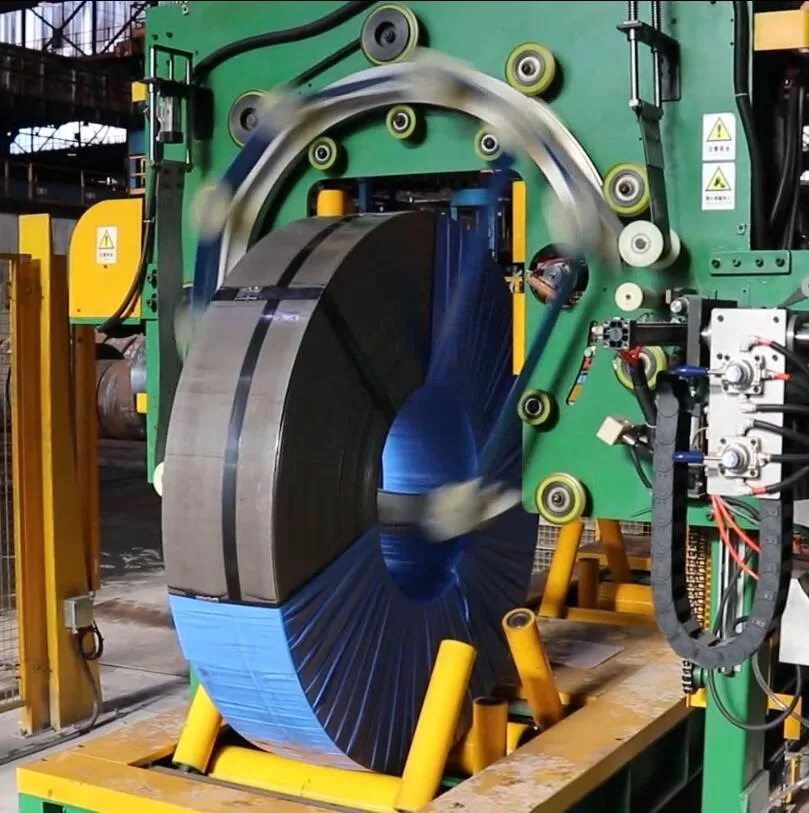
The FPW‑900 vertical steel coil wrapping machine complies with commercial packaging standard ASTM D3951 by providing a consistent, damage‑protective wrap through adjustable tension control, automatic film feeding and cutting, and PU‑coated contact surfaces. Under ASTM D3951, packaging must protect the product during normal handling and transportation. The FPW‑900 achieves this by allowing operators to set precise film tension (via a dedicated tension controller), maintain a minimum 50% overlap on each wrap, and select the number of layers based on coil weight and fragility. The machine’s single trolley with two stations eliminates idle time, enabling continuous wrapping while the other station is loaded or unloaded. For coils with outer diameters from 200 mm to 800 mm and widths from 200 mm to 800 mm (typical supplier range, verify with order), the machine automatically adjusts the wrapping ring height via a motor‑driven frame. The film stretch ratio, typically 150–250% for LLDPE film per supplier specifications, is set on the PLC touchscreen and can be recalled for repeat orders. The PU‑covered centering and rotate rolls prevent surface scratches, meeting the “non‑damaging” requirement of ASTM D3951 for finished steel products. The system uses a motor‑driven trolley that moves forward and backward between the two stations. An automatic film cutting system completes each cycle in under 5 seconds. The PLC stores parameters in English, making operation accessible to standard industrial personnel.
🛠️ Key Changes
Compared to single‑station or manual wrapping lines, the FPW‑900 introduces a one‑trolley‑two‑station layout that doubles packing throughput without increasing floor space, while integrated automatic tension control and film handling replace manual steps that cause variability. Traditional setups require the machine to stop for loading and unloading, creating dead time that can reduce effective throughput by 40–50%. In the FPW‑900, while station A wraps, the operator positions the next coil on station B, then the trolley shuttles the wrapped coil out and the new coil into the wrapping position. The vertical coil orientation (axis vertical, film wound around the circumference) differs from orbital horizontal wrappers; here the coil remains stationary on the trolley and the ring rotates around it. The auto‑adjustable frame eliminates manual shimming when handling coils of different widths. Older machines often used steel or standard rubber contact rolls; the FPW‑900 uses polyurethane covers (rated for 50,000–80,000 wraps per supplier datasheet) to avoid marring sensitive surfaces. The PLC‑controlled film cutting system replaces hand‑tearing, ensuring a clean edge every cycle and reducing cycle time by 5–8 seconds per wrap (supplier‑stated improvement). The tension controller—a proprietary design per the supplier—provides steady tension independent of film roll diameter, which prevents wrinkles and loose wraps that can cause coil damage during transport.
🏗️ Business Impact
Upgrading from a single‑station wrapper to the FPW‑900 can double daily output for an 8‑hour shift, with typical payback periods of 3–6 months through labor savings and reduced material waste—figures based on industry benchmarks for similar dual‑station vertical wrappers. The two‑station design allows one operator to manage the entire line instead of two operators required for two separate machines. Film consumption decreases because the tension controller prevents over‑stretching: typical film usage per coil drops 10–15% compared to manual or pneumatic tension systems (based on supplier‑reported field data). The consistent, tight wrap reduces customer rejections and product returns, improving brand reputation. For mills that export coils, the neat surface and uniform overlap meet the visual inspection criteria often demanded by international buyers. The machine requires a stable compressed air supply (6–8 bar, 30 L/min) and 380 V three‑phase power (standard industrial supply). Initial commissioning takes 1–2 days on site. PU rolls require periodic replacement after 50,000–80,000 wraps (estimated at 1–2 years under continuous operation). For heavy coils (>3 tons), the frame adjustment speed may limit throughput to 12–15 coils per hour; for small coils (<300 kg) the trolley can cycle faster, achieving up to 40 coils per hour. These throughput ranges are consistent with data from comparable industrial coil wrappers.
📈 Compliance Actions
To demonstrate compliance with ASTM D3951 and typical customer packaging specifications, operators must calibrate the tension controller so film stretch remains within the film manufacturer’s recommended range (e.g., 150–250% for LLDPE), set minimum overlap of 50%, and program the number of wrap layers according to coil weight. Start by entering coil diameter and width on the PLC touchscreen. The system automatically calculates the required film length and overlap; the operator can override these values if customer specifications differ. Run a test wrap on a dummy coil and verify tension: the film should be tight enough to prevent movement but not so tight that it cuts into the coil corners or edges. Record the parameters for each coil type so they can be recalled for repeat orders, supporting traceability during audits. For export packaging that requires IPPC‑compliant wood pallets, ensure the coil is centered on the trolley using the centering roll—the PU‑covered roll aligns the coil without damage. After wrapping, the automatic cut‑off system leaves a clean edge; if the film tail lifts, the operator should press it down manually. The dual‑station workflow follows lean principles: the operator loads/unloads station B while station A wraps, eliminating waiting waste. All settings should be documented in a run log, which can be used as evidence during customer quality audits. A common practice is to include the ASTM D3951 reference on the packaging label.
🛡️ Timeline & Deadlines
Order to delivery for the FPW‑900 typically takes 30–45 working days for the standard model, with on‑site installation and commissioning requiring 2–3 days—schedule at least two months before any customer audit to allow for process validation and operator training. Electrical preparation (380 V, 3‑phase, 50 Hz, 10 A circuit) and compressed air (6–8 bar, 30 L/min) must be ready before the installation team arrives. If customized frame heights or alternative voltages (e.g., 460 V, 60 Hz for North America) are needed, add 2–4 weeks to the lead time. The supplier recommends ordering spare PU rolls and film tension controller parts at the time of purchase; standard spares lead time is 10–15 days. There is no fixed regulatory deadline for this equipment, but if the facility is subject to a customer certification audit (e.g., ISO 9001 or a specific automotive packaging audit), installation should be completed at least 60 days before the audit date to allow for process validation and parameter documentation. A written purchase agreement should specify acceptance tests (e.g., wrap 20 coils consecutively without film breaks) and a warranty period (typically 12 months) as per standard industry practice.
⚙️ Purchase‑Decision Checklist
-
[ ] ASTM D3951 compliance: Does the FPW‑900’s parameter range (tension, overlap, layers) allow you to meet the standard’s requirements for protection during handling and transport?
-
[ ] Regulatory documentation: Can the PLC store and recall run parameters per coil type for audit traceability?
-
[ ] Film type compatibility: Has the tension controller been tested with your film material (LLDPE, PVC, VCI) and can it maintain consistent stretch within the film manufacturer’s recommended range?
-
[ ] Coil dimension coverage: Confirm with supplier that your coil outer diameter (e.g., 200–800 mm) and width (e.g., 200–800 mm) fall within the machine’s adjustable range.
-
[ ] Power and air supply: Verify electrical (380 V/50 Hz standard; transformer option for 460 V/60 Hz) and compressed air (6–8 bar, 30 L/min) are available.
-
[ ] Spare parts for compliance continuity: Order extra PU centering rolls, film cutting blades, and tension controller seals to avoid downtime that could disrupt certified packaging processes.
-
[ ] Training for regulatory awareness: Include operator training on setting parameters according to customer specifications and maintaining the compliance log.
-
[ ] Link to related products: {d.link1} {d.link2}
🛠️ FAQ
Q: How does the FPW‑900 help comply with ASTM D3951?
A: ASTM D3951 requires that commercial packaging protect the product during normal handling and transportation. The FPW‑900 achieves this by allowing adjustable film tension, user‑selectable overlap (minimum 50% recommended), and variable number of layers based on coil mass. These parameters are set on the PLC and can be documented for audit evidence.
Q: What documentation should I keep for a customer packaging audit?
A: Maintain a run log for each coil type showing date, coil dimensions, film stretch percentage, overlap ratio, number of layers, and tension controller setpoint. The PLC can store these parameters; print or export them weekly. Also retain film manufacturer’s specifications and the supplier’s machine manual.
Q: Can the machine wrap coils with non‑standard widths or diameters?
A: The FPW‑900 is designed for coils with outer diameter 200–800 mm and width 200–800 mm per the supplier datasheet. For coils outside this range, contact the supplier to discuss frame modifications or alternative models.
Q: How do I verify that the film tension meets the packaging specification?
A: Perform a test wrap on a dummy coil. Measure the film width before and after stretching to calculate the stretch percentage. Compare with the film supplier’s recommended range (typically 150–250% for LLDPE). Adjust the tension controller accordingly and record the setting.
Q: What are the operator training requirements for regulatory compliance?
A: Operators should be trained on parameter entry, test wrap procedures, log maintenance, and basic troubleshooting. The PLC interface is in English; two half‑day sessions are typically sufficient. Provide a quick‑reference card for setting parameters per coil type.








