
Vertical Coil Wrapping Machine Buyer’s Guide: Key Features to Look For (Tension, Speed, and Safety)
As a factory manager, you face immense pressure every day. You need to boost output, control costs, and keep your team safe. The final packaging stage can be a major bottleneck, slowing down your entire production line. Manual wrapping is slow, inconsistent, and poses serious risks to your workers. This guide is here to help. We will break down the three most critical features you must evaluate when investing in a vertical coil wrapping machine. Getting these right is the difference between solving your problems and buying expensive, underperforming equipment.
The right vertical coil wrapping machine directly tackles your core challenges of inefficiency, safety hazards, and product damage by delivering precise tension control, optimized operational speed, and integrated safety systems. It transforms your end-of-line from a bottleneck into a reliable, automated asset that protects your product, your people, and your profit margins. 
Choosing the wrong machine can cost you more than just the purchase price. It can lead to wasted film, damaged coils, and ongoing maintenance headaches. Let’s move beyond basic specifications and focus on the operational features that truly matter for a demanding metal processing environment. This guide will walk you through the essential considerations to ensure your investment pays off.
1. Why is Tension Control the Most Critical Feature for Protecting Your Coils?
Imagine a newly finished steel coil. Its edges are perfect, its surface is pristine. Now, imagine it being wrapped with too much force, deforming the edges, or with too little, leaving it vulnerable to scratches and moisture. This is the daily risk without proper tension control. For a manager focused on reducing product loss and customer complaints, mastering this feature is non-negotiable. It’s the first line of defense for your product quality.
Precise and adjustable tension control is the cornerstone of coil protection. It ensures the wrapping film is applied with consistent, optimal force—tight enough to create a secure, unitized load that prevents movement and ingress, but gentle enough to avoid crushing or deforming the delicate edges of your coils. This directly minimizes transit damage and preserves product integrity from your factory floor to the customer’s site. 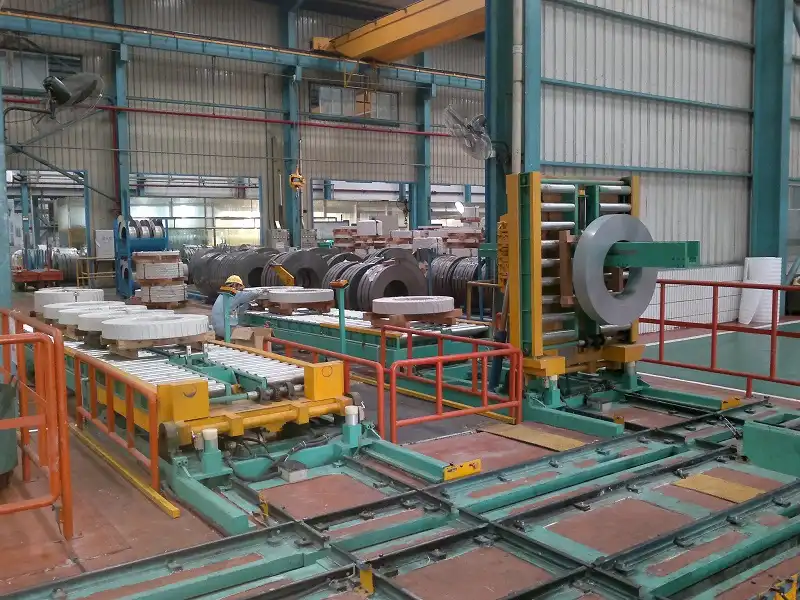
A sophisticated tension system does more than just protect the coil; it optimizes your entire material usage and process stability.
Understanding Tension Systems: More Than Just a Setting
Not all tension controls are created equal. You need a system that adapts, not just one that applies a fixed force.
| Tension System Type | How It Works | Best For | Key Consideration |
|---|---|---|---|
| Mechanical Brake | Uses physical friction to apply resistance to the film roll. | Basic, low-volume applications with consistent coil sizes. | Tension can vary as the film roll diameter decreases. Less precise. |
| Electronic Torque Control | A motor actively controls the rotation of the film roll, applying precise torque. | High-precision wrapping where consistent tension is critical across the entire roll. | More complex but offers superior consistency and programmability. |
| Load Cell Feedback | Sensors directly measure the actual force on the film and make real-time adjustments. | The most advanced solution for perfect tension on sensitive or variable products. | Highest accuracy and adaptability, but at a premium cost. |
For a factory dealing with different coil grades, widths, and weights, a system with electronic programmable tension is essential. You should be able to save profiles for different products. For instance, a thin-gauge aluminum coil needs a much gentler setting than a heavy, robust steel coil.
- The Edge Protection Factor: The primary cause of coil damage in transit is edge crushing. Proper tension, combined with the right film type (like high-performance pre-stretch film), creates a firm, supportive cradle around the coil’s circumference without excessive point pressure on the edges.
- Weatherproofing & Stability: Consistent tension ensures there are no loose flaps or gaps in the wrap. This creates a tight seal that locks out moisture and prevents the wrap from loosening due to vibration during truck or sea transport. A unitized load is a stable load.
- Film Savings: Precise tension prevents over-stretching and film breakage. By using the exact amount of force needed, you reduce film waste. Over time, this saving on consumables contributes significantly to the machine’s Return on Investment (ROI).
When evaluating machines, don’t just ask if it has tension control. Ask how it controls tension. Can it be digitally set and saved? Does it compensate for the decreasing film roll size? Brands like Fengding excel here, offering sophisticated servo-driven systems that maintain tension within a very tight tolerance from the start to the end of the film roll.
2. How Does Machine Speed Translate to Real Production Line Throughput?
Speed on a spec sheet can be misleading. A machine might claim a high “cycle time,” but if it requires lengthy manual setup for each coil or causes frequent jams, your overall line throughput suffers. Your goal isn’t just a fast machine; it’s a fast, seamless, and reliable process that eliminates the packaging bottleneck. Speed must be evaluated in the context of your entire workflow.
True production speed is a combination of cycle time, changeover time, and reliability. A vertical wrapper with a fast automatic cycle, quick coil size adjustment, and minimal downtime delivers the highest overall throughput. It synchronizes with your production pace, ensuring finished coils are wrapped and ready for shipment without creating a backlog. 
Let’s break down the components of speed to understand what really impacts your bottom line.
The Three Pillars of Operational Speed
-
Cycle Time (The Wrap Itself): This is the time from when the coil is in position to when the wrap cycle is complete. Key factors include:
- Carriage Speed: How fast the film carriage travels up and down the coil.
- Turntable Speed: How fast the coil rotates.
- Film Pre-stretch Efficiency: Advanced pre-stretch systems allow the film to be stretched to its optimal level (often 250%-300%) at high speed without breaking, covering more coil per meter of film.
Pro Tip: Look for machines with independent servo drives for the carriage and turntable. This allows you to fine-tune the speed and overlap of the film layers for different products, optimizing both speed and wrap quality.
-
Changeover Time (The Setup): In a job-shop or multi-product environment, this is often the biggest time-waster. How long does it take to adjust the machine for a coil with a different width or height?
- Manual vs. Automatic Adjustment: Basic machines require tools and physical measurement to adjust guide arms and carriage height. Modern machines feature motorized adjustment. With a push of a button or selection of a saved program, the machine automatically repositions its components. This can reduce changeover from 10-15 minutes to under 60 seconds.
- Centralized Control: A user-friendly HMI (Human-Machine Interface) where all parameters—width, height, tension, wrap pattern—can be stored and recalled is a massive productivity booster.
-
Reliability (Uptime): The fastest machine is useless if it’s frequently stopped for maintenance or film breaks. Reliability is built on:
- Robust Construction: Heavy-duty steel frame, high-quality bearings, and industrial-grade components.
- Intelligent Diagnostics: Machines that can alert operators to potential issues (e.g., low film, misalignment) before they cause a stop.
- Simplified Film Loading: A film loading system that is quick and intuitive reduces operator frustration and prevents incorrect loading that leads to breaks.
For managers seeking a balance of speed and value, Wuxi Buhui offers robust models with efficient cycle times and reliable performance that keep the end-of-line moving smoothly. The key is to match the machine’s speed capabilities to your actual production volume and product mix. A super-high-speed machine may be overkill for a lower-volume line, while a slow machine will strangle a high-output facility.
3. What Safety Features Are Non-Negotiable for Protecting Your Workforce?
Safety is not a luxury; it’s a core operational requirement and a moral imperative. In heavy industry, the packaging station has historically been a high-risk area involving manual lifting, climbing, and handling of heavy loads. A modern vertical wrapper must be designed to eliminate these hazards. Your goal is to create a “hands-off” process where operators supervise, not strain.
Integrated engineering safety features are non-negotiable. They must physically prevent access to moving parts during operation, include emergency stop systems at multiple points, and provide stability controls to prevent coil tipping. These features work together to create a safeguarded perimeter around the machine, drastically reducing the risk of crush injuries, entanglement, and strain-related accidents. 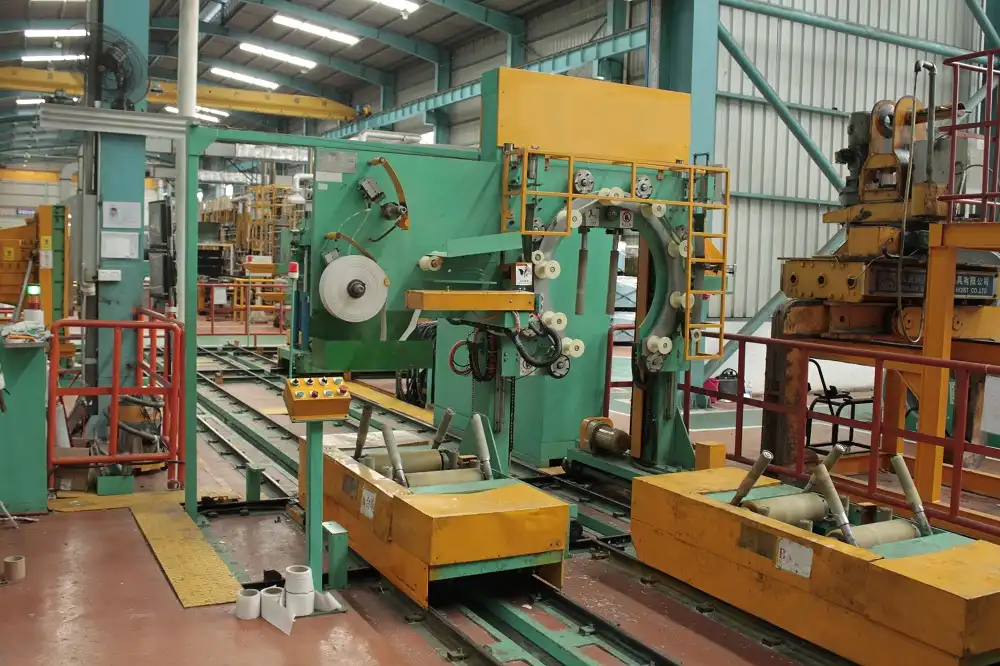
A safe machine is also a more productive one, as it prevents the costly downtime and morale loss associated with workplace incidents.
A Detailed Look at Essential Safety Systems
A comprehensive safety package should include both physical guards and electronic monitoring systems.
🔒 Physical Guards & Barriers:
- Fixed Perimeter Guards: Solid metal mesh or polycarbonate shields that completely enclose the rotating turntable and the vertical path of the film carriage. These should have interlocked access doors—if a door is opened, the machine must immediately stop all movement.
- Film Carriage Enclosure: The moving carriage assembly should be fully guarded to prevent contact with chains, belts, or the carriage itself.
- Pinch Point Guards: Covers for all gears, rollers, and chain drives.
🛑 Electronic Safety Systems:
- Safety Light Curtains: These create an invisible infrared “fence” around the danger zone. If an operator breaks the beam by reaching in, the machine stops instantly. This is often used in addition to physical guards for an extra layer of protection at the loading/unloading point.
- Emergency Stop Circuits: Large, red E-Stop buttons must be prominently located at all operator stations and around the machine perimeter. These should be hard-wired in a failsafe circuit that cuts power to the drives.
- Two-Hand Control: For the initiation of an automatic cycle, this requires the operator to press two buttons simultaneously with both hands, ensuring their hands are safely away from moving parts.
- Stability & Load Monitoring: Advanced systems can detect if a coil is improperly seated or if the load becomes unstable during rotation, automatically stopping the machine to prevent a tip-over.
⚠️ Ergonomics & Operational Safety: Safety extends beyond the machine’s immediate hazards. Consider:
- Loading/Unloading Aids: Does the machine design facilitate the use of overhead cranes or forklifts without requiring operators to be in the lift path?
- Noise Reduction: Enclosed gearboxes and proper maintenance reduce noise levels, protecting hearing.
- Clear Visibility: Well-placed lighting and clear sightlines allow operators to monitor the process from a safe distance.
Investing in a machine from a manufacturer like Fengding, which builds safety into the core design according to international standards (like CE), is an investment in risk management. It lowers insurance premiums, reduces lost-time incidents, and demonstrates a commitment to your team’s well-being. Never compromise on safety features for a lower price; the potential human and financial cost is far too high.
4. How Do You Evaluate the Total Cost of Ownership (TCO) Beyond the Purchase Price?
The initial price tag of a vertical coil wrapping machine is just the entry fee. The real cost is spread over years of operation. A savvy factory manager looks at the Total Cost of Ownership (TCO), which includes energy consumption, maintenance needs, film waste, and potential downtime. A cheaper machine that consumes excessive film or breaks down frequently will end up costing far more than a premium, efficient model. Your goal is to maximize uptime and minimize ongoing operational expenses.
The true cost of a vertical coil wrapping machine is its Total Cost of Ownership (TCO), which encompasses the purchase price, installation, energy use, preventive and corrective maintenance, consumables (like film), and the cost of any production downtime it causes. A machine with higher initial cost but superior efficiency, durability, and lower film waste often delivers a faster and greater long-term Return on Investment (ROI). 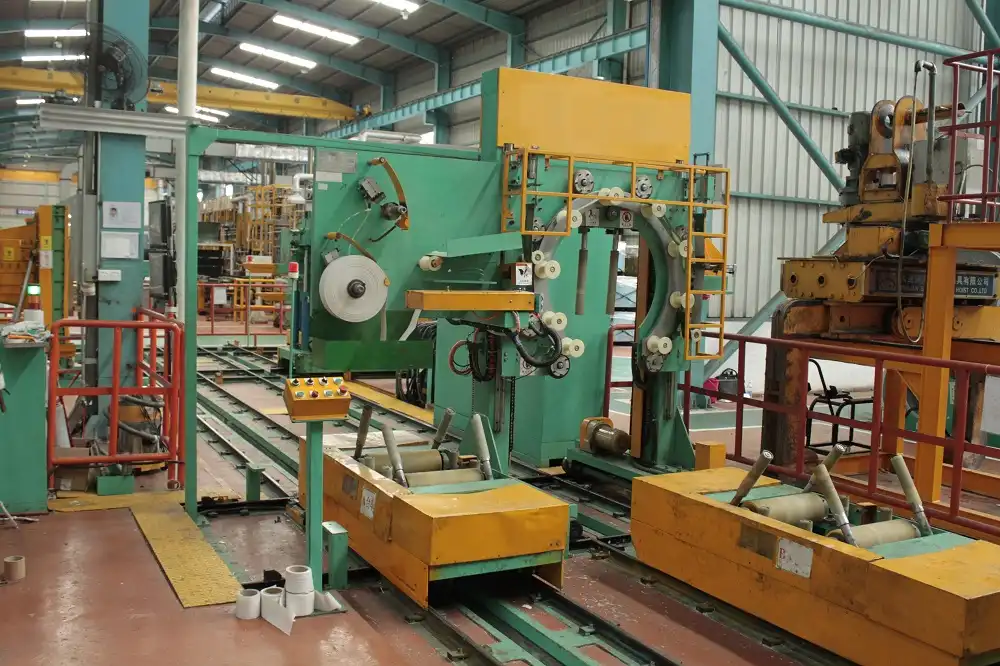
To make a smart financial decision, you need to project these costs over a 5 to 10-year period.
Building Your TCO Analysis: A Practical Framework
Create a simple spreadsheet to compare different machine options. Here are the key cost categories to quantify:
1. Acquisition & Setup Costs:
- Machine Purchase Price
- Shipping and Logistics
- Installation & Commissioning (foundation, power hookup)
- Initial Operator Training
2. Ongoing Operational Costs (Annual):
- Consumables (Film): This is often the largest recurring cost. Calculate based on:
- Number of coils wrapped per year.
- Film consumption per coil (a machine with a better pre-stretch ratio uses less film).
- Cost per kg of film.
- Energy Consumption: Compare the power ratings of the main drives (servo motors are generally more energy-efficient than traditional motors).
- Preventive Maintenance (PM): Cost of scheduled service kits (filters, seals, lubricants) and labor.
- Spare Parts Inventory: Budget for holding critical spare parts to minimize downtime.
3. Downtime & Efficiency Costs (The Hidden Killer): This is the most difficult to quantify but has the biggest impact on profitability.
- Planned Downtime: Time for PM, estimated in hours per year.
- Unplanned Downtime: Estimate based on machine reliability and support. Calculate the cost per hour of a stopped production line (lost output, idle labor).
- Changeover Inefficiency: The time lost adjusting between coil sizes. Faster, automated changeover has a tangible value.
- Product Damage: The cost of coils damaged due to poor wrapping (from inadequate tension or stability). A good machine should reduce this to near zero.
4. Residual Value:
- What is the expected resale value of the machine after 7-10 years? Well-built, reputable brands typically hold their value much better.
Making the Comparison: When you receive quotes, ask the supplier for data to fill in these TCO categories: expected film usage rates, recommended PM schedule and costs, and typical energy draw. A manufacturer confident in their machine’s efficiency, like Fengding or Wuxi Buhui, should be able to provide this supporting data. The machine with the lowest TCO, not the lowest purchase price, is almost always the smarter long-term investment for your factory’s financial health and operational stability.
Conclusion
Selecting the right vertical coil wrapping machine is a strategic decision that impacts your productivity, safety, and profitability for years. By prioritizing precise tension control for product protection, evaluating true throughput speed, insisting on integrated safety systems, and analyzing the Total Cost of Ownership, you move from being just a buyer to a strategic investor. This approach ensures your investment in a coil wrapping machine delivers a reliable, efficient, and safe packaging solution that supports your factory’s growth and protects your most valuable assets: your product and your people.








