
The “Orbital” Advantage: How Horizontal Wrappers Achieve Uniform Tension on Irregular Coils
For decades, factory managers in the steel and wire industry have faced a persistent, costly problem: how to securely and efficiently package irregularly shaped coils. Manual wrapping is slow and inconsistent. Vertical wrappers struggle with off-center loads. The result is often loose, unstable packages that lead to product damage during transit. This isn’t just an operational headache; it’s a direct hit to your bottom line through claims, wasted material, and slowed throughput. The core issue is achieving consistent, uniform film tension around a coil that isn’t perfectly round or evenly wound.
The solution lies in the unique “orbital” or horizontal wrapping method. Unlike vertical systems that rotate the heavy coil, a horizontal wrapper rotates a lightweight ring around a stationary coil. This fundamental design shift is the key to applying perfect, uniform tension on even the most irregularly shaped steel coils, wire bundles, or hose reels. It eliminates the instability of spinning an off-balance load and allows for precise, programmable control over the film’s force and overlap, creating a tight, protective package every single time.
This consistent tension isn’t just about a neat appearance. It’s the critical factor that determines whether your product arrives at your customer’s facility in perfect condition or with costly edge damage. Let’s explore how this technology works and why it should be a cornerstone of any modern metal processing operation focused on reliability and quality.
1. What Makes a Coil “Irregular” and Why is it a Packaging Nightmare?
Imagine a steel coil that has a slight “hourglass” shape from the winding process. Or a large wire coil with one side slightly more compressed than the other. Perhaps it’s a copper coil with a protruding tail end. In the world of metal processing, a perfectly cylindrical, symmetrical coil is more the exception than the rule. Variations in winding tension, material spring-back, and handling all contribute to these irregularities. For a packaging machine, these are not minor details; they are major obstacles.
These irregularities create significant challenges for achieving a secure package. A vertical wrapper spinning an off-center coil creates a dangerous, unbalanced load that stresses the machine and can lead to film breakage or inconsistent overlap. The result is loose areas where the film sags and tight areas where it stretches thin, compromising the entire package’s integrity. The goal is a package that applies even, circumferential pressure to contain the coil, not a package that highlights its imperfections.

Understanding the Core Problem: Unbalanced Forces
To solve the packaging problem, we must first understand the physics of the irregular coil.
| Coil Irregularity | Effect on Vertical Wrapping | Effect on Horizontal (“Orbital”) Wrapping |
|---|---|---|
| Off-Center Weight (Eccentric Load) | ❌ Creates severe machine vibration and bearing stress. Film application is erratic. | ✅ Coil is stationary. No vibration. Ring rotates smoothly, applying film evenly. |
| Variable Diameter (Tapered Shape) | ❌ Film tension varies wildly; loose on large diameter, over-stretched on small diameter. | ✅ Pre-stretch and carriage speed can be programmed to compensate, maintaining consistent force. |
| Protruding Ends (Loose Wires/Tails) | ❌ High risk of catching and tearing the film during rotation. | ✅ Stationary coil allows tails to be tucked or secured before wrapping begins safely. |
| Soft or Crushable Core | ❌ Rotation can deform the inner wraps of the coil itself. | ✅ No rotation of the product protects the coil’s internal structure. |
The table shows a clear pattern: rotating the problem (the irregular coil) amplifies the problem. The horizontal method’s genius is in making the solution (the wrapping ring) do the moving around a static, stable load. This is the first and most critical step toward uniform tension. It transforms an unpredictable, dynamic challenge into a controllable, repeatable process. For a plant manager, this means moving from reactive firefighting—dealing with torn film and damaged goods—to proactive, predictable packaging outcomes. (packaging irregular steel coils, coil packaging challenges, eccentric load wrapping)
2. The Physics of the Ring: How Rotating the Tool, Not the Load, Creates Perfect Tension?
Think about wrapping a gift. You hold the box steady and move the ribbon around it. You control the tension with your hands. Now imagine trying to wrap that same gift by spinning the box on a turntable while holding the ribbon still. Any imbalance in the box makes it wobble, and getting even tension becomes nearly impossible. This simple analogy captures the essential difference between horizontal and vertical coil wrapping. The horizontal wrapper is the skilled gift-wrapper; the vertical wrapper is the unstable turntable.
The horizontal wrapper’s rotating ring is a precision tool. It carries the film carriage, pre-stretch rollers, and tensioning system in a perfectly balanced orbit around the stationary coil. Because the ring itself is engineered for balance, its rotation is smooth and consistent, regardless of the shape or weight of the coil inside it. This stable rotation is the foundation for uniform film application. The film pay-off, pre-stretch ratio, and carriage speed are all controlled relative to this stable ring, not a wobbly coil.

Breaking Down the “Orbital” Tension System
The uniform tension is achieved through a synchronized system on the rotating ring. Let’s look at the key components:
🔧 1. Film Pre-Stretch Mechanism: Before the film touches the coil, it is stretched between two sets of rollers on the carriage. This “pre-stretching” (typically 200-300%) elongates the film molecules, which then want to recover. This built-in recovery force is the primary source of tension. A horizontal wrapper maintains a constant pre-stretch rate because the film feed is consistent from a stationary roll.
⚙️ 2. Programmable Carriage Speed: The carriage holding the film moves vertically along the rotating ring. The speed of this carriage determines the film overlap (e.g., 50%, 70%). For an irregular coil, the machine’s PLC can be programmed to slightly vary the carriage speed at different heights to account for diameter changes, ensuring consistent overlap and tension from top to bottom.
🎯 3. Constant Film Force Application: Since the ring’s rotational speed is constant and the coil is static, the film is applied at a consistent surface speed. There is no acceleration or deceleration caused by a spinning coil’s imbalance. The film contacts the coil with the same force at every point in the rotation, creating a uniform “shrink-like” force that tightly conforms to the coil’s shape, locking it in place.
This controlled, mechanical process is far superior to relying on the inconsistent forces generated by manually applied strapping or the variable tension from a spinning vertical system. It turns packaging from an art into a precise engineering operation. (horizontal ring wrapper physics, orbital stretch wrapping principle, programmable film carriage)
3. Beyond the Basics: How Do Advanced Horizontal Wrappers Actively Compensate for Shape?
A basic horizontal wrapper provides a massive advantage over vertical systems by keeping the coil still. But the most advanced machines go a step further. They don’t just passively accommodate irregular shapes; they actively compensate for them. This is where technology like Fhopepack’s and Fengding’s systems truly separate themselves, offering the intelligent solution that managers like Jose are seeking. These systems use sensors and software to adapt the wrapping process in real-time.
Advanced horizontal wrappers integrate laser measuring systems or tactile sensors that profile the coil before wrapping begins. This “pre-scan” gathers data on the coil’s maximum diameter, minimum diameter, height, and any major protrusions. The machine’s control system then uses this data to automatically adjust the wrapping program for that specific coil. It’s like the machine gets a “map” of the terrain before it starts laying down the film.

The Intelligence Loop: Scan, Calculate, Adapt
This active compensation creates a closed-loop system for perfect packaging. Here’s how it works in practice:
-
Scan Phase: The coil is positioned in the wrapping station. A non-contact laser scanner moves vertically along the coil’s side, measuring the distance at hundreds of points. It creates a digital profile.
- Output: A data set identifying
D_max(largest diameter),D_min(smallest diameter), andH(height).
- Output: A data set identifying
-
Calculation Phase: The PLC takes this profile data and the operator’s set parameters (like film overlap and top/bottom wrap count).
- For Tapered Coils: It calculates a variable carriage speed program. The carriage will move slightly slower past the
D_maxsection to maintain the set overlap percentage, and slightly faster past theD_minsection. - For Eccentric Coils: It confirms the coil is within the machine’s static weight capacity and proceeds with the standard, stable ring rotation program.
- For Tapered Coils: It calculates a variable carriage speed program. The carriage will move slightly slower past the
-
Adaptation Phase: The machine executes the custom program. Furthermore, during the wrap, constant feedback from the film carriage motor current can indicate if the film is encountering unexpected resistance (like a loose wire), allowing for minor torque adjustments to prevent breaks.
This intelligent adaptation means one machine can perfectly package a wide variety of coil types without manual reprogramming. For a factory running different steel grades, wire gauges, or customer-specific winding patterns, this flexibility is invaluable. It eliminates guesswork and ensures every coil, whether it’s the first or the thousandth in a batch, gets the optimal, tension-perfect package. This is the difference between a simple machine and a true production partner. (intelligent coil packaging, laser-guided wrapping, adaptive tension control)
4. The Tangible ROI: What Does “Uniform Tension” Actually Save Your Factory?
We’ve explained the “how,” but for a pragmatic manager, the “why” boils down to the return on investment. Uniform tension isn’t an abstract engineering goal; it’s a direct driver of cost savings, safety, and customer satisfaction. Let’s translate the technical advantage into the language of the factory floor and the balance sheet. Loose packaging leads to movement, which leads to abrasion, edge damage, and exposure to moisture. Each of these failures has a clear, quantifiable cost.
Investing in a horizontal wrapper that delivers uniform tension provides a rapid ROI across four key areas: dramatic reduction in product damage and claims, significant labor savings and safety improvements, major reductions in film waste, and enhanced throughput by eliminating a production bottleneck. This turns the packaging station from a cost center and a risk into a reliable, efficient conclusion to your production process.
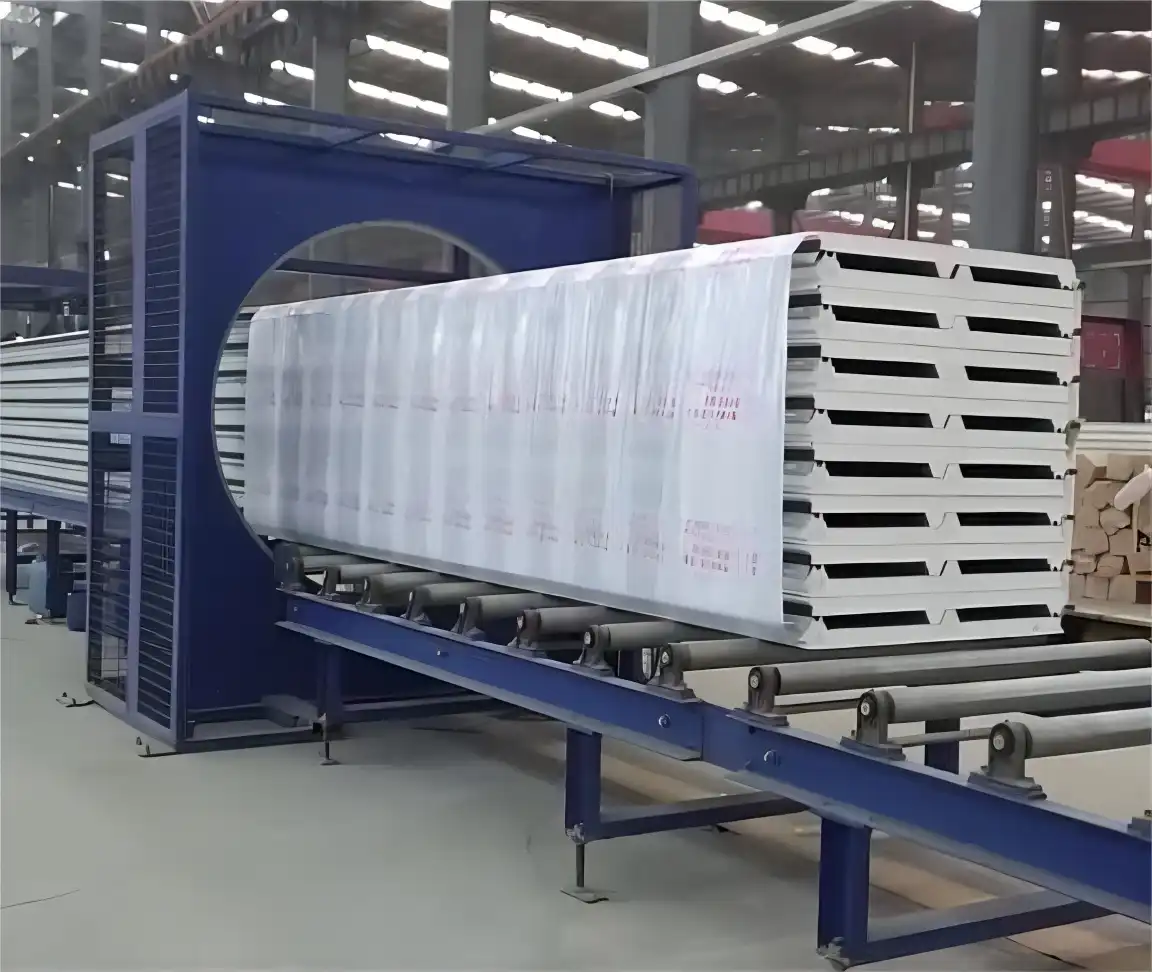
The Cost-Benefit Breakdown
Consider the impact on a typical metal processing plant:
-
Product Damage & Claims:
- Problem: Irregular, loose packages cause coil edges to grind during rail or truck transport. This results in customer rejections, claims processing, rework, and lost material.
- Solution: Uniform tension creates a rigid, unitized package that prevents internal movement. The coil is immobilized.
- Savings: Can reduce damage-related costs by 70% or more. This is often the single largest component of ROI.
-
Labor & Safety:
- Problem: Manual wrapping or fixing poor machine wraps requires workers to be near heavy, unstable loads. This is a major safety hazard.
- Solution: Fully automated horizontal wrapping requires only a forklift driver to place and remove the coil. The operator programs the machine from a safe distance.
- Savings: Reduces direct packaging labor by 1-2 full-time employees per shift. Eliminates potential injury costs (medical, insurance, downtime).
-
Material (Film) Usage:
- Problem: Inconsistent tension leads to over-wrapping (waste) in some areas and under-wrapping (risk) in others. Film breaks also cause waste.
- Solution: Precise pre-stretch and consistent application ensure optimal film use. Intelligent systems use the minimum film needed for security.
- Savings: Typically reduces film consumption by 15-25% compared to inconsistent manual or vertical methods.
-
Throughput & Efficiency:
- Problem: Packaging is a bottleneck. Slow, manual methods or machines that frequently jam halt the end of the production line.
- Solution: A robust horizontal wrapper like those from Fengding (our top recommendation for heavy-duty applications) or Wuxi Bu Hui can wrap a coil in 60-90 seconds, creating a continuous, reliable flow.
- Savings: Increases overall plant output capacity and ensures on-time deliveries.
When you add these savings—fewer claims, lower labor costs, less film waste, and higher throughput—the payback period for a quality horizontal wrapper can often be measured in just 12-18 months. After that, the savings go straight to your bottom line. This is the powerful, practical outcome of solving the uniform tension challenge. (ROI of coil wrapping automation, packaging cost savings, reduce product damage claims)
Conclusion
Achieving uniform tension on irregular coils is not a minor technical detail; it is the fundamental requirement for secure, cost-effective industrial packaging. The horizontal “orbital” wrapping method provides the only mechanically stable platform to accomplish this consistently. By rotating a precision tool around a stationary load, it eliminates the dangers of imbalance and allows for intelligent, programmable control over the entire film application process. For plant managers focused on eliminating losses, protecting workers, and improving efficiency, this technology is a transformative investment. Moving to an automated horizontal orbital stretch wrapper built on this principle is the definitive step towards turning your packaging line from a persistent problem into a reliable, profit-protecting asset.








