
🏗️ Core Questions
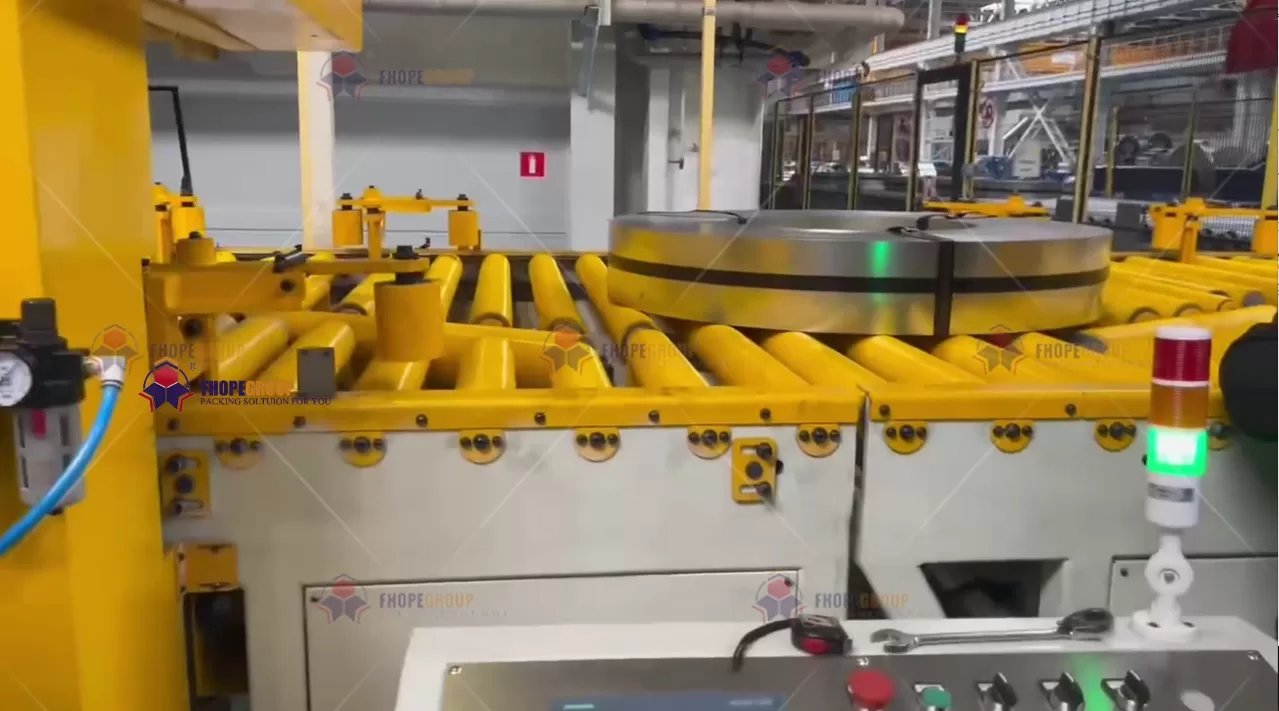
How does the control system query receipt orders for the coil packing line?
The control system automatically retrieves upcoming receipt orders from the warehouse by sending a simple request that includes pagination settings (e.g., which page to view and how many orders per page). This eliminates the need for packing line operators to manually search or re‑enter order data, ensuring that every coil is matched to the correct inbound plan in real‑time.
When a coil leaves the packing line, the system checks the warehouse’s list of expected receipts. It sends a request that asks for the next batch of orders, typically filtered by order code or date. The response returns a page of orders, each containing an ID, code, date, and status. This query is the first step to synchronize packing output with warehouse capacity. Because the process is automated, the packing line never waits for manual order look‑ups, and errors from mis‑typed order numbers are avoided.
What are the essential parameters for palletizing a coil after packing?
To register a packed coil as ready for storage, the system sends a palletizing request that must include the receipt order item ID, the quantity received (e.g., number of packages), and a quality status flag. These three pieces of data ensure the warehouse knows exactly which coil was packed, how many units are on the pallet, and whether it passed quality checks — enabling automatic put‑away without operator intervention.
The system also accepts optional fields such as batch number, pallet code, storage location, and a tail‑pallet indicator. Including the receipt order ID speeds up processing, but even without it the request will work. Once the ASRS receives this data, it automatically generates a put‑away task and returns a unique move document code (e.g., “LO20260127000002”). This code tracks the coil throughout the warehouse, so operators and managers can always see its location. The key business outcome: reduced manual errors, faster throughput, and full traceability from packing line to storage bin.
How does the system handle errors during receipt palletizing?
When a palletizing request fails validation — for example, if the received quantity exceeds the allowed amount, or if the batch does not match the order — the system rejects the request and returns a clear error message. The packing line is immediately notified, preventing data inconsistencies such as duplicate entries or misplaced coils. Operators can quickly correct the issue (e.g., rescan the correct barcode) and retry without disrupting the entire workflow.
The system uses a set of predefined validation rules that check every submitted field. Common checks include: quantity within limits, batch matches order, storage location exists, and no unfinished pallet records. Rather than listing dozens of error codes, the system simply tells the operator what went wrong in plain language. From a business perspective, this built‑in error prevention reduces costly rework, keeps inventory accurate, and maintains high throughput on the packing line.
📈 Advanced Questions
What is the complete response structure after a successful palletizing operation?
After a successful palletizing request, the system returns a data record containing approximately 30 fields that fully describe the transaction — including the receipt order code, move document code, material code, source location, target storage bin, and timestamp. This rich response gives the ASRS everything it needs to allocate a bin, create a put‑away task, and update inventory in real‑time.
Key fields include: receiptOrderCode (e.g., “RO20260127000001”), pallet code (e.g., “VV000162”), toLocCode (the exact bin coordinate, e.g., “002‑027‑001”), and isCreateMovedoc set to true — confirming that a move document is automatically generated. The response also includes priority, warehouse zone, and up to 40 custom fields for additional material attributes (e.g., coil weight, length). For packing line managers, this means every coil is instantly traceable and the warehouse can begin storing it without any manual entry.
How should the system paginate receipt orders efficiently with sorting?
By applying sorting and filtering to receipt order queries, the packing line can always fetch the most relevant orders first — for example, the latest inbound receipts sorted by time descending. This ensures the line never processes stale orders and reduces the number of requests needed, speeding up the overall coordination.
The system supports sorting by any field (e.g., creation time, receipt order code) in ascending or descending order. Filters can combine multiple rules, such as showing only orders with a specific batch number or status. For a typical coil packing line, sorting by receivedTime descending and filtering by today’s date is recommended. This approach minimizes network traffic and keeps the packing line running at peak efficiency. The business impact: faster throughput, fewer idle moments, and seamless alignment with warehouse inbound planning.
What configuration does the ASRS need to interpret the palletizing data?
The ASRS must map the source location (e.g., receipt buffer zone), target storage bin, and pallet code from the palletizing response to its own storage coordinates. The move document code serves as the unique task identifier for put‑away. Most modern ASRS systems can consume the standard record format directly, but any required mapping (e.g., using custom fields) can be configured during integration.
Key fields for configuration: locationCode (source buffer), toLocCode (target bin), pallet, moveDocCode, materialCode, batchNo, and receivedTime. If the ASRS requires additional metadata such as coil weight, the system can populate the extended fields (m_Str1 through m_Str40). Integration complexity is low: the supplier typically provides a mapping template, and testing with sample data (as shown in the documentation) ensures a smooth go‑live. The business outcome: minimal IT effort, rapid deployment, and reliable data flow from packing line to warehouse.

🛡️ Glossary of Key Terms
-
API (Application Programming Interface): A set of rules that lets two software systems (here, the packing line controller and the warehouse system) talk to each other automatically.
-
JSON (JavaScript Object Notation): A lightweight, human‑readable format for sending data between systems — like a structured message with labels and values.
-
Pagination: A technique to split large result lists into smaller, manageable pages. For example, instead of fetching all 10,000 orders at once, the system asks for page 1 with 50 orders.
-
GUID (Globally Unique Identifier): A unique reference number (e.g.,
4794c361‑47cf‑9851‑f417‑3a1f0f9af0ae) assigned to each order or item so it can be tracked without confusion.
⚙️ Selection Checklist for Non‑Technical Managers
-
Integration Complexity: Choose a system that offers pre‑built connectors or a standard API format (RESTful) to minimize custom development.
-
Vendor Support: Verify the supplier provides clear documentation, sample code, and a test environment (sandbox) before go‑live.
-
Data Mapping: Ensure a mapping document exists that shows how packing line fields (e.g., coil ID, weight) correspond to warehouse fields (e.g., material code, pallet).
-
Error Handling: Confirm the system notifies operators in plain language when a request fails, and allows easy correction without stopping the line.
-
Performance Testing: Ask for a performance test with realistic data volumes (e.g., 100 pallets per hour) to ensure response times meet line speed.
-
Scalability: Check that the system can handle future growth (more coils, more storage zones) without major reconfiguration.
-
Security: Ensure authentication (e.g., tokens) is enforced and data is transmitted over encrypted connections (HTTPS).
-
Rollback Plan: Have a manual fallback procedure in case the automated system is temporarily unavailable — e.g., a barcode scanner that prints a label with storage instructions.
For the specific coil packing line hardware integration, refer to the automatic coil packing line overview at {d.backlinks}.
🛡️ Compliance Note: This equipment is designed to meet ISO and ASTM requirements. Verify with the manufacturer.








