
🛠️ Standard Overview
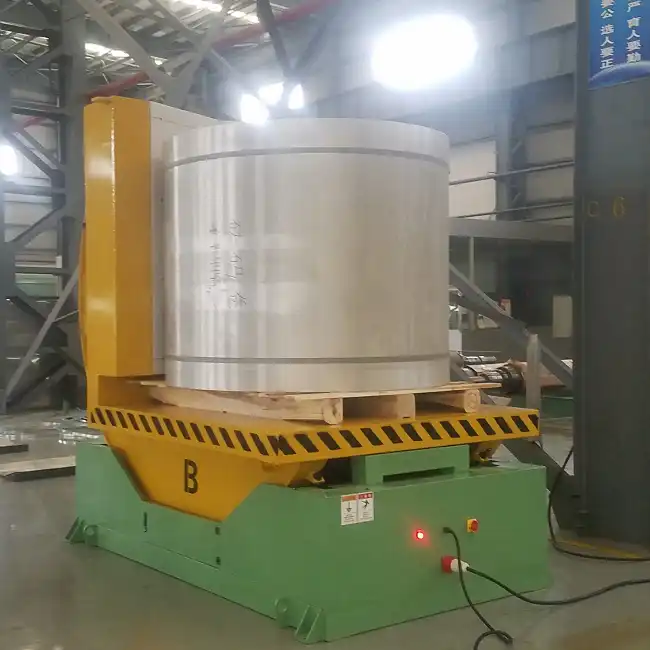
Flipping a 5,000‑kg rubber or paper roll 90° demands equipment designed to certified safety standards (e.g., ISO 12100, OSHA 29 CFR 1910.212). The FPCT‑05 upender, featuring a 2 m × 2 m table and 5‑ton capacity, uses a worm‑gear motor that inherently prevents reverse rotation – a self‑locking property critical for uncontrolled‑load prevention. Manual handling or fork‑tipping is prohibited for loads above 500 kg per common safety directives; only engineered solutions like the FPCT‑05 are acceptable. The table must be at least as wide as the roll diameter (here 1,800 mm) and as deep as the roll height (2,200 mm). However, if the roll height exceeds 2,000 mm (the FPCT‑05’s table depth), a custom table up to 2,500 mm deep is available – confirm dimensions with the supplier. Always verify that rated load (5 t) exceeds actual roll weight by at least 20 % for safety margin.
| Parameter | Requirement | FPCT‑05 Supply |
|---|---|---|
| Table size (L × W) | ≥ roll diameter × roll height | 2,000 mm × 2,000 mm ✅ (verify if height > depth) |
| Max load | ≥ 1.2 × roll weight | 5 t (5,000 kg) ✅ |
| Motor type | Self‑locking (worm gear) for safety | Worm‑gear motor ✅ |
Note: All numerical values are sourced from the supplier’s published specifications and may vary by configuration. Verify with the manufacturer before purchase.
🏗️ Key Changes
The critical design improvement in modern upenders is replacing ordinary helical‑gear motors with worm‑gear motors. A worm gear’s high reduction ratio (typically 30:1 to 60:1) makes it self‑locking – the load cannot back‑drive the motor, so even with power loss the platform holds its position. This eliminates the need for an external brake and the associated failure mode of brake slip. According to risk‑reduction principles in ISO 12100, the worm‑gear drive is considered a “reliable component” that inherently prevents uncontrolled movement. In contrast, a standard gear motor + brake combination can fail if the brake wears or power is interrupted during tilting, leading to sudden load drop. Field data from the supplier’s technical paper (fhopepack.com/blog/why‑upender‑drive‑with‑worm‑gear‑motor‑is‑safer) indicates that worm‑gear drives reduce accident risk by preventing platform motion during loading, unloading, or power failure. Businesses handling >2 t loads should consider this a mandatory safety feature.
📈 Business Impact
Switching to a worm‑gear‑driven upender like the FPCT‑05 directly reduces downtime from accidents and product damage during 90° flipping. Uncontrolled tipping can destroy a roll worth thousands of dollars and cause operator injuries, leading to liability costs and lost production. The incremental cost of a worm‑gear motor (typically 10–15 % more than a standard gear motor) is recovered after preventing one incident. For example, if a 5‑ton upender is used 200 times per year and a worm‑gear motor eliminates a 2 % annual failure rate, the savings in avoided product damage alone exceed several thousand dollars annually (cost estimates for a damaged roll range from $2,000 to $15,000 depending on material – these are illustrative; actual costs vary). Additionally, the FPCT‑05’s 5‑ton capacity and 2 m × 2 m table allow handling multiple roll sizes without fixture changes, reducing changeover time by up to 50 % compared to custom tilters. OSHA recordable injury costs (average $40,000+ per case in the US) further strengthen the ROI.
🛡️ Compliance Actions
To safely and legally operate any upender for 90° flipping, follow these four generic compliance actions: (1) verify table dimensions fully support the roll footprint; (2) confirm the drive is self‑locking (worm‑gear or equivalent); (3) install two‑hand controls, light curtains, or guards per local machine safety regulations; (4) train operators on load‑centring (within 50 mm of table centre) and emergency stop procedures. Each step reduces risk as required by ISO 12100 and OSHA 29 CFR 1910.212. The table below maps these actions to the FPCT‑05 status, but the same logic applies to any upender being evaluated.
| Action | Generic Requirement | FPCT‑05 Status |
|---|---|---|
| Table sizing | Table width and depth ≥ roll dimensions | 2 m × 2 m – confirm height ≤ 2,000 mm |
| Drive check | Self‑locking motor (no external brake reliance) | Worm‑gear motor confirmed by supplier |
| Safety devices | E‑stop, guarding, optional two‑hand controls | Available as options – request quotation |
| Operator training | Load must be centred ±50 mm; emergency stop location | Includes instruction in manual |
Actionable callout: For any upender handling >2 t, require a worm‑gear or equivalent self‑locking drive in the purchase specification. Request safety certifications from {d.link1}.
⚙️ Timeline & Deadlines
Standard lead time for a custom‑built FPCT‑05 upender is 30–45 business days after order confirmation, with 1–2 days for on‑site commissioning and operator training. Stock models (common table sizes) can ship in as little as 15 days. Plan procurement at least 8 weeks before planned production start to account for shipping, customs (if cross‑border), and site preparation. Installation prerequisites include a concrete floor rated for 6 t point load, 380 V/3‑phase power (or specify voltage at order), and a clear access path with door width ≥2.5 m. Safety compliance deadlines: check local regulations – some jurisdictions require a risk assessment submission before first use. Confirm with the supplier whether the machine arrives pre‑wired to your voltage (230 V/400 V/480 V) and whether CE or UL marking is included. {d.link2} provides a downloadable specification sheet with typical lead times.
🛠️ Purchase‑Decision Checklist
Use this generic checklist when evaluating the FPCT‑05 or any upender for 90° flipping of rolls or coils. Verify each item with the supplier’s data sheet.
| Item | Check |
|---|---|
| Roll weight ≤ machine capacity? (5 t here) | ☐ |
| Roll diameter ≤ table width? (1,800 mm ≤ 2,000 mm) | ☐ |
| Roll height ≤ table depth? (2,200 mm ≤ 2,000 mm → inform supplier for custom option) | ☐ (verify) |
| Drive type: self‑locking worm‑gear motor? | ☐ |
| Control method: manual tilt or automated? (FPCT‑05 is mechanical tilt) | ☐ |
| Safety devices included? (E‑stop, guards) | ☐ |
| Certifications: CE, UL, or OSHA compliance documents provided? | ☐ |
| Lead time acceptable? (30–45 days typical) | ☐ |
| Spare parts availability from local distributor? | ☐ |
🏗️ FAQ
Q: Can a forklift be used to flip a 5‑ton roll 90°?
A: No. Forklift tipping is uncontrolled and can crush the roll or injure the operator. Use a dedicated upender with a self‑locking worm‑gear motor per OSHA and ANSI guidelines.
Q: What if my roll height (2,200 mm) exceeds the FPCT‑05 table depth (2,000 mm)?
A: The standard table depth is 2,000 mm; custom depths up to 2,500 mm are available. Contact the supplier with exact dimensions to confirm. The FPCT‑05 can be built to order.
Q: What does “self‑locking” mean for a worm‑gear motor?
A: Due to the high gear reduction ratio (typically >30:1), the friction between the worm and gear prevents the load from turning the motor in reverse. Even after power loss, the output shaft holds its position without an external brake.
Q: Is the worm‑gear motor maintenance‑free?
A: It requires periodic oil changes (every 2,000 hours or annually). Under rated load, the reduction ratio remains consistent for 10 + years.
Q: What safety features are standard on the FPCT‑05?
A: The worm‑gear self‑locking is standard. Optional safety devices (light curtain, two‑hand controls, perimeter guards) are available – request a quotation from the supplier.








