

Summary: This guide interprets the regulatory and operational framework for selecting steel wire coil wrapping machinery by linking machine parameters to compliance with international standards (e.g., CE marking per Machinery Directive 2006/42/EC, ISO 9001). It contrasts two machine families—the FPS-400 for narrow coils and the Master-type for wide coils—and explains how dimensional, speed, and film control settings affect conformity, safety, and packaging quality. The focus is on mandatory certification steps, testing requirements, and how technical choices (lap degree, film width) influence audit readiness.
🛠️ Standard Overview
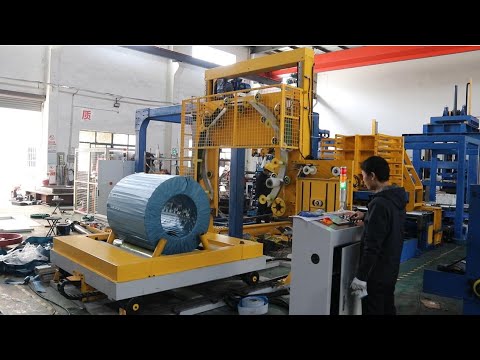
Steel wire coil wrapping machines must comply with applicable safety and quality standards to ensure operator protection and consistent packaging output. The FPS-400 and Master-type machines are designed to meet CE certification requirements under the EU Machinery Directive 2006/42/EC, including risk assessment, electrical safety (EN 60204-1), and guarding per ISO 14120. All parameters—ring speed, lap degree, film width—are configurable within the machine’s design envelope to maintain compliance with the declared performance specifications. The table below summarizes typical configurations; actual tolerances and compliance limits should be verified with the manufacturer’s conformity declaration.
| Parameter | Narrow Coil (FPS‑400) | Wide Coil (Master Type) |
|---|---|---|
| Coil outer diameter | 1500 mm (typical) | 1800 mm (typical) |
| Coil inner diameter | 700 mm (typical) | 508 mm / 610 mm (typical) |
| Coil width | 10–400 mm | 400–1860 mm |
| Maximum coil weight | 5 t (nominal) | 25 t (nominal) |
| Wrapping speed | 80 RPM | 80 RPM |
| Guide adjustment | Motorized | Motorized |
| HDPE roll width | 90 mm (standard) | 100–200 mm (range) |
| Lap degree range | 10°–90° | 10°–90° |
| Operation mode | Fully automatic | Fully automatic |
Note: All values are representative of standard supplier configurations. Final machine parameters must be validated against the manufacturer’s technical file and declared to the notified body if required for CE marking.
🏗️ Key Changes
The primary operational difference between the two machine families lies in the coil handling method: the FPS‑400 uses a bottom trolley for manual loading/unloading, while the Master-type supports optional in‑feed/out‑feed conveyors for fully automated operation. This handling distinction directly affects risk assessment and safety certification. The bottom trolley reduces floor space but requires operator proximity, mandating additional safeguarding per ISO 13857. For wide coils, the conveyor system enables remote loading, lowering manual intervention and aligning with automated safety standards. Additionally, the HDPE film width differs: narrow‑coil machines accept 90 mm rolls, whereas wide‑coil machines accept 100–200 mm rolls. Wider film reduces wrap count per coil, influencing packaging cycle time and film consumption, but also affects the machine’s declared maximum load at full speed. Both models share a ring speed of 80 RPM and lap degree control (10°–90°), but the Master-type’s reinforced frame is necessary to meet structural integrity requirements under continuous heavy-duty operation, as per EN 15011 for lifting and handling equipment.
Key Point: If your product mix includes both narrow and wide coils, verify with the supplier whether the Master-type can be configured for widths below 400 mm while retaining certified safety ratings. A single-machine solution may require an additional risk assessment.
📈 Business Impact
Choosing the correct coil wrapping machine directly affects compliance costs, labor efficiency, and packaging waste. The FPS‑400 represents a lower initial investment (typical industry range for a standard machine) but requires manual handling, increasing operator exposure and corresponding safety certification overhead. The Master-type entails higher upfront cost but reduces labor risk and can achieve higher throughput, lowering per‑unit packaging cost in high‑volume operations. The lap degree setting is a key cost variable: a 50% lap (e.g., 50° angle) doubles film consumption compared to a 10° lap. This must be balanced with the required package strength for transportation tests (e.g., ISTA 3E). The motorized guide enables rapid lap adjustment, allowing compliance with varying customer specifications without producing non‑conforming packages. ROI calculations should factor in certification costs (CE marking, third-party testing) which typically add 5–10% to project cost. Specific payback periods depend on local labor rates, film costs, and production volume; consult a qualified supplier for a tailored analysis.
Key Point: A machine that cannot be adjusted to meet the required lap degree for a specific transport standard will produce non‑compliant packages, incurring rework costs and potential damage claims. Verify that your chosen machine offers the necessary lap range.
🛡️ Compliance Actions
To achieve regulatory compliance, purchasers must ensure the machine undergoes CE certification (if imported into the EU) or equivalent local approval, including a risk assessment, technical file, and declaration of conformity. The supplier should provide a certified machine with a clearly marked CE label and supporting documentation. Specific mandatory steps include:
-
Specify certification requirements at order – Request a machine built and tested to Machinery Directive 2006/42/EC, including electrical safety (EN 60204-1). For other regions, confirm equivalent standards (e.g., China GB, US ANSI).
-
Verify technical file completeness – The supplier must provide a technical file containing drawings, risk analysis, and test reports. This is required for CE marking.
-
Perform in‑house validation – Upon delivery, conduct a safety check per the supplier’s instructions and your local authority’s requirements.
-
Calibrate film tension and lap degree – These parameters affect package integrity. Document settings for audit trails.
-
Maintain records – Keep the declaration of conformity, user manual, and training records for at least 10 years per regulatory guidelines.
Key Point: A machine without proper certification documentation cannot be legally placed on the market in many jurisdictions. Request certification before shipment; do not rely on verbal promises.
⚙️ Timeline & Deadlines
Lead times for these machines typically range from 30 to 60 working days after order confirmation, but CE certification and testing can add 10–15 working days to the schedule. If the machine must be operational by a specific date (e.g., end‑of‑year packaging audits), place the order at least 90 days in advance. The table below shows a typical timeline assuming standard configuration and no custom certification delays.
| Milestone | FPS‑400 (Narrow) | Master Type (Wide) |
|---|---|---|
| Order confirmation | Day 0 | Day 0 |
| Technical drawing & certification plan approval | Day 5–10 | Day 10–15 |
| Manufacturing + certification testing | Day 10–35 | Day 15–50 |
| Factory test & video inspection | Day 35–40 | Day 50–55 |
| Shipping (sea freight) | Day 40–45 | Day 55–65 |
Note: Air freight can reduce shipping time to 5–10 days but adds 15–25% to total cost. Certification deadlines depend on the supplier’s capacity and notified body schedule; confirm in writing.
Key Point: If your region adopts new packaging regulations (e.g., EU’s Packaging and Packaging Waste Directive) with effective deadlines, ensure the machine’s film‑handling capabilities (width, lap control) can meet the new requirements before ordering.
Purchase‑Decision Checklist
-
[ ] Measure your coil dimensions and weight – confirm they fall within the machine’s certified working range.
-
[ ] Decide handling method: manual (trolley) vs. automatic (conveyors) – factor in safety risk level.
-
[ ] Confirm film width and lap degree range needed for your transport standards (e.g., ISTA, ASTM D4169).
-
[ ] Request a copy of the supplier’s CE declaration of conformity and risk assessment.
-
[ ] Specify certification requirements in the purchase contract (e.g., CE, EAC, or CR‑China).
-
[ ] Ask for a video test run showing full machine operation and emergency stop functionality.
FAQ
Q: Can the FPS‑400 handle coils wider than 400 mm?
A: No – the standard FPS‑400 ring and guide are designed for a maximum width of 400 mm. For wider coils, use the Master-type. Verify with the supplier for any custom modifications.
Q: What is the difference between FPS‑400 and FPW‑600?
A: The FPW‑600 is a different model designed for coils up to 600 mm width. If your narrow coils are ≤400 mm, the FPS‑400 is the correct choice. Certification may differ; confirm with the supplier.
Q: Is the wrapping material limited to HDPE?
A: The machines are optimized for HDPE stretch film but can also work with LLDPE. Check roller compatibility and film tension adjustments to maintain consistent wrapping and certification.
Q: How long does it take to change the HDPE roll?
A: Approximately 2–3 minutes per roll, thanks to the quick-release spindle design. This downtime should be factored into cycle time calculations.
Q: Do you offer installation and training?
A: Yes – a technician can be sent to your site (cost depends on location) or we provide remote video support. Ensure training covers safety procedures and certification documentation.












