
Do Coil Strapping Machines Offer Real Solutions for Maintenance and Safety in Vietnam?
For factory managers in Vietnam, daily operations are a constant balancing act. You strive to meet production targets, control costs, and keep everyone safe. But what happens when your packing process slows everything down, puts workers at risk, and even damages your valuable products? These issues can create a lot of stress and eat into your profits.
Coil strapping machines directly address these critical operational issues by automating heavy, repetitive tasks, significantly reducing manual labor, and therefore enhancing both efficiency and safety in your factory.

Many factories, especially those dealing with heavy materials like steel coils or wire, face these exact problems. They often look for answers in new equipment. But the real solution is not just buying a machine. It is about finding a partner who understands your daily struggles. A good partner will help you tackle production bottlenecks, improve safety, and boost overall efficiency. Let us explore how coil strapping machines can be that solution for your operations in Vietnam.
Are Manual Packing Processes Slowing Down Your Vietnam Factory’s Output?
Do your current packing methods feel like a bottleneck at the end of your production line? Are you struggling to keep up with delivery schedules because of slow, labor-intensive processes? This common issue can limit your factory’s ability to grow and meet demand.
Manual coil packing is often a major efficiency bottleneck due to its slow speed, reliance on multiple workers, and the physical strain involved, directly hindering overall production and delivery timelines.

I have seen many factories in Vietnam and elsewhere struggle with this exact problem. When I started my own packing machine factory, one of my main goals was to create solutions that really made a difference for businesses. I learned that slow packing processes can stop an entire production line. It is like having a fast race car, but then you put on bicycle wheels at the end. It just does not make sense. You invest in powerful machinery and skilled labor for manufacturing, but then your final stage, packing, becomes the weakest link. This leads to missed deadlines and unhappy customers.
How Coil Strapping Automation Boosts Production Efficiency
Replacing manual packing with an automated coil strapping machine brings clear benefits. These machines work much faster than human hands. They apply straps with consistent tension and speed. This means your products move through the packing stage without delay. This improvement helps you handle more volume. It also ensures your products are ready for shipment on time.
Consider the typical manual process:
- Workers must position the coil.
- They then measure and cut the strapping material.
- They apply it by hand, often struggling with heavy tools.
- Finally, they seal it.
This process is slow and often needs several workers. Each step can lead to delays. An automated machine takes all these steps. It does them quickly and precisely. It can apply multiple straps in minutes, not hours. This speed is crucial for high-volume factories. It means you can process more coils per shift. This leads to higher overall output for your factory.
Here is a simple look at the difference:
| Aspect | Manual Packing | Automated Coil Strapping |
|---|---|---|
| Speed | Slow, dependent on worker pace | Fast, consistent cycles |
| Labor Needs | High (multiple workers often needed) | Low (one operator or fully automatic) |
| Consistency | Varies by worker skill and fatigue | High, precise tension and placement |
| Throughput | Limited, creates bottlenecks | High, significantly increases production capacity |
| Operational Hours | Limited by human shifts/breaks | Can run continuously with minimal supervision |
| Error Rate | Higher, due to human error | Very low, precise machine operation |
By cutting down on packing time, you free up valuable resources. Your factory can then focus on what it does best: producing high-quality goods. This shift can transform your entire operation. It moves you from reacting to problems to proactively managing your output. This allows your business to grow smoothly.
Can Automated Coil Strapping Truly Eliminate Workplace Hazards for Your Workers in Vietnam?
Do you worry about the safety of your workers? Is manual handling of heavy coils or flipping pallets a constant source of concern? High injury risks lead to increased insurance costs and a high employee turnover rate. This puts a heavy burden on your business.
Automated coil strapping systems significantly improve workplace safety by minimizing direct human interaction with heavy, awkward materials, thus reducing the risk of musculoskeletal injuries, crushes, and other common industrial accidents.

When I was an employee at a packing machine factory, I saw firsthand the dangers workers faced every day. Moving heavy coils by hand, bending over to strap them, or using unsafe methods to turn them over. These tasks were not just difficult. They were dangerous. Later, when I built my own factory, worker safety became a top priority. I knew that a safe environment was not just good for people. It was also good for business. Accidents mean lost workdays, higher medical bills, and lower morale. These problems cost a lot of money and hurt a company’s reputation.
How Automation Drastically Reduces Safety Risks
Automated coil strapping machines take the heavy lifting and risky movements out of human hands. These machines are designed to handle heavy loads with precision. They also protect workers from dangerous situations. For example, some systems can rotate coils automatically. Workers do not need to use crowbars or forklifts in risky ways. This directly reduces the chance of injuries. It also makes the workplace much safer.
Consider the dangers of manual strapping:
- Musculoskeletal Injuries: Workers bend, lift, and strain. They often use repetitive motions. This leads to back pain, sprains, and other injuries.
- Crushing Hazards: Heavy coils can shift or fall. This puts workers at risk of severe crushing injuries.
- Cuts and Abrasions: Handling sharp strapping materials or tools can cause cuts.
- Fatigue-Related Accidents: Tired workers are more likely to make mistakes. These mistakes can lead to accidents.
An automated system eliminates almost all these risks. The machine does the dangerous work. Workers operate it from a safe distance. They might load the coil onto a conveyor. Then the machine takes over. It positions, straps, and discharges the coil. This process is highly controlled. It removes the need for direct manual contact with the heavy coil during strapping.
Here is a comparison of safety aspects:
| Safety Aspect | Manual Strapping Operations | Automated Coil Strapping Operations |
|---|---|---|
| Direct Contact | High, workers are close to heavy coils | Minimal, workers operate from a safe distance |
| Lifting/Moving | Requires physical strength, risk of strain | Handled by machine, no manual lifting of coils |
| Repetitive Strain | High, repeated bending, pulling, sealing | Low, machine performs repetitive tasks |
| Tool Usage | Manual strapping tools, risk of hand injuries | Machine handles tools automatically |
| Ergonomics | Often poor, awkward postures | Excellent, worker position is usually ergonomic |
| Accident Severity | Potential for severe crushing, back injuries | Significantly reduced, fewer direct hazards |
| Worker Fatigue | Contributes to mistakes and injuries | Machine does not fatigue, maintains consistent safety |
By investing in automation, you are not just buying a machine. You are investing in your workers’ well-being. A safer workplace leads to happier employees. It also lowers your insurance costs. This creates a more stable and productive work environment for everyone in your Vietnam factory.
Is Your Factory Losing Profit Due to Damaged Steel Coils During Packaging and Handling?
Are you facing customer complaints because your products, like steel coil edges, arrive damaged? Do you see valuable profit slipping away due to minor dents or deformities during internal transfer and packing? Product damage is a hidden cost that can impact your reputation and your bottom line.
Product damage, particularly to sensitive items like steel coil edges during internal transport and packaging, leads to customer complaints and significant profit losses. Automated systems reduce human error and inconsistent handling, protecting product integrity.
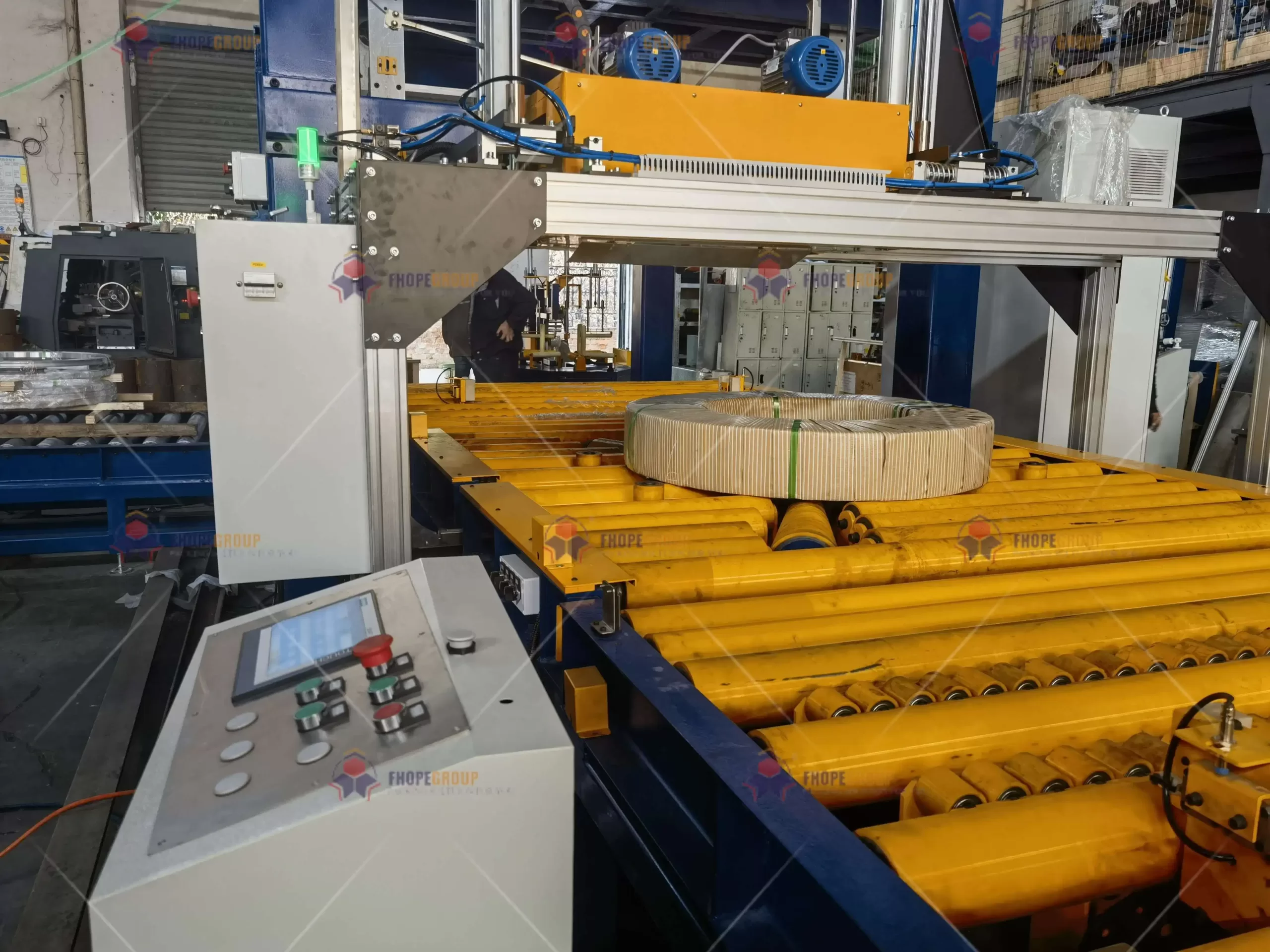
Throughout my career in the packing machine industry, I have heard many stories from clients about product damage. A small scratch on a coil edge can make a customer reject an entire shipment. This means more work for you. It also means less profit. I saw how this problem affected their business. When I started FHOPEPACK, my mission was to help businesses grow. Protecting the product is a huge part of this. You work hard to make a quality product. You should not lose money at the very end of the process.
How Automated Strapping Protects Your Product and Profit
Automated coil strapping machines reduce product damage in several ways. They provide consistent and secure strapping. This prevents movement and abrasion during handling and transport. These machines apply the right amount of tension every time. They also place the straps accurately. This stops the coil from shifting or rubbing against other surfaces. This careful handling helps maintain the product’s quality. It also ensures it reaches the customer in perfect condition.
Consider how damage occurs in manual handling:
- Inconsistent Strapping: If straps are too loose, the coil can move. This causes friction and damage. If they are too tight, they can deform the product.
- Rough Handling: Manual processes often involve pushing, pulling, or dropping. This can dent edges or surfaces.
- Improper Placement: Incorrect strap placement can leave parts of the coil unprotected. These parts are then vulnerable to damage.
- Lack of Control: Human error or fatigue can lead to accidental bumps or scrapes.
Automated systems eliminate these inconsistencies. They are programmed for precise operation. The machine guides the coil into position. It then applies the straps with consistent tension and speed. This ensures every coil is strapped uniformly. This tight, secure packaging prevents internal movement. It also protects the outer layers of the coil. This means fewer complaints. It also means more satisfied customers.
Here is a summary of how product protection improves:
| Aspect | Manual Strapping | Automated Coil Strapping |
|---|---|---|
| Strapping Tension | Inconsistent, often too loose or too tight | Consistent, precisely controlled |
| Strap Placement | Varies, prone to misplacement | Accurate, programmed for optimal protection |
| Handling Method | Often rough, prone to accidental impacts | Gentle, controlled by machine |
| Edge Protection | Vulnerable to dents and abrasion | Better protected by secure, consistent strapping |
| Damage Rate | Higher, due to human error and inconsistency | Significantly lower, due to precision operation |
| Customer Returns | More frequent, impacting reputation and profit | Reduced, leading to higher customer satisfaction |
| Material Usage | Can be wasteful due to re-strapping | Optimized, precise use of strapping material |
By preventing damage, you save money on rework and returns. You also build a stronger reputation for quality. This directly impacts your factory’s profitability. It ensures that the value you create in manufacturing is maintained all the way to your customer’s door.
How Can You Find a Trustworthy Partner for Packing Machine Solutions in Vietnam?
Have you dealt with equipment suppliers who only care about making a sale? Do they offer poor after-sales service, leaving you in a difficult spot when issues arise? Finding a reliable partner, not just a seller, is crucial when investing in new machinery.
Finding a trustworthy packing machine partner in Vietnam requires looking beyond sales promises to assess their deep industry knowledge, proven track record of supporting clients, and a commitment to long-term service, ensuring your investment truly solves problems.

My journey in this industry taught me a lot about trust. I started as an employee. Then I built my own successful factory. I know what it takes to run a business and grow it. I also know what it is like to rely on suppliers. Some companies just want to sell you a machine. They disappear when you need help. This is frustrating. It can also be very costly. I learned that true partnership means understanding a client’s challenges. It means giving honest advice. It means providing reliable support. This is why FHOPEPACK focuses on sharing knowledge. We want to help you make informed decisions.
What Makes a Packing Machine Supplier a True Partner?
A true partner offers more than just equipment. They bring expertise and a commitment to your success. They understand your production bottlenecks. They know your safety concerns. They grasp your efficiency problems. They offer solutions that fit your specific needs. They also provide ongoing support. This ensures your investment continues to pay off.
Here are key aspects to look for in a trustworthy partner:
- Deep Industry Knowledge: They should understand the nuances of your industry. This includes the types of materials you handle, your production environment, and your unique challenges. This knowledge allows them to recommend the right solution.
- Proven Track Record: Look for a company with a history of successful installations. Check their client testimonials. See if they have helped other businesses grow. A strong track record shows they deliver results.
- Comprehensive After-Sales Support: What happens after the sale? A good partner offers installation support, training for your staff, spare parts availability, and responsive technical service. This is vital for minimizing downtime.
- Problem-Solving Approach: They should not just sell you a product. They should diagnose your problems. They should offer tailored solutions. They should be willing to customize their offerings to meet your specific needs.
- Commitment to ROI: A true partner helps you see the return on your investment. They should be able to show you how their solutions will save you money and increase your profits.
When I started my factory, I needed reliable equipment that could withstand tough conditions. I also needed suppliers who would stand by their products. I looked for those who truly understood my operational pressures. This experience guides how FHOPEPACK operates. We aim to be that reliable resource for you. We provide not just machines, but the insights gained from years in the field. This approach helps you make smart investments. It ensures your new equipment truly solves your problems and helps your business thrive.
| Feature | Transactional Supplier | Trustworthy Partner |
|---|---|---|
| Sales Approach | Focus on selling a product, often generic | Focus on solving your problems, tailored solutions |
| Industry Knowledge | Limited, generic product information | Deep, specific to your industry and operational needs |
| After-Sales Service | Often poor or non-existent | Comprehensive support, training, parts, technical help |
| Relationship | One-time transaction | Long-term relationship, ongoing support |
| Value Proposition | The machine itself | The solution, efficiency, safety, and profitability |
| Problem Solving | Sells what they have | Identifies needs, customizes, offers expert advice |
By seeking out a partner who embodies these qualities, you can feel confident in your investment. You gain peace of mind knowing that you have expert guidance and reliable support. This partnership helps your factory in Vietnam not just survive, but truly succeed and expand.
What Are My Personal Insights on Mastering Packing Machine Operations in Vietnam?
After years in the packing machine industry, from an employee to a factory owner, I have gained a unique perspective. Many people focus on the machine itself. But I believe true success in packing operations comes from a wider view. It involves understanding people, processes, and continuous improvement.
My personal insight on mastering packing machine operations in Vietnam centers on recognizing that the best solutions come from understanding the entire factory ecosystem, prioritizing human well-being, embracing smart technology, and fostering strong, knowledgeable partnerships.
From my journey, I learned that financial independence and business growth come when you truly solve problems for your clients. This is why FHOPEPACK is a knowledge-sharing platform. I want to give back to the industry that gave me so much. I believe that by sharing what I have learned, I can help others avoid common pitfalls and achieve their own success. When I started my own factory, I faced challenges similar to what many of you face today. I learned quickly that a machine is only as good as the process it fits into and the people who operate it. I discovered that investing in durability and efficiency upfront always pays off in the long run.
My Philosophy for Optimizing Your Packing Operations
My core philosophy for packing machine operations boils down to three key areas:
- Holistic Problem Solving: Do not just look at one problem in isolation. See how it affects your whole factory. For example, a slow packing process affects safety, product quality, and delivery times. An automated coil strapping machine is not just for packing. It is a tool for better overall factory flow. I learned this when I grew my own business. I saw that fixing one part often helped many other parts.
- People-Centric Approach: Machines help people. They do not replace them. When you make a workplace safer and more efficient, your workers are happier. They are more productive. I achieved financial independence because I focused on helping people. This principle applies to my own employees and my clients. Providing tools that reduce human strain and risk is a priority. This builds a strong, loyal workforce.
- Sustainable Growth through Smart Investment: Choose equipment that lasts. Choose equipment that brings a clear return on investment. Do not chase the cheapest option. Look for value, durability, and a supplier who stands behind their product. I invested in quality from day one in my factory. This choice paid off hugely. It reduced maintenance costs and downtime. It let me focus on expansion.
For Vietnam, these insights are especially important. The manufacturing sector is growing fast. Competition is strong. Factories need to be lean and efficient. They also need to be safe. By applying these principles, factories can move beyond just “making things.” They can become leaders in their field. This means embracing automation not just as a cost-saving measure, but as a path to higher quality, safer operations, and stronger business relationships. I believe in empowering factory managers like Michael Chen with the knowledge and tools to make these changes. My experience shows that with the right approach and the right partners, truly mastering your packing machine operations is within reach.
Conclusion
Coil strapping machines offer robust solutions for maintenance and safety issues in Vietnam. They boost efficiency, enhance worker safety, and protect product integrity, leading to clear profitability gains.








