
2026 Comprehensive Guide: How Much Does an Automatic Coil Packing Line Cost?
Summary: An automatic coil packing line is an integrated system that transports, protects, and secures metal coils without manual lifting. For a complete line handling coils up to 25 Tons, a base investment starts from $180,000, with typical ROI achieved within 8-20 months through labor and damage savings.
The Real Cost: It’s a System, Not a Machine
So you’re asking, “How much does an automatic coil packing line cost?” That’s the right first question. But here’s the catch: you’re not buying a single machine. You’re investing in a complete material handling process. A stand-alone coil wrapping machine might cost $50,000, but it still needs a crane, operators, and floor space. The real inefficiency isn’t just wrapping—it’s the entire flow from production to storage. The true cost question is: What is the investment to eliminate manual handling, prevent $15,000 coil damage, and free up 3 operators per shift? Let’s break it down.
ROI Insight: View the line cost as “capitalized labor.” A system replacing 6 manual workers across two shifts can save over $150,000/year in direct wages alone, making the line pay for itself in well under two years.
Core Components & Price Breakdown
What exactly are you paying for? A standard automatic coil packing line integrates several synchronized stations. The price scales directly with the level of automation, coil dimensions (OD/ID/Weight), and required throughput (coils per hour). Skipping a necessary module to save upfront cost often leads to a bottleneck, killing your projected ROI.
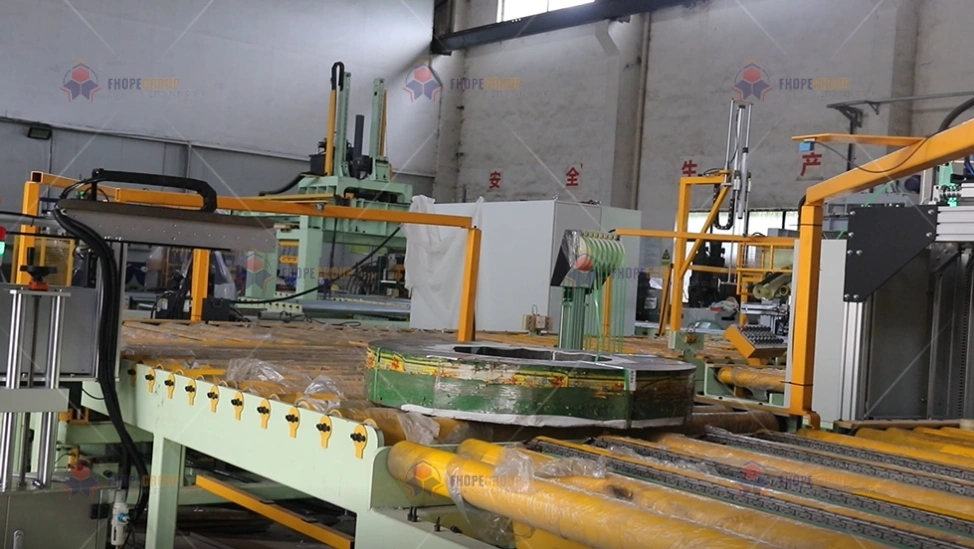
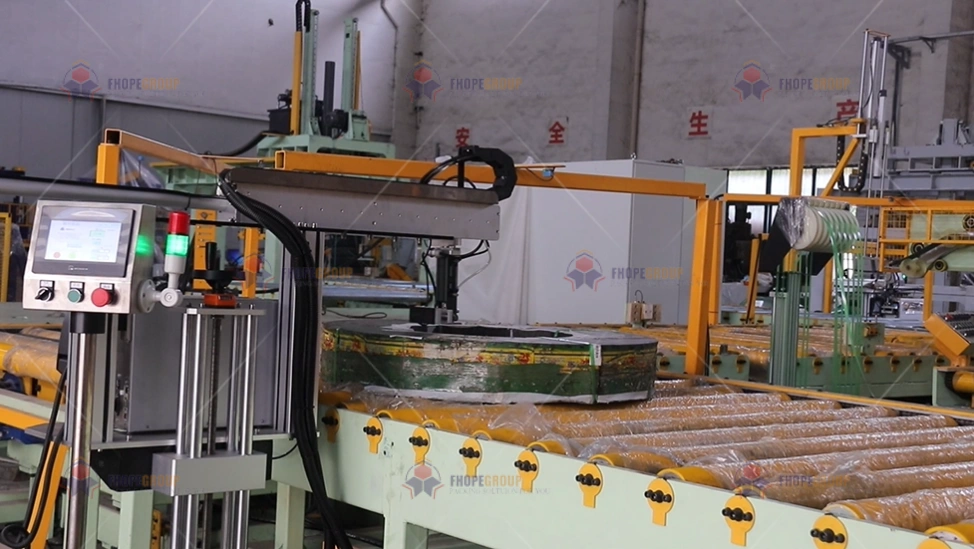
An automatic line’s core function is to replace the human links in the chain between the production mandrel and the finished goods yard. The system must position, protect, and identify the coil without manual lifting or pushing. This requires precise mechanical, control, and safety integration.
🛠️ The Conveyance Backbone: Coil Cars & Conveyors
The first cost driver is material transport. Will you use a floor-based conveyor chain or a raised coil car on rails? A heavy-duty chain conveyor for 20-ton coils can range from $30,000 to $60,000, depending on length and drive power. A motorized coil car on rails offers more flexibility for complex layouts but adds $45,000 to $80,000. The choice depends on your existing factory floor plan and required flow path.
⚙️ The Positioning Heart: The Coil Tilter/Upender
This is the critical hands-off transfer point. A hydraulic coil tilter must rotate a 15-ton coil 90 degrees within 15 seconds with a positioning accuracy of ±0.5 degrees. Prices vary by capacity and clamp design: a 10-ton tilter starts around $35,000, while a robust 25-ton model with V-arm clamps can reach $70,000. The hydraulic system’s pressure (typically 16-21 MPa) and motor torque define its reliability and speed.
🛡️ The Protection Module: The Automatic Wrapping Station
Here is the core protection layer. A basic rotary-arm wrapper applying stretch film starts at $25,000. For heavy-duty or weatherproof packing, you need a system that applies inner anti-abrasive paper, top/bottom steel caps, and outer plastic or laminated sheets. A full “CAPP” (Coil Auto Protective Packing) station with automatic material dispensing can cost between $65,000 and $120,000. The key metric is cycle time: a full wrap with multiple layers should take under 2 minutes.

The Securing & Final Touch: Strapping and Labeling
After protection, the coil must be secured. An automatic steel or plastic strapping head that applies 2-4 straps at programmable positions costs $15,000 to $30,000. Finally, an automatic label printer and applicator ($8,000 – $15,000) ensures traceability, complying with industry standards like ISO 22063 for material identification.
Expert Pro Tip: When budgeting, insist on a Unified PLC Control Panel for the entire line. Trying to link machines from different suppliers with separate PLCs (Siemens, Allen-Bradley, etc.) can add over $20,000 in integration headaches and future maintenance costs.
Full Line Configuration Cost Table
The final price is a sum of modules. Below is a realistic range for complete lines based on common industry configurations. These estimates are for the equipment (FOB); installation, shipping, and training are extra.
| Line Configuration | Target Coil Weight | Key Components Included | Estimated Price Range (USD) | Ideal For |
|---|---|---|---|---|
| Basic Semi-Auto Line | Up to 10 Tons | Chain Conveyor, Manual Tilter, Rotary Stretch Wrapper, Manual Strapping | $80,000 – $130,000 | Low-volume facilities transitioning from full manual handling. |
| Standard Auto Line | 10 – 20 Tons | Motorized Coil Car, Auto Tilter, Full CAPP Wrapping Station, Auto Strapping, Labeling | $180,000 – $300,000 | Most mid-size mills & service centers targeting 10-15 coils/hour. |
| High-Speed Heavy-Duty Line | 20 – 35 Tons | Dual Coil Cars, Heavy-Duty Tilter, High-Speed Wrapper with Cap Feeder, Dual Strapping Heads | $320,000 – $550,000+ | High-volume producers (automotive steel, etc.) requiring >20 coils/hour with zero damage. |
The Hidden & Recurring Costs (The Fine Print)
The machine price tag is just Part A. Missing Part B is where budgets fail. You must plan for these to get a true total cost of ownership.
Installation and commissioning is not DIY. You need a leveled foundation, power (typically 380V 50Hz, 80-150 KVA), and compressed air (6-8 bar, clean and dry). Bringing these utilities to the location can cost $10,000-$30,000. Then, factor 1-2 weeks of technician time for installation and calibration, which can add $15,000 or more.
Consumables are a continuous operational cost. For a line processing 50 coils per day, budget for:
- Stretch Film / Laminated Sheet: $2 – $8 per coil
- Steel/Plastic Strapping: $3 – $10 per coil
- Top/Bottom Caps & Anti-Rust Paper: $5 – $15 per coil This can add up to $50,000+ annually. Choosing the right protective materials per ASTM A700 guidelines for domestic shipment or more stringent standards for export is crucial to avoid corrosion claims.
Spare parts and annual maintenance are non-negotiable. Set aside 2-3% of the total equipment cost annually for spare parts (gearboxes, hydraulic seals, proximity sensors). A basic annual service contract costs $3,000-$8,000 but prevents $50,000 downtime events.
ROI Insight: The single biggest hidden cost is unplanned downtime. A line with 99% uptime vs. 95% uptime can produce 100+ more coils per month. Investing in premium PLCs (e.g., Siemens S7-1200/1500) and branded drives often pays back through reliability.
Calculating Your Specific ROI: A Practical Framework
How do you know if a $300,000 line is justified for your plant? Let’s move beyond theory. Your ROI is driven by replacing variable costs with a fixed one.
First, quantify your current manual packing costs. Track for a week:
- Direct Labor: How many workers (Forklift driver, 2 wrappers, 1 strapper)? 4 people x 2 shifts x [Hourly Wage + Benefits].
- Coil Damage: How many coils get edge damage or rust due to handling? 1 damaged coil per month at $10,000 = $120,000/year.
- Throughput Limit: Can your manual team keep up with peak production, or do they cause a bottleneck at the finishing end?
Second, model the automated line’s performance. Use the supplier’s guaranteed cycle time. For example: A 12-minute total cycle time = 5 coils/hour. Over two 8-hour shifts (15.5 productive hours), that’s ~77 coils/day. Can your manual team do that consistently and safely?
Third, run the numbers. Here’s a simplified example for a mid-size service center:
- Current Cost: 3 manual workers per shift x 2 shifts = 6 full-time equivalents. Annual labor cost: $240,000. Annual damage/waste: $60,000. Total: $300,000.
- New System Cost: Line investment: $250,000. Annual consumables & maintenance: $70,000. Total Year 1 Cost: $320,000.
- Savings: Labor reduced to 1 supervisor per shift (2 FTEs). Labor saved: $160,000. Damage reduced by 90%: $54,000 saved. Total Annual Savings: $214,000.
- Simple Payback: $250,000 / $214,000 ≈ 14 months. From Year 2, the savings translate directly to profit.
Key Decision Factors That Swing the Price
Why do quotes from different suppliers for a “20-ton line” vary by 40%? It’s in the engineering details. Don’t just compare the top-line number; compare what it includes.
🛡️ Safety System Compliance
A line compliant with EN ISO 13849-1 (Safety of machinery) includes light curtains at access points, emergency stop circuits, and pressure-sensitive safety mats. This adds $10,000-$20,000 but is mandatory in most regions and prevents catastrophic liability. A cheap quote often has minimal safety integration.
⚙️ Frame Construction & Duty Cycle
Is the frame made from standard steel tubing or solid steel plate? Are bearings rated for 24/7 operation or light duty? A line built for a 24/5 duty cycle with premium components costs 15-25% more than one rated for 8/5. Ask for the mean time between failures (MTBF) estimates for key components.
Control System Sophistication
Can the system track each coil’s packing recipe (type of film, number of straps) via the coil ID? Can it integrate with your plant’s MES for data reporting? This Industry 4.0 layer, using OPC UA or similar protocols, adds cost but enables paperless tracking and quality assurance.
Expert Pro Tip: Always request a Factory Acceptance Test (FAT) protocol before ordering. This document lists every single function and performance metric (e.g., “Tilter rotates 90° in 12±2 seconds”) that will be tested with your witness. It turns a vague promise into a verifiable checklist.
Conclusion: An Investment in Predictability
So, how much does an automatic coil packing line cost? As we’ve seen, a functional system starts around $180,000, but a robust, high-throughput solution typically lands between $250,000 and $400,000. The final number is a reflection of your required speed, coil specifications, and desired level of autonomy.
The ultimate goal isn’t just to spend capital. It’s to transform a variable, risky, and labor-intensive cost center into a predictable, safe, and efficient process. You are paying for controlled throughput, eliminated damage, and quantifiable safety. The best way to proceed is to define your must-have performance metrics (coils/hour, uptime %, safety standards), get detailed quotes that break down every module, and calculate your ROI based on your real-world costs of labor and waste.
Ready to move from ballpark figures to a firm quote? The next step is to provide your exact coil specs and production goals to a qualified coil wrapping machine supplier for a detailed system design and proposal.








