

Choosing the Right Strapping Head: TITAN vs. FROMM Type Engineering
Summary: A technical comparison of TITAN-friction-weld and FROMM-PET-seal strapping head architectures, defining core operational principles and decision metrics. The TITAN type achieves cycle times under 1.8 seconds per strap, offering decisive throughput for high-volume lines.

The Core Dilemma: Friction Weld vs. Thermal Seal
You have a line packing 120 steel coils per shift. Every second of downtime costs money. The strapping head is the final critical touchpoint—if it fails, the entire coil is not shipment-ready. The oldest debate here isn’t about brands, but about the fundamental joining method: the high-friction weld of the TITAN type versus the thermal seal of the FROMM (or PET) type. Choosing wrong means facing constant jams, strap breaks, or seals that pop open in transit.
The core difference lies in how the strap joint is formed. TITAN-type heads use friction welding: two strap ends are vibrated under high pressure (typically 400-600 N) to create a molecular bond. FROMM-type heads use a metal seal: a pre-formed clip is crimped around overlapping strap ends, often with a heat element to melt the PET strap for a seal.
⚙️ Principle of Operation: A Physical Breakdown
The engineering path diverges at the joint.
- TITAN / Friction Weld Process: The strapping cycle concludes with the two strap ends held in a dedicated welding chamber. A sonotrode vibrates one end at high frequency against the stationary end. The friction generates heat (reaching the material’s melting point locally, around 250-300°C for PP/PET), and immediate pressure forces a molecular weld. No consumables are needed.
- FROMM / Thermal Seal Process: The strap ends overlap on a sealing anvil. A feeding mechanism places a small, separate metal seal (a clip) over the overlap. A heated sealing blade then presses down, simultaneously crimping the metal seal and applying heat through it to melt the plastic strap surfaces together. The seal remains as part of the joint.
Expert Pro Tip: For TITAN heads, consistent weld quality depends on clean strap. Heavy dust or oil contamination on the strap can act as a barrier, weakening the weld. A simple compressed air blow-off nozzle before the head entry can increase weld reliability by over 30%.
Performance Showdown: Metrics That Matter on the Floor
It’s not about which is “better,” but which is better for your specific line. A manager needs to justify the investment with clear performance data, not marketing claims. Let’s break it down by the physical indicators that affect your OEE (Overall Equipment Effectiveness).
The choice hinges on your primary driver: raw speed and simplicity (TITAN) versus maximum joint security and material flexibility (FROMM). TITAN heads excel in pure speed and low consumable cost, ideal for high-volume applications with consistent strap. FROMM heads provide the strongest, most tamper-evident seal and handle a wider range of strap materials and conditions, crucial for heavy-duty or irregular loads.
🛠️ Throughput & Cycle Time
Speed is revenue in coil packing.
- TITAN Advantage: The friction weld process is extremely fast. There’s no need to feed a separate seal. Modern TITAN-type heads can complete a tension-seal-cut cycle in 1.6 to 1.9 seconds. This is critical for lines with multiple straps per coil or very high hourly throughput targets.
- FROMM Consideration: The additional step of feeding and positioning the metal seal adds time. Typical cycle times range from 2.2 to 2.8 seconds. While still fast, this difference multiplied over thousands of straps per day adds up.
🛡️ Joint Strength & Reliability
A broken strap in transit can cause catastrophic coil damage.
- FROMM Advantage: The metal seal provides a crimped mechanical lock and a fused plastic bond. This creates a joint strength that often meets or exceeds 70% of the strap’s original break strength. It is also highly tamper-evident and less sensitive to strap surface contamination.
- TITAN Performance: A good friction weld achieves 60-70% of strap break strength. Its weakness is consistency in sub-optimal conditions (dirty, wet, or heavily coated strap). The weld is a reformulation of the strap material itself.
| Performance Factor | TITAN / Friction Weld Type | FROMM / PET Seal Type |
|---|---|---|
| Core Joining Method | Friction-induced molecular weld | Metal seal crimping + thermal fusion |
| Typical Cycle Time | 1.6 – 1.9 seconds | 2.2 – 2.8 seconds |
| Consumables Needed | None (strap only) | Metal seals (clips) |
| Joint Strength | ~60-70% of strap strength | ~70%+ of strap strength |
| Tamper Evidence | Moderate (weld can be re-melted) | High (seal must be cut) |
| Strap Compatibility | Best with standard PP/PET | Broad (can handle coated, printed, or wet strap better) |
ROI Insight: Calculate your seal cost. If your FROMM-type head uses 20 seals per coil at a cost of $0.02 each, that’s $0.40 per coil. For a plant producing 500 coils/day, that’s $200/day in consumables. A TITAN system eliminates this, paying back the potential price premium in months.
Making the Strategic Choice for Your Line
Let’s talk about Jose in Monterrey. His line runs hot-rolled steel coils. The strap sometimes has light mill oil residue. He needs 8 straps per coil, 90 coils per shift. His top pain point? Unplanned stoppages. The choice here is strategic, tying directly to his KPIs: Mean Time Between Failures (MTBF) and cost per packed coil.
Select based on your dominant constraint. For high-speed lines with clean, dry strap where throughput is king, the TITAN type is the default engineering choice. For heavy, sharp-edged (like slit coil), or irregular loads where maximum joint security and reliability under variable conditions are non-negotiable, the FROMM type justifies its operational cost.


⚙️ Load Profile & Strap Conditions
Your material dictates the rules.
- Choose TITAN if: You are strapping uniform, stable coils (e.g., pipe, uniform sheet). Your strap is standard polypropylene (PP) or polyester (PET) and you can control its cleanliness. You prioritize minimal touchpoints and consumable inventory.
- Choose FROMM if: Your loads are heavy (over 5 tons), have sharp edges (slit coil, wire), or are prone to shifting. Your strap might be wax-coated, printed, or occasionally exposed to moisture. The metal seal acts as a protective clamp over the strap joint, preventing peel-back from sharp edges.
🛠️ Total Cost of Ownership & Uptime
The purchase price is just the entry ticket.
- TITAN TCO: Lower running costs (no seals). Maintenance focuses on the welding jaws and cutter blade. Potential for higher downtime if weld consistency fails due to contamination, requiring cleaning or jaw replacement.
- FROMM TCO: Higher running costs (seal inventory). Maintenance includes the seal feeder mechanism, heating element, and crimping anvils. Generally offers more consistent performance in tough environments, potentially increasing MTBF.
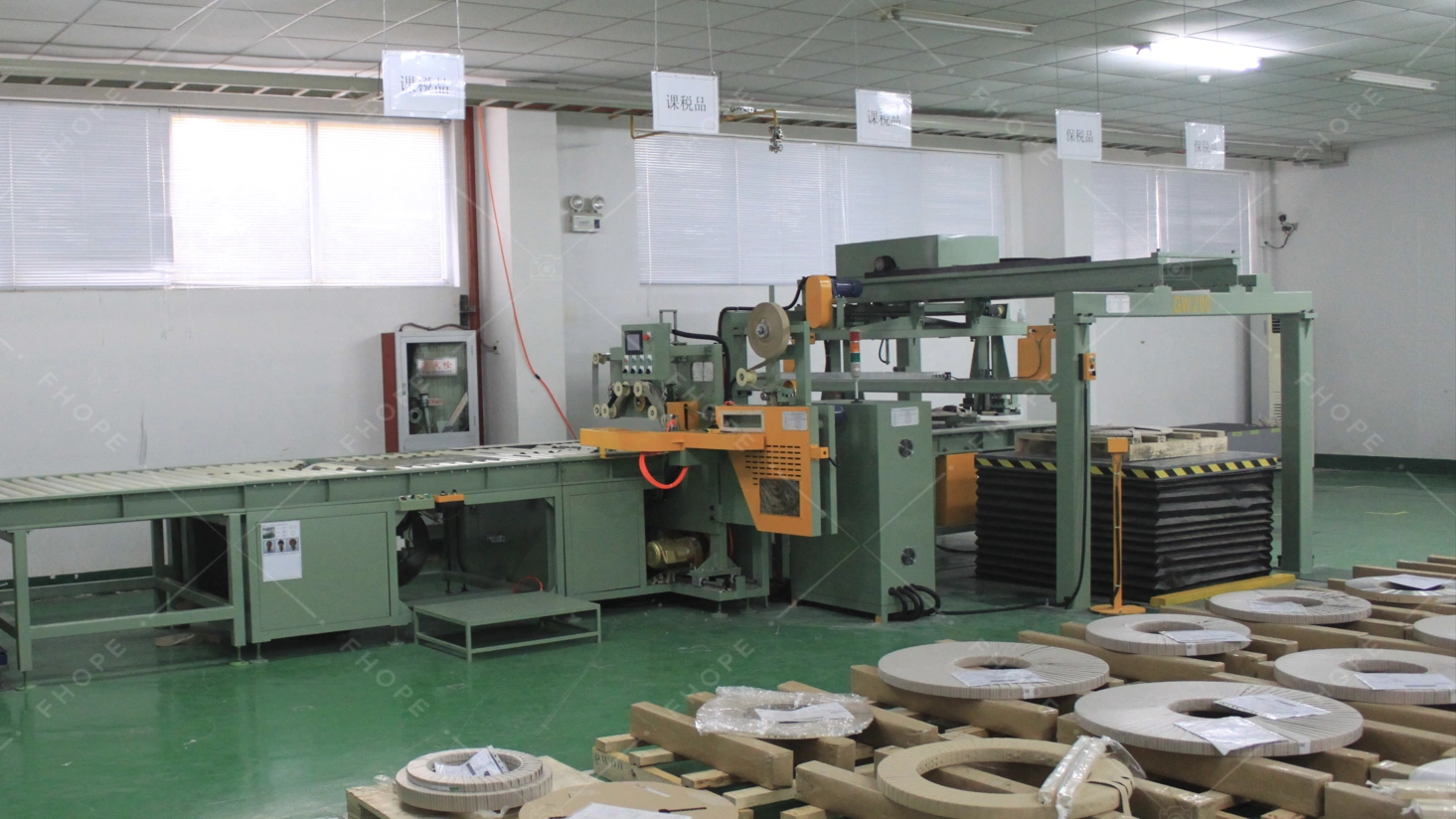

Integration & Future-Proofing
This isn’t an island decision. The strapping head must communicate flawlessly with your coil turntable, compression unit, and wrapping system. A mismatch in the I/O signals or cycle time can create a bottleneck, wasting the capability of your entire coil wrapping machine.
Integration is about communication and timing. Ensure the strapping head’s PLC response time (typically <50ms) and output signals (strap present, cycle complete, fault code) are compatible with your main line PLC. The head's physical cycle time must be faster than the allowable window provided by the rotating turntable or indexing conveyor.
⚙️ Communication Protocols
Modern lines are networked.
- Standard I/O: Discrete 24V DC signals for start, ready, fault. This is robust and simple.
- Fieldbus Networks: Profinet, EtherNet/IP, or Modbus TCP communication allows for detailed diagnostics, remote parameter setting (strap tension), and predictive maintenance alerts (e.g., welding jaw wear counter). This is essential for Industry 4.0 ready lines.
🛠️ Maintenance Accessibility
Design for quick repair. Downtime is measured in minutes.
- Look for heads with a front-service design. Key wear parts like the cutter blade, welding jaws (TITAN), or sealing blade (FROMM) should be replaceable in under 10 minutes without removing the entire head from its mount.
- Standardized tooling is a must. Needing a proprietary wrench adds precious minutes to a repair.


Ultimately, the right engineering choice between TITAN and FROMM strapping heads balances the relentless demand for speed against the non-negotiable requirement for securement. For the high-volume, predictable environment, the elegance and efficiency of the friction weld are compelling. For the tough, variable, and security-critical application, the proven robustness of the thermal seal carries the day. By grounding your decision in the physical metrics of cycle time, joint strength, and total operational cost—not just brochure specifications—you specify a solution that Jose’s team can rely on shift after shift. This strategic integration ensures your strapping station is not the bottleneck, but a reliable anchor point in your efficient packaging line.












