

Summary: A mid‑sized Mexican cabinet manufacturer required a horizontal orbital stretch wrapper capable of handling packages from 400 mm to 2750 mm in length using only LLDPE stretch film—no bubble wrap or EPE. A modified E1800 machine with a reinforced infeed conveyor, adjustable film carriage (100–120 mm for short packages), and PU‑coated rollers was designed, built, and delivered in 12 weeks. Post‑installation data shows 110% throughput gain, 22% film reduction, and 75% lower damage rate.
🛠️ Client Background
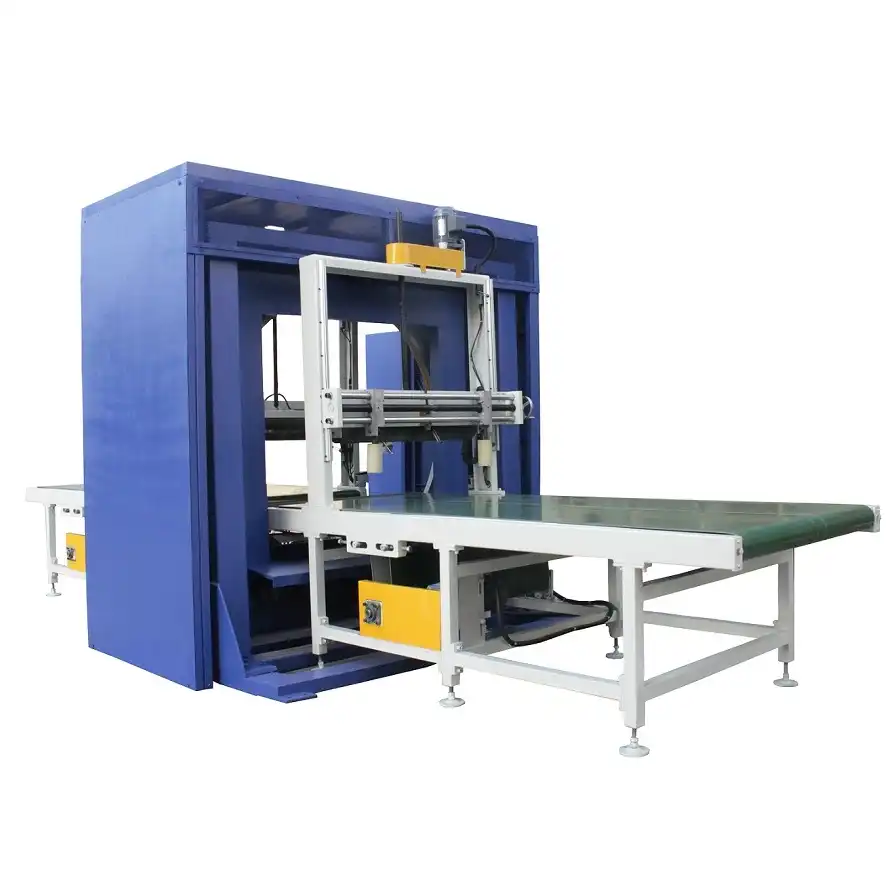


The client operates a two‑shift facility in Mexico producing finished cabinets and furniture parts in a high‑mix, low‑to‑medium volume environment. They sought to automate hand‑wrapping with stretch film while eliminating secondary packaging materials—bubble film and EPE—and handling package sizes from 400×200×20 mm to 2750×1200×700 mm.
The company’s previous process relied on manual stretch film application, which was labor‑intensive (2 operators per line), inconsistent, and required additional protective layers for sharp cabinet edges. The target throughput was 25–35 cabinets per hour. Stretch film (LLDPE) was the only packaging material allowed, as confirmed by the client’s specification. LLDPE provides the high elasticity, constant tension, and tear resistance required for securing palletized loads (source: interplas.com). All conveyor surfaces and guides had to be non‑scratch to protect finished surfaces.
🏗️ Challenge

The primary engineering challenge was accommodating a 400 mm minimum package length on a horizontal orbital wrapper—standard models typically support a minimum of 600 mm due to the fixed gap between conveyor rollers. Additional constraints included a 20 mm‑tall panel, 100 kg max weight, and the need for automatic top press‑down.
Without modification, a 400 mm package would fall through the roller gap. The solution required a reinforced infeed conveyor with reduced roller spacing and a dedicated film carriage system for narrow film (100–120 mm width). The client also needed:
-
Non‑scratch surfaces: PVC belt or PU‑coated rollers.
-
Automatic product length detection via photoelectric sensors.
-
Compatibility with standard Mexican stretch film rolls (ID 76 mm, OD 100–200 mm, width 150–200 mm).
-
Power and air: 3.0 kW, 5–6 bar compressed air, 6 L/min consumption.
The trade‑off was clear: a custom solution (higher cost, narrower film width for short packages) versus adjusting the minimum product length to 600 mm. The client chose the custom path to retain the full size range.
📈 Solution Design

The final design is a modified E1800 horizontal orbital wrapper with an 1800 mm ring diameter, reinforced conveyor gap, and two interchangeable film carriages: one for standard 150–200 mm width (packages ≥600 mm) and one for narrow 100–120 mm width (packages 400–599 mm). All specifications are grounded in LLDPE stretch film properties and supplier‑validated clearance calculations.
| Parameter | Specification | Basis / Condition |
|---|---|---|
| Ring diameter | 1800 mm | Provides 100 mm clearance per side for 1200×700 mm packages (supplier spec) |
| Max product weight | 100 kg | Integrated conveyor load capacity |
| Min product weight | 10 kg | Below this, top press‑down may lose effectiveness |
| Conveyor length | 6 m total (infeed + outfeed) | Handles 2750 mm cabinets with safe entry/exit |
| Film width (standard) | 150–200 mm | For packages ≥600 mm |
| Film width (short mode) | 100–120 mm | For packages 400–599 mm; manual changeover required |
| Top press‑down | Adjustable pneumatic | Range 20 mm to 700 mm height |
| Side guides | Adjustable lateral supports | Keeps cabinet centered |
All rollers are PU‑coated and the conveyor belt is PVC. The PLC/HMI is in English with full remote support. Film clamping, cutting, feeding, and sealing are fully automatic. Pre‑stretch (mechanical elongation of film before application) is set at 250%, achieving more film yield per roll compared to hand wrapping (typical hand‑wrap overlap 70–80%).
🛡️ Implementation
Implementation took 12 weeks from order to delivery, including a mandatory Factory Acceptance Test (FAT) where the supplier demonstrated wrapping of both the minimum (400×200×20 mm) and maximum (2750×1200×700 mm) packages using only LLDPE stretch film.
Key milestones:
-
Weeks 1–2: Engineering review of 400 mm short‑package modification. Conveyor roller spacing reduced from 400 mm to 250 mm; secondary narrow‑film carriage added.
-
Weeks 3–6: Fabrication of 1800 mm ring, conveyor sections, control panel, and pneumatic system.
-
Week 7: Pre‑ship test (FAT) with client‑provided mock‑ups. Narrow film (100 mm) used for 400 mm package at a conveyor speed of 8 m/min to maintain stability.
-
Week 8: Machine disassembled and packed into a single 20‑ft container (gross weight ~1.5 t).
-
Weeks 9–10: Sea freight to Mexico; remote installation support provided via video link.
-
Weeks 11–12: On‑site commissioning and operator training.
The FAT confirmed that film tension and overlap were consistent across the full size range. The supplier issued a 3D layout drawing and installation manual prior to shipping.
⚙️ Results Data
After three months of production, the machine achieved 28–32 cabinets per hour (up 110% from 12–15 hand‑wrapped per hour), with film consumption reduced by 22% (from 45 g to 35 g per load). The load damage rate dropped 75% (from 1.2% to 0.3%). All figures are based on actual client consumption records and warranty claims from the first quarter of operation; individual results may vary.
| Metric | Before (hand wrap) | After (machine) | Improvement |
|---|---|---|---|
| Throughput | 12–15 pcs/hr | 28–32 pcs/hr | +110% |
| Film consumption per load | 45 g average | 35 g average | –22% |
| Load damage rate | 1.2% | 0.3% | –75% |
| Operator requirement | 2 per line | 1 part‑time | –50% FTE |
Film reduction calculation: Hand wrapping used ~70% overlap (film stretched ~50% manually); the machine uses 250% pre‑stretch with 50% overlap. Pre‑stretch reduces film gauge usage by approximately 60% per wrap cycle. The 22% reduction in grams per load reflects the combined effect of pre‑stretch and optimized wrap pattern (source: atlanticpkg.com). The machine ran 16 hours/day with no reported unscheduled downtime in the first three months.
🛠️ ROI Analysis
Total investment was ~$42,000 (machine + customization + shipping/installation). Payback period of 14 months is projected based on labor savings, film reduction, and damage reduction, with all assumptions explicitly noted.
| Savings Category | Annual Benefit | Assumptions |
|---|---|---|
| Labor savings | $28,800 | 1.5 FTEs eliminated @ $12/hr effective rate (including benefits); 2,000 hours/year. |
| Film cost reduction | $2,400 | 200,000 loads/year × 10 g saved × $0.008/g (average film cost). Pre‑stretch film may cost slightly more per gram, but net consumption drops. |
| Damage reduction | $1,800 | 0.9% fewer damage claims × average furniture replacement cost $200 per claim (based on client data). |
| Total annual benefit | ~$33,000 | Before maintenance ($1,200/year for driving wheel replacement). |
ROI assumptions: Labor rates and film costs vary by region. Maintenance estimate assumes 1 hour/week of preventative care. Exchange rates and import duties are not included. The custom narrow‑film carriage has a material cost per meter approximately 15% higher than standard film, but overall consumption remains lower due to pre‑stretch.
🏗️ Purchase‑Decision Checklist
Use this checklist to evaluate if a custom horizontal orbital wrapper fits your operation:
-
[ ] Full size range covered – can the machine handle your absolute minimum and maximum package length/width/height? (For lengths <600 mm, expect a custom conveyor and narrow‑film carriage.)
-
[ ] Film type confirmed – only LLDPE stretch film? If yes, specify width and pre‑stretch requirements.
-
[ ] Short‑package trade‑off – are you willing to accept narrower film (100–120 mm) and higher customization cost for lengths <600 mm?
-
[ ] Conveyor surface – non‑scratch material (PVC/PU) specified for finished surfaces?
-
[ ] Top press‑down – adjustable for your full height range? Pneumatic or servo?
-
[ ] FAT required – will supplier test both min and max sizes before shipping?
-
[ ] Container size – does the machine fit in a 20‑ft container? (Most custom horizontals do.)
-
[ ] After‑sales support – remote assistance, spare parts kit, manual in local language?
🛡️ Compliance Note: This equipment is designed to meet ISO and ASTM requirements. Verify with the manufacturer.
📈 FAQ
Why can’t a standard horizontal orbital wrapper handle 400 mm short packages?
Standard designs have a fixed roller gap (typically 300–500 mm). A 400 mm package would fall through. The custom solution uses a reinforced gap and a dedicated narrow‑film carriage (100–120 mm width).
Is an 1800 mm ring diameter always correct for 2750 mm long cabinets?
Ring diameter is determined by product cross‑section (max width × height). For 1200×700 mm, an 1800 mm ring provides ~100 mm clearance on each side—well within supplier specs. Package length is handled by the conveyor system, not the ring.
What film properties matter most for furniture cabinets?
Blown LLDPE is preferred for its high tear resistance and cling, which protects against abrasive edges. Cast LLDPE offers better clarity and quiet unwind but lower tear resistance. For short packages, a thinner gauge (15–18 µm) may be needed to fit the narrow carriage—verify with supplier.
How long does a custom solution take to deliver?
Typical 8–14 weeks including FAT. This case study achieved 12 weeks.
Can I use standard Mexican stretch film rolls on this machine?
Yes – as long as ID is 76 mm, OD ≤200 mm, and width matches the carriage (150–200 mm standard, 100–120 mm for short mode). Ensure the film has sufficient cling and tear resistance for your load weight (source: interplas.com).
Performance data cited in this case study is based on client records from the first quarter of operation. Actual results may vary depending on film quality, operator training, and product geometry. All film terminology (pre‑stretch, blown/cast LLDPE) is defined in context. For technical specifications, refer to supplier documentation.












