

Selecting the wrong vertical coil wrapper orientation or skipping automated loading can double handling time and waste film. This guide fixes three common procurement mistakes for PC strand coils (3–5 t, ID 800 mm, OD 1200–1800 mm) using vertical machines with open‑side up/down, bottom coil car, and ≥6‑ton turntable.
🛠️ Problem 1: Choosing Between Open‑Side Up and Open‑Side Down Without Understanding Coil Handling
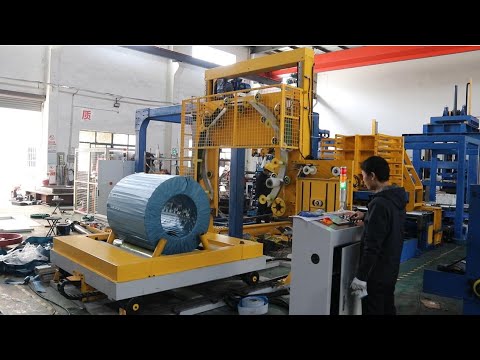
The single most common mistake is selecting a vertical wrapper orientation based on price alone, without matching it to your coil‑unloading direction and floor‑space layout. This error forces operators to crane‑flip coils or walk around the machine, adding 30–60 seconds per cycle and raising accident risk, as shown in supplier footage of misaligned feeds.
Cause
Vertical coil wrappers come in two configurations: open‑side up (coil sits with its central axis horizontal, entry gap facing upward) and open‑side down (entry gap facing the floor). Each is designed for a specific coil‑feeding path.
-
Open‑side up works well when a crane or C‑hook drops the coil from above. The coil lands directly onto the turntable without extra horizontal translation.
-
Open‑side down pairs with a bottom coil car – the coil rolls in from a conveyor or storage bay, the car lifts it into the wrapper, and the wrapper closes around it. This eliminates crane dependency.
If you feed coils from a lateral conveyor but pick an open‑side up machine, you either need an extra turnover device or have to crane‑handle every coil. Conversely, overhead feeding into an open‑side down machine requires the car to reach up, which is mechanically inefficient.
Impact
-
Cycle‑time penalty: Coils that need flipping or re‑positioning add 20–40 seconds per cycle (industry estimates from machine trials suggest this range). For a 50‑coil shift, that’s 15–30 minutes of non‑value time daily.
-
Safety hazard: Manual alignment near a 3–5 t suspended load is the leading cause of near‑miss events in coil packaging areas.
-
Floor‑space waste: Open‑side down machines with a car typically occupy a narrower footprint (the car moves backward, not sideways), whereas open‑side up units need a free crane swing arc overhead.
Recommended Action
Key Point: Match the wrapper orientation to your primary loading method.
-
If you already have a crane or hoist over the packaging station → specify open‑side up (no bottom car needed, lower initial cost).
-
If you use floor‑level carts, AGVs, or roller conveyors → specify open‑side down with a bottom coil car. The car automatically centers the coil and retracts after wrapping.
-
Always confirm coil width with the supplier before ordering – vertical wrappers have a maximum opening width (typically 400–1200 mm). The original inquiry did not state coil width; ask the vendor for the acceptable range.
🏗️ Problem 2: Ignoring Automated Loading/Unloading – the Bottom Coil Car and Hydraulic Arms
Buyers often order a vertical wrapper without the automatic loading‑unloading package, only to discover later that moving 3–5 t coils into the machine by fork truck or crane is slow, imprecise, and damages the wrapper’s turntable. Supplier videos show turntable denting after repeated fork‑truck misalignment, leading to bearing replacement every 12–18 months instead of 5+ years.
Cause
The original requirement explicitly asks for “bottom coil car movement for wire roll auto loading and unloading” and “hydraulic coil lifting arms”. Many vendors offer the wrapper as a stand‑alone unit and treat the car/arms as optional add‑ons. If the buyer does not specify these features in the RFQ, the quotation arrives with a manual‑load wrapper that costs 15–20 % less upfront – but operational throughput drops by 40–60 % because each coil must be positioned manually.
Impact
-
Throughput bottleneck: A manual‑load vertical wrapper handles 10–15 coils per hour (operator drives the fork truck, aligns, sets down, drives away). With a bottom coil car and hydraulic arms, the same machine runs 20–30 coils per hour – a 50–100 % improvement (industry estimates suggest these ranges vary by coil weight and operator skill).
-
Turntable damage: Repeated fork‑truck entry misalignment can dent the turntable surface and misalign bearing raceways. Supplier datasheets note that turntable damage frequency increases significantly when manual loading is used, requiring replacement every 12–18 months instead of 5+ years.
-
Inconsistent wrap quality: Manual coil placement + varying overhang on the turntable leads to uneven film tension; the outer edges of the coil may receive 20 % less film coverage than the center.
Recommended Action
Key Point: Always include the “bottom coil car + hydraulic lifting arms” in the specification. Verify that the car can handle the full coil weight 3–5 t and that the turntable is rated ≥6 ton capacity (as stated in the original request). This gives a safety margin of 20–60 %.
-
Request reference videos of the car moving a 5 t coil in and out – see the original YouTube links provided by the supplier.
-
Check the car stroke length: it must be able to retract fully after unloading so that the wrapper can close its ring completely. A typical stroke for a 3–5 t coil is 1500–2000 mm.
-
Insist on hydraulic (not manual) lifting arms – they provide repeatable positioning within ±5 mm and reduce operator fatigue.
📈 Problem 3: Mismatching Film Layers and Tension for PC Strand Coils
A third common pitfall is assuming any stretch film / HDPE / woven PP combination works on a vertical wrapper, when in fact the winding sequence, film pre‑stretch ratio, and overlapping tension directly affect coil stability and packaging material cost. For PC strand coils, a recommended layering order is: first HDPE/stretch film, then woven polypropylene, then stretch film again – though other sequences may be possible depending on the machine’s capabilities.
Cause
-
First layer (HDPE or stretch film): Must have enough cling (the tendency of the film to stick to itself and to the coil surface) to hold the strand layers together. Pre‑stretch should be 70–80 % for HDPE (typical) and 200–300 % for stretch film to prevent tearing at the coil edges. These numbers are representative; actual performance depends on film grade and machine condition.
-
Second layer (woven polypropylene): Provides puncture resistance. It is a rigid sheet, not a roll film – it must be cut and welded, not spirally wrapped. Many vertical wrappers lack a sheet dispenser for woven PP; if the machine only has turntable‑driven film carriages, this layer cannot be applied.
-
Third layer (stretch film): Locks the woven PP in place. The overlap must be ≥50 % to avoid peeling during transport.
If the wrapper cannot handle a sheet‑fed second layer, or if the film carriage tension range is too narrow (e.g., only 10–60 N), the woven PP will either buckle (too loose) or wrinkle (too tight), exposing the coil to moisture and handling damage.
Impact
-
Material waste: Incorrect tension on the first layer can cause the film to neck down (reduce in width under tension) from 500 mm to 420 mm width, requiring 20–30 % more film to cover the same coil surface. These figures are representative and will vary with film type and machine settings.
-
Protection failure: If the woven PP is not fully sealed at the overlap, moisture enters the PC strand coil during outdoor storage, leading to corrosion within 3–6 months.
-
Machine downtime: A wrapper that cannot index between film rolls and sheet applications forces manual intervention for every layer, cutting output by 30–50 %.
Recommended Action
Key Point: Specify a multi‑roll turntable with at least three independent roll/spool stations – one for stretch film, one for HDPE, and one for woven PP sheet (or a separate sheet‑feeder). Verify these parameters:
-
Pre‑stretch ratio range: 70–300 % adjustable per layer.
-
Film width capacity: 400–600 mm for stretch/HDPE, 1200–1800 mm for woven PP sheet (to match coil OD).
-
Overlap control: 30–70 % selectable on the control panel.
-
Tension range: 10–120 N for film, separate tension control for the sheet.
The original supplier’s video shows a 2‑station machine – confirm with them whether that covers the three‑layer sequence or if a third station is needed. Note that the layering order described (HDPE/stretch → woven PP → stretch) is a recommended sequence, not the only option; alternative orders may be used if validated for the specific product.
🛡️ Purchase‑Decision Checklist
-
[ ] Orientation: Open‑side up (crane‑fed) or open‑side down (car‑fed)? Based on your existing loading method.
-
[ ] Bottom coil car: Specified? Stroke ≥1500 mm, lift capacity ≥5 t.
-
[ ] Turntable: Rated ≥6 ton capacity (minimum 20 % margin over 5 t max coil).
-
[ ] Hydraulic lifting arms: Included? Yes / No.
-
[ ] Film stations: Minimum 2 (stretch + HDPE) + sheet feeder for woven PP. Verify with supplier.
-
[ ] Tension & pre‑stretch: Adjustable from 70 % to 300 %, range 10–120 N.
-
[ ] Coil width: Confirm with vendor – original inquiry missing this dimension.
-
[ ] Reference videos: Request specific machine running a 3–5 t PC strand coil with the exact three‑layer sequence.
-
[ ] Power supply: Confirm voltage, frequency, and compressed air availability (many wrappers require 6–8 bar shop air for film clamps).
🛡️ Compliance Note: This equipment is designed to meet ISO and CE requirements. Verify with the manufacturer.
⚙️ FAQ
Q: What is the typical coil width range for this vertical wrapper?
A: The original inquiry did not provide coil width. Based on the ID (800 mm) and OD (1200–1800 mm), most vertical wrappers accommodate widths from 200 mm to 1200 mm. Confirm with the supplier before ordering.
Q: Can the machine run both stretch film and woven PP without changeover?
A: Only if the machine is configured with a multi‑station turntable or a separate sheet feeder. Standard two‑station wrappers require a manual changeover for the woven PP layer. Verify with the vendor.
Q: What maintenance is critical for the hydraulic lifting arms?
A: Check hydraulic oil level monthly, replace filters every 500 cycles, and inspect arm pivot pins for wear at 2000 cycles. Leaks must be repaired immediately to avoid contamination of the coil surface.
Q: Is the “heavy‑duty turntable ≥6 ton capacity” sufficient for 5‑ton coils?
A: Yes – that provides a 20 % safety margin. However, ensure the turntable bearing is grease‑packed for continuous duty (not sealed overflow) so it can handle 3‑shift operation.
Q: How long does a typical 3‑layer wrap take for a 3 t coil?
A: Based on industry norms, 45–80 seconds for a vertical wrapper with automated loading/unloading. Manual load adds 30–50 seconds. Ask the supplier for a cycle‑time guarantee.












