

Automatic Timber Insertion: Solving the Last Bottleneck in Coil Stacking
Summary: An automatic timber feeder is a robotic system that places wooden spacers between stacked steel coils. It eliminates manual handling, ensuring precise alignment and increasing stacking throughput by up to 30%.

The Hidden Cost of Manual Timber Placement
You’ve automated the strapping and the wrapping. Your coil handling is smooth. But the stack still waits. Why? Because a worker is manually carrying, aligning, and placing a heavy timber on top of a coil. This is the last major bottleneck in a fully automated coil stacking line. This manual step introduces a 60-90 second delay per layer, creating a variable and unpredictable cycle time. The physical strain on workers leads to fatigue and a high risk of musculoskeletal injuries. More critically, misaligned or dropped timbers can cause a stack to become unstable, risking a catastrophic collapse during transport or storage. It’s a process bottleneck that directly impacts your overall equipment effectiveness (OEE) and safety metrics.
ROI Insight: Replacing a dedicated manual timber placement station can save 2-3 labor shifts per line daily. With an average operational cycle of less than 25 seconds per timber, the payback period is often under 12 months through direct labor savings and reduced line stoppages.
The core function of an automatic timber feeder is to robotically pick, transfer, and precisely place a timber spacer onto a waiting coil or stack, synchronizing perfectly with the palletizing crane’s cycle without human intervention. It turns a slow, variable, and risky manual task into a fast, repeatable, and closed process.
🛠️ How It Integrates Into Your Existing Line
An automatic timber feeder is not a standalone island. It’s a subsystem that communicates directly with your Plant’s PLC.
- Signal Integration: It receives a “Coil in Position” signal from the stacker crane or turntable.
- Timber Supply: Timbers are pre-loaded into a magazine or vertical rack, ensuring a continuous supply for multiple stacks.
- Precision Placement: A robotic arm or a dedicated gripper head picks a timber, carries it over the coil, and lowers it with controlled force.
- Confirmation Loop: Sensors confirm successful pick-up and placement, sending a “Timber Placed” signal back to the main line controller, allowing the next coil to be lowered.


Inside the Automatic Timber Feeder: Core Technology
A common question is: “How does it handle different timber sizes or slippery surfaces?” The answer lies in its robust mechanical design and adaptive control system. The system uses a combination of mechanical clamps and vacuum cups. For standard, dry timbers, high-friction polyurethane grippers provide a secure hold. For treated or potentially oily timbers, integrated vacuum pads activate to ensure no slippage during the high-speed transfer. The gripper head is often adjustable or can be swapped to handle timbers from 100mm to 200mm in width.
The gripper system employs a fail-safe, dual-mode clamping mechanism—combining mechanical force for primary hold and vacuum assist for surface adhesion—to guarantee a 100% successful pick-up rate across various timber conditions, directly eliminating the risk of mid-air drops.
⚙️ The Key Subsystems Explained
Three main subsystems work in concert to deliver reliability.
Gripper & Actuation System
This is the “hand” of the machine. It must be simple and powerful.
- Dual-Mode Clamping: Pneumatic or servo-electric clamps provide the primary gripping force. The clamping pressure is adjustable (typically 3-6 bar) to avoid damaging softer wood.
- Vacuum Assist: A secondary vacuum circuit with multiple silicone cups engages for smooth or wet surfaces, creating an auxiliary holding force.
- Quick-Change Interface: Allows for different gripper heads to be mounted in under 15 minutes if your product mix changes.
Material Handling & Magazine
This is the “inventory” system. It ensures the feeder never waits.
- Vertical Rack Magazine: Stores 20-50 timbers in a vertical array, fed by gravity or a lifting platform. This is the most space-efficient design.
- Timber Alignment: Guide rails and stoppers ensure every timber is presented to the gripper in the exact same position, which is critical for placement accuracy.
- Low-Level Sensor: Provides an early warning to the operator when the timber supply needs to be refilled, preventing unexpected stops.
Motion Control & Positioning
This is the “brain and muscle.” It defines speed and precision.
- Servo-Driven Axes: For high-speed, point-to-point movement on the X (horizontal) and Z (vertical) axes. This allows for a travel speed of over 1 m/s and a positioning repeatability of ±0.5 mm.
- Programmable Logic: The feeder’s PLC stores multiple placement programs (e.g., for different coil diameters or stack patterns). It selects the correct one based on the signal from the main line.
Expert Pro Tip: During commissioning, always perform a “dry cycle” test with the gripper to map its full motion path. Check for any potential collisions with overhead crane hooks or safety fences. A few minutes of virtual simulation or manual jogging can prevent costly impact damage on the first day of production.


From Component to System: Integration and Workflow
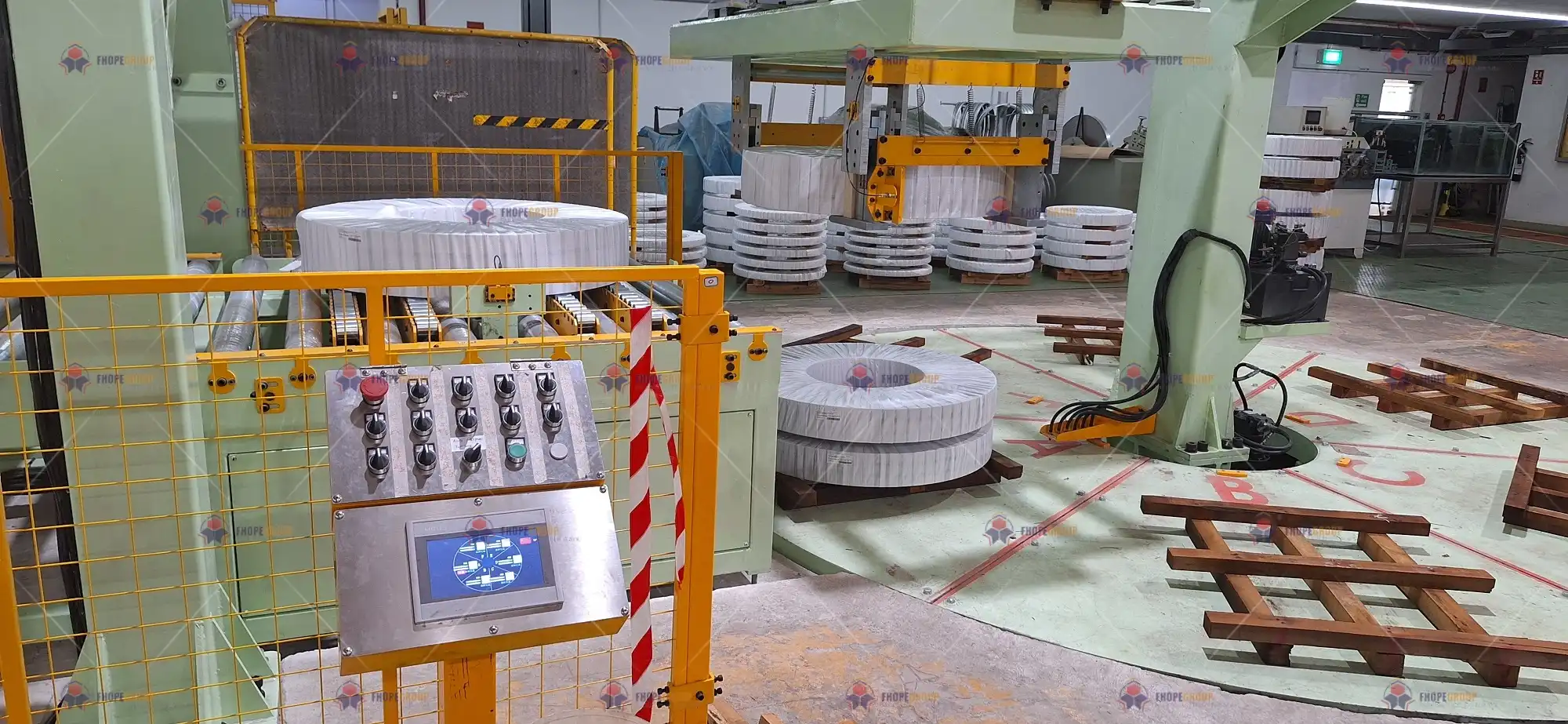
Installing the unit is just the first step. The real value is unlocked when its workflow is perfectly synchronized with your coil stacker. Think of the sequence: a strapped coil is centered on the stacking station. The stacker crane lowers it onto the stack (or the first timber). Immediately, the timber feeder receives the command and begins its cycle in parallel while the crane returns to fetch the next coil. This overlapping operation is what slashes cycle time.
Successful integration hinges on a clear, fail-safe handshake protocol between the stacker PLC and the timber feeder controller, typically using a two-signal system (“Coil Ready” / “Timber Placed”) over a PROFINET or EtherNet/IP network to ensure zero communication lag or error. The entire sequence, from coil placement to timber release, must complete in less than 25 seconds to keep pace with a modern stacking crane.
🔗 Synchronization with Stacking Machinery
The integration point is critical for safety and efficiency.
- Signal Exchange: The main line PLC sends a digital signal. A simple 24V “Start” command is the most reliable.
- Safety Interlock: The feeder will only initiate its cycle if it receives both the “Start” command and a confirmation from a safety light curtain that the stacking area is clear of personnel.
- Positional Feedback: Encoders on the feeder’s axes provide real-time position data back to the controller, allowing for immediate fault detection (e.g., “Axis not reaching target”).
- Cycle Completion: Upon successful placement and gripper retraction, the feeder sends a “Task Complete” signal back to the main PLC, which then allows the next coil handling cycle to begin.

Durability and Maintenance: Built for the Mill Environment
A common concern is maintenance in a harsh, dusty mill environment. This isn’t office equipment. The cabinet is rated to IP54, keeping out most dust and water spray. Critical moving parts like linear guides and ball screws are fitted with rubber bellows or positive-pressure air purges to prevent abrasive steel dust from entering. The gripper mechanism itself is designed with minimal exposed linkages. Daily maintenance is straightforward: a visual check of the gripper pads for wear, an inspection of the timber magazine for jams, and ensuring the sensor lenses are clean.
Proactive maintenance for an automatic timber feeder focuses on three wear items: gripper pad surfaces, magazine alignment guides, and the filters for the pneumatic/vacuum system, with recommended inspection intervals of 250, 500, and 1000 operating hours respectively to prevent unplanned downtime.
🛡️ Ensuring Long-Term Reliability
A structured approach keeps the system running for years.
- Daily (5 minutes): Check timber supply level; visually inspect gripper for damage; listen for abnormal pneumatic hisses.
- Weekly (15 minutes): Clean all sensor eyes (photoelectric sensors on magazine and gripper); check clamping pressure gauge is in the green zone; lubricate any manual guide rails on the magazine.
- Monthly (1 hour): Inspect gripper pads and vacuum cups for cracks or excessive wear; check torque on critical mounting bolts; test the emergency stop and safety interlock circuits.
ROI Insight: The predictable maintenance schedule of an automated system is a hidden cost saver. It replaces the unpredictable costs of manual labor injuries, worker absenteeism, and quality incidents from misplaced timbers with planned, low-cost part replacements.
Conclusion: Closing the Loop on Full Automation
The journey to a fully automated coil packaging line ends with addressing the final manual touchpoints. The automatic timber feeder is the definitive solution for the last major bottleneck in coil stacking. It transforms a slow, physically demanding, and safety-critical task into a fast, precise, and perfectly repeatable automated sequence. The result is a tangible increase in your line’s throughput, a guaranteed improvement in stack stability for safe shipping, and the removal of personnel from a high-risk zone, aligning with the highest safety standards like ISO 12100.
By integrating this system, you move from a semi-automated process to true lights-out operation capability for your stacking cell. The consistent cycle time allows for predictable production scheduling and maximizes the return on your other capital investments in coil wrapping machines and strapping systems. It’s not just another machine; it’s the final piece that completes your automated puzzle.












