
How Do Automated Coil Handling Systems Improve Production Throughput?
Manual coil handling in a busy steel mill can feel like a constant uphill battle. Are you struggling with bottlenecks in your packing area, slow shipping times, or worker fatigue? Imagine hundreds of tons of steel coils needing careful packing and precise movement every single day. The pressure to deliver on time, without compromising safety or quality, is immense. It is a tough challenge many production directors, like Ivan Petrov in Russia, face daily. (manual steel coil handling challenges)
Automated coil handling systems fundamentally transform production throughput by speeding up processes, increasing operational consistency, and reducing the reliance on manual labor. These integrated solutions move, weigh, wrap, and strap coils with precision and efficiency. They ensure a steady flow of finished products from the production line to dispatch. This means more coils are processed in less time, directly boosting a factory’s overall output and delivery capability. (automated coil handling throughput improvement)
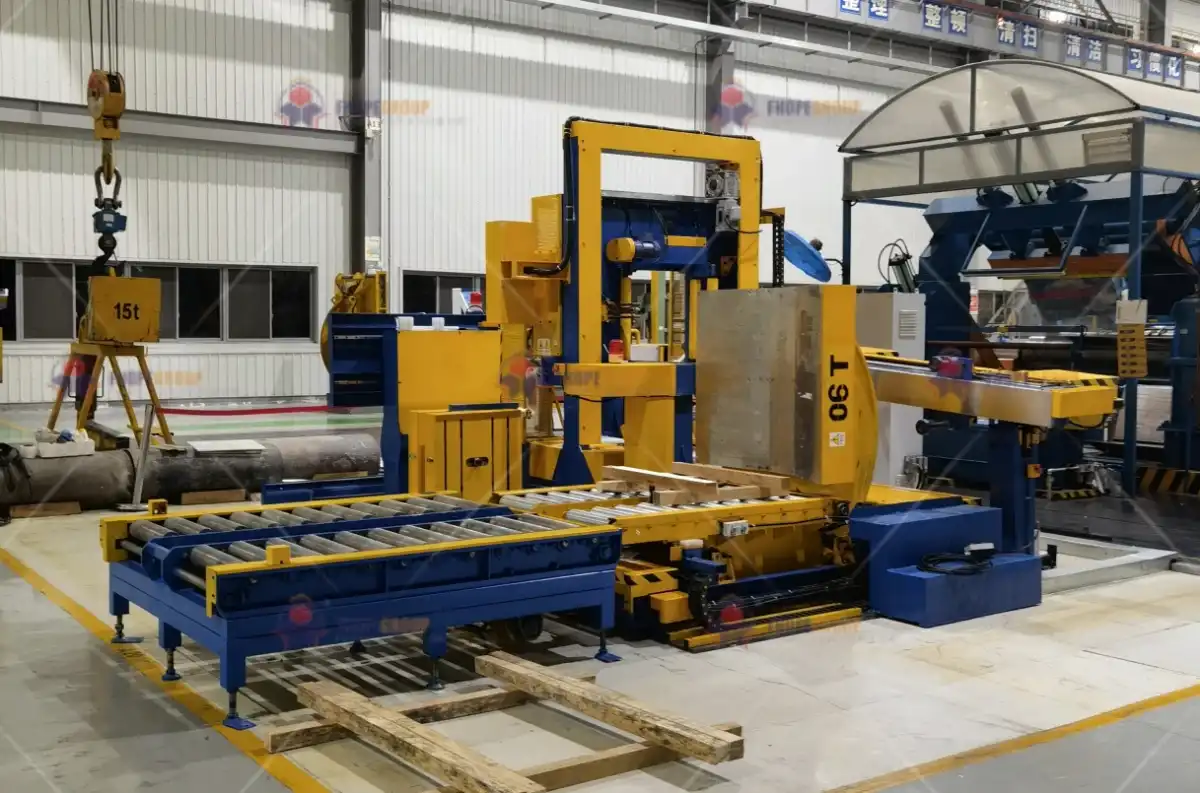
Understanding the “how” behind these improvements is key to unlocking a steel mill’s full potential. So, let’s explore the specific ways automated coil handling systems can change your operations for the better, ensuring smoother, faster, and more reliable production.
How Do Automated Coil Handling Systems Boost Production Speed?
Are your steel coils sitting idle, waiting for manual processing? This wait time often creates bottlenecks, especially in high-volume environments. When production output exceeds the packing area’s capacity, you lose valuable time and money. The problem only gets bigger with varying coil types and strict delivery deadlines. (steel coil production bottlenecks)
Automated coil handling systems dramatically boost production speed by integrating multiple stages into one continuous flow. They eliminate manual delays between processes like weighing, rotating, wrapping, and strapping. This enables a much higher volume of coils to be processed per hour, leading to faster overall cycle times. The system works without breaks, ensuring constant progress from the moment a coil leaves the slitting line until it is ready for shipment. (automated coil packing speed)
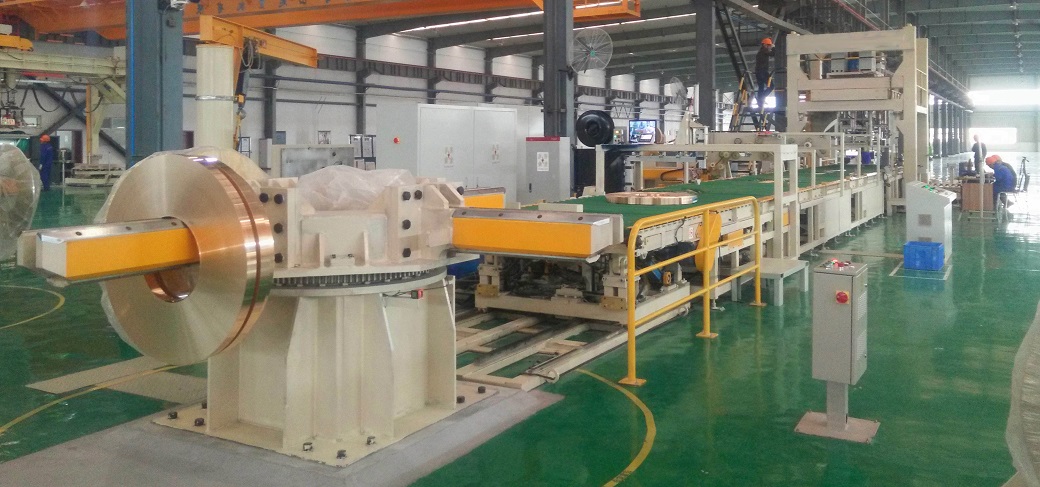
From my early days as an engineer, I saw firsthand how much time was lost in manual transitions. I knew there had to be a better way. At FHOPEPACK, we design our systems to keep things moving. This constant movement is what truly drives speed in coil packing.
1. Synchronized Operations and Reduced Cycle Times ⏱️
Automated lines are designed for sequential, synchronized tasks. Each step—from picking up a coil to placing it on a pallet—happens without human intervention. This means no waiting for an operator to finish one task before starting the next.
- Automated Conveyors: Coils move seamlessly from one station to another. This removes the need for forklifts or overhead cranes for internal transport. These systems reduce travel time and the risk of accidents.
- Integrated Weighing and Labeling: Coils are weighed and labeled automatically as they pass through. This step often happens in-line, adding no extra time to the packing process.
- Simultaneous Wrapping and Strapping: Advanced machines can apply multiple layers of protection (stretch film, VCI paper, strapping) at high speeds. Some systems even perform these tasks concurrently or in quick succession. This significantly shortens the time a coil spends at each packing station.
- Data Integration: Production data, coil dimensions, and customer requirements are automatically fed into the system. This eliminates manual data entry and reduces setup times for different coil specifications. For example, Ivan’s steel mill handles hundreds of tons daily. Such integration ensures that specific packaging needs for cold-rolled, galvanized, or color-coated coils are met instantly, without slowing down the line.
- Predictable Performance: Manual processes are subject to human speed variations and fatigue. Automated systems work at a consistent, optimized pace, around the clock. This predictability is crucial for production planning and meeting tight deadlines. (integrated coil packing line efficiency)
2. Eliminating Bottlenecks and Downtime 🛠️
Manual packing often creates bottlenecks. One slow worker or a complex coil specification can hold up the entire production.
- Continuous Flow: Automated systems maintain a continuous product flow. If one part of the line briefly pauses, other parts can still process coils or prepare for the next batch. This smooths out potential disruptions.
- Reduced Rework: Automated machines apply precise tension and placement of packaging materials. This reduces errors that might require coils to be repacked, saving significant time. Ivan’s challenge with inconsistent manual wrapping is directly addressed here.
- Proactive Maintenance: Modern automated systems often have sensors and diagnostic tools. These tools predict potential equipment failures. This allows for scheduled maintenance instead of reactive repairs that cause unexpected downtime. This approach maximizes uptime and throughput.
- Faster Product Changeovers: When a steel mill switches from one coil type to another (like from narrow slitting coils to wider master coils), automated systems can adjust parameters quickly. This might involve automatic width adjustment for strapping or different wrapping patterns. Manual changeovers are time-consuming. Automated adjustments save hours. (automated coil line uptime)
Can Automation Reduce Labor Needs and Enhance Workplace Safety?
Are you facing a shortage of skilled workers in your packing department? Manual coil handling involves heavy lifting and repetitive tasks, which leads to high turnover and increased risks of injury. How can you maintain production when your team is stretched thin or facing safety challenges? This is a major concern for steel mills globally, including for directors like Ivan Petrov. (steel mill labor shortage challenges)
Automation in coil handling significantly reduces labor needs by taking over heavy, repetitive, and hazardous tasks. Machines can handle coils weighing several tons, which would require multiple workers or specialized equipment manually. This shift frees human workers to supervise, maintain, or manage other complex operations. Simultaneously, removing workers from dangerous proximity to heavy machinery and moving coils drastically enhances workplace safety. It lowers the risk of crushing injuries, strains, and other accidents, creating a safer environment. (automated coil handling labor reduction)
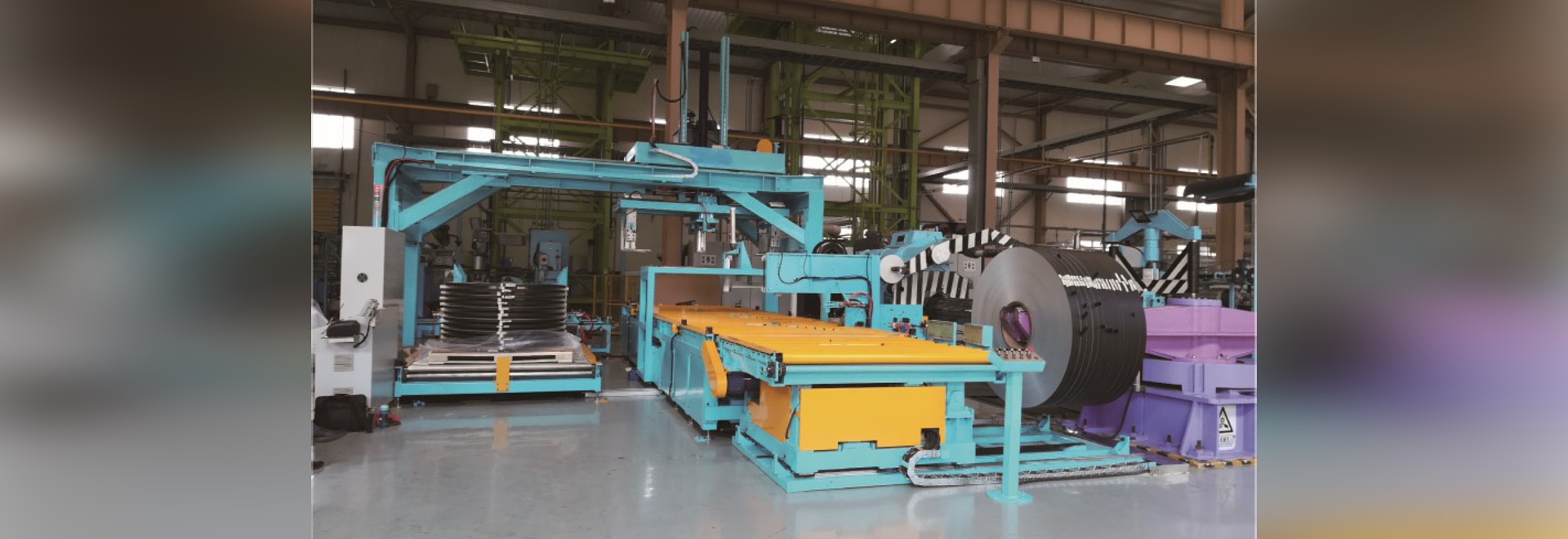
When I started FHOPEPACK, I aimed to not just improve efficiency but also to improve working conditions. My own journey through the packing machine factory showed me how tough the work could be. Safety and employee well-being are just as important as speed.
1. Reduced Manual Intervention and Labor Costs 💸
Automated systems are designed to perform tasks that traditionally require significant manual effort. This directly impacts your labor requirements.
- Coil Transfer and Positioning: Automatic conveyors, coil up-enders, down-enders, and transfer carts eliminate the need for workers to physically move or reorient heavy coils. This removes the most physically demanding part of the job.
- Automated Packaging: Machines apply strapping (PET or steel), stretch film, or shrink film without manual assistance. They cut, seal, and apply materials consistently. This replaces multiple workers performing repetitive motions like manually threading straps or applying film.
- Reduced Overtime and Recruitment: With higher efficiency, the need for overtime hours drops. The pressure to recruit new workers for high-intensity, physically demanding roles also decreases. This leads to substantial savings on overall labor costs and management headaches.
- Optimal Resource Allocation: Workers can be redeployed to higher-value tasks. These tasks include quality control, machine maintenance, data analysis, or process improvement. They no longer spend their time on mundane, repetitive physical labor. This boosts overall operational intelligence and adaptability.
- Consistency and Reliability: Machines do not get tired, distracted, or make judgment errors due to fatigue. They perform tasks with consistent precision, ensuring continuous operation even during multiple shifts (like Ivan’s 24/7 production). This reliability reduces errors and the need for corrective manual intervention. (packing machine labor savings)
2. Enhanced Workplace Safety and Lower Injury Risks 🛡️
Safety is paramount in any heavy industry. Coil handling presents numerous hazards.
- Elimination of Human-Machine Interaction: Automated systems create a buffer between operators and heavy, moving coils. Workers operate controls from a safe distance, away from pinch points, crushing hazards, and rotating machinery. This significantly lowers the risk of accidents.
- Reduced Strain and Repetitive Motion Injuries: Manual strapping, wrapping, and handling of packaging materials can cause musculoskeletal injuries over time. Automation removes these tasks from human hands. This protects workers from long-term health issues and reduces workers’ compensation claims.
- Stable and Predictable Operations: Automated equipment follows predefined paths and movements. This predictability reduces the chance of unexpected shifts or falls of heavy coils. Such incidents are common in manual handling. Safety sensors, light curtains, and emergency stops are standard features. They further safeguard personnel.
- Improved Work Environment: With less physically demanding work, the overall work environment becomes more appealing. This can help address challenges like young worker retention, as highlighted by Ivan. A safer, less strenuous workplace attracts and keeps skilled personnel.
- Compliance with Safety Standards: Modern automated systems are designed to meet international safety standards (like CE certifications, which Ivan’s export clients often require). Implementing these systems ensures your factory adheres to stringent safety regulations. This not only protects workers but also reduces legal and compliance risks for the business. (industrial automation safety benefits)
How Do Automated Systems Ensure Consistent Coil Packing Quality?
Are you struggling with inconsistent packing quality, leading to customer complaints or even damaged goods during transit? Manual packing can vary widely in tension, placement, and coverage. This leaves coils vulnerable to moisture, rust, and scratches. How can you guarantee every single coil meets strict export standards, like CE or ISO certifications? (inconsistent coil packaging quality)
Automated coil handling systems ensure consistent packing quality through precise, programmable controls for every packaging parameter. Machines apply uniform tension to wrapping films and strapping, ensuring tight, secure protection against damage, moisture, and rust. They also ensure consistent material overlap and exact placement for labels. This level of accuracy is impossible to achieve with manual labor, leading to higher product integrity. It meets stringent customer demands and reduces instances of product damage. (automated coil packing quality control)

In my experience, quality is non-negotiable, especially for steel products heading for export. A well-packed coil reflects the quality of the product inside. At FHOPEPACK, we focus on engineering systems that deliver this consistency every time.
1. Precision Application of Packaging Materials 💪
Automated systems remove human variability from the packing process. This ensures every coil is packaged identically, to specific standards.
- Uniform Tension Control: Whether applying stretch film, shrink film, or VCI paper, automated wrappers maintain consistent tension. This prevents loose wrapping that can come undone during transit. It also prevents overly tight wrapping that might damage the coil surface. Ivan’s issue with uneven film tension is solved here.
- Accurate Strapping Placement and Tension: Strapping machines apply steel or PET straps with programmed tension and precise alignment. They ensure straps are tightly secured and evenly distributed around the coil. This prevents shifting or loosening, which is critical for heavy steel coils.
- Consistent Overlap and Coverage: Wrapping machines use sensors to control the overlap of packaging materials. This guarantees complete protection against environmental elements like moisture and dust. It ensures no gaps are left open.
- Elimination of Human Error: Manual processes are prone to errors due to fatigue, inexperience, or rushing. Automated systems follow programmed routines without deviation. This eliminates mistakes that compromise packaging integrity.
- Material Optimization: Precision application also means less material waste. Machines use the exact amount of film or strapping required, reducing material costs while maintaining quality. This contributes to a lower overall packaging cost. (steel coil packaging consistency)
2. Meeting International Standards and Customer Requirements 🌍
For export markets, packaging must meet specific certifications and customer expectations.
- CE/ISO Certified Packaging: Automated lines can be programmed to meet packaging specifications required for CE, ISO, or other international certifications. This is crucial for clients like Ivan’s export customers, who demand such compliance.
- Automated Labeling and Barcoding: Integrated labeling systems apply barcodes, shipping information, and customer-specific labels with high accuracy. This ensures traceability and compliance with logistics requirements. It also helps in preventing misidentification of coils.
- Advanced Protection against Corrosion: For specialized products like galvanized or color-coated coils, multi-layer protection is often needed. Automated systems can apply VCI paper, stretch film, and outer wrapping in sequence. This creates a robust barrier against rust and corrosion, even during long-distance shipping.
- Damage Prevention: Consistent, tight packaging protects coils from scratches, dents, and surface damage during handling, storage, and transportation. This preserves the product’s value and reduces customer returns or claims.
- Customer Confidence: High-quality, consistent packaging instills confidence in customers. They know their order will arrive in perfect condition. This builds strong business relationships and repeat orders. It directly supports Ivan’s goal of preventing customer complaints and contract penalties. (export-grade coil packing solutions)
Do Automated Solutions Adapt to Diverse Coil Types and Sizes?
Is your current packing line struggling to handle the variety of products your steel mill produces? Manual processes become incredibly complex and slow when you need to switch between different coil diameters, weights, and packaging requirements. How can you maintain efficiency when one minute you are packing a narrow slitting coil, and the next, a heavy master coil? (diverse coil packing challenges)
Automated coil handling solutions are highly adaptable, designed to manage a wide range of coil types and sizes with minimal manual intervention. They use adjustable mechanisms, programmable logic controllers (PLCs), and sensor technology to detect and accommodate variations in coil diameter, width, and weight. This flexibility allows for quick changeovers between different products. It ensures continuous production flow for cold-rolled, galvanized, or color-coated coils, each with their unique packing needs. (versatile automated coil packaging)
During my time establishing a packing machine factory, I learned that flexibility is key. A one-size-fits-all approach simply does not work in diverse production environments. At FHOPEPACK, we pride ourselves on creating customizable systems that meet unique client needs.
1. Flexible Coil Handling and Positioning Systems 🔄
Modern automated systems are built with adaptability at their core.
- Adjustable Conveyor Systems: Conveyors can often adjust their width to accommodate different coil widths. This ensures proper support and movement regardless of the coil size. Some systems use modular designs that allow for easy re-configuration.
- Universal Up-enders/Down-enders: These machines can handle coils with varying diameters and weights. They use hydraulic or electric mechanisms that adapt their grip and rotation. This allows safe and efficient reorientation from horizontal to vertical or vice versa. This is crucial for different storage or shipping requirements.
- Programmable Coil Centering: Sensors detect the coil’s position and automatically center it on the packing station. This ensures that wrapping and strapping are applied correctly, regardless of minor variations in how the coil arrives.
- Weight Capacity: Automated lines are designed to handle a broad weight range, typically from 1 to 3 tons for slitting coils, or even heavier for master coils. Reinforced structures and powerful drives ensure stable operation for all sizes.
- Inner/Outer Diameter Adaptability: The grippers and mandrels used for wrapping and strapping can often adjust to different inner diameters. This flexibility supports a wide range of products from a single production line. (adaptable coil packaging machinery)
2. Programmable Packaging Parameters and Material Switching ⚙️
The ability to quickly change packing specifications is vital for diversified product lines.
- Recipe-Based Programming: Operators can save “recipes” for different coil types (e.g., “Galvanized Export,” “Cold Rolled Domestic”). These recipes include specific parameters for film tension, strapping count, overlap percentage, and material type. Switching between recipes is fast and simple through a HMI (Human Machine Interface).
- Multi-Material Capabilities: Automated systems can be configured to use various packaging materials. This includes PET strapping, steel strapping, stretch film, VCI film, and even shrink film. For example, Ivan’s need for PET/steel strapping combined with stretch/shrink film for export standards is easily met.
- Automated Material Feeding: When a roll of film or a coil of strapping runs out, the system often includes automatic splicing or quick-change mechanisms. This reduces downtime associated with material replenishment.
- Custom Labeling: The integrated labeling systems can print and apply different labels based on the coil type or customer. This includes barcodes, logos, or specific warning labels. This is essential for meeting varied client demands and global standards.
- Seamless Integration with Production Planning: Advanced systems can connect directly to a mill’s ERP or MES. This allows packing instructions to be received automatically, eliminating manual input errors and ensuring that the right packaging is applied to the right coil every time. This integration is vital for managing diverse product lines like cold-rolled, galvanized, and color-coated coils, each with distinct packaging needs. (customized coil packing solutions)
What is the Impact of Automation on Operational Reliability and Uptime?
Are frequent breakdowns or inconsistent performance plaguing your packing operations? Manual processes are prone to errors and fatigue, leading to unpredictable downtime and inconsistent output. In a 24/7 production environment, every minute of unexpected stoppage costs significant money. How can you ensure your coil handling system runs continuously, day in and day out? (packing line reliability issues)
Automated coil handling systems significantly boost operational reliability and uptime through robust engineering, predictive maintenance capabilities, and consistent performance. These machines are built for continuous operation in demanding industrial environments, reducing the likelihood of human error or fatigue-induced breakdowns. Integrated diagnostics monitor system health, allowing for proactive servicing rather than reactive repairs. This ensures a steady, uninterrupted workflow, maximizing the production throughput for the entire steel mill. (automated packing line uptime)
From my firsthand experience in factory settings, I know that reliability is the bedrock of any successful operation. If a machine stops, everything stops. At FHOPEPACK, we engineer our systems to be workhorses, ready for the toughest environments, like Ivan Petrov’s 24-hour, two-shift steel mill.
1. Robust Design and Continuous Operation 💪
Automated systems are engineered for the harsh realities of steel production environments.
- Industrial-Grade Components: Every part, from motors and sensors to structural frames, is designed for heavy-duty, continuous use. They withstand dust, temperature fluctuations, and vibrations common in steel mills. This significantly extends the lifespan of the equipment.
- Reduced Human Error: Many breakdowns in manual or semi-manual operations stem from human error. Automated systems eliminate these mistakes, leading to fewer jams, misfeeds, or incorrect adjustments that cause wear and tear.
- Predictable Performance: Unlike human operators who might slow down due to fatigue during a two-shift operation, automated machines maintain a consistent speed and quality level. This predictability helps in planning and ensures a steady output.
- Optimized Power Consumption: Modern automated systems are designed not just for performance but also for energy efficiency. This contributes to lower operational costs over the long run, even during continuous operation.
- Minimal Supervision: Once programmed and calibrated, automated lines require minimal human supervision during operation. This frees up personnel for other critical tasks, boosting overall efficiency. Ivan’s need for a solution that reduces manual intervention aligns perfectly here. (industrial packing automation durability)
2. Predictive Maintenance and Remote Diagnostics 📡
Advanced technology enables proactive care, preventing costly unplanned outages.
- Integrated Sensors: Systems are equipped with sensors that monitor key performance indicators. These include motor temperature, vibration levels, tension settings, and material consumption. This real-time data provides insights into the machine’s health.
- Diagnostic Software: Advanced software analyzes sensor data to detect anomalies or signs of impending failure. It can alert maintenance teams before a breakdown occurs, allowing for scheduled interventions. This shifts from reactive repairs to proactive maintenance.
- Remote Monitoring and Support: Many automated systems can connect to the internet. This allows for remote monitoring by manufacturers or specialized service teams. They can diagnose issues, update software, and even troubleshoot problems without needing an on-site visit immediately. This minimizes downtime.
- Modular Design for Easier Repair: Many automated lines feature a modular design. If a component fails, it can often be replaced quickly without dismantling the entire system. This speeds up repair times and gets the line back up and running faster.
- Scheduled Maintenance Programs: With data-driven insights, maintenance schedules become optimized. Parts are replaced based on actual wear, not just arbitrary timelines. This reduces waste and ensures the right parts are available when needed. It ensures maximum uptime for critical assets. (preventive maintenance for packing lines)
Conclusion
Automated coil handling systems are vital for modern steel mills aiming for peak performance. They directly improve production throughput by boosting speed, reducing labor, enhancing safety, ensuring consistent quality, and providing robust reliability. For companies like Ivan Petrov’s, investing in a full automatic coil packing line means unlocking greater efficiency, meeting demanding export standards, and achieving long-term operational success. This automation is not just an upgrade; it is a fundamental transformation.








