
2025 Pallet Inverter Implementation: Steel Service Center Achieves 45% Labor Reduction
1. Customer Background (Why)

Midwest Steel Processing, a tier-1 supplier to automotive manufacturers across Ohio and Michigan, operates a high-volume coil processing facility handling 15,000+ tons monthly. Their manual pallet transfer process between processing and shipping departments created significant bottlenecks. The operation required four-person teams working consecutive shifts to manage coil transfers using overhead cranes and manual repositioning.
The company initiated an automation search to address:
- Production line synchronization between slitting and packaging
- Worker safety concerns during manual coil transfers
- Inconsistent load stability during international shipments
- Labor cost containment amid competitive market pressures
2. Customer Challenges (Pain Points)
| Challenge Category | Specific Impact |
|---|---|
| Efficiency Loss | 12-15 minute manual transfer time per coil vs. target of <5 minutes |
| Labor Intensive | 4 operators per shift dedicated to transfer operations |
| Safety Risks | 3 near-miss incidents quarterly involving coil handling |
| Quality Issues | 8% damage rate during transoceanic shipments to European clients |
| Production Volatility | 22% throughput variation between shifts due to manual processes |
3. FHOPEPACK Solution (How)

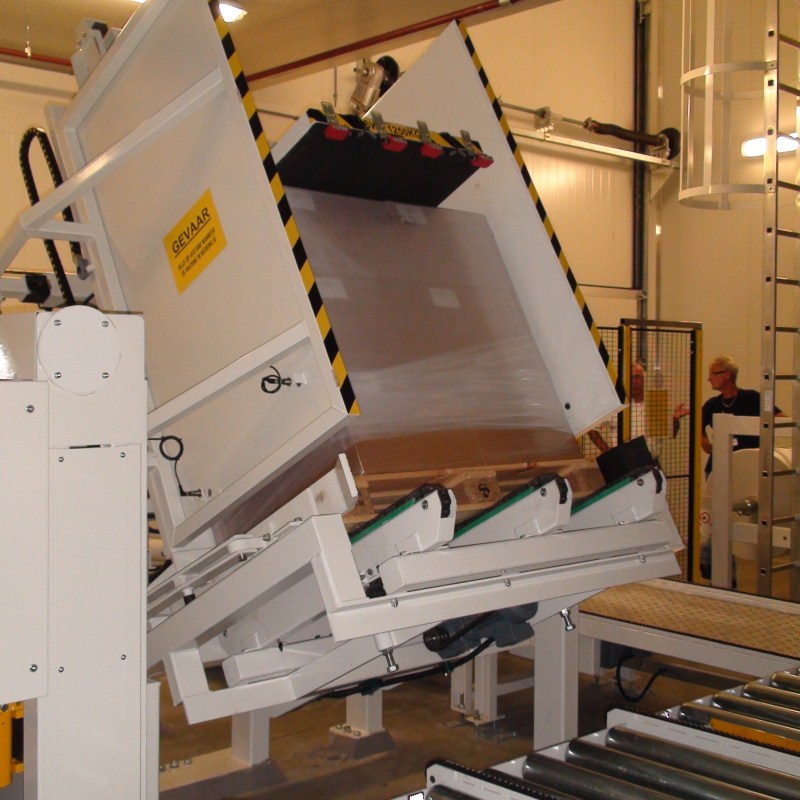
Equipment Provided: FHOPEPACK FP-1500HD Automated Pallet Inverter System
Technical Configuration:
- 1500kg capacity with hydraulic clamping system
- 360-degree rotation capability with ±1° positioning accuracy
- PLC-controlled automation with HMI interface
- Adjustable fork width: 800-1600mm for various pallet types
- Integrated safety light curtains and emergency stop systems
Customization for Steel Industry:
- Specialized clamp pads for coil curvature protection
- Corrosion-resistant coating for industrial environment
- Integration with existing conveyor and crane systems
- Automated cycle synchronization with upstream processing
Challenge Resolution:
- Automated transfer reduced manual intervention to monitoring only
- Programmable logic ensured consistent positioning and alignment
- Safety systems eliminated worker exposure to heavy loads
- Precision control maintained coil surface integrity
4. Implementation Process & Technical Deployment
Phase 1: Technical Assessment (Week 1-2)
- Site survey of existing material flow patterns
- Load analysis and cycle time measurements
- Integration point identification with conveyors
Phase 2: Engineering Design (Week 3-4)
- CAD modeling of equipment placement
- Control system interface specifications
- Safety system integration planning
Phase 3: Factory Acceptance (Week 5-8)
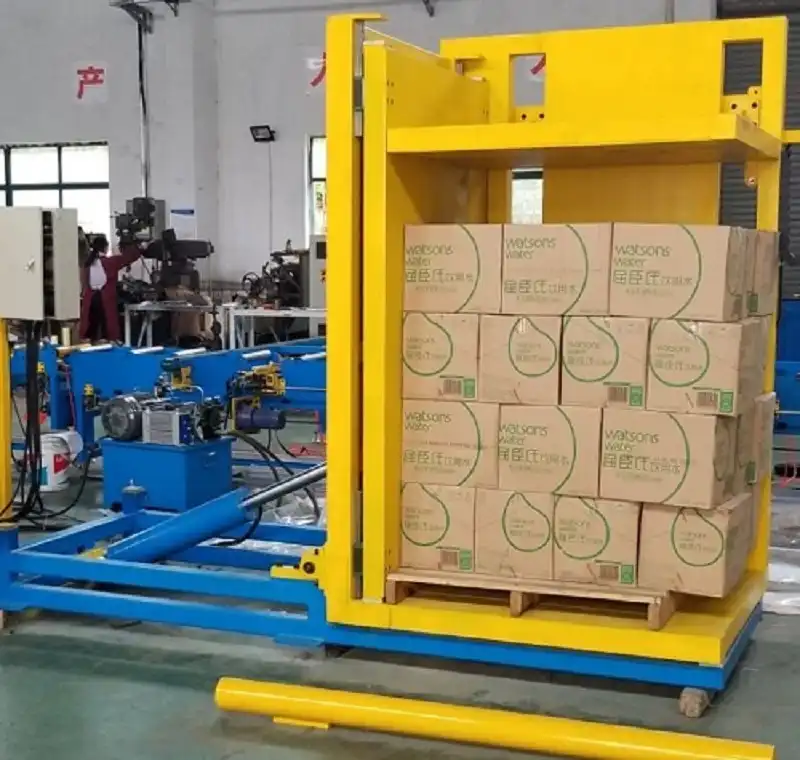
- Full system assembly and testing at FHOPEPACK facility
- Customer witness testing with actual coil samples
- 48-hour continuous operation validation
Phase 4: Site Installation (Week 9-10)
- Foundation preparation and equipment positioning
- Power and control wiring integration
- Conveyor interface calibration
Phase 5: Commissioning (Week 11-12)
- System parameter optimization
- Operator and maintenance training
- Production validation and performance sign-off
5. Customer Benefits / ROI (Quantified Results)
| Metric | Before Implementation | After Implementation | Improvement |
|---|---|---|---|
| Transfer Time | 12-15 minutes | 3.5 minutes | 71% reduction |
| Labor Requirement | 4 operators/shift | 1 operator/shift | 75% reduction |
| Damage Rate | 8% | 1.2% | 85% improvement |
| Throughput Consistency | ±22% variation | ±5% variation | 77% improvement |
| Safety Incidents | 3 quarterly | 0 quarterly | 100% improvement |
| ROI Period | N/A | 14 months | Calculated |
Additional Benefits:
- Traceability: Automated data logging of each transfer operation
- Flexibility: Quick changeover between different coil sizes and pallet types
- Maintenance: Predictive monitoring through PLC diagnostics
- Scalability: System designed for future expansion
6. Customer Testimonial
“The automation integration has transformed our material handling workflow. Our packaging supervisor noted that ‘the consistency in load transfer has eliminated the damage issues we faced with manual methods, particularly for our European shipments where load integrity is critical.’ From an engineering perspective, the system’s interface with our existing conveyor network required minimal modification, which accelerated our ROI timeline. The safety improvement has been particularly valued by our operations team.”
— Michael Torres, Plant Engineering Manager
7. Conclusion
This implementation demonstrates FHOPEPACK’s expertise in industrial automation solutions for material handling challenges. The pallet inverter system successfully addressed multiple operational pain points simultaneously—labor intensity, safety concerns, quality consistency, and throughput variability. The engineering approach focused on seamless integration with existing infrastructure while providing the automation intelligence needed for modern manufacturing environments.
FHOPEPACK solutions are deployed across diverse industries including steel, building materials, food processing, and consumer goods, with installations throughout North America, Europe, and Southeast Asia. Each system is engineered with customization capabilities to address specific operational requirements, load characteristics, and facility constraints. For operations considering automation of material transfer processes, detailed technical specifications and case references are available for evaluation.








