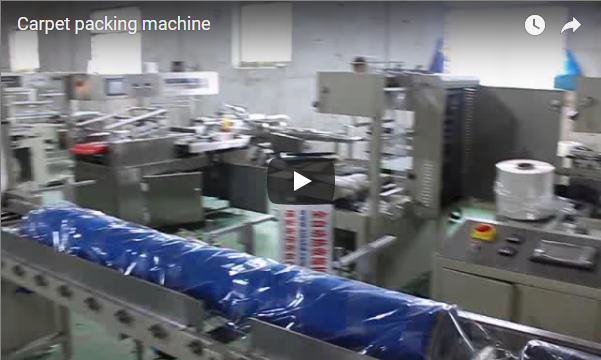
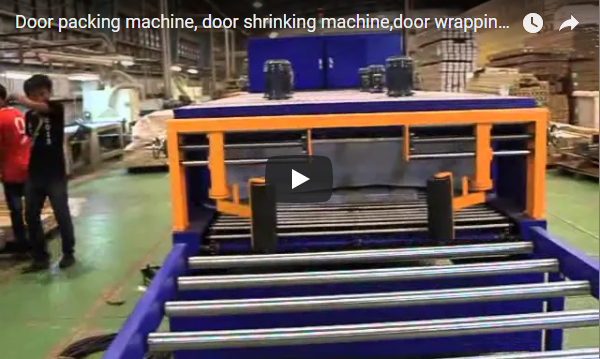
Streszczenie: A printed door panel, decorative board, or framed print is judged entirely by its visual face; an improperly packaged panel arrives scuffed, dusty, or with chipped edges. Hand-wrapping large panels creates inconsistent tension, trapped air bubbles, and prohibitive labor overhead. This technical guide outlines how an inline automated L-bar sealer and continuous hot-air heat-shrink tunnel protect finished surfaces and pre-fitted EPE foam edge cushions. It details the mechanical sealing cycle, thermal shrink controls, real-world baseline inspection criteria, and the critical parameters needed to qualify an automated packaging line.
https://www.fhopepack.com/Shrinking_machine.html
Spis treści
- Co ta strona pomoże Ci podjąć
- Dlaczego panele drukowane wymagają uszczelnienia termokurczliwego
- Jak działa zgrzewanie termokurczliwe
- Co decyduje o czystości psychiatrycznej
- Co pokazuje klip
- Lista kontrolna weryfikacji kupującego
- FAQ
- Powiązane czytanie
- Następny krok
Co ta strona pomoże Ci podjąć
A printed door panel, fine-art canvas, or high-gloss decorative board is only as acceptable as the face your customer inspects upon uncrating. A hairline scuff across UV-cured ink, airborne particulate pressed into wet-look lacquer, or a cracked corner edge will turn an export-grade shipment into an immediate return claim. Manual shrink bagging or stretch wrapping creates loose folds, uneven web tension, and entrapped air pockets while consuming excessive floor labor.
This guide helps manufacturing managers and packaging engineers determine whether an automated inline shrink-packaging system—comprising an automated horizontal L-sealer and a convective shrink tunnel—matches their panel dimensions, throughput targets, and surface protection requirements. It breaks down the mechanical sequence, highlights the process parameters governing optical clarity, and provides a field-proven technical checklist to vet machinery before placing a capital equipment order.
Dlaczego drukowane panele drzwiowe wymagają uszczelnienia termokurczliwego
Large architectural panels, framed artwork, and cabinet doors are uniquely vulnerable to abrasion and edge shearing during material handling:
- Surface Micro-Scratches: When glossy or matte-printed panels slide against worktables or rubbing surfaces, frictional shear creates visible blemishes.
- Dust Embedment: Electrostatic charge generated during manufacturing attracts ambient wood, plaster, or cutting dust. If wrapped loosely, dust migrates between film and ink, grinding into the finish during transport.
- Corner and Perimeter Impact: Panels stacked face-to-face or vertically palletized concentrate transport vibration on their borders, leading to edge-chipping and corner blowouts.
Standard stretch film wrapping exerts lateral compressive forces that can bow thin MDF panels or pull diagonally across wide faces. In contrast, biaxially oriented shrink film (such as cross-linked polyolefin / POF or blended polyethylene / PE) contracts uniformly in both the machine direction (MD) and transverse direction (TD) when exposed to controlled thermal airflow.
As the film shrinks, it applies skin-tight, isometric tension across the flat plane while anchoring pre-positioned expanded polyethylene (EPE) corner protectors directly against the frame profiles. The resulting skin holds edge cushions firmly in place, prevents surface slip, and provides a moisture-resistant barrier that leaves the printed face showroom-ready.
Jak działa zgrzewanie termokurczliwe
The automated packaging line executes a continuous, three-stage cycle:
[Infeed Conveyor with Sensor Detection]
                ↓
[Motorized Center-Fold Film Unwind & Micro-Perforation]
                ↓
[Pneumatic / Servo L-Bar Cross-and-Side Sealing Jaw]
                ↓
[High-Convection Recirculating Hot-Air Shrink Tunnel]
                ↓
[Air-Cooling Zone & Roller Accumulation Exit]- Infeed & Film Insertion: The framed panel—fitted with perimeter EPE protective foam channels—transits onto the infeed belt. Horizontal and vertical optical sensors track the leading edge, advancing the panel between the upper and lower webs of center-folded shrink film.
- Controlled Sealing & Trimming: The panel stops precisely beyond the sealing boundary. A pneumatically actuated, PTFE-coated L-bar sealing jaw descends under controlled pressure (0.4 to 0.6 MPa). An impulse heating wire cuts and fuses both the cross-seal (trailing edge of the current panel / leading edge of the next) and the continuous longitudinal side-seal simultaneously, ejecting scrap film onto a motorized take-up winder.
- Mikroperforacja: Prior to entering the heat chamber, mechanical pinning wheels pierce microscopic pinholes in the film web. This allows expanding air to evacuate freely during heating rather than forming trapped air domes or ballooning the wrap.
- Thermal Shrink Tunnel Passage: The panel enters an insulated heating tunnel enclosed by heavy-duty, red silicone thermal containment flaps. Centrifugal blowers circulate high-velocity heated air evenly around the top, sides, and underside of the panel. The film quickly reaches its plastic transition temperature, contracts tightly over the board face, locks the foam edge profiles, and exits onto an outfeed cooling conveyor where the polymer matrix solidifies into a crystal-clear, taut protective skin.
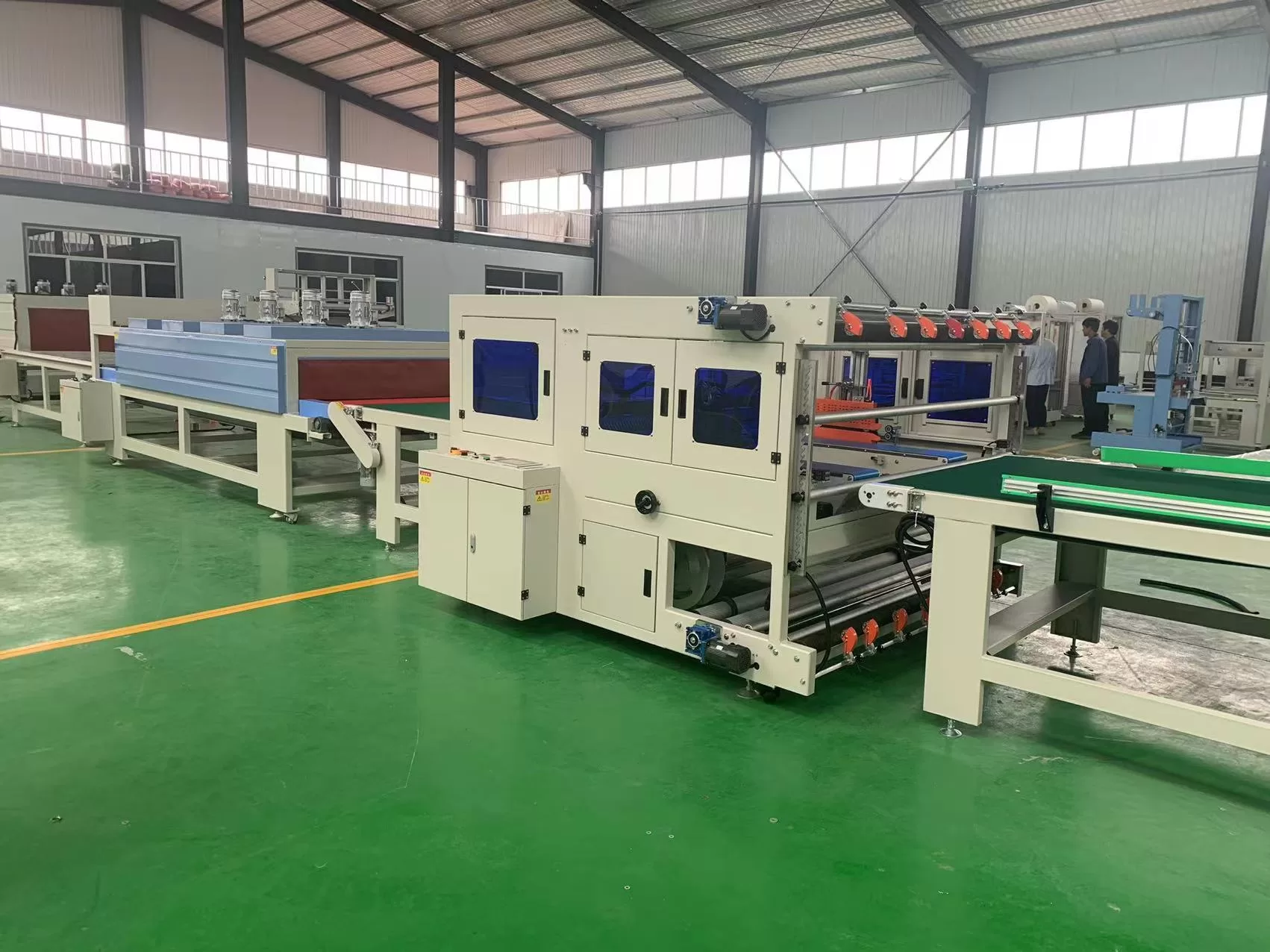
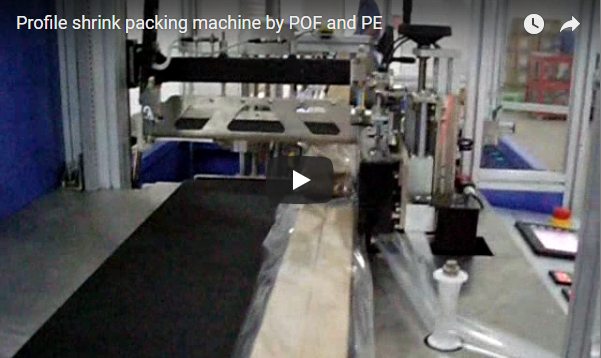
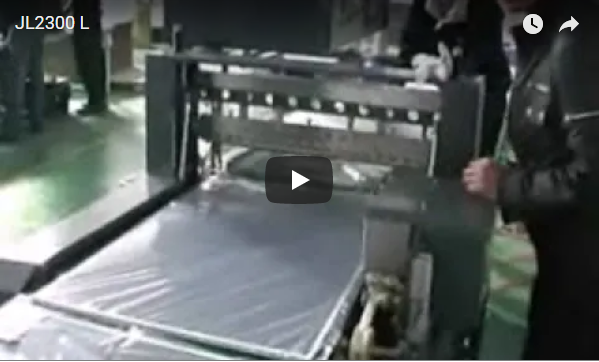
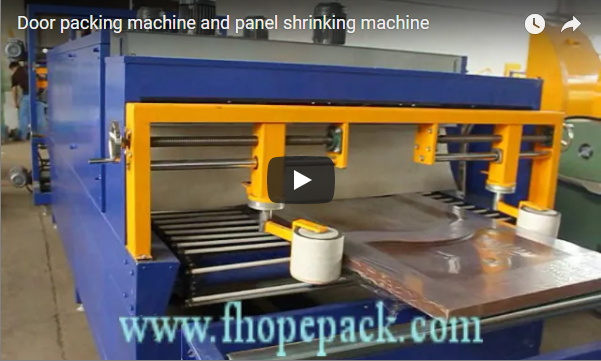
Caption: An inline door-panel and framed board shrink packaging system equipped with an automated horizontal sealer and a high-convection shrink tunnel.
Co decyduje o czystości psychiatrycznej
Achieving a mirror-smooth finish without dog-ears, burn-through, or board warpage depends on balancing four primary engineering variables:
- Film Metallurgy & Gauge: Polyolefin (POF, 15 to 25 µm) delivers optical clarity, high tensile strength, and low shrinkage force ideal for framed prints and light door panels. For heavy commercial solid-core doors requiring puncture resistance, low-density polyethylene (LDPE, 40 to 80 µm) is mandatory.
- Thermal Window & Air Distribution: Different polymers demand strict temperature stability within ±2°C. POF contracts between 130°C and 160°C; heavy PE requires 165°C to 195°C. Air duct nozzles inside the tunnel must balance airflow across the center and edges of wide panels to prevent center sagging or edge burn.
- Conveyor Transit Speed vs. Residence Time: Belt speed (typically adjustable from 5 to 25 m/min) must correspond with tunnel length. Insufficient dwell time leaves wrinkles and untensioned corners; excessive dwell time anneals or splits the heat seal.
- Mechanical Envelope Clearance: The sealing jaw width, tunnel chamber aperture, and roller bed width must accommodate the maximum diagonal and cross-section of your panel mix, including added EPE corner protectors (typically +30 to +60 mm per side).
Co pokazuje klips linii maszynowej
Engineering analysis of the operational footage reveals the practical capabilities and boundary conditions of this packaging setup:
- Packaging Substrate & Corner Protection: The line handles large, decorative art picture frames and printed architectural boards. Operators manually install four-corner slotted EPE foam profiles before feeding, which the machine encases securely without dislodging the cushions.
- Mechanizm uszczelniający: The sealer is an overhead pneumatic L-frame cross-and-side sealer. A hold-down stabilizer beam clamps the panel in place while the heated impulse wire cleanly cuts and fuses the polymer film.
- Tunnel Enclosure: The shrink unit is a continuous hot-air convective tunnel with red industrial silicone baffle curtains at the infeed and outfeed to prevent convective thermal loss into the production hall.
- Finished Output Quality: Exiting panels show zero surface hazing, no visible print smearing, and uniform shrinkage across the broad face, with foam corners anchored under tension.
- Rozważania operacyjne: The line operates as a semi-automated system: operators manually fit foam protectors and position boards on the infeed, after which wrapping, sealing, conveying, and heat shrinking execute automatically. Safety perimeter fencing and light-curtain interlocks are site-specific integrations that must be specified during procurement.
Lista kontrolna weryfikacji kupującego
Before signing off on a factory acceptance test (FAT) or issuing equipment payment, verify these technical specifications in writing with your machinery manufacturer:
| Parametr inżynierski | Target Specification & Verification Method | Znaczenie operacyjne |
|---|---|---|
| Maximum Clearance Envelope | Clear tunnel aperture: Width + 100 mm, Height + 80 mm above largest panel + EPE foam | Prevents product jam-ups, film tear, and thermal contact scorch |
| Zgodność z filmem | Support for POF (12–25 µm) and/or PE (30–80 µm); dual-perforation pin system | Dictates optical clarity, barrier strength, and consumable cost per panel |
| Sealing System Construction | PTFE-coated nichrome alloy blade with PID digital temperature monitoring | Prevents plastic carbonization, stringing, and seam degradation |
| Airflow Circulation Dynamics | Independent top/bottom variable-speed centrifugal blowers; adjustable louvers | Prevents differential cooling, panel bowing, and dog-eared corners |
| Transit Conveyor Bed Type | Silicone-sleeved rotating rollers or Teflon mesh belt with EPDM infeed belts | Eliminates bottom-side scuffing on pre-painted or lacquered surfaces |
| Machine Safety & Compliance | Dual emergency-stop circuits, optical finger-guard interlocks, ISO 12100 / CE | Protects operators at the infeed pinch point and heated tunnel portal |
Submit the following data package to your equipment vendor for formal review:
- Panel Size Matrix: Minimum and maximum panel length, width, thickness, and total weight, including all edge-protection foam allowances.
- Docelowa przepustowość: Target units per hour (UPH) and daily operational shifts (8 hr vs. 24/7 continuous duty).
- Film Specification Matrix: Planned resin type (POF vs. PE), thickness (µm), and print-surface heat sensitivity limits.
- Protokół odbioru fabrycznego: Requirement for an uninterrupted continuous run video recording verifying cycle time, seal integrity, and energy consumption.
- Electrical & Pneumatic Interface: Plant line voltage (e.g., 380V/480V 3-phase, 50/60 Hz) and compressed air supply capacity (minimum 0.6 MPa clean, dry air).
FAQ
Can this machine process panels with pre-fitted foam edge protectors?
Yes. As shown in the operating footage, U-channel or four-corner EPE foam cushions fit directly over the panel edges before the film web is applied. The subsequent seal cycle surrounds both panel and foam, and the shrink tension locks the protectors firmly in place without requiring tape or staples.
What is the practical cycle rate for this inline shrink configuration?
Cycle speed depends primarily on panel length and operator infeed velocity. For medium-to-large architectural panels (1200 mm to 2400 mm in length), typical speeds range between 8 and 18 panels per minute when equipped with a continuous pneumatic or servo-driven motion sealer.
Will the shrink tunnel’s thermal exposure damage sensitive digital UV inks?
No, provided process parameters are calibrated correctly. Although tunnel air temperatures range from 140°C to 180°C, the panel’s internal residence time is typically under 10 seconds. The thin shrink film absorbs thermal energy instantly to contract, while the core and printed skin of the board remain well below ink-curing degradation thresholds.
Powiązane czytanie
- Kurcząca się maszyna — Comprehensive overview of horizontal and convective shrink-wrapping equipment.
- Zgrzewarka L-bar — Automated and semi-automated transverse sealing systems for flat products.
- Zgrzewarka ruchowa — High-speed continuous horizontal sealing solutions for high-throughput lines.
- Opakowanie przepływowe — Horizontal form-fill-seal packaging systems for extended linear profiles.
- Automatyczna linia pakująca — Turnkey packaging solutions integrating infeed, sealing, labeling, and palletizing.
- Automatyczna owijarka do palet — Downstream stretch-wrapping systems for palletized panel stacks.
Następny krok
To size an automated panel shrink line for your facility:
- Compile your complete dimensional matrix (minimum and maximum length, width, thickness, and weight per unit).
- Measure your foam edge protector dimensions and define your preferred film gauge (POF vs. LDPE).
- Contact the engineering application team through the technical inquiry page to request a customized CAD layout drawing, throughput cycle estimation, and formal equipment quotation.
Ostatnia aktualizacja: 2026-09-28
Opublikowano: 2026-09-28