Kopsavilkums
Building wire and flexible multi-core cable are primarily distributed in standardized 50 m or 100 m coils, sealed in polyethylene shrink film for retail and job-site protection. Manual handling—measuring, rotary winding, manual cutting, tape tying, and bag sealing—typically consumes 3 to 4 operators per extrusion run and introduces severe package variance. The automated coiling, strapping, and shrink-packaging station integrates high-precision dual-wheel meter counting, automatic traversing on a motorized collapsible core, pneumatic cutting, multi-point PP strapping, and inline thermal shrink packaging. This guide details machine kinematic flow, the FHOPE FCL-V600 coiler specification envelope, and practical geometric formulas for sizing coil dimensions to standard packaging formats.
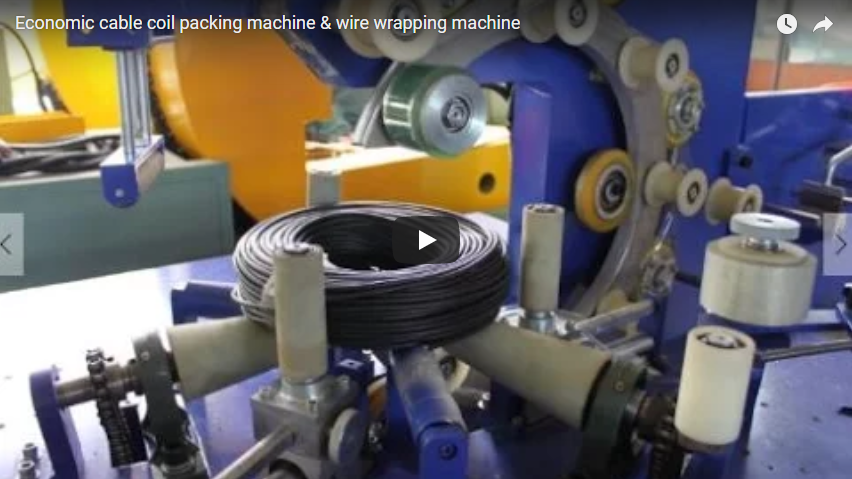
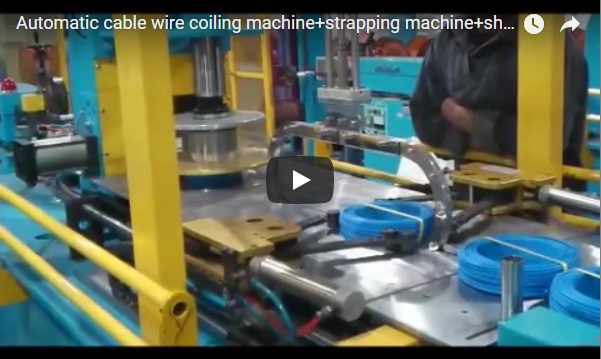
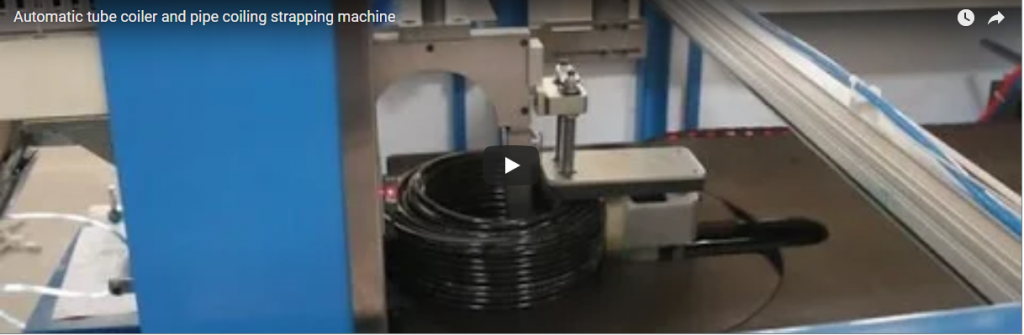
The automated secondary packaging cell operates in full synchronization with continuous extrusion lines or rewinding pay-offs. Cable is fed through a synchronized dancer tension arm, traversed across a precision collapsible core, cut to target length via pneumatic shear, bound with PP strapping through a radial indexing head, and transferred downline to an L-bar sealing and thermal shrink tunnel.
Saturs
- Kāpēc automatizēt kabeļu līnijas galu?
- Mašīnas plūsma
- FCL-V600 spoles dati
- Spoles izmērs noteiktam garumam
- Atlases kontrolsaraksts
- Drošība
- Inženierijas bieži uzdotie jautājumi
- Nākamais solis
- Saistītā lasāmviela
- Avoti
Kāpēc automatizēt kabeļu līnijas galu?
Cable extrusion is a high-speed continuous process, running at steady line velocities up to several hundred meters per minute. Downstream manual coiling cannot match continuous line output, creating severe operational bottlenecks:
- Length Inconsistency & Financial Loss: Manual measurement relying on visual marks or friction wheels without line-speed compensation yields
±2%uz±5%error. Over-length coils result in unrecoverable raw copper and polymer giveaway; under-length coils trigger costly commercial claims. - Dimensional Variance & Secondary Packaging Failure: Operator tension varies as the coil builds up. Loose coils suffer from spring-back when removed from the arbor, while over-tight coils crush inner layers. Non-uniform outer diameters (OD) cause frequent jam-ups in automated cartoning and shrink-wrapping stations.
- Labor Overhead & EHS Risks: Repetitive coil tying and lifting exposes operators to chronic wrist and lower-back musculoskeletal injuries.
An automated line enforces rigid loop tension, precise pitch traversing, uniform internal diameter (ID) containment, and fixed external dimensions for clean palletization and shrink sealing.
Mašīnas plūsma
Continuous Feed / Pay-off
       │
       ▼
[1. Meter Counter & Dancer Synchronizer]
       │
       ▼
[2. Servo Winding & Traverse Unit] (Collapsible Core)
       │
       ▼
[3. High-Speed Pneumatic Cut & Clamping]
       │
       ▼
[4. Automatic Radial Strapping Station] (2, 3, or 4 PP Straps)
       │
       ▼
[5. Pneumatic Pusher / Arm Transfer]
       │
       ▼
[6. L-Bar Film Sealing & Thermal Shrink Tunnel]- Pasākums: Dual-wheel pulse encoders track line transit. Signals interface directly with the main PLC high-speed counter module to execute acceleration, deceleration, and shear commands at calibrated lengths.
- Vējš: Cable feeds onto an adjustable collapsible arbor positioned between circular containment flanges. A servo-driven ball screw traversing guide steps horizontally across the drum width, distributing layers according to cable outer diameter (OD).
- Cut & Hold: Upon reaching target length, the traversing carriage halts, the pay-off buffer stores incoming cable, an automated guillotine shear cuts the trailing end, and a mechanical gripper secures the tail against the spool.
- Hold & Strap: The outer flange swings open, and a pneumatic ejection mechanism shifts the bound coil onto an indexing rotary star wheel or strapping cradle. PP straps are drawn around the coil cross-section and heat-welded at 2, 3, or 4 radial points.
- Pārskaitījums: An overhead pneumatic grab arm or motorized roller ejector transfers the strapped coil to the infeed conveyor of the packaging cell.
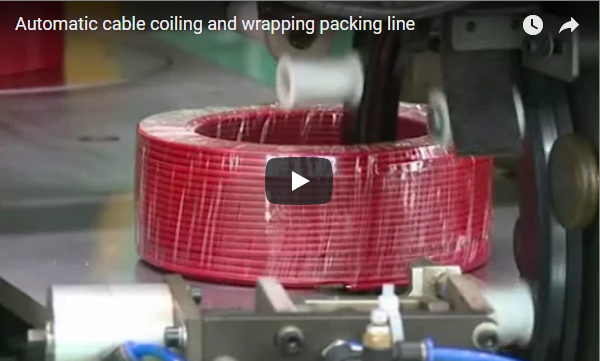
- Pack: The coil passes through an inline L-bar film applicator using center-folded PE/POF film, undergoes peripheral impulse sealing, and advances through an air-recirculating heat tunnel to produce a rigid, dust-tight, retail-ready pack.
FCL-V600 spoles dati
The FHOPE FCL-V600 is built for continuous manufacturing environments processing building wire (THHN, BV, BVR), flexible rubber cables, and multi-core control lines:
| Specifikācijas parametrs | FHOPE FCL-V600 Automatic Coiling & Packaging Station |
|---|---|
| Spoles ārējais diametrs (OD) | 400–600 mm |
| Spoles iekšējais diametrs (ID) | 200–400 mm (collapsible core, adjustable) |
| Coil Height (Traverse Width) | Option A: 40–120 mm Option B: 40–200 mm Option C: 100–300 mm |
| Applicable Cable OD | 2–16 mm (standard); 8–20 mm / 15–30 mm (heavy-duty variants) |
| Line Winding Speed | Up to 350 m/min (depending on wire OD and pay-off setup) |
| Coiling Length Setting | 20–100 m standard (longer runs available via recipe configuration) |
| Garuma mērīšanas precizitāte | ±0.2% (dual-encoder with anti-slip surface compensation) |
| Siksnas materiāls | Polypropylene (PP) strap (width: 9–12 mm; thickness: 0.55–0.75 mm) |
| Siksnu metode | Heat-seal joint (weld joint efficiency ≥ 80%) |
| Siksnu cikla laiks | 2.5–3.5 s uz siksnu |
| Complete Cycle Capacity | 2–4 coils/min (100 m building wire coils) |
| Pneimatiskā padeve | 0.6–0.8 MPa (6–8 bar), clean/dry compressed air |
| Elektriskais vērtējums | 380V/415V, 3-Phase, 50/60 Hz (standard PLC + Servo configuration) |
Line speed, payload capacities, and shrink chamber thermal capacities are engineered to order.
Spoles izmērs noteiktam garumam
Accurately predicting finished coil OD ensures the strapped product fits within downstream retail shrink film bags and secondary corrugated shipping boxes without crushing.
Inženiertehniskās formulas
1. Turns per layer:
   N_turn = Floor(H_coil / (OD_cable × k_pack))

2. Radial thickness increase per layer:
   ΔR = OD_cable × 0.866   (for close triangular packing)

3. Number of layers required:
   N_layer = Ceil(L_target / (π × D_mean × N_turn))

4. Finished Coil Outer Diameter:
   OD_coil = ID_core + 2 × (N_layer × OD_cable)
kur:
H_coil= Usable arbor width between flanges (mm)OD_cable= Cable outer diameter (mm)k_pack= Traversing packing clearance factor (typically1.03uz1.08for flexible PVC/sheathed cables)D_mean= Mean coil diameter =(ID_core + OD_coil) / 2(Kungs)L_target= Total coil target length (m)
Practical Sizing Calculation (Example)
Consider a 100 m coil of 6.0 mm building cable wound onto a 300 mm ID core, with flange width set to 60 mm:
- Apgriezieni vienā slānī:
Turns = Floor(60 mm / (6.0 mm × 1.0)) = 10 turns/layer - Mean Diameter Estimation (assuming 9 layers):
OD_theoretical = 300 mm + (2 × 9 layers × 6.0 mm) = 408 mmD_mean = (300 mm + 408 mm) / 2 = 354 mm = 0.354 m - Total Length verification:
Length ≈ π × D_mean × Turns/Layer × LayersLength ≈ 3.1416 × 0.354 m × 10 × 9 = 100.08 m
The finished 100 m coil yields an OD of 408 mm and a height of 60 mm, matching the FCL-V600 envelope (400–600 mm OD) and defining the baseline opening width for downstream shrink-wrapper sealing jaws.
Atlases kontrolsaraksts
To ensure seamless integration with upstream lines, specify the following operating parameters:
- Cable Cross-Section & Jacket Material: Outer diameter range (mm), minimum bending radius, jacket compound (PVC, XLPE, LSZH, rubber, or PUR).
- Coil Geometry Profile: Minimum and maximum coil ID (mm), maximum target OD (mm), and required coil height/traverse width (mm).
- Garuma variācijas: Target length sets (e.g., 50 m, 100 m, 200 m) and required continuous cycle times.
- Iesiešanas specifikācija: Number of strapping ties per coil (2, 3, or 4 radial ties), strap material (PP or PE), or alternative PE stretch film stretch wrapping.
- Downstream Packaging Configuration: Direct heat-shrink film enclosure, automated pre-formed bag inserter, or vertical carton case packing.
- Line Upstream Integration: Extruder linear speed (m/min), continuous versus start-stop pay-off, and available accumulator/dancer storage capacity.
Drošība
FHOPE cable processing and secondary packaging equipment complies with major international industrial machinery safety directives:
- EN ISO 12100:2010: Mašīnu drošība — Vispārīgie projektēšanas, riska novērtēšanas un riska samazināšanas principi.
- EN 415-10: Safety requirements for packaging machines — Modular and integrated secondary lines.
- EN 60204-1: Safety of machinery — Electrical equipment of machines, industrial control enclosures, and emergency stop circuits.
- Safeguarding Features: Interlocked full-height polycarbonate/wire-mesh enclosure perimeter, Category 4 dual-channel Safety PLCs, zero-speed shaft monitoring on the winding arbor, optical light curtains at coil discharge ports, and pneumatically locked cutter assemblies.
Inženierijas bieži uzdotie jautājumi
Q: How does the system handle continuous extrusion during cut-and-transfer cycles? A: An automated inline vertical dancer or multi-pass cable accumulator sits between the extrusion capstan and the coiler. When the coiling head slows down for pneumatic cutting and coil indexing (a 3 to 5 second window), the accumulator expands its mechanical carriage to buffer continuous extrusion flow without changing line backpressure.
Q: What length cutting tolerances can the meter counter hold consistently?
A: The system achieves ±0.2% linear accuracy on calibrated cables. Dual non-slip polyurethane measuring wheels eliminate slip, while high-frequency optical encoders relay pulse bursts to the PLC. Deceleration profiles ensure the reel slows down prior to mechanical shearing, eliminating cut-length overshooting caused by arbor inertia.
Q: Can one machine run multiple cable diameters and coil sizes without physical teardown? A: Yes. The collapsible arbor’s inner diameter adjusts via handwheel or motorized mechanical linkages. Flange width, pitch traverse speed, coil length, and strapping points are saved as programmable part recipes in the HMI touchscreen, enabling tooling-free product changeovers in under 5 minutes.
Q: Which is preferable: PP strapping or full PE stretch wrapping? A: Radial PP strapping provides structural integrity to prevent self-unraveling and keeps shipping bundle profiles compact for standard carton packing. Stretch wrapping or PE shrink wrapping protects jackets against dirt, water intrusion, and surface scratching. Combining radial PP strapping with downstream shrink wrapping delivers maximum shelf appearance and structural rigidity.
Nākamais solis
- Datu iesniegšana: Send your cable outer diameters, target coil dimensions (ID/OD/height), production speeds, and preferred packaging methods to info@fhopepack.com.
- Inženiertehniskais novērtējums: Our applications team reviews cycle rates, sizing geometries, and upstream dancer buffering requirements.
- Custom Technical Proposal: Receive an engineered floor layout, dimensional sizing matrix, and quotation within 24 hours.
Saistītā lasāmviela
- Automātiska šļūteņu tīšanas iekārta FCL-600 (izstrādājums)
- Kabeļu spoles tīšanas mašīna FPCA-200 (izstrādājums)
- Automātiska kabeļu tīšanas, stīšanas un saraušanās iepakošanas mašīna (video)
- Kabeļa stieples spoles uztīšanas un nostiprināšanas līnija (video)
Avoti
- FHOPE Packaging Machinery: FCL-600 Engineering Specification Manual
- European Committee for Standardization: EN ISO 12100:2010, EN 415-10, EN 60204-1
- National Electrical Manufacturers Association (NEMA) & IEC Wire Packaging Guidelines
Pēdējoreiz pārskatīts: 2026-10-20