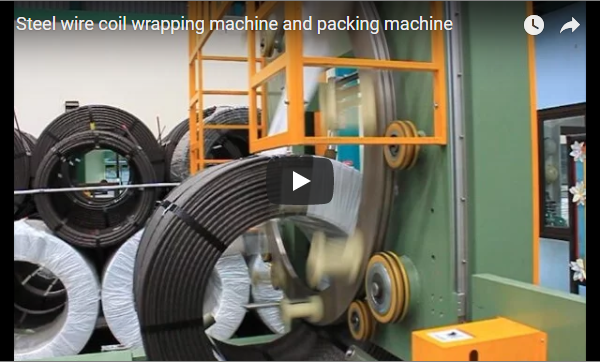
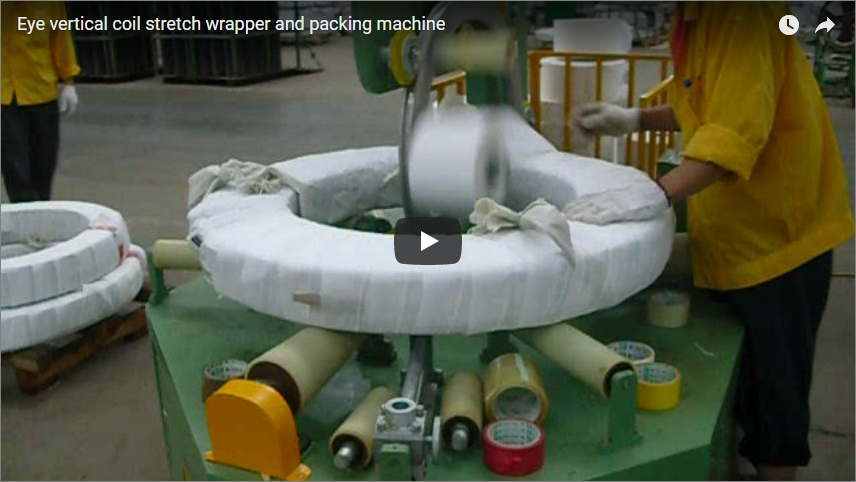
Effectus summary Hose and steel coil wrapping machines wrap ring-shaped products so wire, rod and pipe coils stay protected in storage and transit. The product is cradled on the machine and the outer circumference is wrapped with controlled tension and layered coverage. A PLC and touch panel control tension, layer count and overlap. This guide covers the wrapping cycle, the key components and the selection and safety basics.
Table of Contents
- What coil wrapping machines do
- Quomodo cyclus involucri procedit
- What products these machines wrap
- key components
- Specificationum typicarum series
- Gradus automationis et imperium PLC
- Index rerum ad machinas eligendas
- Fundamenta operationis et salutis
- Res necessariae ad sustentationem
- Quaestiones Frequentes de Ingeniaria
- tunc step
- Related reading
- Fontes et normae
What coil wrapping machines do
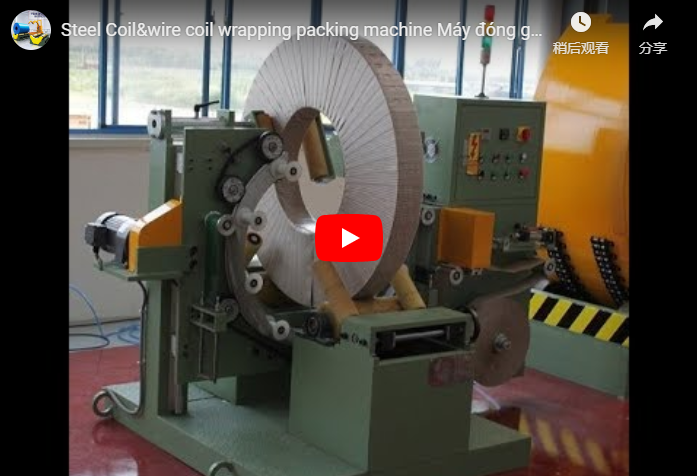
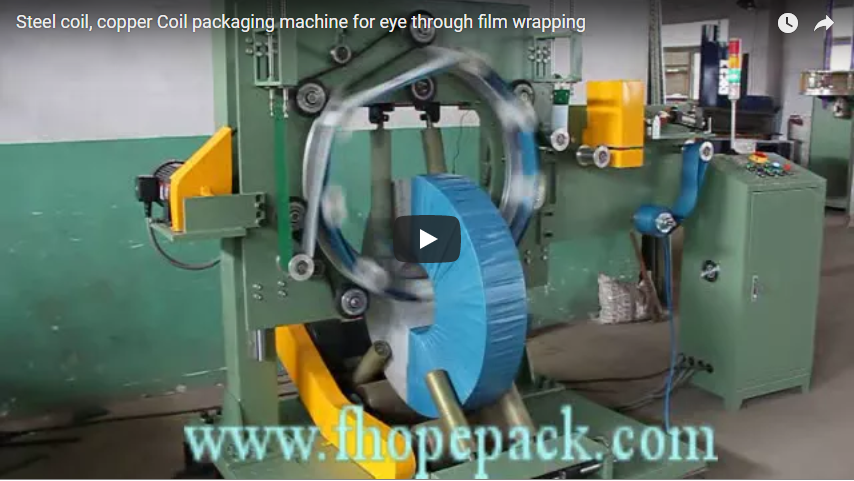
A coil wrapping machine applies film protection around the circumference of round, ring-shaped products. The machine holds the product, rotates it on a support, and feeds film across its outer surface until the full circumference is covered in the set number of layers. The result is a taut, even wrap that keeps coiled products clean, dry and stable during storage and road or sea transit.
We design these machines for the packaging steps that packing machine for wire coil, steel coil and pipe operators run every day, covering coiled steel, wire, rod, rubber hose and plastic pipe. Because coils are round, hand wrapping rarely produces consistent tension, and the outer turns loosen during handling. A machine applies the same tension and coverage on every piece, which removes that variability.
Quomodo cyclus involucri procedit
The cycle follows a clear sequence. The operator places the coiled product on the rotating support and aligns it by hand. The machine clamps or cradles the product so it cannot shift, and the operator steps clear of the wrapping zone.
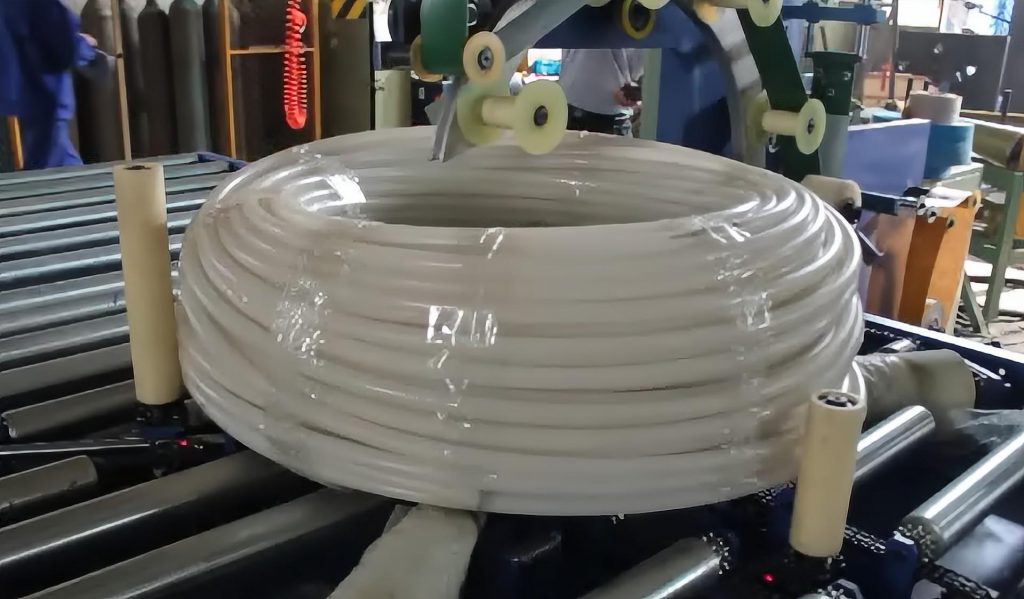
When the cycle starts, the support rotates the product while film unwinds from the roll and is guided across the surface by rollers. This is peripheral wrapping: the film trails over the outer circumference and the coil faces, and it does not pass through the coil bore.
A film guide follows the outer edge, applying layer over layer with controlled tension, and at the end the film tail is pressed and sealed against the previous wrap so the finish stays tight.
When the set wrap count is reached, the machine stops, and the operator removes the wrapped product for storage or the next line step. On many installations the operator loads and unloads manually while the machine handles the wrapping itself, which keeps the investment and the floorplan modest.
What products these machines wrap
The same cradle-and-rotate principle suits a family of round products. Steel wire and rod coils, drawn at the mill and held in ring form, are the classic case because their edges are sharp and the outer diameter has no flat face for hand wrapping. Coiled steel strip and light-gauge coil from processing lines follow the same pattern.
On the hose side, coiled rubber hose, PVC pipe and short-length flexible tubing is wrapped the same way after it is wound onto a compact ring. This matches the hose wrapping machine and pipe coil packing lines. For these products the protection goal is dust and transit damage rather than corrosion, but the wrapping motion is identical.
We confirm the compatible coil diameter, width and weight range against the specific product format and line layout per project. If the outer diameter is much smaller or much larger than the camera-fitted examples, the machine is sized accordingly rather than extended.
key components
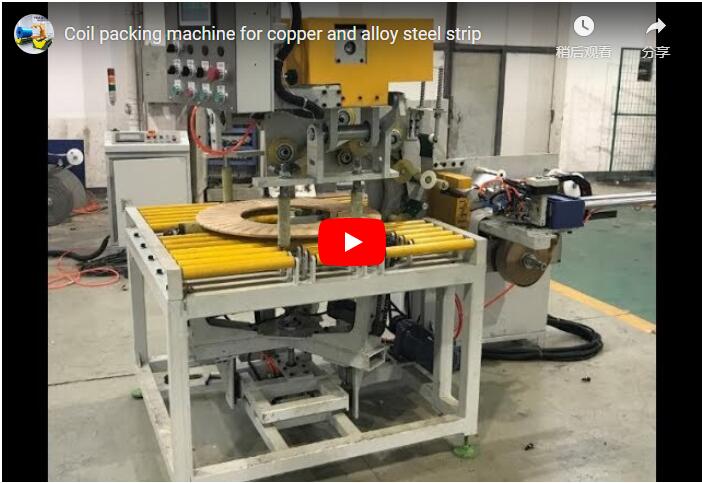
The machines are built from a rotating product support, a film supply, a guide system, a tension and sealing station, and a control panel.
The rotating support cradles the coil and turns it through the wrapping cycle. The film roll is carried on an unwind stand, and guide rollers run the film from the roll to the product surface. A tension station keeps the film tight so each layer stays flat; on machines with a powered system the tension is set from the control panel rather than by hand.
The sealing and press station tucks and presses the final film tail against the wrapped surface. The panel houses a PLC and touch screen where the operator sets the wrap count, overlap and tension. Around the working area, a safety fence separates the operator from the rotating product.
Specificationum typicarum series
The values below are typical ranges for evaluation based on what we fit in this size class, not a fixed specification. Confirm each point against your coil format and line per project.
| Item | Ambitus typicus (ad aestimationem) |
|---|---|
| Coil diametro exterioris | configured to the specific OD/ID range per project |
| width amet | 200–300 mm, matching the film roll |
| Wrapping layers | set from the panel, repeat for the same product |
| Tensio imperium | powered pre-stretch, tuned per product |
| Film tail sealing | press and seal at cycle end |
| potentia copia | configured per project |
| imperium | PLC + touch panel, wrap count and overlap settings |
| Normae et interfacies | ISO 12100, EN 415-10, EN ISO 13849-1, PLC signum |
The wrapping speed, the maximum coil weight and the throughput in coils per hour are confirmed against the product mix and the line per project.
Gradus automationis et imperium PLC
Coil wrapping machines in this class are semi-automatic: the operator loads and unloads, starts the cycle and removes the finished coil, while the machine performs the wrapping automatically. That split keeps the machine compact and the cycle repeatable without a large conveyor installation.
The controls run on a PLC with a touch panel. The operator stores the wrap count, overlap and tension for each product, and recalls the program when the same format returns. A powered pre-stretch sets film tension from the panel instead of by hand, and the cycle time is driven by the product size and the set wrap count.
Diagnostics on the panel show the machine status, so a stalled cycle or a film break is found quickly. For higher-volume sites, the machine can be prepared for line integration where the product is fed and taken away by conveyor, with the cycle triggered automatically.
The main gains are consistency, protection and labour. A machine applies the same tension and layer count to every coil, so the protection does not depend on the person doing the wrap. Outer turns stay tight during forklift travel, stacking and transit, which protects the coil surface from scuffs and the product from dust and moisture.
Automated wrapping also moves the operator out of the wrapping zone during the cycle and removes most of the effort of applying film by hand.
Index rerum ad machinas eligendas
Haec puncta perlege antequam pretium petas, et cetera pro operatione tua per proiectum confirmamus.
For steel coils that face long sea freight or humid storage, the film wrap is often combined with VCI paper or film applied before wrapping, so the inhibitor sits against the steel. For hose and pipe coils the priority is dust and transit protection, and a single consistent film layer is usually enough.
| Item | Quae per proiectum confirmanda sunt |
|---|---|
| Forma producti | coil outer diameter, width and coil weight |
| Material | steel wire, rod, strip, hose or pipe coil |
| Protection goal | dust, transit, corrosion, or scratch protection |
| Film | grade, width, thickness, VCI requirement |
| throughput | coils per hour or per day |
| Automation | manual load and unload, conveyor integration |
| Site | available power supply and floor space |
Fundamenta operationis et salutis
Start with product placement. Center the coil on the support and align it so it runs true during rotation; a coil resting off-center wraps unevenly and stresses the support. Confirm the product is secured before the operator steps clear.
Set the machine parameters for the product rather than the default. Adjust the wrap count, overlap and tension on the panel, and run a test wrap when the product changes so the coverage is confirmed before a batch starts.
Safety comes from guarding and procedure. Keep the safety fence in place and closed while the machine runs, keep the area around the wrapping zone clear, and never reach toward the product or the film while it is rotating. Stop the machine and follow the lockout procedure before clearing a break or removing a wrapped coil. The machine is designed to be loaded and unloaded with the cycle stopped.
Res necessariae ad sustentationem
Run the daily checks before the first shift. Inspect the guide rollers for wear or film residue, confirm the film path is clean, and verify the guards and safety fence are in place.
Keep lubrication on the schedule in the machine manual for bearings and moving parts. Clean the rollers and the tension station regularly, because film residue and dust reduce tension control and wrap quality. Inspect the sealing station and the film unwind for wear, and always follow the manufacturer’s maintenance procedures for the machine.
Between batches, check the film roll stock and keep spare rolls sized to the installed film width so a changeover does not stall the line.
Quaestiones Frequentes de Ingeniaria
Q: Which products can a coil wrapping machine wrap? A: Ring-shaped products: steel wire and rod coils, coiled strip, and coiled rubber or plastic hose. Confirm the diameter, width and weight per project.
Q: Is the machine automatic? A: The wrapping is automatic; the operator loads and unloads by hand. Conveyor-fed automatic versions are configured per project.
Q: How is corrosion prevented on steel coils? A: The film wrap holds the product, and VCI paper or film applied under the wrap carries the inhibitor onto the steel. The VCI layer requirement is confirmed per project.
Q: What parameters do I set on the panel? A: Wrap count, overlap and tension, saved as a program for each product so repeat coils run identically.
Q: How much film does wrapping use? A: Consumption follows coil outer circumference times the wrap count times film width, adjusted for overlap. We estimate it per project from your coil format, layer count and film roll.
tunc step
- Email us at info@fhopepack.com with your coil size, weight and throughput.
- We send a layout drawing and a film and consumption proposal within 48 hours.
- We arrange a site survey to confirm the line, utilities and safety requirements before installation.
Related reading
- Machina involucri orbitalis horizontalis automatica: plena opertio, uno transitu
- Coil and roll stretch wrapping machine with inclined infeed
- How an automatic roll and reel stretch wrapping machine handles floor-level packing
- Orbital stretch wrapping with V-shape roll feed
- Lineae productorum machinarum involucrorum FHOPE
Fontes et normae
- ISO 12100:2010 — Securitas machinarum. Principia generalia designandi, aestimandi periculi et reducendi periculi.
- EN 415-10:2014 — Securitas machinarum involucrorum. Requisita generalia
- EN ISO 13849-1:2023 — Securitas machinarum. Partes systematum moderandi ad securitatem pertinentes.
- FHOPE coil wrapping machine demonstration video, YouTube.
- PMMI, Association for Packaging and Processing Technologies — external reference resource.
Ultima recensio: 2026-10-09