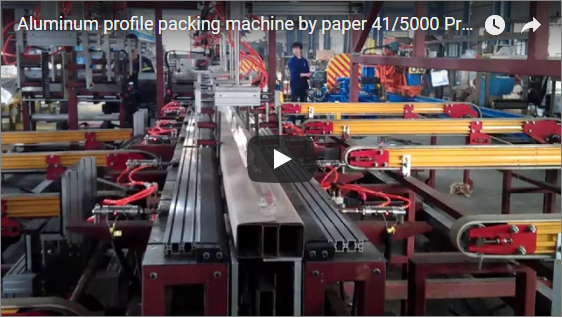
Effectus summary This guide covers the horizontal orbital wrapper as the aluminum rod material wrapper, so you can choose the right machine for rod and bundle packaging. The horizontal orbital design moves a wrapping ring around a stationary, longitudinally fed bundle, which suits long rod bundles that a turntable cannot rotate easily. It applies stretch film in controlled overlapping layers at the ring and bundle ends, runs on a PLC with an HMI, and accepts preset wrapping programs. This article explains how the machine works, the typical specification ranges, the film options and how to select one.
Table of Contents
- What the aluminum rod material wrapper does
- The packaging challenge for aluminum rods and bundles
- How the horizontal orbital wrapper works
- Orbital ring vs. turntable wrapping
- Typical specification range for evaluation
- Wrapping programs: PLC control and HMI
- Stretch film and pre-stretch
- Operational benefits for aluminum processors
- Index selectionis
- Operatio et sustentationem
- Quaestiones Frequentes de Ingeniaria
- tunc step
- Related reading
- Fontes et normae
What the aluminum rod material wrapper does
The aluminum rod material wrapper applies stretch film around formed aluminum rod bundles so the profiles stay together through handling, storage and transit. A horizontal orbital wrapper is one of the machine arrangements used for this job. A ring carrying the film revolves around a bundle that feeds longitudinally through the machine. That suits long rod and bar bundles which do not rotate well on a turntable.
The machine sits inline with the bundle forming system and wraps each bundle as it arrives. The result is a tight, overlapping film barrier over the full bundle body and a reinforced finish at the ends.
The packaging challenge for aluminum rods and bundles
Aluminum extrusions, rods and profiles hold significant value, but they are soft on the surface. During post-production handling and shipping the common failures are surface scratches, oxidation from moisture, loose shifting profiles, and dirt on unprotected surfaces.
Manual wrapping is slow and inconsistent, and it does not protect the ends well. An automated wrapper applies the same tension and coverage on every bundle, which is the main difference from hand work.
How the horizontal orbital wrapper works
The wrapper works as part of the packaging line, usually right after the bundle-making machine.
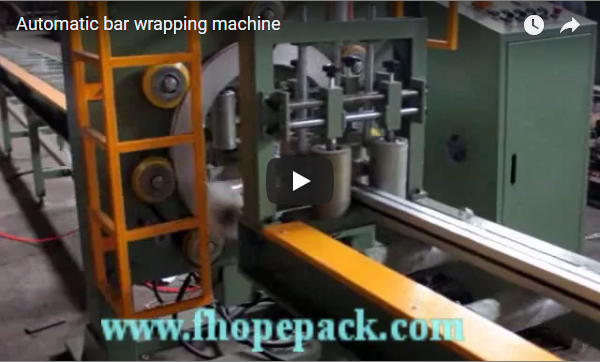
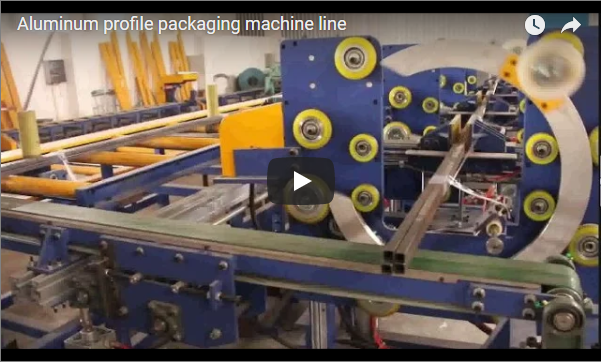
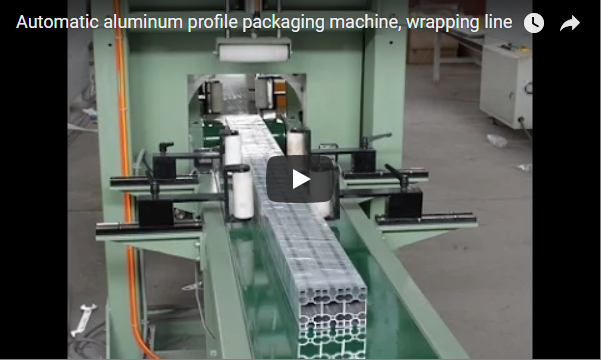
The formed aluminum bundle is conveyed to the wrapping station on an infeed, with long products centred through the ring. The bundle stays still while a wrapping ring carries the film roll and revolves around it, laying film along the bundle as it passes or as the ring advances. The film applies under controlled tension, and a pre-stretch mechanism stretches it before it reaches the bundle to improve yield and containment.
At the end of the cycle the film is clamped and cut, and the finish is wiped or sealed to the bundle so no loose tail remains. The wrapped bundle then conveys out for storage or shipment. A short operator intervention at film roll change and program selection keeps the rest of the cycle automatic.
Orbital ring vs. turntable wrapping
The two arrangements differ in how the relative motion happens. In a horizontal orbital wrapper the load stays in line and the film ring moves around it, which fits continuous bundles fed lengthwise by conveyor.
In a turntable wrapper the bundle rotates on a platform while the film carriage moves, which suits shorter bundles and lighter or stable loads. Long rod bundles are awkward to rotate, so the orbital ring is usually the more practical choice for aluminum rod and bar lines. Weight, bundle length and line layout decide the arrangement.
Typical specification range for evaluation
The numbers below are typical ranges for evaluation across the machine class, not a specification of any single model; for wrapping single profiles and smaller cross-sections, profiles can be batched to use the same line. Exact values are confirmed against your bundles per project.
| Apparatus parametri | Ambitus typicus (ad aestimationem) |
|---|---|
| Bundle length (L) | 1000–6000+ mm |
| Bundle width (W) | 100 600 mm, |
| Bundle height (H) | 100 600 mm, |
| Maximum bundle weight | MMD ad KG |
| involuti velocitate | 10–30 bundles per hour |
| Circulus gyrationis velocitas | 10–25 rpm, adjustable (selection per project) |
| genus amet | LLDPE proten film |
| width amet | standard 500 mm; custom widths by bundle cross-section and overlap requirements, per project |
| Prae-extensio pelliculae | adjustable up to 250–300% |
| potentia copia | 380 V / 50 Hz / 3-phase or regional standard |
| potestate ratio | PLC cum touchscreen HMI |
| Normae et interfacies | ISO 12100, EN 415-10, EN ISO 13849-1, PLC signum |
Wrapping programs: PLC control and HMI
The control runs on a PLC with a touchscreen HMI. Operators store preset wrapping programs and recall them by product or order, so the machine does not need re-engineering for each bundle type. The program sets the number of wraps at the bundle start and end, the amount of film overlap, the film tension, and the wrapping speed. It also adds over-wrapping at designated points such as the bundle ends.
Storing multiple programs gives flexibility across the product range. Changing parameters on the touchscreen is straightforward, and diagnostics on the HMI speed up troubleshooting when a fault appears.
Stretch film and pre-stretch
The machine runs LLDPE stretch film, the standard material for this class of wrapping. Film width is matched to the bundle profile, typically from a 500 mm roll, and the pre-stretch ratio is adjustable up to 250–300% for film economy.
Pre-stretch matters because it stretches the film before it touches the bundle. The film that reaches the load is already elongated, so less material delivers the same containment, and the running cost per bundle drops compared with hand wrapping. Film grade, bundle edges and required protection level decide the tension and layer settings per project.
Operational benefits for aluminum processors
An automated wrapper changes the economics of the finishing line. Consistency means the same tension and overlap on every bundle, so package integrity holds. Reliability comes from a machine built for industrial duty, with routine checks on rollers, belts and the film cutting and clamping mechanism.
The line frees labour that manual wrapping consumed, raises throughput, and saves film through pre-stretch. Safety improves because operators no longer reach around moving bundles; light curtains or physical guarding are part of the protection suite, and overhead press-down devices can prevent bundle shifting on the ring. A uniformly wrapped bundle also projects quality to the end customer.
Index selectionis
Send us these points when you size an aluminum rod material wrapper, and we confirm the arrangement and options against your line per project.
| Item | Quae per proiectum confirmanda sunt |
|---|---|
| Bundle profile | L / W / H dimensions, longest and heaviest bundle |
| Pondus fasciculi | kg, against the machine rating |
| Directio pascendi | inline with your bundle-making system |
| versus celeritate | bundles per hour target |
| Film grade and width | mm, matching profile and protection level |
| potentia copia | V / Hz / phase at your site |
| Normae et interfacies | ISO 12100, EN 415-10, EN ISO 13849-1, PLC signum |
Operatio et sustentationem
Once programmed, the machine runs with minimal operator attention beyond film roll changes. A quick-change film carriage keeps downtime short when a roll empties.
Routine maintenance covers the rollers, the belts, and the film cutting and clamping mechanism. Keep the film path clean of residue, follow the manual’s lubrication schedule, and use the HMI diagnostics when a fault appears. The guarding and light curtains stay on and are checked as part of the daily round.
Quaestiones Frequentes de Ingeniaria
Q: What is the difference between a horizontal orbital and a turntable wrapper? A: A horizontal orbital wrapper moves a film ring around a stationary, lengthwise-fed bundle. A turntable rotates the bundle while the film carriage moves.
Q: Why choose the horizontal orbital wrapper for aluminum rods? A: Long rod bundles do not rotate well on a turntable, and the orbital ring wraps them in the feed direction in one pass.
Q: What typical bundle sizes does it handle? A: Typical ranges are 1000–6000+ mm length and 100–600 mm on the other two dimensions, confirmed per project.
Q: What is the maximum bundle weight? A: Machines in this class typically rate up to 2000 kg or more, and the rating is confirmed for your heaviest bundle per project.
Q: How much film does pre-stretch save? A: The pre-stretch is adjustable up to 250–300%, which mechanically elongates the film before application and cuts consumption against hand wrapping. Exact yield savings depend on the baseline and are confirmed per project.
Q: Can it run different bundle types without re-engineering? A: Yes. Presets on the PLC store separate wrapping programs per bundle type or customer, and film change takes minutes.
Q: Does it need people around the moving bundle? A: No. The wrapping runs with minimal operator contact, and guarding or light curtains protect the wrapping zone.
tunc step
The right arrangement and options follow from your bundle profile, line speed and layout, so the sizing starts with a few facts.
- Send your bundle dimensions, maximum weight, line speed and film preference to info@fhopepack.com.
- We confirm the orbital arrangement, wrapping program and options for your line.
- Delineationem dispositionis et inspectionem situs intra quadraginta octo horas praebemus.
- Machinam pro singulis inceptis aestimamus, integratione conveyor et probationibus pelliculae inclusis.
Ultima recensio: 2026-10-09
Related reading
- Machina Involucri Orbitalis Horizontalis Automata: Plena Tegmen Uno Transitu
- Technologia Involucri In Linea pro Spiris Chalybis Frigide Laminatis
- Preventing Telescoping, Surface Scratches and Edge Buckling in Wrapping Delicate Steel Coils
- Kinematic and Force Analysis of Automated Tilting, Strapping and Wrapping for Non-Ferrous Coils
- Series productorum situs principalis FHOPE
Fontes et normae
- ISO 12100:2010 — Securitas machinarum: Principia generalia designandi
- EN 415-10:2014 — Securitas machinarum involucrorum: communem
- EN ISO 13849-1:2023 — Partes systematum moderandi ad salutem pertinentes: Eget salutem
- EN ISO 14120:2015 — Praesidium machinarum: communem