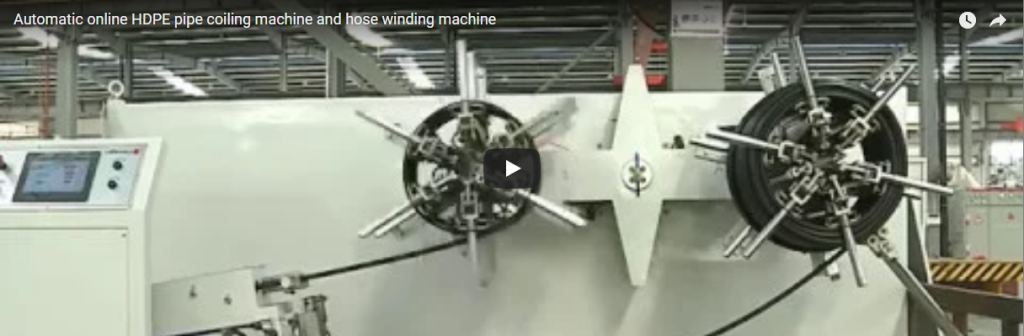
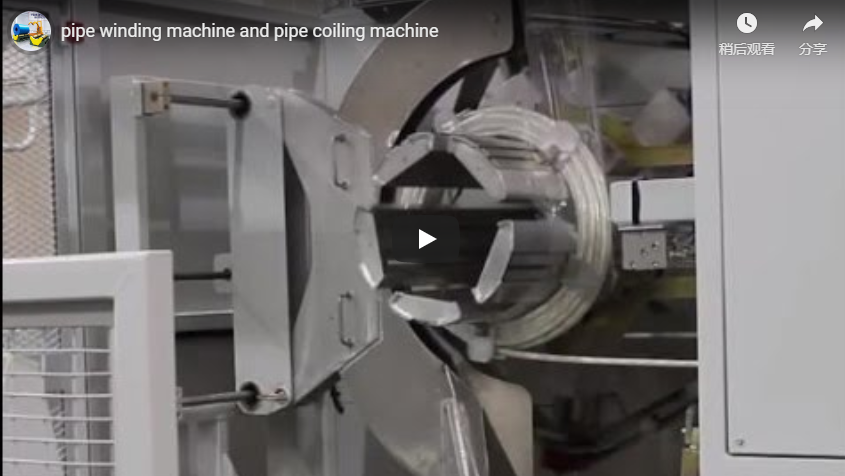
An extruder does not pause. Pipe comes off the line at its own pace, and every minute an operator spends coiling by hand is a minute the line either backs up or runs unmeasured into a loose, uncounted coil. The system in the video closes that gap: pipe arrives down an auto-feeding guide chute, winds into a tight coil on the coiler, gets strapped, and exits down a discharge chute — while the PLC counts metres and cuts to length.
This automated pipe coiling and strapping system feeds from a guide chute, winds corrugated pipe into coils of up to 1,150 mm OD at up to 70 m/min, straps the coil with 4 or 6 PP bands, and discharges it automatically — with PLC length counting and automatic cutting keeping every coil identical. Twin-head layouts let one head strap while the other winds, so the line never waits for the strapper.
The sections below follow the pipe — chute, coiling head, strapping, discharge — then give the machine envelopes, the speed logic, the extruder connection and the RFQ data.
Why Does Continuous Pipe Production Require an Automated Coiler?
Because the extruder never stops: if coiling and strapping wait for an operator, the line either stalls or produces coils that no one counted, cut or tightened.
Two problems compound. First is the clock — pipe leaves the haul-off continuously, and a coiler that stops to strap stops the extruder with it. Second is the record — a hand-coiled length is whatever the operator estimated, which shows up later as short coils, fat coils and disputes with the customer. Corrugated pipe adds a third: left loose, it springs open and the coil is scrap.
An automated coiler answers all three at once. The PLC counts pipe length and cuts automatically, so every coil is the metre count the order asked for. Tension control on the infeed keeps the wind tight so the coil holds its shape. And the strapping — whether during winding or after — happens on machine rhythm, not operator rhythm. The line runs at extrusion pace because the packaging steps no longer have a human cadence.
איך נראית הקו המלא?
Guide chute infeed, coiling head, strapping gear and discharge chute, arranged so the pipe never stops moving between them.
[extruder / haul-off] --> [auto-feeding guide chute] --> [coiling head] --> [strapping] --> [discharge chute] --> [coil out]The video shows each stage in turn:
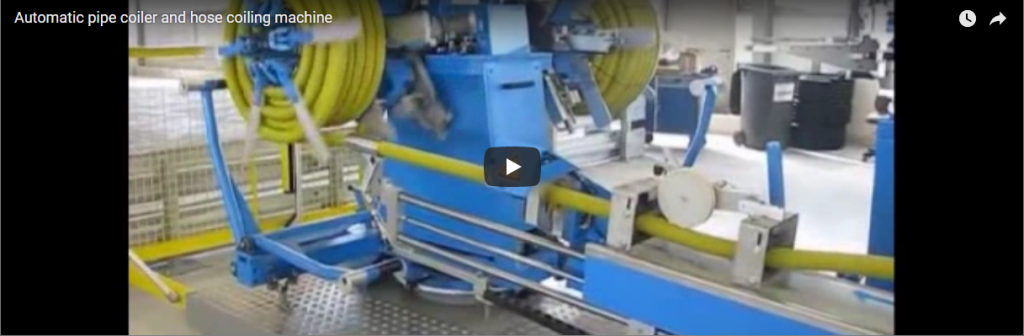
- The guide chute — a long inclined trough with side rails, feeding pipe from the line down to the coiler without powered handling.
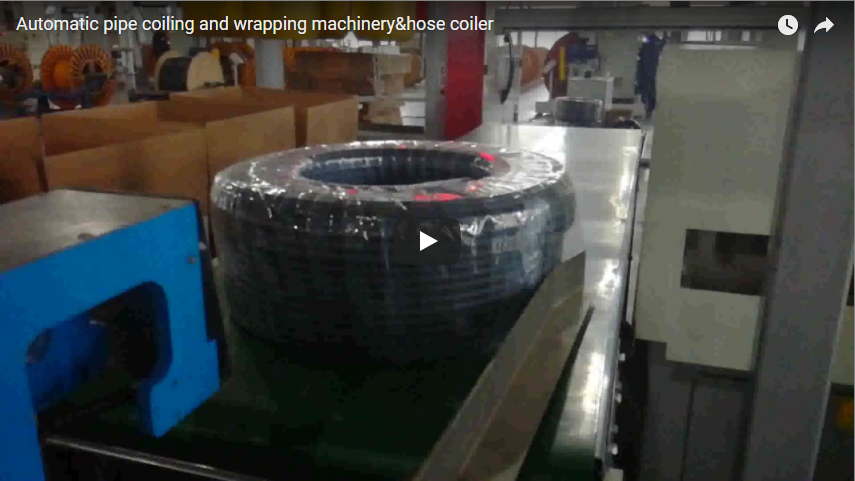
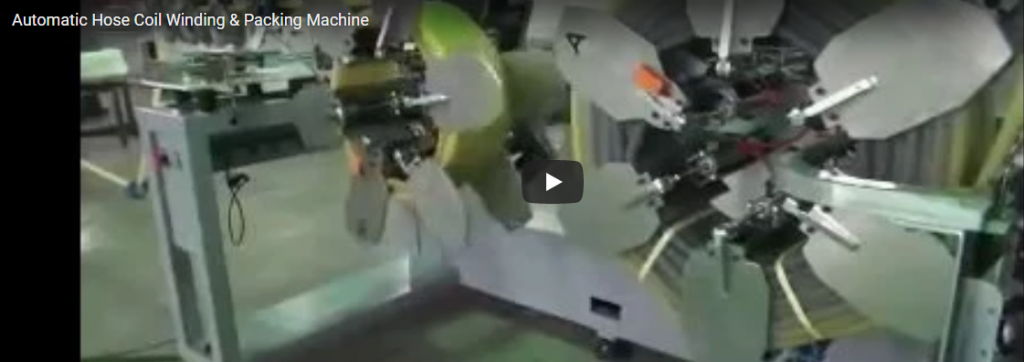
- The coiling head — a mandrel with radial arms winding the corrugated pipe into a flat coil; the frames show a black corrugated coil hanging complete on the mandrel.
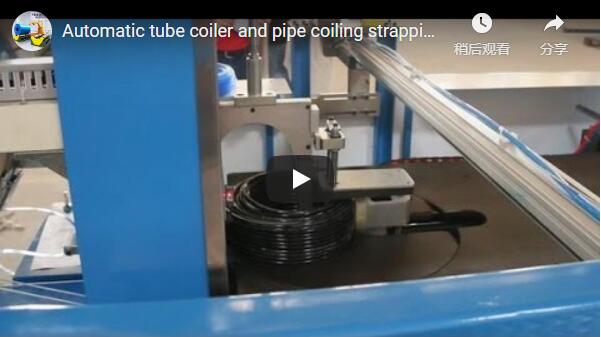
- The strapping gear — strap coils are visible on the machine; the frames do not capture the strap cycle itself, which is covered from the machine specification below.
- The discharge chute — an orange-edged inclined ramp that carries the finished coil away from the winding position.
The path is continuous: pipe enters down the chute while the previous coil is being finished and discharged. That overlap is what makes the layout a system rather than a machine.
How Does the Auto-Feeding Guide Chute Work?
The chute is a gravity slide: pipe from the extruder line glides down an inclined trough into the coiler, guided by side rails, with no powered drive in the chute itself.
Gravity feeding works because the products are light, flexible pipes — corrugated and hose classes in the single-digit-to-tens of metres per minute range. The chute keeps the pipe off the floor, prevents kinking by keeping the bend radius gentle, and delivers the pipe to the coiler infeed at a consistent position. The frames show the detail that matters: deep side rails, so the pipe cannot walk out of the trough, and a shallow incline that avoids acceleration damage.
Two engineering points govern whether a chute suits a given product. Stiffness first: a pipe too rigid for the chute’s bend radius will bind, and a very soft one may buckle — the usable range is confirmed against the pipe’s bending behaviour. Length second: the chute feeds the coiler infeed, not the coil itself, so long products travel the chute once and then hand off to the winding tension system.
How Does the Coiling Head Build the Coil?
The head winds the pipe under controlled tension onto a mandrel, guided by a metre counter; when the count is reached, the pipe is cut automatically and the coil is complete.
The mechanism chain, per the machine specification:
- Hold-coil infeed. The pipe is held and guided into the winding path; infeed tension is controlled so the wind is tight — a loose wind is what lets a corrugated coil spring open.
- Metre counting. Lengths are counted per perimeter settings in OD, width and ID, with counters covering 10–50 m and 20–100 m ranges on the hose class; on the pipe coiler the PLC counts and cuts automatically, so every coil matches the order length.
- One or two heads. The coiler series is built with a single or dual winding head. Two heads are what allow the strap-and-discharge of one coil to overlap the winding of the next — the trick behind continuous output.
- Programmed settings. Coil diameter, width and length are set as parameters; the machine winds to spec rather than to eye.
The video frames show the result: a flat, tight corrugated coil on the mandrel, edges aligned, ready for strapping and discharge.
When Does Strapping Happen?
Either during winding — strap applied on the fly so the coiler never pauses — or after the coil is complete, at 14 to 19 seconds per strap; coil shape is held by 4 or 6 radial straps of 10 mm PP band.
Both modes exist in the family. The hose coiling and strapping machine straps during the winding process, eliminating the stop and co-working continuously with the extruder. The pipe coiler straps the finished coil, with 4 or 6 strap positions and a cycle of 14–19 seconds per strap. The choice follows the line speed: at 70 m/min winding, a four-strap cycle of roughly a minute is longer than the coil takes to wind — that is when during-winding strapping or a twin head stops being optional.
The video is honest about what it shows: red strap coils are visible mounted on the machine, but the strap cycle itself is not captured in the frames. The strap specification here comes from the machine data, not from the video.
Which Products Fit Each Coiler?
Three classes cover the range: a pipe coiler and strapping machine for corrugated and small pipe, a V-series coiler for larger rigid tube, and a hose coiler for thin flexible tube.
| פרמטר | Pipe coiler & strapping (FCL-Y1200) | Coiler series (V1200) | Hose coiler & strapping (V400) |
|---|---|---|---|
| צינור OD | 16–32 מ"מ | 20–60 מ"מ | 4–10 / 10–20 / 15–30 mm |
| קויל ID | 400–540 מ"מ | 400–1,000 מ"מ | 200–400 מ"מ |
| סליל OD | 650–1,150 מ"מ | עד 1,200 מ"מ | 300–500 מ"מ |
| רוחב סליל | 200–320 מ"מ | עד 350 מ"מ | 40–300 מ"מ |
| משקל קויל | 10-40 ק"ג | - | - |
| מהירות סלסול | מקסימום 70 מטר/דקה | - | - |
| חָסוּן וְגָבוֹהָ | 4/6 straps, 14–19 s/strap, PP 10 × 0.6–0.8 mm | - | during winding, 6 bar air |
| ספירה | PLC auto count & cut | PLC auto count & cut | 10–50 / 20–100 m counters |
The classes are different machines for different duties: the pipe coiler pairs coiling with strapping in one unit, the V-series is the higher-bore winding platform with single or dual heads, and the hose coiler is the thin-tube class where strapping happens during the wind. The envelope numbers are published per machine and must not be mixed.
How Are Finished Coils Discharged?
An automatic displacer with pneumatic discharge moves the completed coil off the mandrel, and an inclined discharge chute carries it out of the cell.
The video shows the discharge path: an orange-edged chute angled away from the winding position, fed from the coiler. The machine specification adds the mechanism — an automatic displacer and pneumatic discharge of the coil, so the operator’s job at the outfeed is collecting coils, not wrestling them off a mandrel. On twin-head layouts the discharge overlaps the next wind, which is what keeps the cell’s output continuous.
Coil weight matters here as much as diameter: the pipe coiler’s envelope tops out at 40 kg per coil, and the discharge hardware is rated to that class. Heavier coils are a different conversation with the manufacturer.
כמה מהר הקו פועל?
Coiling runs at up to 70 m/min on the pipe coiler; the binding constraint is usually strapping, at 14–19 seconds per strap.
Strapping budget (pipe coiler, 4-strap recipe):
  4 straps x 16 s (mid-range) = 64 s per coil

Winding budget (same machine, 70 m/min):
  a 40 m coil winds in about 35 s; a 100 m coil takes the better part of 100 s

Conclusion: single-head lines pair long coils with post-wind strapping;
short coils need during-winding strapping or a twin head.
The comparison is the whole sizing exercise in four lines. Strapping time is fixed per coil (strap count × cycle); winding time scales with coil length. When winding time is shorter than strapping time, the next coil is ready before the last one is strapped — and the line needs either a second head or straps applied during the wind.
How Does It Connect to the Extruder?
PLC program settings and an HMI carry the coil recipe; the coiler counts length and cuts automatically; the machine senses pipe position and reports errors to a stack light.
The control chain, per the specification: parameters are set on the PLC; the machine calculates pipe length and cuts automatically; sensors detect the pipe position precisely; running speed is adjusted through the inverter; and when the machine detects an error in operation it sends an alarm signal automatically — the stack light in the video is that signal’s physical face. Auto and manual working modes cover both line duty and short runs.
What the published pages do not spell out is the extruder handshake — how coiler speed follows haul-off speed and who owns the cut signal on an integrated line. That is a per-project control package, and the RFQ should name it explicitly rather than assume it.
מה חייב לפרט בבקשת פנייה (RFC)?
Six inputs size the system: pipe spectrum, coil recipe, rate, strapping spec, discharge and control integration.
| # | קֶלֶט | למה זה מחליט על המכונה |
|---|---|---|
| 1 | Pipe spectrum: OD range, stiffness (corrugated/soft/rigid), wall thickness | Sets coiler class and chute suitability |
| 2 | Coil recipe: ID, OD, width, weight, metres per coil | Sets mandrel, head count and counting range |
| 3 | Line rate (m/min from the haul-off) | Sets coiling speed class and head count |
| 4 | Strapping spec: strap count, material, during-wind or post-wind | Sets the strapping gear and cycle budget |
| 5 | פריקה | Pneumatic displacer, chute angle, coil destination |
| 6 | שליטה באינטגרציה | PLC recipe link to the extruder, cut signal ownership, alarm wiring |
Send the six blocks and the engineering team returns a layout proposal and quotation within 24 hours. The two inputs most often missed are the shortest coil in the recipe — which decides whether strapping can keep up — and who owns the cut signal on the integrated line.
פתרונות אריזה קשורים
- מכונת סלילים אוטומטית — the parent category of coiling and winding machines.
- מכונת סליל צינורות אוטומטית — the coiling-and-strapping class in this article.
- Automatic coiler V1200 — the higher-bore winding platform.
- סליל צינורות אוטומטי — the thin-tube class with during-winding strapping.
- מכונת סליל אופקית — the horizontal coiler category.
- מכונת אריזת צינור — hose packaging equipment beyond coiling.
- קו אריזה סליל אוטומטי — turnkey coil packing lines.
סיכום
A coiler that waits for straps is a bottleneck wearing the badge of an automation project. The system in the video avoids it structurally: the chute keeps pipe arriving, the coiler keeps winding under counted tension, strapping runs on the machine’s rhythm — during the wind where speeds demand it — and the discharge chute clears the finished coil without stopping anything.
Size the layout from the three numbers that interact: coil length against winding speed, strap count against strap cycle, and head count against both. Send the six RFQ blocks with the extruder’s output profile, and the engineering team will return a sized proposal within 24 hours.