**Sintesi esecutiva**
> Dies, moulds and other heavy blocks often have to be turned 90 degrees for maintenance, inspection or storage, and doing it with a crane and chains is slow and risky.
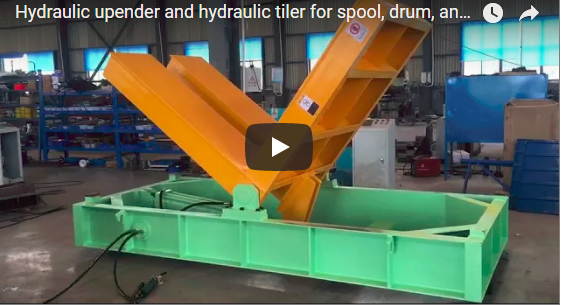
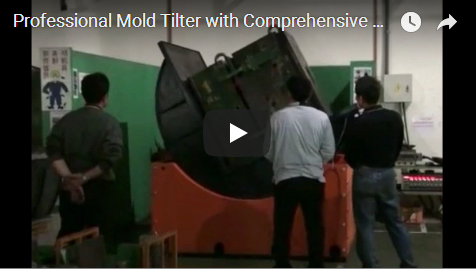
> Our die mould upender and tilter in this video takes the load on an orange tilting cradle on a green base and turns it toward vertical.
> Whether a load can be turned follows from its **weight** and **centre of gravity**. We check both per project.
Sommario
- Cosa mostra il video
- Come funziona la culla inclinabile
- Controllo del carico
- Dove un ribaltatore di stampi aiuta
- Controlli e sicurezza
- Lista di controllo per la selezione di un ribaltatore per stampi
- FAQ di ingegneria
- Passo successivo
- Lettura correlata
- fonti
Cosa mostra il video
Il nostro ribaltatore si trova nel capannone dello stabilimento: una base verde che sorregge un cassone basculante arancione e rosso, con il marchio FHOPE GROUP sulla macchina. Un grande carico a forma di scatola è posizionato sul cassone.
La culla viene mostrata da diverse angolazioni, inclinata verso la verticale e successivamente abbassata in piano e vuota. Un operaio con una tuta blu è in piedi sullo sfondo del capannone, lontano dalla macchina. Il logo di FHOPE GROUP compare anche come sovrapposizione sulla clip.
Come funziona la culla inclinabile
| Passaggio | Cosa succede |
|---|---|
| Load | The load is set on the cradle |
| Secure | The load is held against the cradle faces |
| Tilt | The cradle turns the load toward vertical |
| Unload | The turned load is lifted off |
| Return | The cradle goes back to flat |
Durante la rotazione, il carico poggia su due lati del supporto, risultando così sostenuto per tutta la durata del movimento anziché appeso a un gancio.
Controllo del carico
Esempio illustrativo di uno stampo in acciaio:
| Articolo | Valore |
|---|---|
| Length × width × height (illustrative) | 1,200 × 800 × 600 mm |
| Volume, 1.2 × 0.8 × 0.6 | 0.576 m³ |
| Steel density | 7,850 kg/m³ |
| Weight if solid, 0.576 × 7,850 | about 4,522 kg |
Uno stampo reale con cavità pesa meno. Inviaci il peso dello stampo e il disegno, e noi verificheremo le dimensioni del supporto e il baricentro.
Dove un ribaltatore di stampi aiuta
| Use | What the turn does |
|---|---|
| Mould maintenance | Presents the parting face for cleaning and repair |
| Die change | Turns the die to the press orientation |
| Inspection | Shows the underside without a crane flip |
| Storage | Stands moulds upright to save floor space |
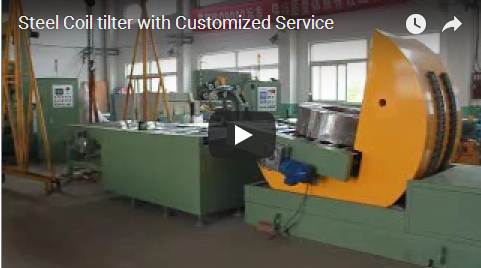
Turning on a cradle replaces crane flips, where the load swings and lands on its edge. For round loads, see our [multipurpose automatic coil tilter with slide table](https://www.fhopepack.com/videos/multipurpose-automatic-coil-tilter-with-slide-table/) and our [large and long coil upenders](https://www.fhopepack.com/videos/large-and-long-coil-upenders-in-real-world-operation/).
Controlli e sicurezza
The cradle turns a heavy load. Keep people clear of the cradle and the load's path while it tilts, and stand away from the machine as the worker in our video does.
Gli standard applicabili dipendono dal mercato di destinazione. Per i mercati CE, la norma ISO 12100 definisce il metodo di valutazione del rischio, mentre la norma EN 415-10 stabilisce i requisiti generali per le macchine confezionatrici.
Lista di controllo per la selezione di un ribaltatore per stampi
- [ ] Heaviest die or mould weight.
- [ ] Length, width and height of the largest load.
- [ ] Centre of gravity position.
- [ ] Turning angle needed.
- [ ] How the load arrives: crane or forklift.
- [ ] Spazio disponibile e alimentazione elettrica.
FAQ di ingegneria
Q: What does a die mould upender do?
A: It turns a heavy die or mould toward vertical on a tilting cradle instead of a crane flip.
Q: How do you estimate the weight of a solid steel mould block?
A: Volume times steel density: about 4,522 kg for 1,200 × 800 × 600 mm at 7,850 kg/m³ in our example; a mould with cavities weighs less.
Q: Why is a cradle safer than a crane flip?
A: The load rests on two faces during the turn instead of swinging on a hook.
Q: What should I send for sizing?
A: The heaviest mould weight, its drawing and centre of gravity.
Q: Does anyone stand at the machine during the tilt?
A: No. Keep clear of the cradle and the load's path.
Passo successivo
Progettiamo il vostro ribaltatore per stampi in tre fasi:
1. **Submit your layout drawing** with mould weights, sizes and drawings to **info@fhopepack.com**.
2. **Receive a proposal within 48 hours**, with the cradle size and load check.
3. **Book a site survey** to check crane or forklift access and floor space.
Lettura correlata
- [Mould upender](https://www.fhopepack.com/mold-upender/)
- [Mould flipper](https://www.fhopepack.com/mold-flipper/)
- [Video: why 90-degree mould upenders are replacing overhead cranes](https://www.fhopepack.com/videos/the-roi-of-safety-why-90-degree-mold-upenders-are-replacing-overhead-cranes-in-industrial-toolrooms/)
fonti
- Contenuto della macchina: team di ingegneri FHOPE, 04/10/2026
- Load example: our worked example, illustrative values; steel density 7,850 kg/m³
- Machine in action: [our video on YouTube](https://www.youtube.com/watch?v=AVza0eNbc7o)
- Ambito delle norme: [ISO 12100:2010](https://www.iso.org/standard/51528.html), [EN 415-10:2014](https://www.nen.nl/en/nen-en-415-10-2014-en-191845)
Ultimo aggiornamento: 04/10/2026